Part 1: The Woman at the Rehearsal Dinner
My sister left her three-year-old daughter on my porch with a pink backpack and a note that said she would return on Monday.
She came back seventeen years later—the night before the girl’s wedding.
By then, Ava no longer called me Aunt Rebecca.
She called me Mom.
The wedding rehearsal was being held at a small lakeside lodge in Wisconsin. Ava stood beneath an arch of white flowers while her fiancé, Noah, practiced pretending not to cry.
I was helping the caterer arrange place cards when the room suddenly went quiet.
My sister Megan stood in the doorway.
She looked healthier than I remembered. Her blond hair was neatly styled, and she wore a pale blue dress with pearl earrings. If you didn’t know our history, you might have mistaken her for an honored guest.
She carried no gift.
Only a white envelope.
“Hello, Becca,” she said.
My hands began to shake.
The last time I had seen Megan in person, Ava was seven. Megan had arrived outside our apartment at midnight, demanded money, and screamed that I had stolen her child when I refused to wake Ava.
After that came silence.
No birthday calls. No Christmas cards. No visits.
At least, that was what I believed.
“Who invited you?” I asked.
“I did.”
Ava’s voice came from behind me.
She walked across the room slowly, still wearing the simple white dress she had chosen for the rehearsal.
For a moment, neither woman moved.
Then Megan opened her arms.
Ava did not step into them.
“You look exactly like I did at your age,” Megan whispered.
“That’s what everyone says.”
Megan lowered her arms.
Noah moved closer to Ava, but she shook her head. Whatever was happening, she had decided to face it herself.
“I’ve been sober for three years,” Megan said. “I have a job. I have an apartment in Rockford. I’m not the person I was.”
“I’m glad,” Ava replied.
She said it kindly, but she did not call her Mom.
At dinner, Megan’s place card was at the end of the family table. Mine was beside Ava’s.
Megan stared at the arrangement.
“Tomorrow, where am I sitting?” she asked.
“Front row,” Ava said. “Beside Grandma’s empty chair.”
Our mother, Evelyn, had died two years earlier.
Megan looked toward me.
“And where is she sitting?”
“Mom is sitting on the other side.”
Megan flinched at the word.
“I’m your mother.”
“You’re my biological mother,” Ava said carefully.
“I didn’t come all this way to be introduced like a medical fact.”
I stood.
“This is Ava’s wedding. If you came to make her choose—”
Megan turned on me.
“You’ve had seventeen years. You got the birthdays, the school plays, the graduations. You got everything because everyone decided I was disposable.”
“You left her on my porch.”
“For one weekend!”
“You disappeared for fourteen months.”
Her eyes filled with tears.
“Because I was sick.”
“And I was twenty-nine, working two jobs and raising a terrified child who slept beside the front door because she thought every car might be yours.”
The room went silent.
Megan gripped the white envelope.
Then she said something that made my stomach drop.
“I wrote to her.”
“No, you didn’t.”
“I wrote dozens of times.”
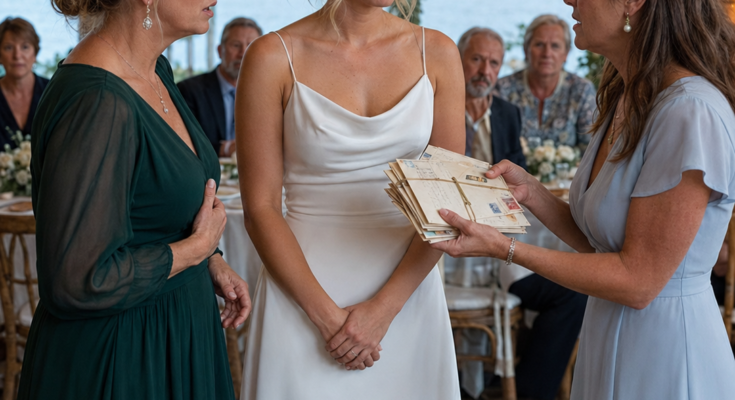
She placed the envelope on the table.
Inside were photocopies of letters addressed to Ava. Some had been sent from a rehabilitation center. Others came from a county jail, a halfway house, and apartments in three different states.
Across several envelopes, someone had written RETURN TO SENDER—DO NOT CONTACT THIS CHILD.
I recognized the handwriting immediately.
It belonged to our mother.
Part 2: The Letters Nobody Read
I sat down because my legs would no longer hold me.
“Mom told me you never contacted us,” I said.
Megan laughed bitterly.
“Mom told me you wanted me gone.”
She showed me a letter Evelyn had sent to the treatment center when Ava was five.
Rebecca is finally giving that child a stable life. If you love Ava, stay away. If you return, I will make sure the court knows every arrest, every relapse, and every man you brought near her.
I read it twice.
Our mother had helped me obtain guardianship. She accompanied me to court, paid part of the attorney’s fee, and sat beside me when the judge approved Ava’s adoption.
I thought she was protecting us.
Megan believed she was erasing her.
“Why didn’t you call me directly?” I asked.
“I did. Mom answered your home phone. Later, she said you changed the number because you were afraid of me.”
“I changed it because she said dealers were looking for you.”
We stared at each other across seventeen years of decisions neither of us fully understood.
Then Ava placed a small cedar box on the table.
It had belonged to Evelyn.
“I found these while cleaning Grandma’s house,” she said.
Inside were twenty-six original letters, all still sealed.
There were birthday cards for ages five through sixteen. A crayon drawing Megan had made in rehab. A photograph taken beside a one-year sobriety cake. An apology written on six pages of lined paper.
Our mother had kept every letter.
She had simply never delivered them.
“How long have you known?” I asked Ava.
“Three months.”
The answer hurt.
“Why didn’t you tell me?”
“Because I needed to know whether you were part of it.”
I felt as if she had struck me.
Then I realized she had every right to wonder.
“And now?” I whispered.
Ava looked at the woman who gave birth to her and the woman who raised her.
“Now I believe both of you were told the version Grandma needed you to believe.”
Megan wiped her face.
“Then let me be your mother tomorrow.”
Ava’s expression changed.
“You still think this is about a chair.”
“It’s about being recognized.”
“So recognize her.” Ava pointed toward me. “She stayed when staying was hard. She worked nights. She learned how to braid my hair from library books. She sat outside my bedroom during panic attacks because I was afraid people disappeared while I slept.”
Megan looked down.
Ava continued more softly.
“Grandma stole your letters. She did not steal seventeen years of choices.”
Megan’s face crumpled.
For the first time that evening, she stopped defending herself.
Part 3: The Walk Down the Aisle
Megan left the lodge before dessert.
Ava watched her go but did not follow.
“Do you want me to ask her to come back?” I said.
“No. If she comes tomorrow, I need it to be because she can accept the place I’m offering—not because she wants to take yours.”
That night, neither of us slept.
We sat on the floor of my hotel room opening the letters in order.
In the earliest ones, Megan made promises she was not yet capable of keeping.
I’ll be home by Christmas.
I’m never using again.
Soon we’ll have our own apartment.
Later, the letters changed.
She stopped asking Ava to wait for her. She began asking about school, favorite books, and whether she still hated peas. She wrote that recovery did not entitle her to forgiveness. She said she wanted Ava to know that being abandoned had never meant being unloved.
Near sunrise, Ava found the final letter.
It had been written when she was sixteen.
I used to tell myself Rebecca stole my place. The truth is that she stood in the place I left empty. If you call her Mom, she earned it. I hope someday I can hear you say it without feeling like I’ve lost you again.
Ava cried against my shoulder.
So did I.
The wedding began at four the next afternoon.
Megan’s chair remained empty as the musicians started playing.
I stood with Ava behind the closed doors of the lodge.
She wore her grandmother’s pearl bracelet and carried white roses wrapped in lace from my wedding dress.
“Ready?” I asked.
“Almost.”
She kept looking through the window.
Then a blue sedan pulled into the parking lot.
Megan stepped out wearing the same dress from the rehearsal. She hurried toward the lodge but stopped before entering, as though asking herself whether she had the right.
Ava opened the door.
Megan’s eyes moved from the bouquet to my arm linked with Ava’s.
“I’m sorry,” she said. “I came here demanding the reward without doing the work.”
Ava held out her free hand.
“You can sit in the front row.”
Megan nodded.
“Thank you.”
“But Rebecca is walking me down the aisle.”
Megan looked at me.
For seventeen years, I had imagined what I would say if she returned. I had rehearsed accusations in the shower, in traffic, and during sleepless nights beside Ava’s bed.
Now none of them felt necessary.
“There’s room for you,” I told her. “But there isn’t an empty place waiting for you to reclaim. You’ll have to build something new.”
“I understand.”
And this time, I believed she did.
Megan entered first and took her seat beside our mother’s empty chair.
Then the doors opened again.
I walked Ava toward Noah.
Halfway down the aisle, Ava squeezed my arm.
“You know I wasn’t looking for a replacement mother,” she whispered.
“I know.”
“I was looking for the truth.”
“Did you find it?”
She glanced toward Megan, who was crying silently in the front row.
“Enough to begin.”
Megan did not become Ava’s mother overnight.
Real families do not repair themselves in a single wedding scene.
She began with Sunday phone calls. Then coffee in public places. Later, she attended a counseling session with Ava and listened while her daughter described what abandonment had done to her.
Some conversations ended in tears. Others ended early.
But Megan kept showing up.
The following Mother’s Day, Ava came to my house carrying two envelopes.
She mailed one to Megan.
She handed the other to me.
On the front, it said MOM.
Inside, she had written:
Blood explains where I came from. Love explains who stayed. Truth is what finally gave all three of us a future.
I placed the card beside the pink backpack Megan had left on my porch seventeen years earlier.
For years, I kept that backpack as proof that my sister had abandoned her child.
Now it reminded me of something more complicated.
One woman had left.
One woman had stayed.
And one frightened little girl had grown into a woman strong enough to face the truth without allowing it to erase either one.