PART 1 — THE THIRTY-DAY NOTICE
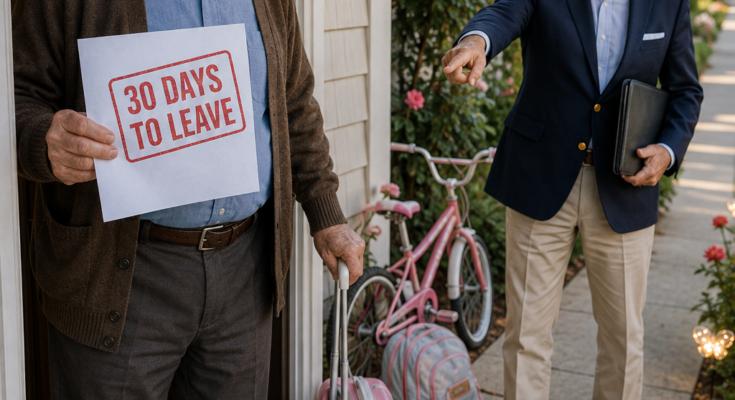
Two days after I buried my daughter, the president of my HOA knocked on my door and told me her ten-year-old child could not live with me.
My granddaughter Lily was sitting at the kitchen table when he arrived.
She was wearing one of my old T-shirts as pajamas, quietly drawing a picture of her parents. Since the accident, she had barely spoken above a whisper.
I stepped onto the porch and pulled the door closed behind me.
Grant Holloway stood there holding a leather folder. He was sixty-three, always perfectly shaved, perfectly dressed, and perfectly convinced that every rule existed for him to enforce.
“I’m sorry for your loss, Walter,” he said.
“Thank you.”
“Unfortunately, we need to discuss the child.”
The way he said it bothered me.
Not Lily.
Not my granddaughter.
The child.
“What about her?”
“As you know, Oak Haven is a fifty-five-and-older community. Permanent residents under eighteen are prohibited.”
“She just lost both her parents.”
“I understand this is difficult.”
“No, Grant. You don’t.”
He opened the folder and handed me a notice.
UNAUTHORIZED OCCUPANT.
The homeowner has thirty days to restore compliance.
I read it twice before understanding what it meant.
“You want me to send her away?”
“I’m informing you of the rules.”
“I’m her only living grandparent.”
“There may be other arrangements available—extended family, foster placement—”
“Foster placement?”
My voice rose so sharply that Lily heard me through the door.
It opened a few inches.
“Grandpa?”
I turned and forced my face to soften.
“It’s okay, sweetheart. Go finish your drawing.”
She looked at Grant.
He did not smile at her.
When the door closed, I stepped toward him.
“You came to my house and suggested I place my granddaughter in foster care?”
“I’m not here to debate family choices.”
“You’re asking me to choose between Lily and my home.”
Grant straightened his jacket.
“You made that choice when you purchased property in an age-restricted community.”
My wife Miriam and I had moved into Oak Haven twelve years earlier. We chose it because it was quiet, affordable, and close to our daughter Rebecca.
Miriam died four years before the accident.
Every room still contained a piece of her. Her teacups remained in the kitchen cabinet. Her gardening gloves hung in the garage. The bedroom wallpaper she chose was still covered with tiny blue flowers.
This house was the last place where my family had been whole.
Now Grant wanted me to abandon it—or abandon Lily.
“You have thirty days,” he said. “After that, the association may begin imposing daily fines.”
I tore the notice in half.
Grant watched the pieces fall between us.
“That doesn’t make it disappear.”
“Get off my porch.”
That evening, Lily found the torn notice in the trash.
“What does unauthorized mean?” she asked.
I looked up from the dishes.
“Where did you hear that word?”
“It was on the paper.”
“It means someone made a mistake.”
“Did I make a mistake?”
My heart broke all over again.
I knelt beside her.
“No. None of this is your fault.”
“Am I allowed to stay here?”
“Of course you are.”
It was a promise I had no idea how to keep.
Rebecca and her husband, Daniel, had died when a truck crossed the center line on a wet highway. Lily survived because she had stayed overnight at a friend’s house.
One phone call had turned me from a retired widower into the parent of a grieving ten-year-old.
I didn’t know how to braid hair. I burned the first lunch I packed for her. I had to watch an online video to understand the school’s parent portal.
But every morning, I got up and tried again.
A week after Grant’s visit, the fines began.
One hundred dollars per day.
Then came complaints about Lily’s bicycle on the porch.
Her sidewalk chalk.
The pink curtains in her bedroom.
Someone even reported the small solar lights she placed around Miriam’s rose garden because they were shaped like butterflies.
Grant photographed every “violation.”
At the end of the second week, he arrived with another board member.
“Your current balance is $2,100,” he said. “If the unauthorized occupancy continues, the association will consider further legal remedies.”
“You mean you’ll try to take my house.”
“I mean this matter needs to be resolved.”
Lily was standing behind me.
Grant saw her this time.
She held a small suitcase.
I stared at it.
“Why are you carrying that?”
Her chin trembled.
“I can go somewhere else if I’m making you lose Grandma’s house.”
I forgot Grant was there.
I took the suitcase from her and pulled her into my arms.
“You are not going anywhere.”
“But the man said—”
“The man is wrong.”
Grant cleared his throat.
“Walter, making promises you can’t legally keep will only make this harder for her.”
I looked at him over Lily’s head.
“Leave.”
The next day, I met with an attorney.
She reviewed Oak Haven’s rules and warned me that age-restricted communities could impose occupancy limits. Fighting the HOA might take months and cost more than I could afford.
“If the documents say no minors, our options may be limited,” she said carefully.
That night, I started packing.
Not Lily’s things.
Mine.
I would sell the house, even if it meant leaving every memory Miriam and I had made there.
In the garage, I pulled down an old box marked MIRIAM—HOA PAPERS.
My wife had served on Oak Haven’s rules committee years earlier. She saved everything—meeting agendas, newsletters, handwritten notes, even expired parking permits.
At the bottom of the box was a faded green folder.
Inside, I found a document called:
THE FAMILY HARDSHIP AMENDMENT.
The first paragraph made my hands shake.
A minor placed under the legal guardianship of a permanent resident following the death, abandonment, or incapacity of the minor’s parents shall be permitted to reside in the community for as long as the guardianship remains in effect.
The amendment had been approved eight years earlier.
Miriam’s signature appeared at the bottom.
So did Grant Holloway’s.
PART 2 — WHAT GRANT WANTED
I called my attorney the next morning.
She asked me to send photographs of every page in the folder.
Two hours later, she called back.
“Walter, stop packing.”
“The amendment is valid?”
“It appears to be. It was approved by the board, signed, and recorded with the association’s official governing documents.”
“Then why isn’t it in the handbook?”
“That is an excellent question.”
She sent a letter to Grant demanding that the fines be cancelled and Lily’s residency formally recognized.
His attorney responded that the amendment had been “superseded by later policy.”
But they did not provide the later policy.
Instead, Grant scheduled a hearing to begin the process of placing a lien against my home.
Word spread quickly.
Some neighbors supported me.
Others avoided me.
A few said they felt sorry for Lily but had moved to Oak Haven specifically because children were not permitted.
Then Margaret Ellis knocked on my door.
Margaret was eighty-one and lived near the community pond. She carried a plate of oatmeal cookies and walked with two canes.
“I heard you found Miriam’s amendment,” she said.
“You knew about it?”
“It was written because of me.”
Years earlier, Margaret’s son had disappeared, leaving two young boys with nowhere to go. The old HOA board tried to remove them from her home.
Miriam fought for her.
“She said no grandmother should have to choose between her home and her grandchildren,” Margaret told me.
The hardship amendment passed by one vote.
Grant’s vote.
“He knows exactly what that document says,” Margaret continued. “He argued against it for weeks before finally voting yes because the whole neighborhood was angry with him.”
“Then why is he doing this?”
Margaret hesitated.
“Your house.”
“What about it?”
“Grant’s sister has been trying to buy a place here for almost a year. She wants a corner property close to the clubhouse.”
I lived in the only corner house currently occupied by a single owner.
At first, I thought it had to be a coincidence.
Then my attorney obtained copies of emails between Grant and other board members.
In one, Grant described my situation as an opportunity to “restore the property to compliant ownership.”
Another board member asked what that meant.
Grant replied:
Walter won’t fight for long. He’s seventy and overwhelmed. Once the fines become serious, he’ll sell. I already have an interested buyer who understands our standards.
The interested buyer was his sister.
She had even submitted an informal offer for my house—nearly $80,000 below its appraised value.
Grant wasn’t protecting Oak Haven.
He was using Lily’s tragedy to force me out so his sister could buy my home cheaply.
I sat at the kitchen table staring at the email.
Lily was upstairs asleep beneath the pink curtains Grant had cited as a violation.
Miriam’s photograph stood beside me.
She had been gone for four years, yet somehow she was still protecting us.
I touched her signature on the amendment.
“You always did plan ahead,” I whispered.
The hearing took place on a Tuesday evening.
Grant sat in the center of the board table. Behind him, a large sign read:
OAK HAVEN—PEACEFUL LIVING BEGINS WITH GOOD NEIGHBORS.
Nearly every chair was occupied.
My attorney sat beside me.
Lily waited at Margaret’s house because I refused to let Grant discuss her as though she were a violation while she sat in the room.
Grant opened the hearing.
“Mr. Cole has allowed an unauthorized minor to reside permanently in his home despite repeated notices.”
My attorney placed the hardship amendment on the table.
“This minor is expressly protected under your governing documents.”
Grant barely glanced at it.
“That amendment is outdated.”
“Then show us the document that replaced it.”
“Our legal counsel is reviewing the matter.”
“You’ve had three weeks.”
Grant’s jaw tightened.
“The purpose of this community is to provide a quiet environment for older adults.”
A man in the audience stood.
It was George Ramsey, a retired teacher who lived three houses from me.
“Lily reads on her porch,” he said. “She’s quieter than your leaf blower.”
Several people laughed.
Grant struck his gavel.
“This is not an open discussion.”
Margaret rose with help from her canes.
“It became an open discussion when you tried to throw out the second orphaned child to live in this neighborhood.”
The room went silent.
Grant looked at her.
“No one is throwing anyone out.”
“You suggested foster care,” I said.
“That was taken out of context.”
“How do you take that out of context?”
My attorney distributed copies of Grant’s email about forcing me to sell.
One by one, the board members read it.
Grant’s sister was seated in the second row. Her face turned bright red.
She stood.
“You told me Walter wanted to move,” she said.
Grant did not answer.
“You said he had already asked you to find a buyer.”
“I was trying to resolve a difficult situation.”
“You used me.”
She threw the house offer onto the table and walked out.
Grant called for a five-minute recess.
No one moved.
Then Thomas Keller, the board’s vice president, removed his nameplate and placed it beside Grant.
“I move that we suspend President Holloway immediately pending an investigation into abuse of authority and undisclosed personal conflicts.”
A second board member raised her hand.
“I second it.”
Grant stared at them.
“You can’t do this.”
Thomas looked toward the residents filling the room.
“Actually, the rules are very clear.”
PART 3 — LILY’S HOUSE
Grant was removed from the meeting by a vote of four to one.
His was the only vote against it.
The new acting board cancelled every fine against me before the night ended. They also issued a written confirmation that Lily was legally permitted to remain in my home.
When I returned from the clubhouse, she was asleep on Margaret’s couch with cookie crumbs on her shirt.
I carried her home.
She woke as I tucked her into bed.
“Do I have to leave?” she whispered.
“No.”
“Are you sure?”
“I’m sure.”
She wrapped both arms around my neck.
It was the first time she had hugged me without being asked since her parents died.
The investigation uncovered more than I expected.
Grant had removed the hardship amendment from the resident handbook three years earlier, calling it “unnecessary historical material.” He never conducted a vote to repeal it because he knew he didn’t have enough support.
He had also instructed the management company not to mention it when I challenged Lily’s residency.
The fines were never about community rules.
They were pressure.
Grant believed that grief, age, and money would eventually force me to surrender.
The homeowners voted to remove him permanently from the board.
He remained in Oak Haven for several months, but the neighborhood he once controlled no longer welcomed him warmly. People stopped asking him to organize events. Board members stopped accepting his private “suggestions.” Residents began reading every rule he had introduced.
His sister withdrew her offer for my house and sent me a letter apologizing.
She said she had not known Lily existed.
I believed her.
Grant never apologized.
But by then, I no longer needed him to.
Something else changed after the hearing.
Residents began leaving small gifts on our porch.
A retired school librarian brought Lily a box of books.
George repaired her bicycle.
Margaret taught her how to make oatmeal cookies, although Lily secretly told me mine were better.
Someone replaced the butterfly lights Grant had removed from Miriam’s garden.
This time, twenty-six glowing butterflies appeared among the roses.
No one admitted buying them.
One afternoon, Thomas visited with a carpenter and asked to inspect the unused storage room beside the clubhouse.
Three months later, the HOA opened a small family room for visiting grandchildren. It contained books, puzzles, art supplies, and a table for homework.
A brass plaque hung beside the door:
THE MIRIAM COLE FAMILY ROOM
Because Growing Older Should Never Mean Closing the Door on Family.
I cried when I saw it.
Lily traced her grandmother’s name with one finger.
“Did Grandma make the rule that let me stay?”
“She helped.”
“Did she know I would need it?”
“No, sweetheart.”
I looked at Miriam’s name.
“She just knew that someday, someone might.”
The first year with Lily was not easy.
Grief doesn’t disappear when a meeting ends.
She had nightmares. She stopped speaking at school. Some mornings, she refused to leave her room because she was afraid something would happen to me while she was gone.
I learned to braid her hair badly.
I learned that children sometimes ask impossible questions while you are driving.
I learned to keep strawberry ice cream in the freezer and to check underneath the bed even when both of us knew there were no monsters.
Lily learned that old men forget permission slips.
She learned that burnt toast could be scraped.
She learned that I would be waiting when the school bus brought her home.
A year after Grant knocked on my door, Lily planted a small apple tree beside Miriam’s roses.
She pressed the soil around it and asked, “Will we still be here when it gets big?”
I thought of the thirty-day notice.
The fines.
The suitcase she had packed because she believed she was destroying my life.
Then I looked at our house—the house where Miriam’s teacups remained in the cabinet, where Rebecca had once run through the sprinklers, and where Lily’s pink curtains now moved gently in the upstairs window.
“Yes,” I told her. “We’ll be here.”
She smiled.
“What if the HOA changes its mind?”
I handed her the watering can.
“The HOA works for the neighborhood now. The neighborhood doesn’t work for one man.”
That summer, Oak Haven held its first Grandchildren’s Day.
The pool was loud. Sidewalks were covered in chalk. Bicycles rested against porch railings.
It was probably the least peaceful day in the community’s history.
Almost everyone loved it.
I sat beneath an umbrella while Lily played cards with Margaret. For the first time since the accident, I heard my granddaughter laugh the way she used to.
A full, careless laugh.
The sound reached every corner of the clubhouse.
Grant had tried to remove Lily because he believed she didn’t belong in our community.
Instead, he reminded the community what belonging actually meant.
A house can be replaced.
Rules can be rewritten.
But when a frightened child asks if she still has a family, there is only one acceptable answer:
“Yes.
And you’re already home.”