
PART 1
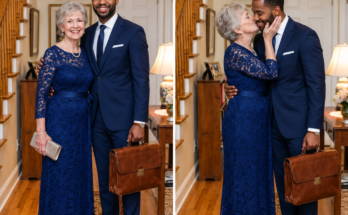
I never imagined I would wear a wedding ring again, especially at my age. Thomas had been my first love at seventeen, back when life felt full of endless possibility. He met me at the bus station the morning I left for college, tears in his eyes. “Please don’t go. Stay here with me.” But I’d worked too hard to walk away from what I’d earned. I watched him disappear into the distance, never imagining it would be fifty-six years before I saw him again.
Life moved on. My pension wasn’t enough eventually, so I took a nursing position back in my hometown. One morning I picked up a patient’s chart and my heart nearly stopped.
Thomas.
Thin, pale, weakened by illness — but the moment our eyes met, we both knew each other instantly. “Hello, Nancy,” he whispered.
From then on, I spent every possible moment with him. He told me he’d never married. Neither had I. One afternoon, his fingers weak but his grip steady, he asked, “Will you marry me? It’s my last wish.”
Stage-four cancer. No miracle coming. After a lifetime of wondering what might have been, I couldn’t bear losing him twice.
I said yes.
We married in his hospital room — no flowers, no music, just one nurse, his attorney, and the two of us holding hands. For one beautiful month, I was his wife.
Then I became his widow.
The morning after his funeral, his attorney knocked on my door, carrying a small wooden box. He set it on my kitchen table, smiled in a way I couldn’t understand, and said, “Thomas was right. You finally walked straight into his trap.”
My heart pounded. With trembling hands, I lifted the lid.
I screamed.
PART 2
Inside the box wasn’t anything sinister. It was a stack of letters, dozens of them, tied with faded ribbon, along with a small velvet pouch and a folded document with an official state seal.
The attorney, watching my face carefully, finally softened his strange smile into something gentler. “I’m sorry for the dramatic delivery,” he said. “Thomas made me promise to say those exact words before you opened it. He said you’d understand once you saw what was inside. He had quite a sense of humor, even at the end.”
I lifted the first letter with shaking hands. The handwriting was unmistakably Thomas’s, though the ink had faded with decades. It was dated the year I’d left for college — written the same week I’d boarded that bus, apparently, and never sent.
“Nancy, I said something cruel at the station because I was scared of losing you, not because I didn’t want you to go. I’ve torn up eleven drafts of this letter trying to say it right. Go. Build the life you earned. I’ll be here if you ever decide to come back to it.”
Beneath it were more letters, one for nearly every year of the fifty-six we’d spent apart. He’d written to me on my birthday, some years. On the anniversary of the day I left, other years. He’d never mailed a single one, but he’d kept writing, decade after decade, a private correspondence with a version of me only he could see.
“He started writing again the week you were transferred to his floor,” the attorney said. “Real letters this time — plans, actually. He asked me to help him with something he’d wanted to do for fifty-six years but never had the nerve to attempt while there was still a life ahead of him that might change his mind.”
I opened the velvet pouch. Inside was a ring — not the simple band we’d exchanged in the hospital, but an older one, worn smooth, clearly decades old.
“That ring,” the attorney said quietly, “he bought it the year you left. He never dated anyone else long enough to give it to them. He carried it with him the entire time, waiting for a version of his life where he’d have the chance.”
PART 3
The folded document beneath everything else was the part that finally made sense of the attorney’s strange greeting.
It was a trust, established the same week Thomas proposed to me in his hospital bed — not a hurried, deathbed decision, but something he’d apparently been planning for weeks before he ever asked me to marry him, quietly working with his attorney on paperwork I knew nothing about while we spent our afternoons trading old stories about high school.
“Thomas built the family business into something considerably larger than either of you probably remember from fifty years ago,” the attorney explained. “He never had children, never had another marriage. When you two reconnected, he told me — I remember this exactly — ‘I finally get a real chance, and I’m not going to waste one single day of it being careful.'”
The trust named me as full beneficiary of the majority of his estate — not an overwhelming fortune, but a meaningful one, enough to mean I’d never again have to work a shift I was too tired for just to keep my pension stretching far enough.
“‘The trap,'” the attorney said, finally explaining his opening words, “was his own joke. He made me promise to deliver that exact line, because he said you’d spent fifty-six years being too proud and too independent to accept help from anyone, and he wanted his last laugh to be finally trapping you into accepting something good, whether you wanted to or not.”
I laughed and cried at the same time, sitting at my kitchen table surrounded by fifty-six years of unsent letters, a ring he’d carried through every relationship he never had, and a final, gentle joke from a man who’d apparently spent his whole life loving me quietly enough that I never once suspected it until a hospital chart put his name in front of me again.
I read every letter over the following weeks, one a night, learning the shape of an entire life I’d missed — the business he’d built, the parents he’d buried, the version of loneliness he’d apparently decided, somewhere along the way, was simply the cost of a promise he’d made himself never to settle for less than what we’d once imagined together at seventeen.
I used part of the trust to establish a small scholarship at our old high school, in both our names, for students choosing between staying close to home and chasing something further away — the same choice that had once cost us fifty-six years, given now, hopefully, to someone who might navigate it a little more gently than we did.
I still wear his ring. Not the one from our hospital wedding, but the older one, the one he carried for over five decades waiting for a chance he wasn’t sure would ever come.
Some love stories don’t get their happy ending on schedule. Sometimes they wait fifty-six years, arrive wearing a hospital gown instead of a tuxedo, and still manage, somehow, to get the very last word.
— The End —