PART 1 — THE RED NOTICE
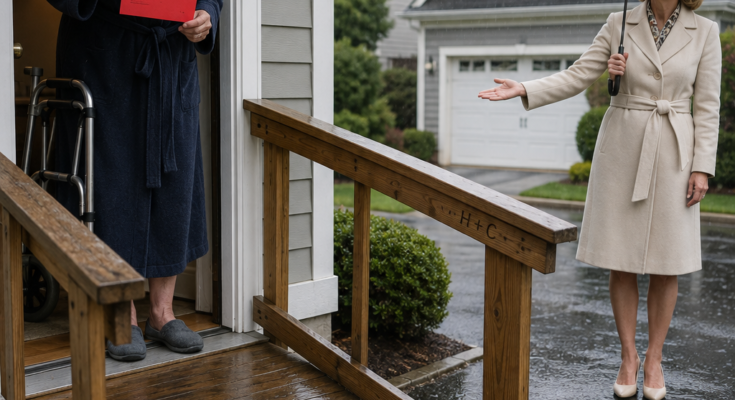
Three weeks after my husband died, the president of our homeowners association taped a red violation notice to the wheelchair ramp he had built with his own hands.
REMOVE THE UNAPPROVED STRUCTURE WITHIN TEN DAYS.
FAILURE TO COMPLY MAY RESULT IN DAILY FINES AND A LIEN AGAINST THE PROPERTY.
I stood on the porch in my robe, reading those words while the morning rain soaked through my slippers.
The ramp was still scattered with pale scratches from Henry’s walker. Near the top rail, he had carved our initials—H + C—just as he had done on a picnic table during our first date forty-two years earlier.
To the HOA, it was an “unapproved structure.”
To me, it was the last thing my husband had ever built.
“Mrs. Bennett?”
I looked up.
Diane Mercer, the HOA president, stood at the end of my driveway beneath a spotless white umbrella. She wore high heels, a cream-colored coat, and the same cold expression she had worn at Henry’s funeral.
“You received several courtesy reminders before your husband passed,” she said.
“Henry was dying.”
“I understand this is an emotional time, but rules don’t stop applying because someone is grieving.”
For a moment, I couldn’t speak.
Diane glanced at the ramp as if it were garbage someone had dumped on her lawn.
“It affects the neighborhood’s appearance.”
“My husband needed it to get inside his own home.”
“He no longer needs it.”
Those five words hurt more than anything else she could have said.
I gripped the porch railing.
“Get off my property.”
Her smile tightened.
“You have ten days.”
Then she turned and walked away.
I had lived in Willow Creek for twenty-seven years. Henry and I had bought our little gray house when the neighborhood was still surrounded by empty fields. We planted the maple tree in the front yard, replaced the kitchen cabinets ourselves, and raised our daughter, Naomi, in the bedroom overlooking the garden.
The HOA had once been three neighbors collecting money to maintain the entrance sign.
Then Diane moved in.
Within two years, she became president. Suddenly, mailboxes had to be one of three approved shades of black. Trash cans couldn’t remain visible seventeen minutes after collection. Garden flags were limited to “seasonally appropriate designs.”
Henry used to call her “the mayor of nowhere.”
I never found it funny.
Especially after he became sick.
The violation notices kept coming.
The ramp.
The overgrown rosebushes.
Naomi’s car parked in my driveway overnight.
A small wooden birdhouse Henry had made during his final week in the garage.
By the end of the month, the HOA claimed I owed $3,840 in fines and legal fees.
Naomi wanted me to fight.
“Mom, this isn’t normal,” she said, sorting through the notices at my kitchen table. “They’re trying to scare you.”
“I don’t have the strength.”
“That’s why they chose now.”
She was right, but admitting it made me feel even smaller.
I had spent eleven months helping Henry fight cancer. I had measured medicine, changed bandages, washed sheets, and held his hand through nights when the pain became unbearable.
When it was over, I didn’t feel brave.
I felt empty.
Then Diane came back.
This time, she brought two board members and a man carrying a clipboard.
“We’re conducting an exterior compliance inspection,” she announced.
“You’re not coming inside.”
“We don’t need to. However, you should understand that if the balance remains unpaid, the association may proceed with collection remedies against your property.”
“You mean you’ll take my house?”
Diane tilted her head.
“I’m saying you should take your obligations seriously.”
Behind her, one of the board members stared at the ground.
That was when I realized this wasn’t about a ramp.
Diane believed I was too heartbroken to resist.
She believed a sixty-seven-year-old widow would quietly pay whatever she demanded—or lose everything Henry and I had built.
That night, I climbed into the attic searching for the original house plans.
Instead, I found Henry’s old metal toolbox pushed behind a stack of Christmas decorations.
Inside was a blue binder, a flash drive, and an envelope with my name written across the front.
My hands began trembling before I even opened it.
Henry’s letter contained only four sentences.
Claire, if you’re reading this, Diane finally came after the house.
Don’t pay her anything.
Take the blue binder to Naomi.
Then look at page forty-seven.
PART 2 — WHAT HENRY KNEW
I called Naomi at midnight.
She arrived fifteen minutes later wearing pajama pants beneath her winter coat. We sat at the kitchen table where her father had once helped her with homework, and together we opened the blue binder.
The first pages contained HOA budgets, meeting minutes, invoices, and bank statements.
Then I remembered something I had almost forgotten.
Before his diagnosis, Henry had served as the HOA treasurer.
He resigned after only six months, telling me the board had become “more trouble than it was worth.” Whenever I asked what happened, he changed the subject.
Page forty-seven told me why.
It was an invoice for $18,600 from Mercer Community Services.
The company had supposedly repaired drainage around the neighborhood pond. But attached photographs showed broken pipes, unfinished trenches, and equipment that appeared never to have moved.
Naomi opened her laptop.
“Mercer Community Services belongs to Diane’s brother-in-law.”
We kept reading.
Landscaping contracts had tripled in one year. Roof repairs on the community clubhouse had been paid for twice. More than $91,000 had disappeared from the reserve fund through companies connected to Diane’s family.
There were emails too.
In one, Henry questioned an invoice.
Diane replied:
Sign it and stop creating problems. Most residents never read the reports anyway.
In another, she warned him that his “uncooperative behavior” could result in closer inspections of our property.
Henry had refused to approve the payments.
Two weeks later, the board removed him as treasurer.
The flash drive contained copies of everything.
“Dad knew,” Naomi whispered.
“And he never told me.”
“He was protecting you. You were already taking care of him.”
At the back of the binder, I found another note.
I wanted to expose this myself, Claire. If I don’t get the chance, finish it properly. Not for revenge. For everyone she frightened into silence.
The next morning, Naomi took me to see an attorney named Marcus Green.
He spent nearly three hours reviewing the documents.
When he finished, he removed his glasses and said, “Mrs. Bennett, don’t remove that ramp. Don’t pay these fines. And from now on, save every letter they send you.”
“Can she take my house?”
“Not if I have anything to say about it.”
For the first time since Henry died, I felt something stronger than grief.
I felt angry.
Marcus requested the HOA’s complete financial records and formally challenged the violations. Diane responded by scheduling an emergency disciplinary hearing.
She expected me to appear alone.
Instead, I spent the next six days knocking on doors.
At first, people were afraid to talk.
Then the stories came pouring out.
Mr. Alvarez had been fined because his granddaughter’s wheelchair-accessible van remained in his driveway overnight.
Eighty-year-old Ruth Lawson had paid $1,200 after Diane claimed her faded curtains reduced neighboring property values.
A young couple had received weekly fines while their premature baby was in the hospital because they had not replaced three brown patches in their lawn.
Diane hadn’t merely enforced rules.
She had learned which residents were tired, grieving, elderly, or frightened—and squeezed them until they paid.
When I showed them Henry’s records, fear turned into fury.
The disciplinary hearing was scheduled for seven on Thursday evening.
Diane sat behind a long table in the clubhouse, flanked by the other board members. Thirty folding chairs had been arranged for residents.
Every chair was filled.
People stood along the walls and crowded into the doorway.
Diane’s confidence flickered when I entered with Naomi, Marcus, and the blue binder.
She recovered quickly.
“This hearing concerns Mrs. Bennett’s repeated violations,” she began. “It is not a public debate.”
Marcus placed a letter on the table.
“It is now.”
He explained that residents representing more than half the neighborhood had signed a petition demanding a special recall election and an independent audit.
Diane stared at me.
“You have no idea what you’re doing.”
I opened Henry’s binder.
“Actually, my husband left very clear instructions.”
Her face changed when she saw it.
Only for a second—but everyone noticed.
I turned to page forty-seven.
“Would you like to explain why the HOA paid your brother-in-law $18,600 for drainage work that was never completed?”
The room erupted.
Diane struck the table with her gavel.
“This meeting is adjourned!”
“No,” said a voice from the back.
It was Thomas Reed, the board’s quietest member—the man who had stared at the ground during the inspection of my house.
He stood slowly.
“The meeting isn’t over.”
Diane glared at him.
Thomas reached into his briefcase and removed another folder.
“I have the original bank records,” he said. “Henry asked me to keep them somewhere safe.”
Then he looked directly at me.
“He knew Diane would try to destroy the copies after he was gone.”
PART 3 — HENRY’S LAST VOTE
For several seconds, no one moved.
Diane looked from Thomas’s folder to Henry’s binder.
Then she laughed.
It was a strange, brittle sound.
“These are administrative misunderstandings,” she said. “If confidential HOA documents were removed without authorization, the people responsible may face legal action.”
Marcus leaned forward.
“You may want to be careful about threatening witnesses.”
That silenced her.
Thomas handed copies of the bank records to the other board members. They showed withdrawals, altered invoices, and payments approved during meetings that had never occurred.
One payment had been authorized using Henry’s electronic signature—three weeks after he entered hospice care.
My stomach turned when I saw it.
She hadn’t only stolen money.
She had used my dying husband’s name to do it.
Diane stood abruptly and gathered her purse.
“You can discuss this with my attorney.”
She made it halfway to the door before Ruth Lawson stepped into her path.
Ruth was barely five feet tall, with silver hair and a cane decorated with blue flowers.
“You made me cry over my curtains,” she said quietly. “I want you to remember that.”
Diane couldn’t look at her.
She pushed past the crowd and left.
The audit took two months.
It found more than $140,000 in questionable payments, undisclosed family contracts, and fines that had never been properly authorized.
Diane resigned before the recall vote, but that didn’t end the investigation. The association’s insurance company became involved. So did the state authorities. Several contracts were cancelled, part of the missing money was recovered, and every violation issued under Diane’s so-called “special enforcement policy” was reviewed.
Mine was the first to be dismissed.
The lien threat disappeared.
The fines were erased.
The ramp stayed.
But something still bothered me.
Everyone kept congratulating me as if I had defeated Diane.
I hadn’t.
Henry had.
He had gathered the records while fighting an illness that left him too weak to climb the stairs. He had hidden copies because he understood what fear could do to decent people. And when he realized he might not live long enough to finish the fight, he trusted me to carry it the rest of the way.
At the next community meeting, the residents elected a new board.
To my surprise, they elected me president.
I tried to refuse.
“I don’t know anything about running an HOA,” I told them.
Thomas smiled.
“That may be exactly what we need.”
My first act was to cancel every unnecessary fine against residents experiencing illness, bereavement, or financial hardship.
My second was to publish every contract and expense online, where every homeowner could read it.
My third was personal.
The HOA had demanded that I remove Henry’s birdhouse because it was not an approved color.
I brought it to the meeting and placed it on the table.
“This stays too.”
Everyone voted yes.
Spring arrived slowly that year.
Naomi helped me trim the rosebushes. Mr. Alvarez repaired the loose board on the ramp. Ruth brought lemonade and supervised from the porch, which mostly meant telling us we were doing everything wrong.
For the first time in months, my house sounded alive again.
One warm afternoon, I noticed a small brass plaque attached to the ramp.
I assumed Naomi had put it there, but she denied it.
So did Mr. Alvarez.
The plaque read:
HENRY BENNETT RAMP
BUILT WITH LOVE. DEFENDED BY NEIGHBORS.
I sat on the top step and ran my fingers over the words.
The grief was still there. It always would be.
But grief had changed shape.
It was no longer an empty room or an untouched coffee mug. It was the maple tree Henry planted, the birdhouse he built, the evidence he saved, and the neighbors who had finally stopped being afraid.
A year after Diane taped that red notice to my door, I received a plain white envelope with no return address.
Inside was a check reimbursing the last of the fines she had forced residents to pay.
There was no apology.
Only a handwritten sentence:
You ruined my life over a wooden ramp.
I turned the note over and wrote my reply.
No, Diane. You ruined your life because you believed grieving people were weak.
Then I placed both notes in Henry’s blue binder.
Not because I wanted to remember Diane.
Because I wanted to remember the lesson she taught me:
Some people see kindness and mistake it for surrender.
Some people see grief and mistake it for helplessness.
And some people don’t realize that the quiet widow standing alone on her porch once spent forty-two years beside a man who taught her exactly how to fight.