Part One: What He Left Behind
Derek reached across my lap and opened the door like he was clearing space for cargo.
“Get out, Olivia.”
The bus stop was cracked concrete and rusted metal, a dead neighborhood I didn’t recognize. He emptied my purse into his hand — wallet, cards, the $32 I’d been quietly saving, my phone — and held it all up like evidence in a trial I hadn’t known I was standing.
“You need to learn the value of money,” he said. “Figure out how to get home without mine.”
The crime, if you could call it that, had been groceries, gas, and an $80 gift for my mother, recovering from surgery. Nothing reckless. Nothing that hadn’t come out of the account my own paycheck went into every two weeks. Derek had simply decided, somewhere between the receipt and the front door, that this was the week I needed correcting.
His taillights disappeared around the corner. I sat on that bench until the sun dropped low enough to turn the air sharp, watching buses stop and pull away without me, too humiliated to explain to a single driver why I had no fare and no phone and no plan.
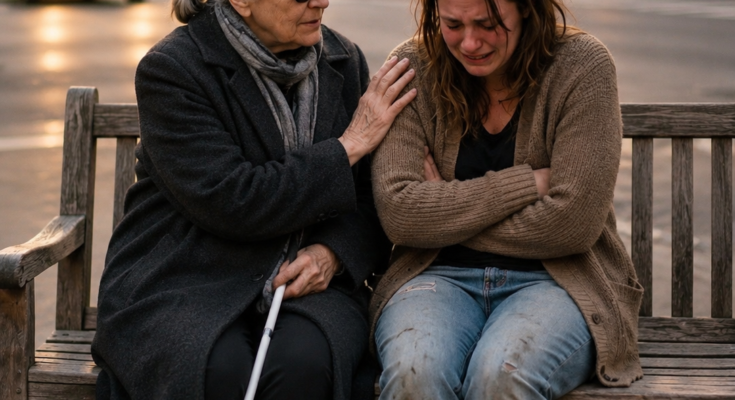
Then I heard a cane tapping the concrete.
An elderly woman in dark sunglasses lowered herself onto the bench beside me with the unhurried certainty of someone who’d never once needed to see a room to understand it.
“You’ve been crying for quite some time, dear,” she said. “My eyes don’t work. My ears work perfectly well.”
I don’t know why I told her everything. Maybe because a stranger is sometimes easier than anyone who already has an opinion of you. The credit card statements. The lectures. The friends who’d quietly stopped calling because Derek made every visit feel like an interrogation afterward. The apologies I’d learned to give just to keep the kitchen quiet.
When I finished, she asked what I planned to do once I got home.
“Apologize, I guess,” I said. “Try to be better.”
Her chin lifted, sharp as a verdict. “Olivia. Buying groceries and a gift for your sick mother is not irresponsibility. Taking your resources, isolating you, and leaving you here to teach a lesson is control.”
Control. The word landed harder than anything Derek had ever called me.
A black car eased to the curb, polished enough to catch the last orange light of the day. A driver in gray stepped out. “Mrs. Wilmington.”
She rose with her cane. “My name is Catherine Wilmington,” she told me. Then, quieter, close to my ear: “When we get into that car, pretend you’re my granddaughter. Your husband thought he left you with no one tonight.”
She smiled the way people do when they already know how a story ends.
“He was wrong.”
Part Two: The House With No Mirrors She Needed
The house wasn’t a house. White columns, iron gates, a staircase curving beneath a chandelier I couldn’t stop looking at, half-convinced I’d wandered into someone else’s life by mistake. Margaret, the housekeeper, prepared a guest room bigger than my apartment. Thomas brought soup without being asked twice.
Over dinner, Catherine told me who she’d been before blindness took her sight ten years earlier: founder and, for three decades, sole owner of Wilmington Industries, a name I recognized the way you recognize a mountain range you’ve simply never had reason to visit.
“You are not helpless,” she said, setting down her spoon with the precision of someone who’d long ago stopped needing to look at what her hands were doing. “You have been trained to feel helpless. There’s a difference, and it matters more than you think.”
By the next afternoon, her attorney sat at the dining table with a legal pad and a laptop, walking through five months of joint account statements I’d never once thought to question. Hotel charges I didn’t recognize. Restaurant receipts for two, on nights Derek told me he was working late. Money — my money, my library paycheck — quietly rerouted into charges that had nothing to do with either of our lives together.
I stared at the numbers until they blurred into something unreadable.
Catherine’s fingers found the edge of the folder without needing to see it. “Evidence,” she said, “has a way of helping a woman remember her own voice.”
Five days after the bus stop, she told me about the gala — the children’s hospital fundraiser, the biggest event of the social season, the kind of room Derek’s car dealership would never miss sponsoring.
“He’ll be there,” I said.
“With the woman he assumed you’d never find out about,” Catherine said, entirely unbothered, like she was reading a weather forecast.
My stomach dropped anyway. “I can’t face him.”
“You won’t be facing him as the woman he abandoned,” she said. “You’ll be facing him as the woman he underestimated. There’s quite a lot of room between those two women, Olivia. I’d like you to stand in it on Saturday.”
Part Three: The Glass That Broke First
I stepped out of Catherine’s car Saturday night in an emerald dress that felt less like fabric and more like armor. Flashbulbs caught Catherine’s name being whispered through the crowd before we’d even crossed the entrance. Thomas walked her in on one side. I held the other.
Then I saw Derek near the bar, laughing with his boss Brenda, a champagne glass loose in his hand, looking exactly as relaxed as a man who believes the woman he stranded is still sitting on a bus bench somewhere, waiting to be forgiven.
His eyes found mine. The glass slipped and shattered against the floor.
“Olivia?” He pushed through the crowd, voice too loud for the sudden hush spreading around us. “Where have you been?”
Catherine stepped in front of me before I had to decide what to say. “You must be Derek,” she said pleasantly. “I’ve heard so much about you this week. Very little of it good.”
“Whatever this is,” Derek said, lowering his voice, glancing at the guests already angling their phones toward us, “let’s discuss it somewhere private.”
“There’s no discussion needed,” I said. “You left me at a bus stop with nothing. This is simply where I ended up instead.”
Brenda had drifted closer, her own glass forgotten in her hand. “Mrs. Wilmington, is everything alright?”
“Perfectly,” Catherine said. “I was only mentioning to Derek that my attorney and I spent the week reviewing some financial paperwork. Hotel charges. That sort of thing. He can explain them to his wife here, or somewhere more private, given his employer is standing three feet away.”
Brenda’s expression sharpened into something entirely different. “Hotel charges,” she repeated slowly. “Derek — is this connected to the ‘client dinners’ you’ve been expensing through the dealership?”
She didn’t wait for an answer. She pulled up the expense reports right there in the ballroom, scrolling with the particular fury of someone realizing exactly how her trust had been spent. “My office. Monday. Don’t bother coming in before then.”
Derek’s evening dismantled itself in real time, in front of donors and photographers and the one person whose good opinion had apparently mattered more to him than mine. He left alone, Brenda’s stare following him all the way to the door.
What came out over the following weeks was worse than a few unexplained hotel charges — thousands of my own paycheck deposits quietly redirected toward a coworker named Kayla Preston, documented cleanly enough by Catherine’s attorney, Denise Okonkwo, that the divorce settlement leaned firmly in my favor before Derek’s own lawyer had finished reading the folder. Brenda fired him within the month. The dealership, it turned out, didn’t take kindly to “client dinners” that had never involved a single client.
I moved into my own apartment eventually, small but entirely mine, though Catherine and I never really let go of each other after that. Sunday dinners became permanent. She still tells me, whenever I catch myself shrinking in a room the way Derek trained me to, that I was never as helpless as I’d once been convinced.
I think about that bus stop sometimes — the cracked concrete, the empty street, the specific loneliness of believing I had nowhere left to go. I understand now that Derek’s cruelty that evening wasn’t where my story fell apart.
It was, against every intention of his, exactly where it started belonging to me again.
— The End —