PART 1
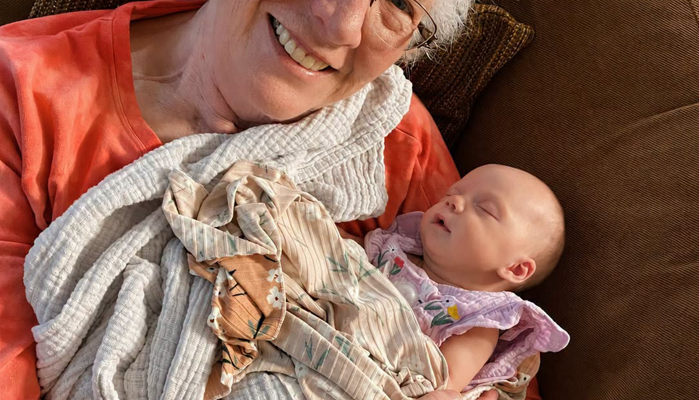
When the judge entered the courtroom, my daughter didn’t even look at me. I stood beside my lawyer, holding my three-month-old daughter, Emily, sleeping against my chest.
“Mrs. Miller,” the judge said, “your children claim you are no longer capable of making decisions for yourself. They’re requesting control over your medical care, your assets, and custody of your baby.”
“Do you really believe I’ve lost my mind?” I asked my daughter, Susan.
“Mom, you’re seventy-nine. Three months ago you came home with a newborn, announcing she’s your daughter. You won’t tell us who the father is, where this baby came from, or why you plan to leave her your fortune.”
“I haven’t left her my entire fortune.”
“Not yet,” my son Michael said coldly. “But your lawyer’s already prepared the documents.”
Six months earlier, they’d still called me every Sunday. The moment they learned I was pregnant, everything changed. Susan said I was bringing shame on the family. Michael demanded I terminate the pregnancy. When I refused, they questioned whether I’d signed legal documents at all — their real fear had nothing to do with my health. It was about who might become my legal heir.
The judge reviewed the medical reports. “These indicate the pregnancy was closely monitored, and that you were fully conscious, competent, and informed of all risks.”
“Those doctors were paid,” Michael interrupted. “Our mother is wealthy. Her money can buy any report she wants.”
“You’ll speak only when asked a question,” the judge said sharply.
Susan’s lawyer stood. “Mrs. Miller, is it true your husband died forty-six years ago?”
“Yes.”
“And you never remarried?”
“No.”
“Then how do you explain this child?”
“I’m ready to explain everything,” I said, “but only when the other person involved arrives.”
I looked toward the door. Still closed. He’d promised he would come. The hearing had run forty minutes already, and his chair remained empty.
Susan’s lawyer placed a photograph on the table — my husband George’s funeral, forty-six years earlier.
“Mrs. Miller, are you claiming the father of this newborn is a man buried nearly half a century ago?”
Susan turned to me, horrified. “You mean Dad? That’s impossible!”
“I know what it may seem like.”
“No! You don’t understand! This proves you’ve completely lost touch with reality!”
PART 2
The courtroom door opened.
Dr. Warren Pruitt, the fertility specialist who’d overseen Emily’s conception, walked in carrying a slim folder, apologizing to the judge for his delay — a delayed flight, nothing more sinister than that. My shoulders finally released a breath I’d been holding for forty minutes.
“Your Honor,” Dr. Pruitt said, “I believe I can clarify the confusion surrounding this case, if the court will allow me to explain the medical history.”
The judge nodded, and Dr. Pruitt turned to face Susan and Michael directly.
“In 1979, George and Eleanor Miller underwent a then-experimental fertility procedure at my predecessor’s clinic, after struggling for years to conceive a second child. Several embryos were created and cryogenically preserved using the technology available at the time — technology considerably more limited than today’s, but sufficient, as it turns out, for long-term storage. George passed away eighteen months later, before any additional embryos were used. Mrs. Miller chose, quietly, not to pursue the remaining embryos at the time, grieving, and raising the two children she already had.”
Susan’s face had gone pale.
“Four years ago,” Dr. Pruitt continued, “advances in embryo viability testing allowed our clinic to determine that two of those original embryos remained viable after over four decades in storage — an extraordinarily rare outcome, but not an impossible one. Mrs. Miller came to me privately, wanting to know if it was still possible to have George’s child, forty years after his death. Given her age, natural pregnancy wasn’t a safe option. We proceeded instead with a gestational surrogate, using one of the preserved embryos. Emily is the biological daughter of both George and Eleanor Miller, conceived from an embryo created together, decades before either of you were old enough to remember your father at all.”
The courtroom had gone completely silent.
“The ‘father who arrived at the door,'” Dr. Pruitt added gently, glancing toward me, “was never meant to imply George himself, Your Honor. Mrs. Miller was referring to me — the physician who oversaw the surrogacy, and who could confirm the medical and legal chain of custody for the embryo, the surrogate agreement, and Emily’s biological parentage. I apologize for the confusion my delay caused.”
PART 3
The room took a long moment to absorb what Dr. Pruitt had just laid out. Susan sat frozen, staring at the folder in front of her lawyer as though it might rearrange itself into something easier to understand. Michael’s earlier fury had drained into something quieter, more uncertain.
“You’re saying,” the judge said slowly, “that this child is the biological daughter of Eleanor and George Miller, conceived through an embryo created during their marriage and carried by a gestational surrogate four years ago.”
“That’s correct, Your Honor,” Dr. Pruitt said. “I have the original 1979 consent forms, the storage records from three different facilities over the decades, the viability testing from four years ago, and the surrogacy agreement, all available for the court’s review.”
He placed the folder on the table. The judge reviewed it for several long minutes while the courtroom sat in near-total silence.
“Mrs. Miller,” the judge finally said, “why didn’t you simply explain this from the beginning?”
I looked at my children before I answered. “Because for six months, they had already decided I was losing my mind before they ever asked me a single question with an open mind. I told my lawyer I wanted the medical evidence to speak for itself, in front of a judge, rather than have my own children dismiss the truth the way they’d dismissed everything else I tried to tell them since I first found out I was pregnant.”
Susan finally spoke, her voice small. “Mom, why didn’t you just tell us about the embryos? We would have understood.”
“Would you have?” I asked. “You demanded I terminate a pregnancy before you knew anything about where it came from. You accused my doctors of manipulating me before you’d asked me a single genuine question. I didn’t trust that the truth would matter to either of you as much as your fear of losing part of an inheritance you’d already started dividing up in your heads.”
Michael, to his credit, looked genuinely ashamed for the first time since the hearing began. “We were scared,” he admitted. “It didn’t look like anything that made sense. A baby, at your age, no explanation—it looked like exploitation. We thought someone was taking advantage of you.”
“I understand why it looked that way,” I said. “I don’t understand why neither of you asked me directly before hiring lawyers instead.”
The judge, after reviewing the full documentation, dismissed the competency petition outright, finding no evidence whatsoever supporting a claim of diminished capacity, and noting for the record that the children’s petition appeared to have been filed primarily in response to concerns about inheritance rather than genuine welfare.
The ride home from the courthouse was quiet. Susan and Michael didn’t come with me — that reconciliation, when it eventually happened, took months of careful, honest conversation, therapy for all three of us, and a slow rebuilding of trust that the courtroom alone couldn’t repair.
Emily is two now, growing up surrounded, eventually, by a family that came back together once the shock wore off and the anger gave way to something more like wonder — a sister forty-six years younger than her siblings, conceived from an embryo created before either of them were born, carrying pieces of a father none of us expected to meet again in any form.
I still keep George’s photograph from that courtroom folder, the one taken at his funeral, beside a newer one of him — a version I never had, imagined by our daughter’s face, the same eyes, the same slight tilt of the chin when she’s concentrating.
Sometimes the family you’re most afraid to lose is the one that finally teaches you love doesn’t run out — it just occasionally arrives forty years later than anyone expected, and asks you to be brave enough to let it in.
— The End —
(This is a work of fiction.)