At 3 a.m., my husband collapsed at his young female colleague’s Chicago apartment, and his parents demanded I sign emergency surgery consent before asking why he was there. I calmly refused, opened the lab results they had not seen yet, and then noticed the woman hiding behind my mother-in-law was wearing a pair of navy silk pajamas I knew far too well.
Part 1: Sign It, Hannah
“Sign it, Hannah.”
My mother-in-law pushed the pen into my hand so forcefully it almost slipped between my fingers.
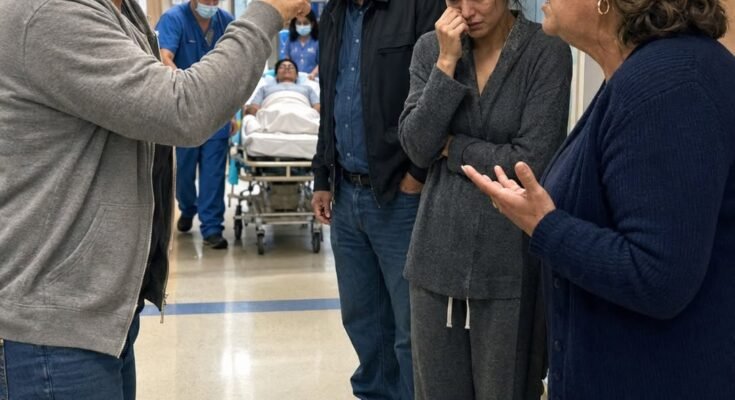
Behind her, the doors to Trauma Bay Three remained closed.
My husband, Nathaniel Turner, was somewhere on the other side surrounded by monitors, IV lines, and an emergency team that believed they might be dealing with a serious problem involving his heart’s main artery.
It was barely four in the morning.
Cold Chicago rain streaked the windows at the end of the emergency department hallway, and I was still wearing cotton pajama pants beneath the windbreaker I had thrown on when the hospital called.
Susan Turner did not care about any of that.
“He’s our only son,” she said. “They told us every minute matters.”
Her husband, Robert, stood beside her gripping the back of a blue plastic chair.
“Please, Hannah.”
I looked down at the consent form.
Then I looked at Dr. Harris.
“Where is the CT result?”
His expression tightened.
“The scanner is temporarily unavailable.”
“Bedside echo?”
“Being arranged.”
“Chemistry panel?”
“Still processing.”
“Troponin?”
“Pending.”
Susan stared at me as though I had suddenly started speaking another language.
“What are you doing?”
“Making sure we know what we’re treating.”
“They said he needs surgery.”
“They said they suspect he may need surgery.”
That difference mattered.
Especially to me.
What Susan and Robert did not know was that the story Nate had told them about my career for eight years was almost completely false.
According to him, I did part-time clerical work for a medical clinic.
It was easier that way, he had once told me.
His mother respected titles, salaries, and traditional roles with almost religious devotion. Nate hated the way his parents compared people, and he hated even more that my medical career had advanced faster than his corporate one.
So I agreed not to talk much about my work around them.
At first, I thought I was protecting his pride.
Over time, silence became routine.
And routine became a lie Nate seemed increasingly comfortable telling for me.
That night, however, none of that mattered as much as the numbers I was waiting to see.
Six months earlier, Nate’s physical had been normal.
No history of severe hypertension.
No known connective-tissue disorder.
No established structural heart disease.
Yet someone wanted my signature for an invasive emergency procedure before the supporting tests were complete.
I was not refusing treatment.
I was refusing panic.
Then I heard plastic sandals scrape across the tile.
A young woman stepped out from the darker corner of the waiting area carrying two bottles of water.
I recognized her immediately.
Khloe Mercer.
Nate’s new administrative assistant.
Twenty-two years old.
Employed at his real-estate company for roughly three months.
Her hair was tangled. Mud marked the sides of her inexpensive slides. She kept her eyes lowered as she handed Robert a bottle.
But it was not her face that held my attention.
It was what she was wearing.
Navy silk pajamas with pale gold geometric trim.
My stomach tightened.
Months earlier, I had purchased two matching sets from a boutique on Michigan Avenue.
One was mine.
The other belonged to Nate.
Khloe noticed where I was looking.
Her fingers immediately pulled at the front of the silk shirt.
Susan moved beside her.
“Thank God Khloe was there when Nate got sick.”
I turned slowly.
“There where?”
Nobody answered.
I looked at Robert.
“Where did my husband collapse?”
His eyes dropped.
Susan finally said it.
“At Khloe’s apartment.”
The pen was still in my hand.
I set it on the clipboard.
Then I faced Khloe.
“Why was Nate at your apartment at three in the morning?”
She clasped both hands together.
“He came by with work documents.”
“What documents?”
“The new development project.”
“That project closed last week.”
Her mouth opened.
Nothing came out.
Susan stepped between us.
“This is not the time for jealousy.”
“It is exactly the time to establish an accurate history.”
Khloe blinked.
I continued.
“When did his symptoms begin?”
“I don’t know exactly.”
“Chest discomfort first? Dizziness? Shortness of breath?”
“He just felt bad.”
“Did he lose consciousness immediately?”
“I think so.”
“Did he fall?”
“Yes.”
“Did he strike anything?”
“I—I don’t know.”
“How long before you called 911?”
Her fingers tightened around the pajama cuff.
“I panicked.”
“That isn’t a time.”
Dr. Harris approached again.
“Mrs. Turner, we need a decision.”
“Are the labs available?”
“Not in the chart yet.”
I took out my phone.
Through my professional medical credentials, I had access to the connected clinical system handling Nate’s case. After completing verification, I opened his record.
The laboratory panel appeared seconds later.
I stopped breathing for half a beat.
Potassium: dangerously low.
Sodium: markedly elevated.
Creatinine: well above baseline.
Hematocrit: high.
The pattern was not subtle.
Nate was severely dehydrated and profoundly depleted of an electrolyte his heart needed to maintain a stable rhythm.
I scrolled farther.
The available cardiac markers did not support the certainty with which everyone had been discussing a major arterial emergency.
I turned the screen toward Robert.
“Look at this.”
He squinted.
“I don’t understand those numbers.”
“You don’t need to understand all of them.”
I pointed.
“This potassium level can destabilize the heart.”
Then another value.
“This sodium level supports severe fluid loss.”
Then the kidney function.
“And this tells me his kidneys are under acute stress.”
Susan’s face changed.
“What are you saying?”
“I’m saying his blood work is pointing somewhere else.”
Dr. Harris took two fast steps toward the workstation and pulled up the same results.
His eyes moved across the screen.
Once.
Twice.
The confidence left his face.
I said quietly, “Correct the volume loss. Replace potassium carefully under continuous monitoring. Repeat the ECG and get critical care involved before anyone commits him to an operation based on an unconfirmed diagnosis.”
For the first time since I arrived, nobody argued with me.
Dr. Harris reached for the phone.
“Hold the OR.”
Susan’s hand went to her mouth.
Robert sank into the nearest chair.
And Khloe?
Khloe backed away until the backs of her knees touched another row of seats.
She was not watching the doctor.
She was watching me.
Dr. Harris ended the call and turned around.
“Dr. Turner,” he said, using my title for the first time, “which institution are you with?”
Susan’s head snapped toward me.
Robert slowly stood.
Khloe’s fingers tightened around the navy silk shirt she had been trying to hide.
I reached into my purse, removed my hospital identification badge, and held it where all three of them could see the name Nate had spent eight years making sure his family never understood.
Part 2: The Name on the Badge
The badge read: Hannah Turner, MD — Attending Physician, Critical Care Medicine, Northwestern Memorial Hospital.
Below that, smaller: Director, Medical ICU.
Susan read it twice, her lips moving slightly, like the words might rearrange themselves into the version of me she’d spent eight years believing.
“Clerical work,” she said faintly.
“That’s what Nate told you,” I said. “Not what I do.”
I didn’t explain the rest right there in the hallway — that Nate had asked me, gently at first and then simply by never correcting the lie, to stay small around his parents. That his mother measured people in titles and salaries, and somewhere in our second year of marriage, my title had quietly overtaken his. That silence had felt, at the time, like a kindness I was allowed to give him. It stopped feeling like a kindness around year four. I just never found the right moment to say so.
Dr. Harris was still at the workstation, but a nurse had pulled up something else — the building security log from Khloe’s apartment complex, requested by the paramedics for the incident report.
“Ma’am,” the nurse said to Khloe, not unkindly, “the sign-in shows your guest arrived at 9:42 p.m.”
Khloe’s face went white.
“That’s — that can’t be right.”
“It’s timestamped,” the nurse said. “Front desk cameras too, if it comes to that.”
Nine forty-two. Not a quick drop-off of documents on a project that had closed a week earlier. Nate had been in that apartment for over five hours before anyone called for help.
Susan looked at Khloe. Then at the navy silk pajamas. Then, for the first time all night, she didn’t say a single word in her son’s defense.
Part 3: What I Stopped Hiding
Nate stabilized within two hours. Potassium replacement, careful fluid correction, continuous cardiac monitoring — exactly what I’d ordered before anyone knew to call me Dr. Turner instead of just Hannah. The OR stayed empty. Whatever had been happening in that apartment for five and a half hours, it had left him critically dehydrated and dangerously depleted, not in need of an emergency artery repair. Dr. Harris later told me, quietly, that another twenty or thirty minutes without correction could have gone very differently.
He woke around seven, groggy, IV lines taped to both arms, and the first thing he said, before he even asked how he felt, was, “Where’s Khloe?”
Not where’s my wife. Not what happened.
Where’s Khloe.
I let that sit in the room for a moment before I answered.
“Gone. Your parents sent her home a few hours ago.” I paused. “After the building’s sign-in log put you there at 9:42, not sometime around midnight the way she told everyone.”
His eyes found mine, and whatever he saw there told him the rest of the conversation wasn’t going to go the way eight years of quiet arrangements had taught him it usually did.
“Hannah—”
“I’m not doing this here,” I said. “You’re stable. That’s the only thing I came to confirm.”
Susan tried, over the next several days, to reframe things the way she’d always managed to reframe things — Nate had been under so much stress, the project, the market, people make mistakes, surely we could all move past this as a family. I listened to about four minutes of it in the hospital cafeteria before I told her, calmly, the way I deliver news to families every week in the ICU, that I wasn’t interested in moving past something I’d only just been allowed to see clearly.
“You hid who I was for eight years because it made your family more comfortable,” I said. “I’m done making anyone comfortable at my own expense.”
She didn’t have a response to that. It might have been the first time in her life someone had said it to her directly.
I filed for divorce three weeks later, once Nate was fully recovered and there was no longer any medical reason for me to be managing his care. My attorney, a friend from residency who’d since specialized in exactly this kind of case, told me my professional standing actually worked in my favor — eight years of a spouse’s income and reputation quietly attributed to “clerical work” doesn’t hold up well once real financial records enter a courtroom.
Robert called me once, alone, a few months after everything was final. He didn’t defend Nate. He just said, “I always wondered why you never talked about work at dinner. I should have asked you directly instead of just accepting whatever Nate told us.”
“You could still ask,” I told him. “I’m not hiding anymore.”
We talk sometimes now, actually, mostly about his grandchildren from his other son, occasionally about medicine, since it turns out Robert finds ICU cases genuinely interesting once someone bothers to explain them to him. Susan and I don’t speak. I’ve made my peace with that.
I still work the same unit, same title, same badge. The only thing that changed is that I stopped leaving it in my purse.
Khloe, as far as I know, no longer works at the real estate company. Nate moved out of state a year later, chasing some new development deal, still telling people whatever version of the story made him look least like a man whose wife had to correct his medical care in front of his own parents at four in the morning.
I kept the navy silk pajamas, the ones that matched Nate’s. I wear mine most nights now, alone, in an apartment I chose entirely by myself, and I don’t think about the other set at all anymore.