Part 1: The Christmas Card
I folded the card once.
Then again.
“Where exactly am I supposed to spend Christmas?”
Her smile barely moved.
“There are places for people in your situation.”
I knew exactly what she meant.
Six months earlier, I had told them about my Parkinson’s diagnosis. I was still independent. My doctor had said I was in the early stages. I drove, cooked, managed my own house, and handled my own finances.
But since the diagnosis, every small mistake had become evidence against me.
A trembling hand.
A few drops of wine on a white carpet.
A slow step near the stairs.
Each one became another reason David and Zuri said I needed “more help.”
David leaned forward, using the careful tone he saved for conversations where he wanted to sound reasonable.
“Mom, what if you fall? What if you leave the stove on? We worry about you.”
I looked at him.
He did not look worried.
He looked prepared.
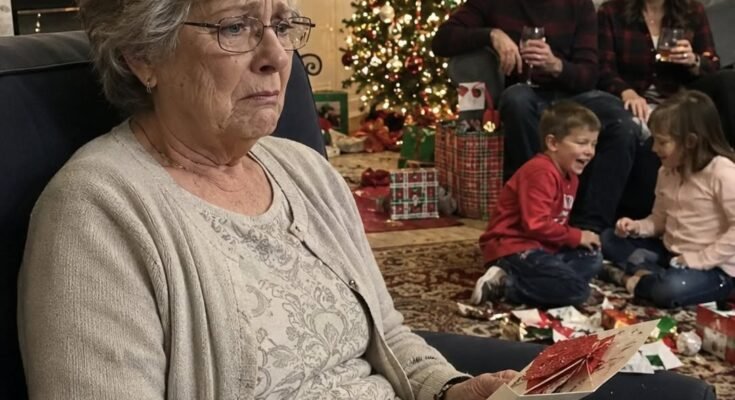
Around us, the Christmas tree glowed with ornaments I had collected over decades. My grandmother’s angel still sat at the top. I had cooked most of the dinner they had just eaten, despite Zuri suggesting my shaking hands made that “risky.”
Now they were discussing where to send me.
I stood slowly.
“I need some air.”
David did not move to help.
“Take your time, Mom.”
The back porch was freezing. I gripped the railing and watched my breath disappear into the Connecticut night.
Through the glass door, the party restarted almost immediately.
Zuri showed off a new piece of jewelry.
The children went back to their gifts.
David refilled his drink.
The card was still in my hand.
That was when something inside me became very calm.
They did not see me as family anymore.
They saw a problem.
What they did not know was how much of their comfortable life depended on the woman they were trying to push aside.
They did not know about the investments Harold had left behind.
They did not know about the life insurance.
They did not know what I had quietly accumulated by living modestly for years.
And most importantly, they had never bothered to ask who was covering certain bills every month.
I went home that night and barely slept.
The next morning, David called.
I let it go to voicemail.
“Hey, Mom. Just checking on you. Zuri’s joke was a little harsh, but you know how she is. Anyway, maybe we can look at some of those facilities we mentioned. No pressure.”
I deleted the message.
Then I called James Morrison, the attorney who had handled Harold’s estate.
“I need to update some things.”
James had known my husband for decades. When I explained that I wanted my affairs organized and accessible from overseas, he went quiet.
“Overseas?”
“Yes.”
“Myrtle, are you sure?”
“I’ve never been more sure.”
Over the next few days, I moved carefully.
I opened a new bank account.
I organized my medical records.
I arranged international prescriptions.
I researched countries with good health care, manageable living costs, and enough distance that nobody could simply drive over and pressure me into changing my mind.
Portugal kept rising to the top.
Then I wrote the letter.
Seven drafts.
The first was angry.
The second was too sad.
The third explained too much.
The final version was simple.
I told them Christmas had made something clear: my presence had become a burden to them, so I was removing that burden. I told them I had arranged my own housing and care. I told them I was safe.
Beside the letter, I placed a folder.
That folder mattered more.
Inside were documents David had never bothered to examine.
Insurance information.
Household expenses.
Payment records.
Accounts.
On January 3, before sunrise, two suitcases sat beside my front door.
I left family photographs on the mantel.
I left my mother’s china in the cabinet.
I even left Harold’s reading glasses where they had remained for three years.
At the airport, my hand trembled around my passport.
For a moment, I almost turned around.
Then I remembered the laughter.
I boarded the plane.
Hours later, as the aircraft descended toward Lisbon, I turned my American phone back on.
The screen lit up so fast I thought something was wrong.
Missed calls.
Texts.
Voicemails.
More kept appearing.
David.
Zuri.
David again.
The messages changed as I scrolled.
“Mom, where are you?”
Then:
“I found your letter.”
Then:
“What do you mean you left?”
Then the tone shifted.
“Call me now.”
Another message appeared.
“The mortgage company says the payments came from your account.”
Then another.
“Emma’s school says you’re listed as the tuition payer.”
Then another.
“The insurance company says you’re the policy holder.”
I stood beside the baggage carousel in Lisbon, staring at the screen while strangers collected their suitcases around me.
Fifty-three missed calls.
Twenty-nine messages.
The family that had laughed while telling me Christmas was not for me suddenly could not stop calling.
Then one final text from David appeared.
“Mom, please. I found the folder. I didn’t know. Just tell me you’re safe.”
I read it twice.
Then I looked at the sealed document James had told me not to discuss until I was ready.
Because the bills David had just discovered were only the beginning…
Part 2: The Sealed Envelope
I hadn’t opened the sealed envelope myself yet. James had handed it to me the day before I flew out, told me to wait until I actually needed it, and I trusted him the way I’d trusted him with everything since Harold died.
Standing at that baggage carousel, phone buzzing in my hand, I finally opened it.
Inside was a formal notice, drafted weeks earlier at my instruction: a termination letter transferring all automatic payments — the mortgage, Emma’s tuition, the life insurance premium — out of my name, effective the date I boarded the plane. James had already filed it. The mortgage company had thirty days to receive a new payer or the account would go into default. The school had been notified that tuition sponsorship was ending at semester’s close. The insurance policy, the one covering David’s own health coverage gap after he’d left his job to “find something more meaningful” two years ago, required a new policyholder within sixty days or it would lapse entirely.
I hadn’t done this out of spite. I’d built it months before Christmas, quietly, the way I did most things — a fail-safe in case my hands or my mind ever stopped cooperating and I needed someone else to make these calls for me. I never imagined I’d be the one triggering it on purpose.
I texted David back one line: I’m safe. Talk to James Morrison about the accounts. I’m not managing them from here.
Then I turned my phone off again, picked up my suitcases, and walked out into a warm Lisbon evening that smelled like salt water and orange blossoms, leaving fifty-three unanswered calls behind me on a runway an ocean away.
Part 3: What It Cost Them to Ask a Real Question
David called James Morrison the next morning, apparently expecting a quick fix, a misunderstanding, some paperwork he could sign to make his mother’s money reappear where it had always quietly been. He’d never once, in six years, asked where that money came from. He’d just gotten used to bills that paid themselves.
“There’s no fix,” James told him, according to the email he sent me a few days later, recounting the call almost word for word because he thought I’d want to know. “Your mother restructured her finances before she left. She’s not required to explain herself to you, and frankly, given what she described about Christmas, I don’t think she owes you the courtesy.”
David called me eleven more times over the following week. I answered on the twelfth, mostly because I didn’t want Zuri finding a way to guilt Emma into calling instead.
“Mom, we can’t lose the house,” he said, skipping past any version of hello. “You know Zuri’s salary alone doesn’t cover the mortgage. And Emma’s tuition—”
“I know exactly what those numbers are,” I said. “I’ve been paying them for six years.”
Silence.
“You never asked me for help,” he finally said, quieter. “I didn’t know.”
“You never asked me anything,” I said. “You asked me where I should go for Christmas instead of asking me where I wanted to spend it. There’s a difference.”
He didn’t have an answer for that.
I didn’t rescue them. I want to be honest about that part, because it would be a nicer story if I’d swept back in with a grand gesture, but I didn’t. David and Zuri sold the second car. Emma switched from her private school to the public one two towns over, which she told me later, in an email she wrote entirely on her own, she actually preferred, because the kids there didn’t ask what her father did for a living. David went back to work in his old field within two months, something he’d been putting off “finding the right opportunity” to do for two years while I quietly covered the gap.
It took almost a year before David asked me a real question instead of a request. He called on a Tuesday, my evening, his afternoon, and asked how Parkinson’s was actually affecting me day to day — not whether I could still manage, but what it actually felt like, what helped, what didn’t. It was the first time in years he’d asked about my life instead of my liabilities.
I told him about the tremor, about the medication schedule, about the physical therapist I’d found in Lisbon who didn’t treat me like a liability. He listened for almost forty minutes without once mentioning facilities.
“I’m sorry,” he said at the end. “Not just about Christmas. About all the years before it, when I let Zuri decide who you were to us.”
I didn’t tell him it was fine. It wasn’t, and pretending otherwise would have undone the only thing that actually changed anything — the fact that, for once, consequences had reached him before an apology did.
I still live in Lisbon. My hands still shake some mornings, less on others. I take a water aerobics class twice a week with three Portuguese women in their seventies who’ve never once suggested I needed “more help,” only more sunscreen. Emma visited last spring, on her own, without her parents, and cried on my balcony for reasons that had nothing to do with money.
I send David one thing every Christmas now: a photograph, not a check. This year it was the view from my kitchen window, tile rooftops running down toward the river.
He wrote back: “Looks like somewhere you actually belong.”
He wasn’t wrong. It just took losing a house he never realized wasn’t fully his to figure that out.