My mother-in-law announced the family cruise during Sunday dinner and passed out 11 blue folders, one to everyone except me. The booking sheet listed my husband Eric in Cabin 8234 with “guest pending,” even though I had paid the $4,760 deposit from my own account. Patricia smiled over the potato salad and said, “It was just an oversight, dear.” By dessert, I had found the email she had forgotten existed.
Part 1: The Blue Folders
Patricia loved having an audience.
She owned a round oak table with 2 leaf inserts and had a rule that nobody touched their food until she sat down. She passed rolls like communion and corrected people with a laugh so gentle you almost missed the insult.
That Sunday, she served ham, green beans with bacon, and the potato salad she always claimed was “too rich for store people.” I brought iced tea in a plastic pitcher because Eric had asked me to keep the peace.
I was trying. I truly was.
Then she placed the folders on the table.
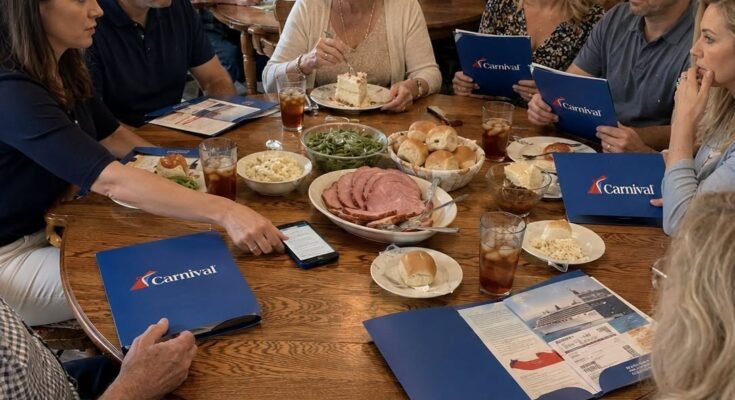
Blue Carnival folders. Luggage tags inside. Printed itineraries. Small sticky notes with everyone’s cabin number written in Patricia’s slanted handwriting.
Eric received one.
His sister Megan got one.
Even Megan’s boyfriend of 4 months, Trevor, had one.
I sat quietly with my hands in my lap while folders passed around me like mail meant for everyone else.
Eric frowned. “Mom, where’s Dana’s?”
Patricia didn’t look at him. She spooned potato salad onto her plate and said, “It was just an oversight, dear.”
Dear.
That word always sounded different coming from her.
I asked to look at Eric’s folder. Patricia said there was no reason because everything had already been arranged.
So naturally, I checked.
Cabin 8234. Eric Malloy. Guest pending.
Pending.
I had paid the original deposit 6 months earlier after Patricia claimed her card was “acting funny.” $4,760 from my Regions checking account, transferred while I sat in the dentist’s parking lot waiting for a crown to set. She promised to repay me “after the holidays.”
She never did.
The smell of ham and coffee hung heavily in the dining room. Eric’s knee bounced beneath the table. He hated confronting his mother. He could negotiate with insurance adjusters all day, then become 12 years old the moment Patricia cleared her throat.
Megan said, “Maybe you can still come if somebody cancels.”
Trevor stared down at his roll.
That was when I understood they already knew. Maybe not about the money, but about me being excluded. The little family secret had been printed, stapled, and handed around inside blue folders.
I excused myself and went to the bathroom.
Patricia’s guest bathroom had decorative seashell soap nobody was allowed to use and a framed sign reading BLESS THIS MESS. I locked the door and opened my email.
I searched “Carnival Patricia Malloy.”
There it was.
A confirmation chain from 6 months earlier because I had been copied when I made the payment. Patricia must have forgotten. Or maybe she assumed I would never look.
The original passenger list showed my name beside Eric’s.
Dana Malloy. Paid.
Then, 18 days later, Patricia emailed the cruise agent, a woman named Leanne, and wrote: Please remove Dana from Eric’s cabin for now. Family decision.
Family decision.
I took a screenshot.
Then I noticed an attachment below it. Patricia had sent Leanne a copy of the Malloy Family Trust distribution letter. I recognized the document. I had found it in Eric’s desk when we refinanced our house. His late father, Frank, had included one unusual condition because he never trusted Patricia’s games.
No family funds for travel unless legal spouses are included or decline in writing.
I had never declined anything.
I returned to the table while Patricia was slicing coconut cake.
She looked at my empty hands and smiled.
I placed my phone beside her plate, screen facing up, with Leanne’s email open.
Patricia leaned close enough to read the first line.
Part 2: “Family Decision”
Patricia’s fork stopped halfway to the coconut cake.
“Family decision,” she read aloud, then stopped, her voice thinning as she registered the second document beneath it — the trust letter, the one with Frank’s signature and the clause she’d apparently forgotten I’d ever seen.
“Where did you get this?” she asked.
“You sent it,” I said. “To Leanne. Eighteen days after I paid for a cabin with my name on it.”
Eric leaned over to look at the screen, and I watched his face change in real time — confusion, then recognition, then something harder settling into his jaw.
“Mom. You used trust money for this cruise?”
“Some of it,” Patricia said, too quickly. “Your father wanted the family to travel together.”
“Dad wanted the family to travel together,” Eric said. “That includes Dana. He wrote that into the trust specifically because he didn’t trust you not to find a workaround.”
Megan set down her fork. Trevor looked like he was doing the math on how fast he could leave without seeming rude.
“It was a scheduling issue,” Patricia tried. “I was going to sort it out before the sailing date.”
“You emailed a cruise agent and called it a family decision,” I said. “There’s no version of that sentence that’s a scheduling issue.”
Patricia’s composure, the same one she’d worn through thirty years of gentle insults over dinner rolls, finally cracked at the edges.
“I don’t see why this needs to become a whole production,” she said.
“It became a production,” Eric said quietly, “the moment you handed out eleven folders and skipped my wife.”
The table went silent except for the hum of the ceiling fan. I could hear the ice melting in my plastic pitcher of tea, the one I’d brought because Eric had asked me to keep the peace, back when I still thought peace was something worth keeping quiet for.
“I want the deposit back,” I said. “Tonight, or a written commitment to repay it by Friday. And I want to know exactly how much trust money went into this trip, because if it violates Frank’s condition, that’s not just a family matter anymore.”
Part 3: What the Trust Actually Said
“Not just a family matter” turned out to be the sentence that actually moved Patricia, more than anything about my hurt feelings ever had. She’d spent thirty years perfecting the art of gentle, deniable cruelty at her own dinner table. She had never once had to answer to an attorney about it.
The Malloy Family Trust wasn’t hers. She was the surviving spouse and a beneficiary, but the trustee of record was a firm called Whitmore & Case, the same attorneys who’d handled Frank’s estate five years earlier. Frank, it turned out, hadn’t trusted his wife with unsupervised access to a joint checking account, let alone an irrevocable trust — which was exactly why he’d built in language a court would actually enforce.
I called Whitmore & Case myself Monday morning, screenshots ready, and asked a simple question: had any trust distributions funded this cruise, and if so, had the spousal-inclusion condition been satisfied?
The answer came back within two business days. Yes, and no.
Roughly six thousand dollars in trust funds had gone toward cabin upgrades and a shore excursion package for Megan and Trevor, distributed the same week Patricia removed me from Eric’s cabin. Under the trust’s terms, that distribution was conditional on all legal spouses either being included or formally declining in writing. I had done neither. I had, in fact, paid a deposit and been quietly erased from a passenger manifest eighteen days later.
Whitmore & Case sent Patricia a letter I never got to read in full, but Eric described it as “the most polite way a lawyer has ever told my mother she might have to give money back.”
Patricia had three options, according to the trustee: reinstate me properly on the booking and repay my deposit directly, in which case the distribution stood; formally document that I’d declined to travel, which would have required my actual signature and, notably, wasn’t true; or return the six thousand dollars to the trust and fund the upgrades herself, out of pocket, without touching Frank’s money again without prior approval.
She chose the first option within a week, mostly because it was the cheapest one that didn’t require writing a personal check for six thousand dollars.
I received an updated Carnival confirmation email eleven days after that Sunday dinner. Dana Malloy, Cabin 8234, paid in full, no longer pending. My deposit was wired back to my Regions account the same afternoon, no explanation attached, no apology in the memo line.
Patricia never actually said sorry, not in the way people mean when they use the word honestly. What I got instead was a stiff phone call about “logistics” and a comment about how she “hoped I understood how stressful trip planning could be for a family this large.” I told her I understood completely, and that I hoped she understood how stressful it was discovering your own mother-in-law had quietly erased you from a family vacation you’d personally financed.
She didn’t have a response for that.
We went on the cruise. Eric booked our excursions separately from his mother’s for the first time in either of our marriages, and neither of us apologized for it. Megan, to her credit, pulled me aside on the second night and admitted she’d known about the folders in advance and hadn’t said anything, and that she was sorry, actually sorry, in the version of the word that meant something.
Patricia and I are civil now. Sunday dinners still happen, though I bring my own dessert now instead of just the iced tea, and I’ve stopped waiting for her to notice when she’s left me out of something — I just notice it myself, in writing, before dessert is served.
Frank, wherever he is, built that clause into his trust for a reason. I like to think he’d have appreciated exactly how it finally got used.