Part One: Twelve Minutes
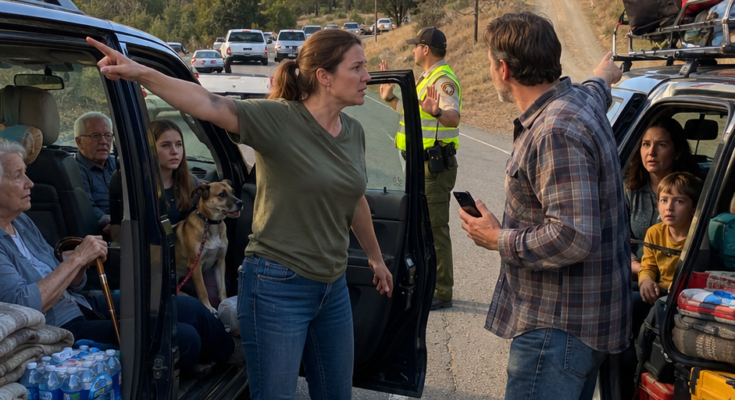
The sheriff’s deputy leaned toward my open window and looked into the crowded SUV.
“Is everyone accounted for?”
“My daughter, my mother, our dog, and one elderly neighbor.”
“Good. Stay on the marked route and keep moving east. Do not take Pine Hollow Road, even if your GPS recommends it.”
“Why?”
“The bridge is closed. Fire crossed the road beyond it.”
“What about the old logging road?”
“Locked gate. No outlet.”
He stepped back and waved me forward.
That was when my phone rang.
My brother Logan’s name appeared on the screen.
“I’m going back to your house,” he said.
“No, you’re not.”
“I left my document case in the guest room.”
“It’s in my vehicle.”
Silence.
“What?”
“I picked it up when the evacuation order came through.”
“You went through my belongings?”
“You left it beside the bed after I told everyone to load up.”
“My laptop is still there.”
“Then your laptop stays.”
Behind me, vehicles crawled through a cloud of dust and ash. The sky above the western ridge had turned brown, and charred pine needles drifted across the road.
My thirteen-year-old daughter, Chloe, sat in the back holding our dog’s leash. My seventy-four-year-old mother occupied the passenger seat with her cane tucked beside her.
Mr. Bell, our eighty-one-year-old neighbor, sat behind Mom holding a small canvas bag and the framed wedding picture he had chosen when I gave him sixty seconds to leave his house.
His son had been trying to reach him for almost an hour, but fallen branches blocked the western entrance to our neighborhood.
When the evacuation alert arrived, I checked on Mr. Bell before loading anything else.
Logan had been less cooperative.
At 3:18 that afternoon, our phones issued an evacuation warning because three lightning fires had merged west of town.
At 3:26, the warning became a mandatory order.
By 3:30, my mother, daughter, dog, and emergency bags were inside the SUV.
Logan was still in my garage.
“I need ten minutes,” he said.
“You have three.”
“You don’t even know how close the fire is.”
“Neither do you. That’s the reason we leave now.”
For years, Logan had made jokes about the evacuation checklist taped inside my pantry.
He called my go-bags expensive backpacks waiting for a disaster that would never arrive. He mocked the paper map in my glove compartment because everyone had navigation apps.
He once told Chloe that keeping the gas tank above half full proved I worried professionally.
Now he was loading two suitcases, a desktop computer, three boxes of tools, a large cooler, and a television he had purchased four days earlier.
His wife, Natalie, stood beside their SUV holding their six-year-old son’s hand.
“Logan,” she said. “We have to leave.”
“I’m almost finished.”
A burned pine needle landed in the driveway between them.
Natalie placed their son in the back seat and took Logan’s keys from the ignition.
“You have thirty seconds.”
He abandoned the television beside my garage.
We left in two vehicles, with Logan following behind me.
At least, he followed until we reached the first evacuation checkpoint.
Now he was threatening to turn around.
“The officer said nobody is allowed back,” I told him.
“I won’t use the checkpoint. Pine Hollow loops behind the neighborhood.”
“The bridge is closed, and fire crossed the road.”
“My navigation says it’s open.”
“The deputy standing in front of the fire says it isn’t.”
“You always think your way is the only safe way.”
“This isn’t my way. It’s the official evacuation route.”
“We’ve moved half a mile in twenty minutes.”
“Because the entire town is leaving.”
“I can take the logging road and meet you on the highway.”
“The logging road has a locked gate.”
“You don’t know that.”
“The deputy just told me.”
Traffic began moving again.
“Stay behind me,” I said. “We have water, food, medication and enough fuel to wait in traffic.”
“I’m at a quarter tank.”
I looked at my own gauge. Nearly full.
“Why didn’t you refuel yesterday?”
“Because we’re on vacation.”
“The gas stations are already overwhelmed. You cannot assume you’ll find fuel during an evacuation.”
“I’ll be fine.”
“Logan—”
The call ended.
I checked my mirror.
His SUV was no longer behind me.
Natalie called thirty seconds later.
“He turned onto Pine Hollow.”
“Tell him to turn around.”
“I already did.”
“What did he say?”
“He said you’re trying to frighten us.”
I pulled into the first safe turnout.
I couldn’t reverse against evacuation traffic. I couldn’t leave Mom, Chloe, Mr. Bell, and the dog beside a smoke-filled road. And I couldn’t chase an adult who had deliberately ignored a deputy.
So I opened the paper map in my glove compartment.
Pine Hollow crossed a narrow drainage area before climbing toward the ridge. The logging road branched north shortly before the bridge.
It eventually connected to the highway—but only after crossing private timberland protected by a steel gate.
On Logan’s phone, it probably appeared as a thin gray line.
The app did not show the gate.
I called him.
No answer.
I called Natalie.
No answer.
Mom watched me from the passenger seat.
“You cannot rescue someone from every bad decision,” she said.
“That doesn’t mean I stop trying.”
At 4:12, Logan finally called.
The confidence had disappeared from his voice.
“We reached the bridge,” he said.
“Turn around.”
“I can’t.”
“Why?”
“There are vehicles behind us.”
“How many?”
“I don’t know. Five or six. They followed me off the main road.”
I closed my eyes.
“Then everyone needs to turn around carefully.”
“There isn’t enough room.”
“Where is the fire?”
“I can see smoke beyond the trees.”
“Call 911 and give them your location.”
“I already called. They said crews are handling structure fires.”
“Stay on the line with the dispatcher.”
“I think the logging road connects from here.”
“It leads to a locked gate.”
“We can cut the chain.”
“What happens if you drive deeper into the forest and cannot open it?”
“It’s better than sitting here.”
“No, it isn’t. Do not move toward an unfamiliar road with fire beyond it.”
Someone began shouting in the background.
Natalie was crying.
Then I heard their son ask why the sky had become so dark.
“Logan,” I said, “turn those vehicles around now.”
His reply came quietly.
“There’s another problem.”
“What?”
“A tree just fell across the road behind us.”
Then the call dropped.
(Continued in Part Two)
Part Two: The Thin Gray Line
I called 911 and gave the dispatcher everything I knew.
Six vehicles trapped near the closed Pine Hollow bridge.
A fallen tree blocking the route behind them.
At least one child.
Smoke visible beyond the drainage area.
The dispatcher asked for exact coordinates.
Logan didn’t know them.
His navigation app showed only a blue dot on a gray road.
Fortunately, Natalie had shared her phone location with me before their trip. The connection was intermittent, but her last update placed the SUV less than half a mile south of the bridge.
I read the coordinates to the dispatcher.
“That helps,” she said. “Do not attempt to return for them.”
“I understand.”
“Continue to the evacuation center. We’ll notify crews operating in that area.”
I wanted to believe that sharing their location counted as doing something.
It didn’t feel like enough.
We reached the county fairgrounds forty minutes later. Volunteers directed us into a parking area and distributed water.
I helped Mom from the passenger seat and found a chair for Mr. Bell beneath the livestock pavilion.
Chloe took the dog to the animal check-in station.
Then I stood beside the SUV and called Logan again.
No answer.
I called Natalie.
Nothing.
For twenty minutes, there was no news.
I imagined smoke filling their vehicle. I imagined flames reaching the dry grass along the road. I imagined my nephew asking why none of the adults could fix what was happening.
At 5:03, Logan called.
“We’re trying to move the tree.”
“With what?”
“One driver has a chain. Another has a pickup.”
“Is the tree completely blocking the road?”
“Yes.”
“Stay away if it’s burning, tangled with utility lines, or unstable.”
“There are no lines.”
“Did you confirm that or are you guessing?”
He didn’t answer.
“Logan, a vehicle recovery strap is not automatically safe for pulling trees. If something breaks under tension, it can seriously injure someone.”
“What are we supposed to do?”
“Wait for responders unless the fire makes staying more dangerous. Keep the vehicle positioned to leave. Close the windows. Put the ventilation system on recirculate.”
“What about the logging road?”
“No.”
“The fire isn’t there yet.”
“You don’t know what is beyond that ridge.”
A man shouted that he had found a saw.
“Is it a chainsaw?” I asked.
“A folding camp saw.”
“You’re not cutting through a fallen pine with a folding saw before the fire reaches you.”
“Then give me a better idea.”
“I gave your coordinates to emergency services. Make every vehicle visible. Turn on hazard lights. Do not scatter into the woods.”
Natalie took the phone.
“The smoke is getting thicker,” she said.
“Are you still inside the SUV?”
“Yes.”
“Keep your son inside. Give him water. Use a properly fitted particulate respirator if you have one.”
“We don’t.”
“There are two in the side pocket of Logan’s emergency bag.”
“What emergency bag?”
“The red backpack I put in your vehicle before we left.”
I heard her searching.
“You packed a bag for us?”
“I packed one because Logan said you didn’t need it.”
Inside were respirators, water, flashlights, a basic first-aid kit, a battery bank, emergency contact cards, spare medication, snacks, and a small radio.
It wasn’t enough to solve their situation.
But it gave them useful options while they waited.
“I found the masks,” Natalie said.
“Put one on yourself. Help your son with his, but remember that fit matters and small children may not get a proper seal. These reduce smoke particles; they do not make dangerous conditions safe.”
Logan took the phone back.
“I hear an engine.”
“From which direction?”
“I can’t tell.”
The line filled with static.
Then I heard Natalie shout.
The call ended.
I tried again.
No connection.
Five minutes passed.
Then ten.
At the fairgrounds, a large screen displayed the evacuation zones. Pine Hollow sat inside a red area marked closed.
I found a sheriff’s deputy near the registration tables and explained the situation.
He made a call, listened for a moment, and wrote something on his clipboard.
“Crews are moving toward those coordinates,” he said.
“Have they reached the vehicles?”
“Not yet.”
“What happens if the fire reaches them first?”
“They need to follow the dispatcher’s instructions and stay where crews can find them.”
At 5:29, my phone rang from an unfamiliar number.
“This is Captain Ruiz with county fire,” a man said. “Are you related to Logan Mercer?”
“Yes.”
“We located the vehicle group near Pine Hollow.”
“Are they safe?”
There was a brief pause.
“We found the vehicles,” he said. “But several occupants are no longer inside them.”
(Continued in Part Three)
Part Three: What They Left Behind
My legs nearly gave out.
“What do you mean they aren’t inside?”
“Stay calm. We have crews checking the immediate area.”
“Was my brother’s family in the SUV?”
“The vehicle was empty when we reached it.”
I pressed the phone harder against my ear.
“His wife and six-year-old son were with him.”
“We know. There are footprints leading toward the drainage area.”
“Why would they leave the vehicle?”
“We’re determining that now.”
Then another voice spoke near the captain.
Someone called Logan’s name.
A moment later, Captain Ruiz returned.
“We found them.”
“Are they hurt?”
“They appear all right. They’re walking back with a firefighter.”
I sat down on the edge of the fairgrounds curb.
The story reached me in pieces.
After the call dropped, a driver near the back of the line saw sparks in the dry grass beside the fallen tree. Everyone assumed the main fire had reached them.
One man shouted that they needed to run toward the creek.
Panic moved faster than information.
Several adults left their vehicles and followed him down the slope.
Logan, Natalie, and their son followed because they were afraid of being left alone.
The “creek” was a seasonal drainage channel with almost no water in it.
Dense brush covered both sides.
If the group had continued farther, trees would have hidden them from the road, their vehicles, and the responding fire crew.
Natalie stopped when their son tripped.
She remembered what I had said: do not scatter into the woods.
She refused to continue.
That argument delayed the group long enough for them to hear the county brush truck arriving above.
The sparks beside the tree had not come from the wildfire.
They came from a driver repeatedly spinning his pickup’s tires while trying to pull the trunk away. The metal chain had dragged across loose rock and dry debris.
The group returned to the road.
Firefighters used chainsaws to clear part of the fallen tree. They turned the trapped vehicles around one at a time and escorted them back toward the official evacuation route.
Nobody used the logging road.
Nobody cut the locked gate.
Logan’s SUV reached the fairgrounds shortly after sunset.
Ash covered the hood. Branches had scratched both sides, and the low-fuel warning glowed on the dashboard.
Natalie stepped out carrying their sleeping son.
She walked past Logan without speaking.
He remained behind the wheel for nearly a minute.
When he finally climbed out, he looked toward my SUV.
“You have my document case?”
I opened the rear door and handed it to him.
He held it against his chest.
Then he noticed the supplies packed behind the seats: water, blankets, pet food, first-aid kit, battery packs, flashlights, paper maps, medication, spare clothing, and copies of important documents.
“You loaded all of this in twelve minutes?”
“No. Most of it was already packed.”
A volunteer offered him three bottles of water.
He emptied the first without stopping.
Our neighborhood remained closed for four days.
Fourteen structures west of town were destroyed. Two barns burned, along with several vehicles and miles of fencing.
My house survived.
The detached garage did not.
The television Logan had spent precious minutes trying to save was found beneath part of the collapsed roof. It had melted into a slab of black plastic and glass.
Logan stared at it when we were finally allowed home.
“I almost turned around for my laptop,” he said.
“I know.”
“It wasn’t backed up.”
“That can be corrected.”
He looked toward the ridge.
The fire had stopped less than half a mile from Pine Hollow Road.
If the wind had changed earlier, or if Logan had driven deeper toward the logging gate, the outcome could have been very different.
Two weeks later, I found him at my kitchen table copying the evacuation checklist from the pantry door.
He made one go-bag for each member of his family. Natalie added their son’s medication, emergency contact card, spare clothes, and favorite stuffed animal.
They scanned their documents and stored encrypted copies away from their home.
Logan placed paper maps in both vehicles. He added drinking water, a flashlight, first-aid supplies, a battery jump pack, tire inflator, roadside tools, phone chargers, and pet equipment.
Most importantly, he stopped allowing his fuel gauge to drop below half during fire season.
The following summer, another evacuation warning arrived after a grass fire jumped the highway.
Firefighters contained it before an evacuation order became necessary.
But five minutes after the warning, Logan sent me a photograph.
His family was dressed.
Their dog was secured.
Their bags were loaded.
The SUV’s tank was full.
Beneath the picture, he wrote:
Waiting early beats escaping late.
Pine Hollow taught him something no navigation app could.
A crisis does not care how confident you feel, how expensive your vehicle is, or how convincing a shortcut looks on a screen.
Preparedness buys time.
But only if you use that time before the road closes behind you.
Survival Knowledge Behind the Story
- Leave as soon as authorities issue an evacuation order. Replaceable possessions are not worth becoming trapped—or forcing responders to rescue you.
- Learn at least two official evacuation routes. Follow live emergency instructions because fires, floods, fallen trees, and road damage can close familiar roads quickly.
- Do not rely entirely on navigation apps. Carry paper maps and download offline maps before an emergency.
- Keep your vehicle at least half full during high-risk seasons. Gas stations may lose electricity, run out of fuel, or develop long lines.
- Prepare go-bags in advance. Include water, food, essential medication, first-aid supplies, flashlights, batteries, chargers, cash, hygiene items, spare clothing, and document copies.
- Prepare separate supplies for children, elderly relatives, pets, and anyone with medical or mobility needs.
- Back up important files and photographs somewhere outside your home.
- Share your route, destination, and phone location with a trusted contact. Coordinates can help responders find you when landmarks are obscured.
- If trapped, stay where rescuers can locate you unless remaining there presents an immediate greater danger. Do not scatter into unfamiliar woods without reliable information or official direction.
- Do not pull heavy trees with improvised straps or chains unless you have the correct equipment and training. Equipment can fail violently, and fallen trees may hide electrical hazards.
- Properly fitted particulate respirators can reduce exposure to smoke particles, but they do not supply oxygen or protect against every dangerous gas. They are not a substitute for evacuation.
- Practice your loading plan. Decide beforehand which vehicle carries the people, animals, bags, medical supplies, and documents.
The best evacuation plan is not the cleverest route out.
It is the plan that gets everyone moving while safe roads are still open.