“I’m sorry, ma’am,” the server said. “I was told this seat didn’t have a meal.”
She was a young girl, maybe nineteen, in a black vest and a white shirt, carrying a tray of plated chicken and green beans. She looked down at my name card. Then at her little printed list. Then back at me.
“I can check with the kitchen,” she said.
“That’s all right, honey,” I said. “Don’t trouble yourself.”
She hesitated. Then she moved on to the next table.
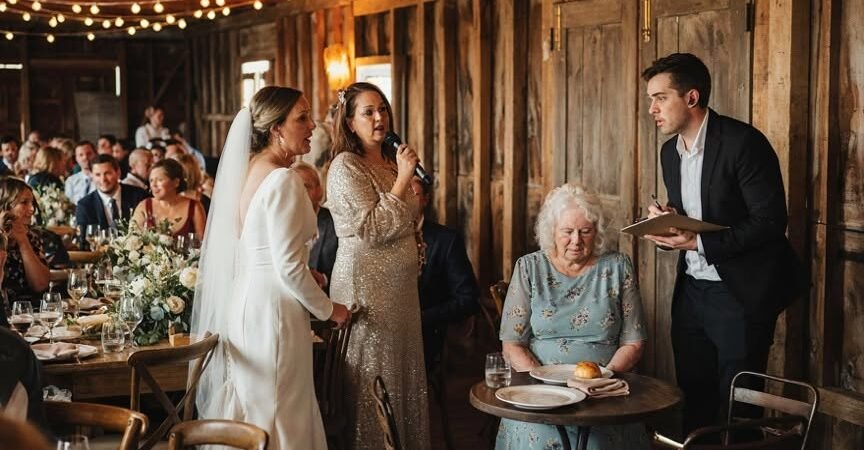
I looked down at my place setting. A white china plate with nothing on it. A folded cloth napkin. A dinner roll in a little basket somebody had set in the middle of the table.
My name card was propped against my water glass in pretty gold calligraphy.
June Carver. Table 14.
Table 14 was in the very back corner of the barn. Right beside the swinging kitchen doors. Every thirty seconds, they banged open and a server pushed through with a tray, and a blast of hot air and clanging pans came out with them.
Sitting at Table 14 with me were the DJ’s girlfriend, two little boys who belonged to one of the bartenders, and a photographer’s assistant who kept getting up to change batteries.
Across the barn, under the strings of white lights hanging from the old wooden beams, my granddaughter sat at the head table in her wedding dress. Laughing. Beautiful.
And beside her, in a sequined champagne gown, sat her mother. My daughter-in-law, Pam.
Pam was laughing too.
I picked up the dinner roll. I tore off a little piece. I ate it.
I didn’t say one word.
It was Megan’s day. I’d have eaten a hundred dinner rolls before I’d have done one thing to spoil it.
My name is June Carver. I’m seventy-six years old. I taught fourth grade in Franklin, Indiana for thirty-four years.
And what nobody at that wedding knew, except the bride and the woman who ran the venue, was that the barn we were all sitting in had been paid for with my money.
Twelve thousand dollars of it.
And the contract had my name on it.
My granddaughter Megan is the light of my life. I want you to understand that before I tell you anything else.
My son, Greg, married Pam when he was twenty-four. Megan came along two years later.
When Megan was five, Pam hurt her back in a car accident on Highway 31. She had two surgeries. The doctors gave her pain pills. A lot of them.
By the time Megan was six, Pam was in trouble.
Greg was working for a pipeline company back then. He was gone three weeks out of every month, laying pipe in North Dakota and Texas. He didn’t see it happening. Or he didn’t want to.
I saw it.
I saw my granddaughter come to school in the same clothes three days in a row. I saw her eating peanut butter crackers out of the vending machine for lunch. I saw the bruise on her arm from where she’d fallen down the stairs trying to carry a laundry basket because nobody else was doing the laundry.
So I took her.
Greg agreed. Pam was too sick to argue. We filed the paperwork with a lawyer in Franklin, and the court gave me temporary guardianship.
Megan lived with me in my little house on Jefferson Street from the time she was six until the summer she turned fourteen.
Eight years.
I packed her lunches. I braided her hair every morning before school. I sat through every piano recital and every 4-H fair and every middle school band concert. When she got her period for the first time, she called me from the girls’ bathroom at Custer Elementary, crying, and I drove over and brought her a fresh pair of jeans and a candy bar.
Meanwhile, Pam got help.
She went to a treatment center in Indianapolis for three months. Then outpatient. Then meetings, twice a week, for years. I’ll give her that. She did the work. She got well.
The summer Megan turned fourteen, Pam came to my front door with a two-year sobriety chip in her hand and asked for her daughter back.
I said yes.
It was the right thing. It was what Megan needed. A girl needs her mother.
But I never stopped being her grandma.
And Pam never forgave me for having been her mother for eight years when she couldn’t.
It came out in small ways at first.
Pam would “forget” to tell me about Megan’s school awards ceremonies. I’d find out afterward from other teachers in town.
At Thanksgiving, Pam would seat me at the far end of the table with the little kids.
When Megan graduated from Franklin Community High School, Pam ordered six tickets for the ceremony. Megan’s dad. Pam. Pam’s parents. Pam’s sister. Pam’s sister’s husband.
I watched from the bleachers in the back. Megan found me afterward in the parking lot and cried into my shoulder because she didn’t know.
“It’s all right, sweetheart,” I told her. “I could see you just fine.”
Megan’s twenty-six now. She’s a dental hygienist in Greenwood. Last Christmas, she got engaged to a sweet young man named Josh Reynolds. He’s an electrician. He calls me “Grandma June” and shovels my sidewalk without being asked.
Two weeks after they got engaged, Megan called me crying.
“Grandma, I found the place. Willow Creek Barn, out on County Road 400. It’s perfect. It’s got the white lights and the old beams and a big pond out back for pictures.”
“That sounds beautiful, honey.”
“It’s eighteen thousand dollars.” She was sobbing now. “Mom and Dad said they can only do six. That’s all they’ve got. Josh’s parents are paying for the rehearsal dinner and the band. I don’t know what to do.”
I sat at my kitchen table. I looked at the calendar on my refrigerator.
My husband, Don, passed in 2019. He was a rural mail carrier for thirty-one years. He left me his pension and a life insurance policy for $75,000. I put most of it in a savings account at First Merchants Bank and never touched it.
I’d always told myself it was for an emergency.
I couldn’t think of anything that mattered more than this.
“Megan,” I said. “I’ll pay the rest.”
She went quiet on the phone.
“Grandma, that’s twelve thousand dollars.”
“I know what it is.”
“I can’t let you do that.”
“You didn’t let me,” I said. “I decided.”
She cried even harder.
Then she said something that broke my heart a little.
“Grandma? Can you not tell Mom? She’ll be embarrassed. She already feels bad they can only do six.”
“Of course, sweetheart,” I said. “Nobody needs to know.”
The next Saturday, Megan and I drove out to Willow Creek Barn together.
It was a beautiful old place. A white dairy barn from 1920 that a young couple had restored. Big wooden beams. A long gravel drive lined with maple trees. A pond out back with a little dock.
The woman who ran it met us at the door. Denise Kowalski. She was in her fifties, with short gray hair and a black blazer and a clipboard she never set down.
She sat us in her little office in the old milk house and went over the contract.
Venue rental, Saturday, June 15th. Tables, chairs, linens, the string lights. Catering for one hundred and sixty guests. Plated dinner. Chicken or beef.
Total: $18,000.
“We require a deposit of $12,000 to hold the date,” Denise said. “The remaining balance of $6,000 is due on the night of the event, before the reception ends. We also hold a $1,000 refundable damage deposit, which we return to the contract holder within thirty days if everything’s in good order.”
“Who should be listed as the contract holder?” she asked.
Megan looked at me.
“I’m paying the deposit,” I said. “Put it in my name.”
Denise typed it in. She printed out three copies. I signed all three in blue ink.
June A. Carver.
Then I wrote out a check from my account at First Merchants Bank for $13,000. The deposit, plus the damage deposit.
Denise took it and smiled at me.
“Your granddaughter’s lucky,” she said.
“No,” I said. “I’m the lucky one.”
Megan hugged me in the parking lot so hard she knocked my glasses off.
“I love you, Grandma,” she whispered. “I’ll never forget this.”
“Just have a beautiful day, sweetheart,” I said. “That’s all I want.”
Megan told her mother the venue was “all taken care of.” Pam didn’t ask questions. Megan said Pam assumed Josh’s parents had chipped in more than they said.
And Greg gave Pam a check for $6,000 to cover their share of the balance.
At least, that’s what he told me later.
I didn’t think about the seating chart until I walked into Willow Creek Barn on the night of the wedding.
The ceremony was out by the pond at five o’clock. It was perfect. Megan walked down the grassy aisle on Greg’s arm in her grandmother’s veil. My veil. The one I wore in 1969. She’d asked me for it at Easter.
Josh cried when he saw her. Everybody did.
I sat in the fourth row of white folding chairs and held a tissue and couldn’t stop smiling.
Then everybody walked up to the barn for the reception.
There was a big table by the door with little name cards lined up in rows. Each one in gold calligraphy. Pam had hired a woman from Indianapolis to do them.
I looked for my name.
The front tables were labeled with the families. Table 1: Bride’s Parents. Table 2: Groom’s Parents. Table 3: Bride’s Grandparents.
I picked up the card at Table 3.
Richard and Carol Novak. Pam’s parents.
Next to them, Josh’s grandparents.
No June Carver.
I looked through every card on that table. One at a time.
I finally found mine at the very end of the last row.
June Carver. Table 14.
A young groomsman saw me holding it and pointed helpfully toward the back corner of the barn.
“Fourteen’s back there, ma’am. By the kitchen.”
I walked back there. I sat down. I smoothed my dress, a pale blue chiffon I’d bought at Kohl’s just for that day.
And then the servers came out with dinner. And the young girl with the tray told me I didn’t have a meal.
I ate my dinner roll.
Across the barn, Pam stood up from the head table to greet her parents. She glanced toward the back. Just for a second.
Our eyes met.
And then she smiled. And looked away.
That’s when I understood. It wasn’t a mistake. It wasn’t a mix-up with the calligrapher.
Pam had done it on purpose.
For eight years, she’d watched me raise her daughter. And now, on her daughter’s wedding day, she was going to make sure everyone in that barn knew exactly where I belonged.
In the back. By the kitchen. With nothing on my plate.
I could have left.
I want you to know I thought about it. I could have stood up, walked out to my Buick in the gravel lot and driven home to Jefferson Street. Nobody would even have noticed I was gone.
But Megan would have noticed. Later. When she looked at the pictures.
So I stayed.
I sat at Table 14 and listened to the kitchen doors bang open and shut. I helped the bartender’s little boys cut up their chicken tenders. I let the DJ’s girlfriend show me pictures of her new puppy on her phone.
One of the little boys, maybe six years old, looked at my empty plate.
“Why don’t you get any food?” he asked.
“I’m not very hungry, honey,” I said.
He looked at me for a long time with that serious way little boys have. Then he slid three of his chicken tenders onto my plate with his fingers.
“You can have some of mine,” he said.
I had to look up at the ceiling beams for a minute.
At eight-thirty, the DJ turned down the music.
“Ladies and gentlemen,” he said. “It’s time for the toasts!”
The best man went first. He told a funny story about Josh getting lost on a fishing trip. The maid of honor went next. She cried through the whole thing.
Then Pam stood up.
She took the microphone from the maid of honor. She smoothed down her sequined dress. The string lights made it sparkle.
“I just want to say a few words,” Pam said. “As the mother of the bride.”
Everybody clapped.
“Twenty-six years ago, I held this beautiful girl for the very first time. And I knew my life would never be the same.”
She talked about Megan’s first steps. Her first day of kindergarten.
She didn’t mention the eight years in between. Not one word.
Then she turned and put her hand on Greg’s shoulder.
“And I want to thank my wonderful husband, Greg. Because none of this, this beautiful barn, this beautiful night, none of it would be possible without him. Greg, thank you for making our daughter’s dream come true.”
The whole barn clapped. Greg looked down at his plate.
That’s when I saw a woman in a black blazer, holding a clipboard, start walking across the dance floor.
Denise Kowalski.
Denise walked straight up to the head table.
She leaned down and said something quietly to Pam, who was still holding the microphone.
I watched Pam’s face change.
First confused. Then annoyed. Then something else. Something I couldn’t read from across the barn.
Pam said something back to Denise. Then she lifted her arm.
And pointed.
Across the entire barn. Past the dance floor. Past all one hundred and sixty guests.
Right at Table 14.
Right at me.
Denise turned around and looked where Pam was pointing. Then she started walking.
All the way across that barn. Her heels clicking on the old wooden floor. The whole room watching her, because Pam still had the microphone in her hand and the music was still off.
She stopped at my table.
“Mrs. Carver?” she said.
“Yes.”
“I’m so sorry to bother you during the toasts.” She held up her clipboard. “The contract is in your name. I need your signature for the final balance of $6,000 before the end of the night. That’s our policy.”
Then she glanced down. At my empty place setting. The little pile of chicken tenders on my plate. The half-eaten dinner roll.
Her face changed.
“Ma’am,” she said, a little louder than she meant to. “Why don’t you have a plate? You were on our list for a beef entrée.”
I looked up at her. Then across the barn at the head table.
Every single person at that head table had turned around to look at me.
Including my granddaughter.
Megan was staring at me in her wedding dress. At Table 14. At the kitchen doors banging behind me. At my empty plate.
I watched her figure it out. All of it. All at once.
Her face crumpled.
Pam was still standing there with the microphone.
“Well, Mother June,” Pam said into it, with a little laugh. “I guess you’d better pay up.”
Somebody near the front laughed nervously. Nobody else did.
I set down my napkin.
“I’d be glad to sign, Denise,” I said. “But I want to make sure I understand. Is the $6,000 the balance that I owe? Or the balance Megan’s parents agreed to pay?”
Denise flipped a page on her clipboard.
“According to my notes from our meeting in January,” she said slowly, “you paid the $12,000 deposit. The remaining $6,000 was to be paid by the bride’s parents on the night of the event.”
She looked over her shoulder at the head table.
“I asked Mrs. Novak-Carver for it just now,” Denise said. “She told me to come to you.”
The barn went completely silent.
You could hear the ice machine humming in the kitchen behind me.
At the head table, Greg slowly turned to look at his wife.
“Pam,” he said. Not into any microphone. But in that silence, everybody heard it. “I gave you a check for six thousand dollars in April. For the barn.”
Pam’s face went red under her makeup.
“Greg, not now.”
“Where’s the money, Pam?”
“I said not now!”
But Megan was already standing up.
She stood up from the head table in her wedding dress. She gathered up the long skirt in both hands. She picked up her own plate. A full plate of beef tenderloin and roasted potatoes and green beans that she’d barely touched.
And she walked.
All the way across that barn. Past the dance floor. Past the cake table. Past one hundred and sixty guests who were all watching her with their mouths open.
She walked right past her mother and didn’t even look at her.
She set her plate down in front of me at Table 14.
Then she knelt down on the old wooden floor in her white dress, right beside my chair, and put her arms around my neck.
“Grandma,” she whispered. “I didn’t know. I swear to God I didn’t know where she put you.”
“I know you didn’t, sweetheart.”
“You paid for this whole barn. And she put you by the kitchen.”
“It’s all right.”
“It’s not all right!” Megan pulled back. Her mascara was running. “It’s not all right, Grandma.”
She stood up. She turned around and faced the whole room. She held out her hand toward the DJ.
He looked at Pam. Then at Megan. Then he walked over and handed Megan a microphone.
My granddaughter took a deep breath.
“I’m sorry,” she said. “I know this isn’t how toasts are supposed to go. But I need everybody to know something.”
“When I was six years old,” Megan said, “my mom got sick. Really sick. And for eight years, this woman raised me.”
She pointed at me.
“My Grandma June. She packed my lunches. She braided my hair every single morning. She came to every recital and every ball game and every parent-teacher conference. She taught me how to bake bread and balance a checkbook and say my prayers.”
Her voice cracked.
“When I called her in January crying because I couldn’t afford this barn, she didn’t even hesitate. She paid twelve thousand dollars. Out of the life insurance my grandpa left her when he died. She paid it so I could get married here. And she asked for nothing. She didn’t even want anybody to know.”
People were turning around in their chairs now. Looking at me.
“I asked her not to tell my mom,” Megan said. “Because I didn’t want my mom to feel embarrassed.” She looked at Pam. “And tonight, my mom put her at a table by the kitchen. And told the caterer not to bring her any dinner.”
Somebody at Table 6 gasped out loud.
“I’m sorry, Mom,” Megan said. Her voice was shaking, but she didn’t look away. “I love you. And I know you worked hard to get better. I’m proud of you for that. But you don’t get to do this to her. Not tonight. Not ever.”
Pam stood frozen at the head table with her microphone hanging at her side.
Megan turned back to the room.
“So I’d like to make a toast,” she said. “To my Grandma June. The reason I’m standing here tonight. In every way.”
She lifted her water glass.
And one hundred and sixty people stood up.
Josh’s grandfather was the first one. A big retired farmer in a bolo tie. Then Josh’s parents. Then the whole table of my old fellow teachers from Custer Elementary that Megan had invited. Then everybody.
“To Grandma June,” they said.
The little boy beside me stood up on his chair and held up his juice box.
“To Grandma June!” he yelled.
Everybody laughed. And it broke something open in that room.
I sat there at Table 14, holding my granddaughter’s hand, crying into my napkin like a fool.
Denise Kowalski cleared her throat beside me.
“Mrs. Carver,” she said quietly, “I don’t want to make tonight any harder than it already is. But I do still need that balance before the end of the night. It’s in the contract.”
I looked across the barn. Greg was sitting at the head table with his head in his hands. Pam was standing by the bar, talking fast and low to her father. Her mother was staring at her like she’d never seen her before.
“I’ll take care of it,” I said.
I reached for my purse. I always carry my checkbook. Don used to tease me about it. “You’re the last person in Indiana who still writes checks, June.”
But before I could open it, a hand came down on my shoulder.
It was Greg.
He’d walked all the way back from the head table. His face was gray.
“No, Mom,” he said. “Put that away.”
He pulled his wallet out of his suit jacket. He took out a credit card. He handed it to Denise.
“Run the six thousand on this,” he said.
“Greg, you don’t have to…”
“Yes, I do.” His voice was rough. “I gave Pam a check for six thousand dollars in April. She told me she paid the barn. I believed her.”
He looked down at me.
“Mom, I didn’t know where she put you tonight. I didn’t know she told the caterer you didn’t get a meal. I didn’t know any of it.” His eyes filled with tears. “I didn’t know you paid for the whole barn.”
“Megan asked me not to tell.”
“I know.” He wiped his eyes with the back of his hand. “I know she did. Because she didn’t want her mother to be embarrassed. And her mother did this.”
Denise ran the card on a little reader on her clipboard. It beeped.
“Approved,” she said. She tore off the receipt and handed it to Greg.
Then she turned to me.
“Mrs. Carver,” she said. “Your $1,000 damage deposit will be refunded to you within thirty days. Since the contract is in your name.” She paused. “And for what it’s worth, I’m very sorry about your dinner. That’s never happened at my venue before. It won’t happen again.”
She turned and walked toward the kitchen. Thirty seconds later, the kitchen doors banged open, and the head chef himself came out carrying a hot plate of beef tenderloin, mashed potatoes and roasted carrots.
He set it down in front of me with a little bow.
“On the house, ma’am,” he said.
I’ll be honest. The rest of that reception was a little strange.
Pam left early. Her father drove her home. I heard later she cried in the car the whole way back to Franklin.
The DJ put the music back on. People danced. Josh and Megan cut the cake. Josh’s grandfather asked me to dance to an old Patsy Cline song, and I said yes, and he stepped on my feet three times and apologized every single time.
At the end of the night, when they did the last dance, Megan came and found me at Table 14.
“Grandma,” she said. “Will you dance with me?”
“Sweetheart, this is supposed to be with your husband.”
“Josh said it’s fine. He’s dancing with his mom.”
So I danced with my granddaughter. In my blue chiffon dress from Kohl’s. Under the white string lights. In the barn I paid for.
She put her head on my shoulder, the way she used to when she was little and couldn’t sleep.
“I’m sorry, Grandma,” she whispered.
“For what, honey?”
“For asking you to keep it a secret. I think that’s what made Mom think she could do it. Because nobody knew.”
I held her a little tighter.
“You didn’t do anything wrong,” I said. “You were trying to protect your mother. That’s what good daughters do.”
“You should have told somebody.”
“Maybe,” I said. “But then you wouldn’t have walked across that whole barn with your dinner plate.”
She laughed into my shoulder.
“I’ll never forget the look on Mom’s face,” she said.
“I’ll never forget the look on yours,” I said.
Three weeks later, a check came in the mail from Willow Creek Barn.
$1,000. Refund of damage deposit. Pay to the order of June A. Carver.
And tucked in the envelope with it was a handwritten note on Willow Creek Barn stationery.
“Mrs. Carver, I’ve run this venue for eleven years. I have never once seen a bride walk across the room with her own plate. Thank you for reminding me why I do this job. If you ever want to come out and sit by the pond, the door’s always open. Denise.”
I put that note on my refrigerator. It’s still there.
Pam didn’t speak to me for almost four months.
I didn’t call her either. Some things need to sit a while before they’re ready to be talked about.
Greg came over every Sunday after church, the way he always had. But he was quieter. He told me he and Pam were seeing a marriage counselor in Greenwood.
The six thousand dollars, it turned out, had gone to Pam’s dress, her hair and makeup, a spa weekend in French Lick with her sister, and a new set of living room furniture she said she needed “for when people came over after the wedding.”
She’d planned to tell Greg the venue gave them a discount. She figured nobody would ever check.
She didn’t know the contract was in my name.
In October, on a Tuesday afternoon, my doorbell rang.
It was Pam.
She was standing on my front porch on Jefferson Street holding a foil-covered casserole dish in both hands. She looked smaller than I remembered. No makeup. Hair pulled back.
“June,” she said. “Can I come in?”
I stepped aside.
She set the casserole on my kitchen table. Chicken and noodles. My recipe. The one I’d taught Megan to make when she was nine.
She sat down in the chair across from me. The same chair Megan used to sit in to do her homework.
For a long time, she didn’t say anything.
Then she reached into her purse and took out an envelope. She slid it across the table.
Inside was a cashier’s check from Indiana Members Credit Union.
$6,000. Pay to the order of June Carver.
“I took out a personal loan,” Pam said quietly. “Greg paid the barn that night. But that money was supposed to come from me. I spent it on myself. And I let you sit by the kitchen while I did it.”
“Pam, I don’t need this.”
“I know you don’t need it.” Her voice cracked. “But I need to give it.”
She looked down at her hands.
“My sponsor says I have to make amends,” she said. “For the people I’ve hurt. I’ve been sober eighteen years. I thought I was done with that list a long time ago.” She laughed, but there was nothing funny in it. “Turns out I left the biggest one off.”
I sat there across the table from my daughter-in-law and didn’t say anything for a while.
Then I asked her the question I’d been wondering about for four months.
“Why, Pam? Why put me by the kitchen? On Megan’s day?”
She was quiet for so long I didn’t think she’d answer.
“Because for eight years,” she finally said, “you got to be her mother. And I didn’t. Because of what I did. Because I was too sick to take care of my own little girl.”
Tears started running down her face.
“Every time Megan says ‘Grandma June taught me’ or ‘Grandma June always said,’ it’s like a knife. It’s every Christmas morning I missed. Every bedtime story. Every first day of school.” She wiped her eyes. “And on her wedding day, I just wanted one day where I was the most important one. Where she was mine.”
“She was always yours, Pam,” I said. “Even those eight years. Every night when I tucked her in, she said her prayers for you. Every single night. ‘God bless Mommy and help her get better.’ Eight years.”
Pam put her face in her hands.
“I never knew that,” she whispered.
“I never told you,” I said. “Maybe I should have.”
We sat there in my little kitchen for a long time. The clock on the wall ticked. A car went by outside.
Finally, I picked up the cashier’s check. I looked at it.
Then I handed it back across the table.
“I want you to do something else with this,” I said.
Pam looked up at me.
“Megan and Josh are trying to save up for a down payment on a house in Greenwood,” I said. “They’re about six thousand short. Megan told me last week. She’s too proud to ask anybody.”
I pushed the envelope into Pam’s hands.
“You give it to her,” I said. “From her mother. Not from me. Let it be from you.”
Pam stared at me.
“June,” she said. “Why would you do that? After everything?”
“Because I didn’t spend eight years raising that girl so the two of us could keep fighting over her,” I said. “She’s got enough love for both of us. She always did.”
Pam started crying again. Harder this time.
Then she stood up, came around my kitchen table, and hugged me.
It was the first time Pam ever hugged me in twenty-eight years.
Megan and Josh closed on their house in Greenwood the week before Christmas.
A little three-bedroom ranch on a cul-de-sac. With a big backyard and a swing set the old owners left behind.
Pam gave them the $6,000 for the down payment at Thanksgiving dinner. In front of everybody. Megan cried so hard she had to leave the table.
I didn’t say a word. I just passed the mashed potatoes.
That Christmas, Megan hosted dinner at her new house for the very first time.
I drove over on Christmas Day with a pecan pie in a box on the passenger seat of my Buick. Pam brought her green bean casserole. Greg brought a ham. Josh’s parents brought rolls and wine.
When I walked into Megan’s little dining room, I saw she’d set the table herself. Mismatched plates. Paper napkins folded into little triangles. A centerpiece made out of pinecones from the backyard.
And at every place, a little name card.
Not in gold calligraphy. Just in Megan’s own handwriting, with a black Sharpie, on folded index cards.
I walked around the table looking for mine.
Josh. Megan. Mom. Dad. Josh’s parents.
At the head of the table, at the seat closest to the Christmas tree, there was a card propped against the water glass.
“Grandma June.”
And underneath it, in smaller letters:
“Table 1. Always.”
I stood there holding that little index card for a long time.
Pam came up beside me. She looked down at the card in my hand.
Then she reached over and gently squeezed my arm.
“She’s right, June,” Pam said quietly. “Table 1. Always.”
I sat down at the head of my granddaughter’s table.
And when Megan came out of the kitchen carrying the ham on a platter, she set the very first plate in front of me.
Full. Steaming. With a dinner roll on the side.
She leaned down and kissed the top of my head.
“Merry Christmas, Grandma,” she said. “Nobody in this family eats by the kitchen anymore.”