He took one step toward the bed.
“I want to stay,” he said. “Please. Let me stay. Let me hold them. I’ll sleep in the chair. I’ll do the night feeds. I’ll do everything. Please, Em.”
Part of me wanted to say yes so badly it hurt.
That was the picture I’d carried all morning. All year, really. All ten years. Andrew in the chair by the window, the girls in his arms, the gold chocolate bar on the tray table, both of us crying and laughing at the same time.
I could still see it, golden and perfect.
He had come back.
That didn’t mean I trusted him again.
“I’m going to recover at my mom’s,” I said.
My mother didn’t say anything. She just reached over and put her hand on my ankle under the blanket.
“And I’ll decide about us when I’m ready,” I said. “Not when you are.”
Andrew stood very still.
I watched him take it in. I watched him want to argue. I watched him open his mouth and close it again.
Then he nodded, once.
He walked over to the bassinet.
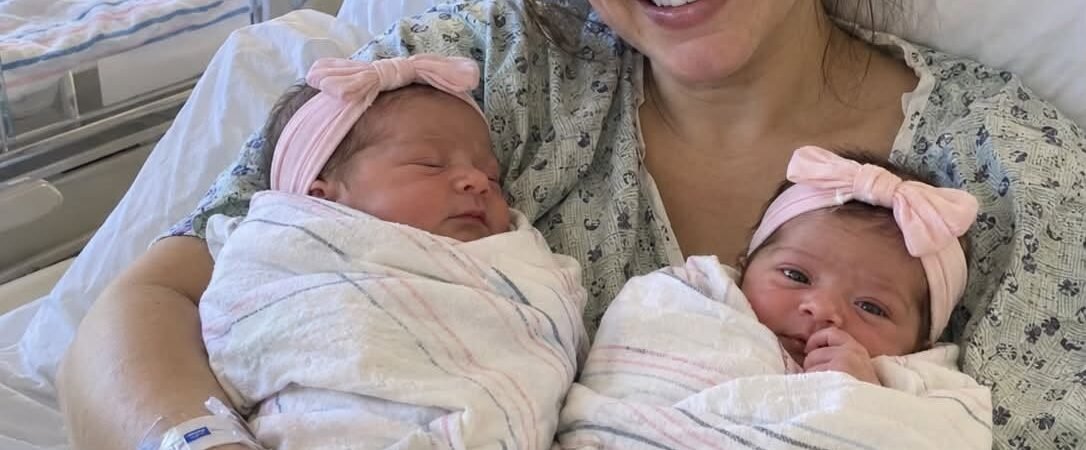
He looked at the girls for a long moment. Ivy was asleep. Nora was awake, staring up at nothing with her dark, unfocused newborn eyes and the little worried crease in her forehead.
He reached down and touched one tiny foot with a trembling finger.
Nora’s toes curled.
He made a sound like something breaking inside him.
Then he turned and went to the door.
“I love you,” he said.
“I know,” I said.
It was true. And it wasn’t enough.
He left.
My mother stood up.
She didn’t say anything about Andrew. She didn’t say anything about Carol. She just moved the cup of water closer to my hand on the tray table.
Then she reached down into the hospital bag by the window, the one Andrew had packed so carefully. She pulled out the gold-wrapped caramel chocolate bar and set it on the tray beside the water, within reach.
Then she sat back down beside me.
One of the girls began to fuss. It was Ivy this time.
“Mom,” I said, “can you help me lift her?”
“Of course, sweetheart.”
She stood. She slid one hand beneath Ivy’s head and the other under her bottom. She lifted her out of the bassinet and brought her over to me, waiting until I had her settled before letting go.
Then she brought Nora too.
I held both girls against me. My mother tucked a pillow beneath my arm so I wouldn’t strain the incision.
This time, when Ivy reached out, her little fist closed around my finger.
And this time, I didn’t turn my head to look for anyone.
I stayed at my mother’s house for seven weeks.
It was the same house I grew up in, a small yellow two-story on a quiet street, with creaky floors and a kitchen that always smelled like toast. My old bedroom still had glow-in-the-dark stars on the ceiling. My mother pushed my childhood bed against the wall and borrowed two bassinets from a woman at her church.
The first two weeks were a blur.
I don’t remember much about them. I remember feeding. Feeding and changing and feeding again. I remember that twins never sleep at the same time, no matter what the books promise. I remember that my incision burned every time I laughed or coughed or sneezed, and that I sneezed a lot that October. I remember my mother standing at the stove at three in the morning making scrambled eggs, holding Nora in one arm and the spatula in the other, singing old Motown songs under her breath.
I remember crying in the shower so the water would cover the sound.
I remember the chocolate bar sitting on my nightstand, still wrapped.
I couldn’t eat it. I couldn’t throw it away either.
Andrew texted every day.
Not long texts. He didn’t beg. He didn’t make speeches. Just small things.
How are they today?
Did Nora gain any weight?
I put the car seats in your mom’s garage. Both bases installed. I checked them twice.
I’m sorry.
The first week, I didn’t answer at all.
The second week, I sent him pictures. Only of the girls, never of me. Ivy asleep with her arms thrown over her head like she was on a roller coaster. Nora frowning at a ceiling fan.
He wrote back every time, within a minute, no matter what time it was. Two in the afternoon. Four in the morning.
She looks like you when she sleeps.
She has your frown. That’s your exact frown.
On the tenth day, my mother answered the front door and found a cooler on the porch.
Inside, there were frozen meals. Lasagna. Chicken soup. My favorite curry from the Thai place on Fifth, frozen in individual portions, with the containers labeled in Andrew’s careful block capitals. EMMA — CURRY — 2 MIN THEN STIR.
There was a note taped to the lid.
For your mom, so she doesn’t have to cook. I won’t come in unless you want me to. — A.
My mother read the note. Then she looked at me over the top of it.
“Well,” she said. “He labels things.”
“He’s always labeled things.”
“Hmm.” She carried the cooler into the kitchen. “He’s not a terrible man, Emma. I want you to know I think that. He’s not a terrible man. He did a terrible thing.”
“I know.”
“Those are different.”
“I know, Mom.”
She started stacking the containers in the freezer.
“I’m not telling you what to do,” she said. “I’m just telling you that I know the difference. And so do you.”
Daniel called on day twelve.
I almost didn’t answer. I didn’t know what to say to him. I was so embarrassed, embarrassed for Andrew and for me, even though I hadn’t done anything.
“Hey, Em,” he said.
“Hey.”
“How are they?”
“Loud.”
He laughed. It sounded tired.
“Priya wants to bring dinner. And to meet them. If that’s okay.”
“Of course it’s okay.”
There was a pause.
“Em,” he said. “I’m not calling to tell you what to do about Andrew. That’s not my business. But I want to tell you what happened. At my house. Because I don’t think he’s told you.”
I sat down on the edge of my childhood bed.
“Okay.”
“He showed up at my door,” Daniel said. “Shaking. He didn’t even say hello. He just held up his phone with that picture on it and said, ‘Tell me the truth.’” Daniel’s voice went rough. “And I said, ‘Andrew, you were standing right there. You were holding the cake.’ And he just stared at me. He stared at me for a long time. Like he was trying to remember.”
“He didn’t remember?”
“I don’t think he’d let himself,” Daniel said. “His mother had told him a story. A really specific one. Come around the side of the house, caught you alone. And he’d been sitting in a hospital hallway for two hours with that story in his head. By the time he got to me, I think he couldn’t see anything else.”
I didn’t say anything.
“He sat down on my front steps and cried for twenty minutes,” Daniel said. “Then he looked up and said, ‘What have I done? I left her. She woke up and I wasn’t there.’ And then your call came. And I don’t think I’ve ever seen anyone get into a car that fast.”
He paused.
“I’m still angry with him,” Daniel said quietly. “I need you to know that too. I’ve been his friend for twelve years, and he looked me in the face and asked if I’d slept with his wife. I’m still angry. But I wanted you to know he figured it out before your call. Not after. He was already on his way back in his head.”
“Thank you, Daniel.”
“Bring the girls to meet Theo soon,” he said. “He’s been practicing. He keeps telling everyone he’s going to be the boss of them.”
On day fifteen, I said Andrew could come see the girls.
Just the girls. At my mother’s house. For one hour.
He came at two o’clock on a Saturday. He knocked instead of ringing the bell, like he was afraid of waking someone up. He was wearing a clean shirt. He’d gotten a haircut. He looked like he hadn’t slept in two weeks.
My mother let him in. She didn’t hug him. But she didn’t close the door in his face either.
He came into the living room where I was sitting on the couch with Nora on my chest and Ivy in the bassinet beside me.
He stopped in the middle of the room.
“Hi,” he said.
“Hi.”
“Can I…?” He gestured toward the bassinet.
“Wash your hands first.”
He went to the kitchen. I heard the water running for a long time, the full twenty seconds, the way the nurses taught us.
When he came back, I showed him how to pick up Ivy without putting pressure on her neck. He already knew. He’d held them in the nursery that first hour, before he left. He’d taken a class. He’d watched videos.
But he let me show him anyway.
He sat down in my mother’s armchair with Ivy in his arms.
He didn’t say anything for a long time. He just looked at her.
Then he started to cry. Not loudly. Just tears running down his face, silently, dripping off his chin onto Ivy’s blanket.
“She’s gotten so big,” he whispered.
“She’s gained almost a pound,” I said.
“I missed it.”
“Yeah,” I said. “You did.”
He nodded slowly. He didn’t argue. He didn’t say but.
He just held her and cried and let me watch him do it.
When his hour was up, he handed her back to me very carefully. He thanked my mother on the way out. At the front door, he turned around.
“Same time next week?” he asked. “If you’ll let me.”
“We’ll see,” I said.
He came the next Saturday. And the next.
The third Saturday, I let him stay for two hours. The fourth, he gave Nora her bottle while I took a nap upstairs. When I came down, he was asleep in the armchair with her on his chest, both of them snoring.
My mother was sitting at the kitchen table watching them through the doorway, drinking coffee.
“He hasn’t moved in forty minutes,” she said quietly. “He was afraid he’d wake her.”
That fourth Saturday, before he left, we sat on my mother’s back steps while the girls slept.
It was cold. November. The maple tree in the backyard had dropped all its leaves. Andrew sat a careful distance away from me on the concrete step.
“Can I tell you something?” he said.
“Only smart things allowed.”
He almost smiled. Then he didn’t.
“I told her,” he said. “Mom. I went to her house on Tuesday, and I sat down at her kitchen table. And I told her that she isn’t going to see the girls unless you say so. And even then, not alone. Not ever.” He looked at his hands. “She cried. She said I was choosing you over my own mother.”
“What did you say?”
“I said yes.” He swallowed. “I said, ‘Yes, Mom. I’m choosing my wife and my daughters. I should have done it eleven years ago. I’m sorry it took me this long.’”
I didn’t say anything.
“She said Dad would never have done that to his mother,” Andrew said. “And I said, ‘No. Dad did something much worse to you. And I almost did the same thing to Emma. Because you taught me to look for it everywhere.’”
He rubbed his face.
“She didn’t say anything after that,” he said. “She just sat there. I left.”
“And I’ve started seeing someone,” Andrew said. “A therapist. Dr. Hale. Twice a week.”
I turned to look at him.
“About the numbers,” he said. “About… all of it. Why I believed her. Why it was so easy for me to believe her.” He was quiet for a moment. “Dr. Hale asked me what I was actually afraid of. That day. In the hospital. And I said I was afraid they weren’t mine. And she kept asking. Why does that scare you so much? And I said, because then it would mean I couldn’t give you anything. That I’d failed at the one thing. And you’d have to find it somewhere else.”
He looked out at the bare maple tree.
“She said that wasn’t a fear about you,” he said. “It was a fear about me. And I made you pay for it.”
I sat there on the cold step for a long time.
Then I said the thing I’d been holding for four weeks.
“Do you know what the worst part was?”
“Me leaving.”
“No,” I said. “Well, yes. But no.” I pulled my sweater tighter. “The worst part was that I couldn’t stand up. I had two babies, and I’d just gotten everything we ever wanted, and I couldn’t stand up. And the one person I’d always been able to lean on was gone. And I had to let a stranger pick up my daughter.”
He closed his eyes.
“You remember the bathroom floor?” I said.
He nodded. He couldn’t speak.
“That’s the night I always think about,” I said. “When I wonder if I married the right person. You didn’t have an answer. You didn’t fix anything. You just sat down beside me and stayed.”
I looked at him.
“That’s all I wanted, Andrew. In that hospital bed. I didn’t need you to have answers. I just needed you to stay.”
He didn’t say anything for a long time.
Then he said, “I know. I know that’s what you needed. And I didn’t give it to you.” He wiped his eyes with the heel of his hand. “I can’t take it back. I’d give anything to take it back. But I can’t.”
“No,” I said. “You can’t.”
“I can only show up,” he said. “Every day. For as long as you’ll let me. I know that’s not the same thing. I know it doesn’t fix it.”
“No,” I said. “It doesn’t fix it.”
I looked out at the maple tree.
“But it’s a start,” I said.
I went home in the first week of December.
Not because everything was fixed. It wasn’t. I went home because the girls were seven weeks old and needed their own cribs, the ones their father had built on a schedule. I went home because my mother’s back was killing her from the air mattress. I went home because I’d watched Andrew show up every single Saturday for six weeks, on time, with his hands washed and his phone off and his head down, and I wanted to see if he could do it every day too.
We made rules before I came back.
It was my idea. I wrote them on a piece of paper at my mother’s kitchen table, and Andrew read them twice and signed his name at the bottom like it was a contract. He didn’t argue with a single one.
Couples counseling, every week, for at least six months.
Your mother doesn’t come to the house. If she sees the girls, it’s somewhere public, with both of us there, and only when I say so.
When I call, you answer. Every time. If you can’t talk, you pick up and say, “I can’t talk.” But you pick up.
If you ever doubt something about me again, you ask me first. Not her. Not anyone. Me.
The first few weeks at home were strange.
We were careful with each other. Too careful. We said “thank you” too much and “sorry” too much. We moved around each other in the kitchen like strangers in a hallway.
He slept in the guest room for the first two weeks. It was his idea. I didn’t stop him.
But every night, when one of the girls woke up crying, I heard his door open before I could even sit up. I heard his footsteps go down the hall to the nursery. I heard him murmuring to them in the dark, I’ve got you, I’ve got you, Daddy’s here.
Every single night. Usually twice. Sometimes three times.
Carol sent a card in December.
It came in the mail, addressed to both of us, in her perfect slanted handwriting. A Christmas card. On the front was a picture of an angel. Inside, she’d written:
I have been thinking a great deal. I would like to meet my granddaughters. I am willing to do so on whatever terms you feel are appropriate. — Carol.
It wasn’t an apology. Not really. It didn’t say she was sorry. It didn’t say she’d been wrong.
But it said whatever terms you feel are appropriate. It didn’t say I am the grandmother, after all.
I read it three times. Then I handed it to Andrew.
He read it. He looked at me.
“It’s up to you,” he said. “Whatever you decide.”
“I know.”
I put the card in the kitchen drawer with the takeout menus.
I didn’t answer it that month. Or the next.
In March, we met Carol at a coffee shop downtown, for forty-five minutes. Andrew and I sat on one side of the table with the girls in their car seats, and Carol sat on the other side. She held Ivy for ten minutes. She held Nora for ten minutes. Her hands shook the whole time.
She didn’t say anything about noses or chins.
When we left, she said, “Thank you, Emma.” She said it to me, not to Andrew.
It was the first time in eleven years she’d thanked me for anything.
It isn’t forgiveness. I don’t know if it ever will be. But it’s something.
Daniel and Andrew didn’t talk for almost three months.
Then one Sunday in January, Daniel showed up at our front door with Theo, who was five and holding a stuffed giraffe in each hand.
“He wanted to give the girls their presents,” Daniel said. “He’s been planning it since Halloween.”
Theo marched straight past us into the living room. He stood over the bassinets and solemnly placed one giraffe in each.
“I’m the boss of you,” he informed Ivy and Nora. “But I’ll be nice about it.”
Andrew stood in the hallway beside Daniel. Neither of them said anything for a long time.
“I’m sorry,” Andrew said finally. “I’m so sorry, Dan.”
“I know you are,” Daniel said.
“I don’t know how to make it up to you.”
Daniel watched his son leaning over the bassinets, explaining the rules of hide-and-seek to two babies who couldn’t hold their heads up yet.
“You could start,” he said, “by making coffee. I’ve been up since five.”
Andrew made coffee. They sat at the kitchen table and drank it and didn’t talk about anything important. Football. Work. Theo’s new obsession with volcanoes.
It wasn’t fixed. But it was coffee.
The night that changed it for me, the night I knew, wasn’t dramatic.
It was a Tuesday at the end of February. The girls were four months old. Nora had a cold, her first one, and she’d been crying for hours. That thin, furious wail. Nothing helped. Not feeding, not rocking, not the white noise machine, not the car ride around the block at midnight.
At two in the morning, I was so tired I couldn’t see straight. I’d been up with her since nine. I went into the bathroom and sat down on the closed lid of the toilet and put my face in my hands.
Then I slid down onto the floor.
The tile was cold against my back.
I wasn’t crying, exactly. I was just too tired to stay upright.
I heard Nora stop crying in the nursery. I heard Andrew’s voice, low and soft. Then his footsteps in the hallway.
The bathroom door opened.
He didn’t turn on the light.
He just stood there in the doorway for a moment, looking at me on the floor. Then he slid down the wall and sat beside me.
He didn’t say it would be okay.
He didn’t have an answer.
He just sat there, his shoulder pressed against mine.
After a while, he reached into the pocket of his robe and pulled something out. Gold wrapper. Crinkled.
It was the caramel chocolate bar.
I’d brought it home from my mother’s in December, still wrapped, and put it in my nightstand drawer. I’d forgotten it was there. Or I’d pretended to.
“I found it when I was looking for the thermometer,” he said quietly. “I didn’t know if you wanted it anymore. You never ate it.”
I stared at it.
“It was for afterward,” I said.
“I know.”
“I didn’t know when afterward was.”
He was quiet.
“I don’t know either,” he said. “But you’ve been up since nine, Em. Maybe it’s tonight.”
I took the chocolate bar from his hand.
I unwrapped it slowly. The gold foil crinkled loudly in the dark bathroom. I broke it in half. The caramel stretched between the two pieces in a long golden string.
I handed him half.
We sat there on the cold tile, eating chocolate in the dark, not saying anything.
Down the hall, both girls were asleep, finally, at the same time, for once.
After a while, I leaned my head on his shoulder.
He didn’t move. He didn’t say anything. He just stayed.
He moved back into our bedroom in March.
We still go to counseling every Thursday. We still fight sometimes, about real things, the way married people do. When we argue now, he doesn’t rub the back of his neck and change the subject. He says what he means, even when it’s hard.
He answers on the first ring, every single time. Even at work. Even in meetings. Even if all he says is, “Em, I can’t talk, I’m with a client. Are you okay?”
I am.
The girls are eight months old now.
Ivy is loud and fearless and has already tried to climb out of her crib twice. Nora is quiet and watchful, and she still has that little worried crease in her forehead when she’s thinking hard about something, like a ceiling fan, or a dog, or her father’s face.
They don’t look like Daniel. They never did.
They look like potatoes, mostly. Very cute potatoes. My mother says so every time she visits.
Last week, Andrew was sitting on the living room floor with Nora in his lap, reading her a board book about farm animals. He was doing all the voices. The cow, the pig, and a very unconvincing duck.
Nora wasn’t listening to the book. She was staring up at him with her serious dark eyes.
Then she reached up and wrapped her whole fist around his finger.
Andrew stopped reading.
He looked down at her tiny hand holding on to him. Then he looked up at me, standing in the kitchen doorway with a dish towel over my shoulder.
His eyes were wet.
“Em,” he whispered. “Look.”
He didn’t have to ask me to come see. I was already there.
And this time, he hadn’t missed it.