“Twenty-five thousand dollars,” he said, “is what I figure your share is worth to you. Since it’s the only reason you come out here.”
Part Nine: The Notebook
Nobody said anything for a long time.
The wood stove crackled. Outside, the wind blew snow across the yard.
Then Grandpa did something none of us expected.
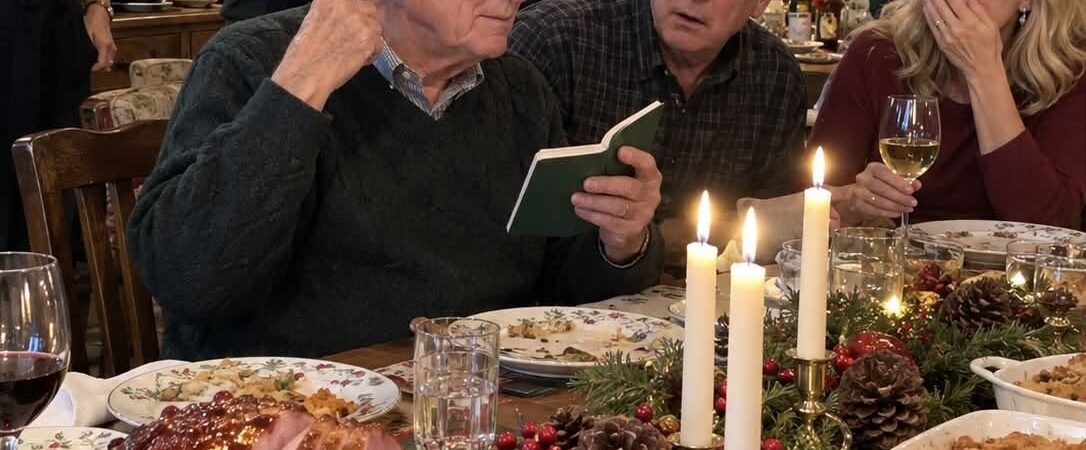
He opened the green notebook.
“I want to read you some things,” he said. “Not to embarrass anybody. You’ve done that well enough on your own.”
He turned a few pages.
“I want to read you the other things I heard,” he said.
He put on his reading glasses. He found a page.
“July fourth, 2023,” he read. “Lacey, on the porch. She said she gets scared at school sometimes and draws so the bad feelings get quieter. She said she wishes she could live out here because nobody tells you what you should be.”
He looked up.
Lacey was crying openly now. Her sketchbook was clutched against her chest.
“Lacey,” Grandpa said gently. “Those drawings you do. The barn. The cats. The cottonwood tree by the creek.”
Lacey nodded.
“Bea saw them,” Grandpa said. “You left your sketchbook on the porch one Easter. She looked through it. She cried. She told me, Henry, that girl sees this place the way we do.”
He took off his glasses.
“There’s a scholarship fund in the will,” he said. “For art school. Anywhere you want to go. It’s in your name. Your parents can’t touch it.”
Lacey made a sound I’ll never forget. Half sob, half laugh.
Across the table, Linda turned to her daughter.
“Lacey,” she said. “What is he talking about?”
Lacey wiped her face.
“I’ve been telling you for three years I want to go to art school,” she said. “You said it was a waste of money.”
She looked at Grandpa.
“He’s the only one who listened,” she said. “And I didn’t even know he could hear me.”
Grandpa turned another page.
“Thanksgiving, 2023,” he read. “Marcy, in the kitchen with Bea. She said, I married into the best family in Gage County. I’d do anything for those two.”
Aunt Marcy put her hand over her heart.
Grandpa turned another page.
“Christmas, 2022. Katie, in the kitchen, washing dishes. She said to Bea, I’ll never leave. Not as long as they need me.”
I didn’t know he’d heard that. I didn’t even remember saying it.
He turned to a page near the back. The handwriting was different. Rounder. Neater.
“This one isn’t mine,” he said quietly. “Bea wrote this one. In September. After she got too weak to come to the table.”
He held up the notebook so we could see the page.
“She asked me to read it at Christmas,” he said. “If she wasn’t here.”
His voice got thick. He cleared his throat twice.
“To Linda,” he read.
Aunt Linda looked up.
“Linda, my firstborn,” Grandpa read. “I know you’ve been saying things about the farm. Your father told me. I’ve heard some of them myself.”
He paused.
“I want you to know that I’m not angry. I’m sad. Because I remember you at six years old, riding on your daddy’s lap on that old 4020 tractor, steering while he worked the pedals. You told everyone at church you were a farmer.”
Linda put her hand over her mouth.
“I don’t know when the farm stopped being home to you,” Grandpa read, “and started being money. Maybe it was when you moved to the city. Maybe it was when life got expensive. Maybe it was my fault for not noticing sooner.”
He turned the page.
“But I want you to know this. You can come home anytime. Not for the land. For your father. He’s going to be so lonely when I’m gone. He’ll never say it. He’ll sit at the end of that table and nod and pretend he can’t hear. But he can. He always could.”
“Talk to him, Linda,” Grandpa read. “Not about him. To him. That’s all I’m asking.”
He closed the notebook.
“Love always,” he said quietly. “Mom.”
Part Ten: Linda
Aunt Linda put her head down on the table and cried.
Not the polite crying she’d done at the funeral. Real crying. Her whole body shaking. Her face pressed against the wine-stained tablecloth.
Gary stood behind her looking helpless. Brett stared at the floor.
Nobody else moved.
After a long time, Linda lifted her head.
Her mascara had run down her cheeks. She looked older than I’d ever seen her. She looked like a woman who had just heard her mother’s voice from the other side.
“Dad,” she said. “I’m so sorry.”
Grandpa looked at her for a long time.
“For what, exactly?” he asked.
It wasn’t cruel. It was a real question.
Linda wiped her face with her napkin.
“For all of it,” she said. “For the things I said. For pricing the land. For not coming when Mom was dying. For saying what I said in the church basement.”
She took a shaky breath.
“For forgetting you were in the room,” she said.
Grandpa nodded slowly.
“That’s the one that hurt,” he said. “Not the money. Not the land. I don’t care about any of that.”
He looked down the table at her.
“You stopped talking to me, Linda,” he said. “Six years. You talked over me. Around me. About me. But you never once talked to me.”
Linda started crying again.
“I thought you couldn’t hear,” she said. “I thought there was no point.”
Grandpa leaned back in his chair.
“Linda,” he said quietly. “Even when I couldn’t hear, I could see your face. I could see whether you looked at me.”
He shook his head.
“You didn’t,” he said.
Brett finally stood up.
He looked shaky and gray. He walked around the long table until he was standing beside Grandpa’s chair. Two feet away. Exactly where he’d been sitting that Easter.
“Grandpa,” he said. “I called you a vegetable.”
“You did,” Grandpa said.
“I said to put you somewhere,” Brett said. “I said to split it.”
“You did,” Grandpa said.
Brett’s voice broke.
“I was drunk,” he said. “I was angry about my loans. I was mad at everybody. I don’t even remember saying it.”
“I remember,” Grandpa said. “It’s on page twenty-three.”
Brett laughed. Then he started crying.
“I’m sorry,” he said. “I’m really sorry.”
Grandpa looked up at his grandson for a long moment.
“You’ve got a hundred and eighteen thousand dollars in student loans,” Grandpa said. “From a school you didn’t finish.”
Brett blinked. “How do you know that?”
“Your mother said it at Thanksgiving,” Grandpa said. “Page forty-one.”
He folded his hands on the table.
“Here’s what I’ll do,” Grandpa said. “Tom needs help this spring. Planting season. Six days a week, dawn to dark, March through May. Hard work. Dirty work. The kind that doesn’t care who your parents are.”
He looked at Brett.
“You work the whole season,” he said, “and I’ll pay you a fair wage. A good one. Enough to make a dent in those loans. But you have to earn every dollar. And you have to show up.”
Brett stared at him.
“You’d do that?” he said. “After what I said?”
“I’m not doing it because of what you said,” Grandpa said. “I’m doing it because I think you’ve never once been proud of yourself. And I think you might be, if you planted a field.”
Part Eleven: After the Dishes
Uncle Gary and Aunt Linda left early that night. Brett went with them. Lacey asked if she could stay at the farmhouse through New Year’s. Grandpa said yes before her mother could answer.
The rest of us cleaned up. Uncle Tom and Mr. Dawson carried dishes to the kitchen. Aunt Marcy scrubbed the wine stain on Grandma’s tablecloth with salt and cold water and muttered that it was ruined. Lacey sat at the kitchen counter and drew.
Mr. Dawson finally ate a plate of ham. He said it was worth the wait.
Later, after everyone had gone home or gone to bed, I found Grandpa on the back porch.
He was sitting in Grandma’s rocking chair, not his own. Wrapped in a quilt she’d made. Looking out at the dark fields covered in snow, lit silver by the moon.
I brought him a cup of decaf. I sat in his rocker beside him.
“You okay, Grandpa?” I asked.
He didn’t answer for a while.
“I’m tired, Katie,” he said finally. “Six years is a long time to pretend.”
“Why did you do it?” I asked. “Really?”
He took a sip of coffee.
“At first,” he said, “I think I wanted to know who loved me. Not the farm. Me. When I was useful, everybody loved me. When I was just an old deaf man at the end of the table, I wanted to see who’d still sit beside me.”
“And?” I asked.
He looked out at the fields.
“Tom did,” he said. “Marcy. Lacey. You.”
He paused.
“And Bea,” he said. “Always Bea.”
“What about Linda?” I asked. “Do you think she’ll change?”
Grandpa thought about it.
“I don’t know,” he said. “I hope so. Bea hoped so. That’s why she wrote the letter.”
He set his cup on the porch railing.
“I’m not trying to punish her, Katie,” he said. “I’m just done pretending I didn’t hear. That’s all.”
He tapped the hearing aid behind his ear.
“Your grandma told me something the day I got these,” he said. “In the car. You were driving. You probably didn’t hear.”
“What did she say?”
He smiled.
“She said, Henry, be careful what you listen for. You’ll find it,” he said.
He looked at me.
“I listened for who loved me,” he said. “And I found them.”
Part Twelve: Spring
Brett showed up on March first at five in the morning.
I’ll admit, none of us thought he would. Uncle Tom had bet Aunt Marcy ten dollars he’d last three days. He showed up in brand-new work boots and a Carhartt jacket with the tags still on it.
The first week was rough. He got the tractor stuck in a wet spot in the north field. He backed the grain truck into a fence post. He fell asleep in the cab at lunch and Tom had to knock on the window to wake him.
But he kept showing up.
By April, his boots weren’t new anymore. His hands had calluses. He’d learned how to calibrate a planter and how to check the moisture of the soil by squeezing a handful of it. He’d started eating lunch with Grandpa on the tailgate of the pickup, every day at noon.
I don’t know what they talked about. Brett never told me.
But one afternoon in May, I drove out to the south parcel with a thermos of coffee. I found them sitting on the tailgate together, looking at forty acres of freshly planted corn. Little green rows coming up through the dark soil.
Brett was talking. Grandpa was listening.
Neither of them was pretending anything.
When planting season ended, Grandpa paid Brett twenty-two thousand dollars. Brett put every cent toward his loans.
Then he asked if he could come back for harvest.
Lacey started at the Kansas City Art Institute in August.
Grandpa drove her down himself. I went along to help. We loaded her dorm room with art supplies and a mini-fridge and a framed photo of Grandma standing in the garden.
Before we left, Lacey gave Grandpa a present wrapped in brown paper.
It was a drawing. A pencil sketch of the farmhouse dining table, with twenty-two chairs around it. In the chair at the head of the table sat an old man in a brown cardigan, with his fork set neatly beside his plate.
He was looking up. Listening.
Part Thirteen: Linda Comes Home
Aunt Linda didn’t come to the farm for a long time after Christmas.
She sent a card on Grandpa’s birthday in March. It said Happy Birthday, Dad and nothing else. He kept it on the kitchen windowsill anyway.
In June, she called. Grandpa answered on the third ring. They talked for four minutes about the weather.
In August, she called again. Twenty minutes. About Lacey and art school.
In October, she came to the farm.
She came alone. No Gary. No wine.
She knocked on the back door like a guest. Grandpa was in the kitchen making coffee. He opened the door and looked at her for a long moment.
“Linda,” he said.
“Hi, Dad,” she said. “Can I come in?”
I was in the living room. I didn’t mean to listen. But the farmhouse is small, and the walls are thin.
They sat at the kitchen table. Grandpa poured her a cup of coffee.
For a while, neither of them said anything.
Then Linda said, “I read Mom’s letter again. Mr. Dawson sent me a copy.”
“I know,” Grandpa said. “I asked him to.”
“I’ve been thinking about the tractor,” Linda said. “The old 4020. Steering while you worked the pedals. I’d forgotten about that until Mom wrote it.”
“You told everyone at church you were a farmer,” Grandpa said.
Linda laughed. It was a wet, shaky laugh.
“I did,” she said. “I really thought I was.”
“What happened?” Grandpa asked.
It was quiet for a long time.
“I got embarrassed,” Linda said finally. “When I went to college in Lincoln. Everyone there was from the city. Their parents were doctors and lawyers. They laughed about farm kids. So I stopped telling people where I came from.”
She took a breath.
“And then I married Gary, and he cared about money more than anything, and I started caring about it too. And somewhere along the way, I started seeing this place the way he did. As something worth money. Not as home.”
“I’m sorry, Dad,” she said. “I’ve said it before. But I don’t think I knew what I was apologizing for until now.”
“What are you apologizing for now?” Grandpa asked.
Linda was quiet for a moment.
“For talking about you,” she said. “Instead of to you.”
I heard a chair scrape. Then I heard my grandfather’s voice, softer than I’d heard it in a long time.
“That’s all your mother wanted, honey,” he said.
And then I heard my aunt crying. And I heard my grandfather say, “Come here,” and I didn’t listen anymore. I went out to the porch and gave them the kitchen.
Part Fourteen: The Next Christmas
This Christmas, there were twenty-four people at the farmhouse.
Brett brought his girlfriend again, and she brought a pie that was almost as good as Grandma’s. Lacey came home from art school with a portfolio and a nose ring that made Aunt Marcy gasp and then say it was actually kind of nice. Uncle Tom carved the ham. Mr. Dawson came, and this time he came inside.
Gary came too. He was quieter than usual. He didn’t take out his phone once.
Grandpa sat at the head of the table in his brown cardigan with the leather buttons.
He didn’t pretend anymore. When somebody talked to him, he answered. When somebody made a joke, he laughed. When Lacey showed him pictures from her art class, he asked questions about every one.
People talked to him now. Not around him. To him.
Halfway through dinner, Aunt Linda stood up.
She tapped her water glass with a spoon. The table went quiet.
“I want to say something,” she said. “It’s short.”
She turned toward the head of the table. Toward Grandpa.
She looked him right in the eye.
“Dad,” she said. “I love you. Not the farm. You.”
She paused. Her voice wavered, but she kept going.
“I’m talking to you,” she said. “Not about you. I want everyone to know that.”
She raised her glass.
“To Dad,” she said.
Twenty-four people raised their glasses.
“To Dad,” they said. “To Grandpa. To Henry.”
Grandpa didn’t say anything for a moment. His eyes were shining.
Then he raised his own glass.
“To Bea,” he said quietly.
“To Bea,” we all said.
After dinner, Grandpa asked me to help him with something in the living room.
He took the green notebook out of his cardigan pocket. The cover was even softer now. The pages were full.
He opened it to the last page. There was one blank line left at the bottom.
He handed me a pen.
“You write this one, Katie,” he said.
“What should I write?”
He looked through the doorway into the dining room. At Linda helping Aunt Marcy clear plates. At Brett showing Uncle Tom something on his phone, a photo of the corn they’d planted together. At Lacey sketching the Christmas tree in the corner.
At twenty-four people who were all, for once, actually talking to each other.
“Write the date,” he said. “And then write: Christmas. Everybody talked to each other. Nobody said anything I wouldn’t want to hear.”
I wrote it.
He closed the notebook and held it for a long moment. Then he handed it to me.
“Keep it,” he said. “I don’t need it anymore.”
“Grandpa,” I said. “Why not?”
He reached up and tapped the little device behind his ear.
“Because I’m done listening for who loves me,” he said. “I know now.”
He smiled.
“From here on out,” he said, “I’m just going to enjoy hearing them.”