Then, before I pulled out of the driveway, I texted my brothers.
Mom’s tank is full. Next October, send the propane money to me. I’ll explain at Easter.
Dean called inside a minute. He lives in Fargo and manages a farm equipment dealership.
“Julie? What’s going on? Is Mom okay?”
“Mom’s okay. She’s warm now.”
“What do you mean, now?”
“I’ll tell you everything at Easter, Dean. Face to face. I promise.”
“Is this about Pam?”
I didn’t answer right away.
“Mom’s warm,” I said. “That’s what matters today.”
Rob was out feeding cows on his ranch near Mandan. He called that night, after dark, when he finally came in out of the cold.
“Got your text,” he said in his slow, deep voice. Rob talks like Dad. “Mom all right?”
“She’s all right now, Rob.”
He was quiet for a while. I could hear his TV in the background and his wife Shirley asking who it was.
“Pam?” he asked.
“At Easter. Face to face.”
“Okay.” He was quiet again. “Julie. Thanks for going out there.” Pam called on Thursday, the day after I got back to Bismarck.
I was at my desk at the credit union, reviewing a car loan application, when my phone lit up with her name. I stepped into the break room and closed the door.
“Hi, Pam.”
“The co-op called me.” Her voice was tight and fast. “They said the tank’s been moved off my account. Into your name. Without telling me.”
“Yes.”
“You went behind my back.”
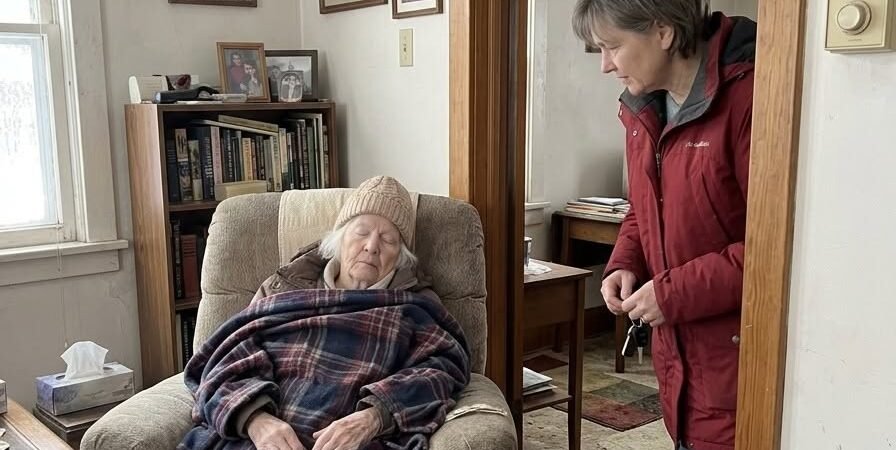
“I went to the co-op,” I said. “Mom’s tank was at five percent, Pam. It was thirty-one below. She was sleeping in her coat. The thermostat was at fifty-eight. There was frost on the inside of the windows.”
Silence on the line.
“I didn’t know it was that low,” Pam said finally. Her voice had changed.
“The October delivery was two hundred gallons, Pam. Not four hundred. There was no top-off.”
“I was going to get one.” Her voice cracked. “I was going to, Julie. After Christmas. Things have just been so…”
“I know about Mark. I know about the checks from Mom.”
There was a sharp intake of breath.
“She told you about the checks?”
“I saw them on her bank statement.”
“You went through her bank statements?” Pam’s voice went high and shrill. “Who do you think you are? You drive out from Bismarck one time and suddenly you’re in charge of everything? I’m the one who’s here, Julie! I’m the one who drives her to the doctor and the bank and church. I’m the one who goes out there every week. Where are you? Where are Rob and Dean? A hundred and twenty miles away!”
“Pam…”
“You don’t know what it’s been like! You don’t know anything!”
She hung up.
I stood in the break room holding my phone, my heart pounding.
The worst part was that she wasn’t entirely wrong. Pam was the one who lived close. For four years she’d been the one driving Mom to appointments, picking up her prescriptions at the drugstore in Harvey, sitting with her through the long first winter after Dad died. Rob, Dean, and I sent our money and made our Monday phone calls and came home for holidays. Pam did the rest.
But none of that meant Mom should freeze.
We didn’t speak for eleven weeks. The following Tuesday, I took another personal day and drove Mom to Mr. Ostrander’s office in Harvey.
Mr. Ostrander has been our family’s lawyer for thirty years. He’s in his seventies now, a thin, stooped man with a white mustache and a cardigan with leather elbow patches. His office is above the hardware store on Main Street, up a narrow flight of creaky stairs.
He listened to everything. The propane, the coat, the frost on the windows. Then I showed him the bank statements.
He studied the four checks for a long time.
“Arlene,” he said gently, “these are your checks. Your handwriting. Did anyone pressure you to write them?”
“No,” Mom said firmly. “Pam never asked me for a dime. I offered. Mark can’t work, and I wanted to help.”
“That’s your right. It’s your money, and you can give it to whoever you choose.” He took off his reading glasses. “But I’ll tell you what worries me. You gave away five thousand six hundred dollars, and then you sat in a cold house because you thought you couldn’t afford to heat it. That tells me nobody was looking at the whole picture. Not you, not Pam, not anybody.”
Mom looked down at her lap.
“So here’s what I’d suggest,” Mr. Ostrander said. “First, let’s get you a durable power of attorney for your finances, and a health care directive. You pick who you want. That person would be able to act for you if you ever couldn’t act for yourself. Right now nobody can.”
“What about Pam being on my bank account?”
“Being a joint owner on your checking account is not the same as a power of attorney,” he explained. “When someone is a joint owner, the money in that account legally belongs to both of you. And when you pass, it generally goes straight to the joint owner, not through your trust or your will. Walt set up your trust so all four children would share equally. If Pam stays on the account, whatever’s in it when you die would likely go to her alone.”
Mom’s eyes went wide. “I didn’t know that.”
“Most people don’t,” Mr. Ostrander said. “It’s very common, and it causes a lot of hard feelings in families. Walt wouldn’t have wanted that.”
“No,” Mom said softly. “He wouldn’t.”
She sat quietly for a long time. Then she said, “I want Julie and Rob on the power of attorney. Together. Both of them have to agree on things. And I want Pam off the checking account.” She paused. “But I want her to be able to see my statements. I don’t want her to think I’m hiding anything from her.”
Mr. Ostrander nodded. “We can have the bank set Pam up with view-only online access, so she can see the account without being an owner. And Julie and Rob can be your agents under the power of attorney. That’s a good plan, Arlene.”
Mom signed the durable power of attorney and her health care directive that afternoon, in front of Mr. Ostrander and a notary from the bank downstairs. Rob drove over from Mandan the next week to sign his acceptance as co-agent.
On the way home, Mom looked out the window at the snow-covered fields.
“I want you to tell Pam yourself,” she said. “About the bank account. I don’t want her finding out from the bank.”
“I’ll tell her at Easter, Mom.”
“She’s going to be hurt.”
“I know.”
Mom sighed. “Your father always said the hardest thing about raising four children was that they never stopped being four different children.” Those eleven weeks were long.
I called Mom every evening instead of every Monday. She told me about the cats, the weather, the church ladies’ quilting group, and a cardinal that had started coming to the feeder outside the kitchen window. Every time, before we hung up, I asked her the same question.
“What does the thermostat say, Mom?”
“Seventy,” she’d say. And then, a little sheepishly, “Sixty-eight at night.”
In late February the co-op’s monitor reported the tank at thirty percent, and a truck came out and filled it without anybody calling. Bev phoned me afterward to let me know.
“Kyle filled her up this morning,” she said. “Three hundred and forty gallons. Your mom came out on the porch in a sweater and brought him a plate of cookies.”
I laughed for the first time in weeks.
The charge was $711. It went on my Visa. I didn’t mind.
I didn’t hear from Pam. Not a call, not a text, not a card. When I asked Mom about her, she’d say, “She’s been out a few times. She doesn’t talk about you. She’s just tired, honey.”
Through Rob’s wife Shirley, who keeps in touch with everyone, I heard more. Mark’s back surgery had been more complicated than they expected. He’d been approved for short-term disability through his employer, but it only paid sixty percent of his wages and ran out after twelve weeks. His long-term disability claim had been denied the first time. They’d gotten a bill from Trinity Hospital for $18,400 after insurance, for their share of the surgery and the hospital stay. And they were two months behind on their mortgage.
Shirley said Pam had picked up extra shifts at the nursing home where she works as a CNA. She was working sixty hours a week.
“She’s drowning, Julie,” Shirley said on the phone. “She’s not a bad person. She’s just drowning, and she’s too proud to say so.”
I sat with that a long time.
At work, I’d seen hundreds of families like Pam’s. Good, hardworking people who get hit with one medical emergency and watch everything slide out from under them. The hospital bill comes, then the late mortgage notice, then the credit card balances climb. They stop opening the mail because every envelope is bad news.
I’d also seen what happens when they’re too ashamed to ask for help.
I thought about my sister ordering two hundred gallons of propane instead of four hundred, and maybe using the rest of our money to keep her lights on. I thought about my mother writing $1,400 checks so her daughter wouldn’t lose her house, then turning the thermostat down so she wouldn’t run out of propane.
Two people I loved, each trying to protect the other, and nobody telling the truth.
And me, a hundred and twenty miles away, sending my $250 every October and feeling like I’d done my part. Easter came in the middle of April, cold and gray, with old snow still in the ditches and the first geese coming back over the fields.
We all came home to the farm the way we always do.
Steve and I drove out from Bismarck on Saturday afternoon. Rob and Shirley came from Mandan. Dean came from Fargo with his teenage son, Tanner. By Sunday morning, the old farmhouse was full and warm, the thermostat at seventy, the kitchen windows steamed up from the cooking.
Mom had the ham in the oven by eight. Her kuchen, the German custard pie her mother taught her to make, peach and prune, sat cooling on the counter beside a plate of cinnamon rolls. The house smelled like cloves and brown sugar and coffee.
Rob and Dean sat at the kitchen table with their coffee, the way they’ve sat at that table since they were boys. Steve and Shirley were in the living room with Tanner, watching a basketball game.
Mom sat in her chair by the window, where the light was best for her crossword puzzle.
No coat. No hat. Just a lavender cardigan and her reading glasses.
I’d told Rob and Dean everything the night before, out in the machine shed where Mom couldn’t hear. The propane. The coat. The frost on the windows. The checks. Mr. Ostrander. The power of attorney.
Dean had gone pale. Rob had stood there in the cold shed for a long time without saying anything. Then he’d kicked an empty oil can across the concrete floor so hard it dented.
“She was sleeping in her coat,” he said. “In Dad’s chair.”
“Yes.”
“Thirty below.”
“Yes.”
“Why didn’t she call one of us?”
“Because she didn’t want Pam to get in trouble.”
Rob put his hand over his face.
“Dad told us,” he said through his fingers. “The last thing he told us. Don’t let her get cold out there.”
“I know, Rob.”
We stood in the shed a long time. Then Dean said quietly, “Is Pam coming tomorrow?”
“Mom says she is.”
“What are we going to say to her?”
I’d been thinking about that for eleven weeks. I still didn’t have an answer. Pam came in last.
Her car pulled into the yard at eleven-thirty, half an hour after everyone else. I watched through the kitchen window as she got out. She was alone. Mark had stayed home, and the kids were with his parents.
She looked thinner than at Christmas. Her coat hung loose on her shoulders, and there were dark circles under her eyes. Her hair, which she’d always kept so nice, was pulled back in a plain ponytail.
She came in through the kitchen door, stamping snow off her boots on the rug.
“Happy Easter,” she said quietly, to nobody in particular.
“Happy Easter, honey,” Mom said from her chair.
Rob and Dean looked up from their coffee. Nobody else said anything.
She wasn’t empty-handed. She was carrying a large brown accordion file, the kind with an elastic band around it, thick and bulging. And on top of it, a white envelope.
She walked to the kitchen table and set them down in front of all of us.
The kitchen went quiet. Even the basketball game in the living room seemed to fade. Steve, Shirley, and Tanner had stopped talking. I could hear the clock on the wall again, ticking.
Rob put his cup down.
Pam looked at Mom, then at me, and took a breath.
“I need to tell you all something,” she said. “And I need you to let me get through it.”
Nobody moved.
She opened the white envelope first. Inside were four cashier’s checks from Harvey State Bank. She laid them on the table one by one, the way you’d deal cards.