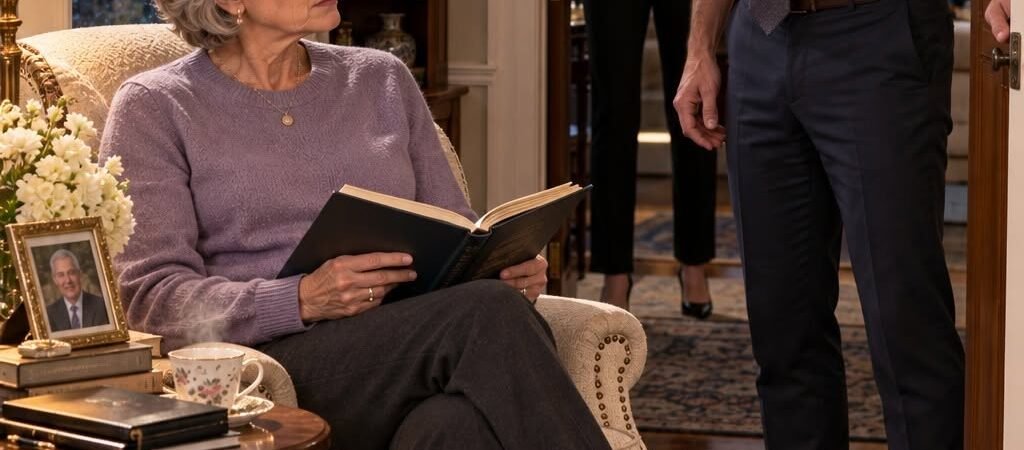
At nine the following morning, my attorney arrived carrying a brown leather briefcase.
His name was Arthur Bennett.
He had been my lawyer for almost twenty years, long enough to remember when Northstar Freight Solutions was still operating from a rented warehouse with twelve employees and a secondhand delivery truck.
He had helped negotiate the company’s sale.
He had reviewed my estate plan after my husband died.
And he knew exactly how much I disliked unnecessary drama.
Which was why his first question surprised me.
“Ruth, are you absolutely certain you want them present for this conversation?”
I looked toward the kitchen.
Travis and Melanie were waiting there.
Melanie had dressed carefully.
Pearl earrings.
A pale blue blouse.
A pleasant expression that looked almost painful to maintain.
“Yes,” I said.
Arthur studied me.
“Then let’s make sure we keep the conversation factual.”
I nodded.
“That is exactly what I want.”
We entered the kitchen together.
Travis stood immediately.
“Mr. Bennett.”
Arthur shook his hand.
“Good morning, Travis.”
Melanie smiled.
“It’s so nice to meet you.”
Arthur nodded politely.
“Mrs. Collins.”
She gestured toward the table.
“Please, sit.”
I almost smiled.
Yesterday, she’d ordered me out of this very kitchen.
Today, she was behaving like the gracious hostess of a house she didn’t own.
Arthur placed his briefcase on the table.
I sat in my usual chair.
Travis and Melanie sat opposite us.
For several seconds, nobody spoke.
Then Arthur opened a folder.
“Ruth has asked me to clarify the ownership and occupancy arrangements concerning this property.”
Melanie smiled.
“Of course.”
He placed a copy of the deed on the table.
“The property is titled solely in Ruth’s name.”
Travis nodded.
“I understand.”
Arthur continued.
“Ruth has also instructed me to prepare the appropriate written notice ending the current living arrangement, subject to the legal requirements that apply.”
Melanie’s smile disappeared.
“Ending?”
I looked at her.
“Yes.”
She turned toward Travis.
He stared at the table.
Arthur continued.
“Any occupancy rights will be respected. There will be no unlawful lockout or interruption of essential services. But Ruth does not intend to continue providing indefinite housing and financial support.”
Melanie folded her arms.
“This is because of one argument?”
I looked at her.
“No.”
She stared.
“This is because of two years of disrespect.”
Her cheeks reddened.
“And because of something else.”
Arthur removed another document.
Melanie’s expression changed.
I watched carefully.
He placed a printed email on the table.
“Three months ago, my office received an inquiry from a private elder-law consulting service.”
Travis frowned.
“What kind of inquiry?”
Arthur looked at him.
“The service asked whether Ruth had previously executed documents authorizing another person to manage her property or financial affairs.”
My son stared.
Melanie’s face went pale.
I took a breath.
“The inquiry specifically asked about powers of attorney and potential guardianship procedures.”
Travis turned toward his wife.
“Melanie?”
She looked down.
Arthur continued.
“The person who contacted the service was identified as Melanie Collins.”
Silence.
Travis stared at her.
“Melanie, what is he talking about?”
She swallowed.
“It wasn’t like that.”
I looked at her.
“Then tell us what it was.”
She shifted.
“I was worried about Ruth.”
I waited.
“She’d been acting secretive.”
I nodded.
“Secretive because I wouldn’t give you access to my bank statements?”
She looked away.
Arthur spoke calmly.
“Seeking information about legal procedures is not itself wrongdoing. But it is important to distinguish a legitimate concern about someone’s capacity from an effort to gain control of that person’s assets.”
Melanie’s face reddened.
“I never tried to take anything.”
Arthur placed another page on the table.
“This is a copy of a questionnaire submitted to the consulting service.”
Melanie stared.
He continued.
“The questionnaire asked whether a court-appointed guardian could manage real estate and investment accounts.”
Travis looked at his wife.
“Investment accounts?”
She said nothing.
He turned toward me.
“Mom, I didn’t know about this.”
I studied him.
“Didn’t you?”
His face tightened.
“I knew Melanie was worried about you.”
I nodded.
“And?”
He swallowed.
“She said we should talk to someone.”
I looked at him.
“Did you ask me whether I needed help?”
He lowered his eyes.
“No.”
“Did you ask whether I was having trouble paying bills?”
“No.”
“Did you ask whether I was confused about my finances?”
He whispered, “No.”
I took a breath.
“Then what exactly were you worried about?”
He looked toward Melanie.
She stared at the table.
Finally, he whispered, “That you were keeping things from us.”
I nodded slowly.
“Things like my own money.”
He closed his eyes.
Melanie suddenly leaned forward.
“Ruth, you can’t blame us for being concerned.”
I looked at her.
“Concerned about what?”
She hesitated.
“You’re seventy.”
“Yes.”
“You live alone in your head half the time.”
I stared.
“You don’t tell us anything.”
I nodded.
“That’s called privacy.”
She threw up her hands.
“You’re making it sound sinister.”
I looked at Arthur.
He waited.
Then I turned back toward her.
“Melanie, why did you ask whether someone could manage my investments?”
She swallowed.
“I was trying to understand our options.”
I held her gaze.
“Our options?”
She looked toward Travis.
He said nothing.
I continued.
“Were you planning to ask me whether I wanted assistance?”
She hesitated.
Then whispered, “Eventually.”
I nodded.
“After finding out whether you could obtain control without my agreement?”
Her face reddened.
“That isn’t fair.”
I looked at her.
“Neither was threatening to put me in a facility because I wouldn’t surrender my Social Security check.”
She looked away.
The room became quiet.
Arthur closed the folder.
“Ruth’s estate documents have been reviewed. Her decisions remain her own. Any future legal challenge would require proper evidence and process, not assumptions based on age or financial privacy.”
Travis rubbed his forehead.
“Mom, I swear I didn’t know how far Melanie had gone.”
I looked at him.
“Travis, you heard her threaten me.”
His eyes filled.
“And you said nothing.”
He lowered his head.
I continued.
“You watched her insult me.”
Tears slipped down his cheeks.
“You allowed her to speak as though I had no right to live in my own home.”
He covered his face.
I swallowed.
“That was enough.”
Melanie stood abruptly.
“So that’s it?”
I looked up.
“What?”
“You’re throwing us out because we hurt your feelings?”
I remained seated.
“No.”
My voice was steady.
“I’m ending an arrangement in which I pay for almost everything while being treated as though I contribute nothing.”
She laughed bitterly.
“And what are we supposed to do?”
I looked at her.
“You’re adults.”
She stared.
“You have incomes.”
Silence.
“You have choices.”
Her face reddened.
“And you have time to make appropriate housing arrangements under the notice and process Arthur will explain.”
Travis looked up.
“Mom, please.”
I turned toward him.
He was crying.
“Can we work something out?”
I studied his face.
There was a time when tears would have changed my answer.
When I would have immediately tried to make everything better.
But I had spent two years making things better for people who never asked whether I was all right.
“Travis,” I said gently, “you and Melanie need to learn how to manage your own lives.”
He swallowed.
“I know.”
I nodded.
“Then this is where you begin.”
The weeks that followed were unpleasant.
Melanie accused me of turning the family against her.
She told friends I had become controlling.
She complained that I was humiliating her.
Some people believed her.
Others asked questions.
I didn’t chase anyone down to defend myself.
Arthur handled the formal property matters.
My financial adviser, Elaine Foster, helped me review every recurring payment and authorization associated with my accounts.
I made sure essential household services remained safe and available while Travis and Melanie completed their move.
But I no longer funded their personal spending.
No designer purchases.
No vacations.
No credit-card payments.
No luxury subscriptions.
No emergency transfers disguised as temporary loans.
For the first time in years, every dollar leaving my accounts had a purpose I had chosen.
Melanie hated it.
Travis struggled.
And I discovered something surprising.
The world didn’t end.
Their lives became less comfortable.
Mine became more peaceful.
They eventually found a rental townhouse twenty minutes away.
It wasn’t luxurious.
It had a small kitchen, a narrow driveway, and a backyard barely large enough for a patio table.
But it was within their budget.
On moving day, Travis carried the last box to his car.
I stood on the porch.
Seattle rain drifted through the afternoon air.
He looked toward the house.
Then back at me.
“Mom?”
“Yes?”
“Did you really sell your company for ninety million?”
I smiled faintly.
“Yes.”
He shook his head.
“I still can’t believe it.”
I nodded.
“I know.”
He hesitated.
“Why didn’t you ever tell me?”
I thought about the years.
The tuition.
The emergency loans.
The credit-card balances.
The quiet transfers.
The times I’d helped him without asking for anything in return.
Then I answered.
“Because I wanted you to understand that my value wasn’t connected to how much money I had.”
His eyes filled.
“I know that now.”
I studied him.
“Do you?”
He nodded.
Then whispered, “I’m starting to.”
I stepped closer.
“Travis, when your father died, I was lonely.”
His expression changed.
I continued.
“When you asked to move in, I thought having family around would make the house feel alive again.”
He looked down.
“For a while, it did.”
My throat tightened.
“Then I started feeling like a guest in the home I’d spent my life building.”
Tears slipped down his cheeks.
“Mom, I’m sorry.”
I nodded.
“Thank you.”
He swallowed.
“Can you forgive me?”
I took a breath.
“I hope I can.”
His face crumpled.
“But trust takes time.”
He nodded.
“I understand.”
I looked at him.
“And forgiveness doesn’t mean moving back in.”
He gave a small, sad smile.
“I know.”
For the first time, I believed he might.
Not because he was crying.
But because he didn’t argue.
He didn’t ask for another check.
Didn’t ask me to reconsider.
Didn’t tell me Melanie was stressed.
He simply stood there and accepted what I’d said.
Then he hugged me.
I held him for a moment.
He was still my son.
The boy who’d once fallen asleep against Thomas’s shoulder.
The teenager who’d broken his arm playing basketball.
The young man who’d cried at his father’s funeral.
I loved him.
But loving him no longer meant financing every mistake or absorbing every insult.
When he drove away, I remained on the porch.
The driveway was empty.
The house was quiet.
And for the first time in two years, I felt as though I could breathe.
That autumn, I made several changes.
I updated my estate plan.
Reviewed my financial arrangements.
And established clear instructions for the management of my assets if I ever genuinely needed assistance.
Arthur helped me select independent professionals for roles that required financial oversight.
I wanted decisions about my future to be made according to my wishes.
Not according to whoever happened to believe they deserved my money.
I also created a charitable foundation.
Not because I wanted public attention.
I didn’t.
But because I’d spent decades building a company that connected businesses across borders.
I wanted part of what I’d earned to help people build stable lives of their own.
The foundation supported vocational training, transportation access, and education for people entering logistics and skilled trades.
We funded scholarships.
Provided equipment grants.
And partnered with organizations that helped older adults recognize financial exploitation.
That last program mattered to me more than I expected.
At the first workshop, I sat quietly in the back.
A woman in her late sixties stood and asked a question.
“What if the person taking advantage of you is your own child?”
The room became silent.
I looked at her.
She was clutching a tissue.
Her hands trembled.
I recognized the expression on her face.
Love.
Fear.
Shame.
And the terrible confusion of feeling guilty for wanting to protect yourself.
After the session, I approached her.
“My name is Ruth.”
She smiled weakly.
“I’m Carol.”
I nodded.
“Would you like to sit for a moment?”
She began crying.
We sat together near the window.
She told me her son had been pressuring her to sign documents she didn’t understand.
She didn’t know how to say no.
I listened.
Then said gently, “You don’t have to sign anything today.”
Her eyes filled.
“And you don’t have to make decisions about your property without independent advice.”
She nodded slowly.
I continued.
“Being a parent doesn’t mean giving up the right to protect yourself.”
She began crying harder.
I held her hand.
And in that moment, I realized something important.
The years I’d spent building my company had taught me how to recognize risk in contracts and financial systems.
But the experience with Travis and Melanie had taught me how easily emotional pressure could make even a careful person ignore warning signs.
I couldn’t undo the past.
But I could use what I’d learned.
Winter arrived.
The rain turned colder.
The house settled into its familiar quiet.
I began inviting friends over again.
My neighbor, Joan, came for tea every Thursday.
My former business partner, David, visited when he was in Seattle.
And I started taking long walks beside Lake Washington, sometimes carrying the black leather notebook that had helped me see the truth.
I no longer used it to count what I’d given Travis.
I had already learned that lesson.
Instead, I began writing down things I wanted to do.
Visit the coast.
Take a painting class.
Spend more time with friends.
Travel without feeling obligated to bring gifts.
And finally learn to make the lemon cake Thomas had loved.
Small things.
Ordinary things.
Things I’d postponed while managing everyone else’s emergencies.
One afternoon, Travis called.
“Mom?”
“Hello, sweetheart.”
He hesitated.
“Would you like to have lunch sometime?”
I smiled.
“Of course.”
He took a breath.
“Just us.”
I nodded.
“That sounds nice.”
We met at a small restaurant overlooking the water.
He arrived early.
When I walked in, he stood.
“Hi, Mom.”
I smiled.
“Hello, Travis.”
He looked different.
Not dramatically.
But there was something quieter about him.
He wasn’t wearing the expensive watch I’d helped him buy.
He wasn’t complaining about money.
And when the waitress brought the menus, he didn’t immediately look toward me.
We ordered.
Talked about the weather.
His work.
The house.
Then he set down his fork.
“Mom, I need to tell you something.”
I looked at him.
“Yes?”
He swallowed.
“Melanie and I are seeing a counselor.”
I nodded.
“I’m glad.”
He stared at his hands.
“She doesn’t like talking about what happened.”
I waited.
“But I’m learning that I can’t keep avoiding conflict just because I’m afraid someone will get angry.”
My throat tightened.
He looked up.
“I did that with you.”
I nodded.
“Yes.”
He continued.
“I let her say things I knew were wrong.”
Tears gathered in his eyes.
“And I told myself staying quiet would keep the peace.”
I looked at him.
“Whose peace?”
He closed his eyes.
Then whispered, “Mine.”
I felt tears gathering.
He nodded.
“I know.”
For several seconds, neither spoke.
Then he said, “I’m sorry, Mom.”
I took a breath.
“Thank you.”
He looked at me.
“Not because you have money.”
I smiled sadly.
“I know.”
“Not because of the house.”
I nodded.
“Because you deserved better from me.”
My eyes filled.
For the first time, his apology didn’t sound like a request.
He wasn’t asking me to fix anything.
He wasn’t trying to get something back.
He was simply acknowledging what he’d done.
That mattered.
When lunch ended, the waitress brought the bill.
I reached for my purse out of habit.
Travis gently stopped me.
“Mom.”
I looked up.
He smiled.
“I’ve got this.”
I hesitated.
Then slowly put my purse away.
“Thank you.”
He paid.
It wasn’t a grand gesture.
The meal cost less than sixty dollars.
But for the first time in years, my son had invited me somewhere without expecting me to cover the expense.
I smiled all the way home.
Not because sixty dollars mattered.
But because the choice did.
That Christmas, I decorated the house myself.
I hung the wreath Thomas and I had bought years earlier.
Placed candles in the windows.
And set our old wooden nativity scene on the mantel.
I invited Joan, David, and a few friends for dinner.
Travis called to ask whether he could visit on Christmas Eve.
I said yes.
He arrived alone.
Carrying a small wrapped package.
We sat in the living room beside the tree.
He handed it to me.
“Merry Christmas, Mom.”
I smiled.
“Merry Christmas.”
Inside was a framed photograph.
Thomas and me.
Standing in front of the first Northstar Freight Solutions warehouse.
I was thirty-four.
Thomas had his arm around my shoulders.
Behind us stood the company’s first delivery truck.
Its paint was faded.
The sign above the warehouse was crooked.
And we were smiling as though we owned the world.
I stared at the photograph.
“Where did you find this?”
Travis smiled.
“Dad kept it in an old box.”
My throat tightened.
“I remember that day.”
He nodded.
“You’d just signed your first major contract.”
I laughed softly.
“Yes.”
He looked at me.
“Dad used to tell me how hard you worked.”
Tears slipped down my cheeks.
I touched the frame.
“He worked hard too.”
Travis nodded.
“I know.”
For several seconds, we sat quietly.
Then he said, “Mom, I used to think you were just lucky.”
I looked at him.
He continued.
“I thought the company happened because things worked out.”
I smiled faintly.
“They didn’t always.”
He nodded.
“I know that now.”
His eyes filled.
“I wish I’d paid more attention.”
I reached for his hand.
“You can start now.”
He squeezed my fingers.
And for the first time in a long while, I felt hope.
Not that everything would return to the way it had been.
I didn’t want that.
But that we might build a relationship in which love wasn’t measured by what I paid for.
After Travis left, I placed the photograph beside Thomas’s favorite chair.
I stood looking at it for a long time.
The younger version of me stared back.
A woman who’d built a company from nothing.
Who’d negotiated contracts across continents.
Who’d raised a son.
Who’d loved her husband.
Who’d survived his death.
And who’d somehow allowed two people to convince her that she was a burden.
I shook my head gently.
“Not anymore,” I whispered.
Then I opened the black leather notebook.
For years, it had contained numbers.
Payments.
Loans.
Expenses.
Transfers.
A record of everything I’d given.
I turned to a fresh page.
At the top, I wrote:
THINGS MONEY CANNOT BUY.
Then I began.
Respect.
Peace.
Honesty.
Trust.
A home where I feel safe.
A relationship where I am valued.
And the freedom to say no.
I stared at the list.
Then smiled.
Ninety million dollars.
That was the number Melanie had found impossible to believe.
The number that had transformed her anger into calculation.
The number Travis had repeated in disbelief.
But sitting in my quiet living room, I realized it wasn’t the most important number in my life.
Not even close.
The most important number was one.
One life.
Mine.
One home where I could finally feel comfortable.
One future I still had the right to shape.
And one decision that had changed everything.
The decision to stop paying for my own mistreatment.
I closed the notebook.
Turned off the lamp.
And looked toward the rain-streaked windows.
Seattle was quiet beneath the winter sky.
The house was warm.
The doors were secure.
And every room felt like mine again.
I thought about the morning Melanie had called me garbage.
About Travis hiding behind his newspaper.
About the way I’d sat silently with my cold coffee.
For a moment, I’d felt invisible.
Small.
Unwanted.
But I hadn’t been powerless.
I’d simply forgotten that I was allowed to use the power I already had.
I looked toward Thomas’s photograph.
Then whispered, “I finally did it.”
In my mind, I could almost hear his voice.
I know you did, Ruth.
I smiled.
And for the first time since his death, the silence in our house didn’t feel like something missing.
It felt like something returned.
Peace.
The kind we’d spent a lifetime building.
The kind no amount of money could purchase if I kept allowing other people to take it away.
And the kind I would never again surrender just to keep someone else comfortable.