“We have a routine, Mom,” my son said. “The kids have school. Ashley works from home. It just wouldn’t work right now.”
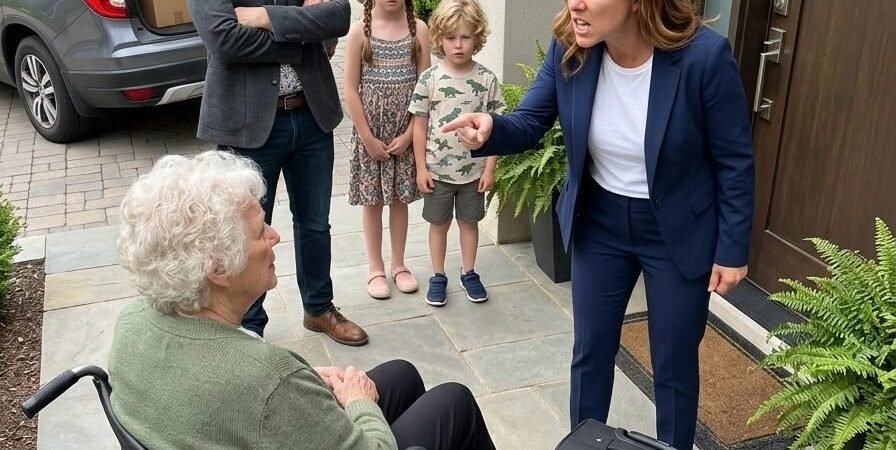
I was sitting in my wheelchair at the bottom of his driveway on a Sunday afternoon in October. It had taken me two buses and forty minutes to get there. My back ached. My hands were raw from pushing the wheels up the slope of his street in the Florida heat.
Michael stood at the top of the driveway with his arms crossed. Behind him, his big two-story house sat on the cul-de-sac with its matching mailbox and its perfect green lawn. Four bedrooms. Three bathrooms. A three-car garage.
His wife, Ashley, stood in the open front doorway in white linen pants, with her arms folded too.
“Michael,” I said. “I’m not asking for much. I just need somewhere safe to sleep. Just for a little while. I can’t get up the stairs in my apartment anymore. I fell in the bathroom twice last month.”
“Mom, that’s exactly why you need real help,” Michael said. “Professional help. There are places for this. Assisted living. Programs. People who handle this kind of thing.”
“The guest room’s being worked on,” Ashley said from the doorway. “We’re having it redone.”
I looked past her into the front hallway. I could see two pairs of children’s sneakers by the door. And two little faces peeking around the corner of the hall, then disappearing.
My grandchildren. Ethan and Lily.
“Please,” I said.
Michael walked down the driveway toward me. For one second, I thought he was going to hug me.
Instead, he put both hands on the handles of my wheelchair. And he turned me around. And he pushed me backward, down the slope of his driveway, to the sidewalk.
“Call me when you’ve looked at some of those places, Mom,” he said. “Ashley can send you some links.”
Then he walked back up the driveway and went inside. Ashley closed the front door.
I sat there on the sidewalk for a long time.
I had $237 in my checking account. My prescription refill was due Wednesday. The copay was $84.
My name is Helen Carter. I’m seventy-two years old. My husband, Robert, had been gone twenty-two months.
And that night, back in my apartment, unable to climb the stairs to my own bed, I slept on the couch. Again.
It was three in the morning when I remembered the card.
Robert gave it to me about a year before he died. A plain white business card with a phone number and an address in downtown St. Petersburg. Pinnacle Private Banking.
On the back, in his handwriting, he’d written three words.
Emergency access only.
“What is this?” I’d asked him.
“Just in case,” he said. He kissed my forehead. “If you ever really need something, Helen, and I’m not here, you go there. Promise me.”
I promised. And then I put the card in my jewelry box and forgot all about it.
Robert repaired air conditioners for forty-one years. He drove the same old white Ford truck for nineteen of them. He came home every night with grease under his fingernails and told me we had enough.
I didn’t think there was anything at Pinnacle Private Banking but maybe a small savings account.
But I was out of options.
The next morning, I put on my good navy blouse. I called a cab I couldn’t afford. And I rolled myself into a marble lobby on Central Avenue with the card in my lap.
A young woman at the front desk looked at the card. Then she looked at me in my wheelchair. Then she picked up her phone.
Two minutes later, a gray-haired man in a dark suit came down the hall. He took one look at the handwriting on the back of that card, and his face softened.
“Mrs. Carter,” he said. “We’ve been waiting for you. Please. Come into my office.”
He held the door. When I rolled inside, he reached behind him and closed it.
Then he turned his computer monitor toward me.
On the screen was a photograph of Robert. Standing outside an industrial warehouse. Smiling that crooked smile he always got when somebody surprised him with a camera.
Underneath his picture was a company name.
Carter Industrial Holdings.
And underneath that was a number.
$8,746,319.42.
I stared at it.
Then I looked at the man.
“I think you’ve made a mistake,” I said.
He pulled a chair closer and sat down beside me.
“My name is Daniel Whitmore, Mrs. Carter. I worked with your husband for fourteen years. There’s no mistake.”
I looked at the screen again.
Eight million dollars.
And yesterday, I’d been begging my son for a place to sleep.
My hands started shaking so badly I had to press them against my knees.
“Robert fixed air conditioners,” I whispered.
Daniel nodded. “He did. But in 2006, he also invested in a small company in Tampa that made industrial cooling systems for warehouses and data centers. He put in $40,000 of his savings. He helped them design their first unit in his own garage.” Daniel smiled a little. “When that company was bought by a national manufacturer in 2019, his ownership share became extremely valuable.”
I remembered Robert coming home late from “side jobs” in Tampa. I remembered the old truck he refused to replace. I remembered him squeezing my hand at the kitchen table and saying, “We’ve got enough, Helen. We’ve always had enough.”
“Why didn’t he ever tell me?”
Daniel opened his desk drawer. He took out a cream-colored envelope.
My name was written across the front.
Helen.
I’d know that crooked H anywhere.
For several seconds, I couldn’t open it. It felt like holding something alive.
Finally, I slid my finger under the flap.
“My dearest Helen,
If you’re reading this, then life has brought you somewhere you need something I can no longer give you myself.
I wish I could be there. I wish I could make you coffee and sit beside you and tell you everything is going to be all right.
But since I can’t, I’ve left you the means to make sure nobody ever decides your worth for you.
There’s something I should have told you about Michael. I was afraid it would break your heart. I was wrong to keep it from you.
Ask Daniel for the blue folder.
And remember, sweetheart, love should never require you to disappear.
Always yours,
Robert.”
I pressed the letter against my chest.
For twenty-two months, I’d been trying to remember the sound of his voice without crying. Now it was like he’d reached across the years and spoken right into my ear.
Daniel waited until I looked up. Then he unlocked a filing cabinet and took out a thick blue folder. He set it on the desk in front of me.
“Mrs. Carter,” he said carefully, “before you read this, I want you to understand that your husband took extraordinary steps to protect you.”
“From what?”
Daniel’s face changed.
“From your son.”
The words landed so heavy I forgot to breathe.
I opened the folder.
The first document was seven years old. A transfer of $180,000 from one of Robert’s investment accounts into a business registered under Michael’s name. Carter Pool and Patio Design.
“Robert helped Michael start his business,” I said. “I remember.”
Daniel shook his head slowly.
“Your husband found out about that transfer after it happened. He believed Michael had gotten into his banking login without permission.”
He pointed to the authorization at the bottom of the page.
Robert Carter.
The signature looked almost right. Almost.
But the R was wrong.
Robert broke three fingers in a fishing boat accident when he was nineteen. Ever since, he wrote his capital R with a narrow, cramped little loop.
This one was wide and round.
“He forged it,” I whispered.
“Your husband believed so.”
The next page was a repayment agreement. Signed by Michael. He promised to pay back every dollar within five years. $3,000 a month.
The payments stopped after eleven months.
Then there was a short letter from Robert, typed, with his signature at the bottom.
“Michael, I won’t destroy your family over money. But if you ever try to take advantage of your mother, I’ll make sure she’s protected from you.”
I stared at those words.
Robert knew. For seven years, he knew. He carried this secret while we ate Sunday dinners together, celebrated birthdays and watched our grandchildren grow up.
“Why didn’t he tell me?”
Daniel folded his hands.
“He told me once that you’d blame yourself for anything your son ever did wrong.”
I looked down at my lap. Because Robert was right. Even sitting there, part of me was wondering what I’d done wrong to raise a man who’d steal from his own father.
Daniel turned to the last document in the folder.
“There’s something more recent,” he said.
It was dated six months earlier. A letter on plain white paper, addressed to Pinnacle Private Banking.
It said that I, Helen Carter, was experiencing cognitive decline after my husband’s death, and that I was authorizing my son, Michael Carter, to manage all of my financial affairs.
My signature was at the bottom.
I never signed it. I’d never even seen it.
“Who sent this?” I asked.
Daniel looked right at me. “Michael.”
My stomach turned over.
“He contacted us and claimed he had authority to manage your finances,” Daniel said. “Our compliance department rejected it. The document wasn’t notarized, and we couldn’t verify the signature with you. We sent a letter to your address asking you to come in and confirm it.”
“I never got any letter.”
“I suspected you might not have,” Daniel said quietly. “Michael listed his own home as your mailing address on the request.”
I remembered Michael standing in his driveway the day before. Assisted living. Programs. People who handle this kind of thing.
Suddenly, it didn’t sound like concern anymore.
It sounded like preparation.
“Can he get this money?” I asked.
“No, ma’am. Your husband placed everything in an irrevocable trust for your benefit. You’re the sole beneficiary. You have full authority under its terms. Nobody else can touch a dollar of it without your written consent. Not even me.”
I wiped my eyes.
“Then I need an attorney,” I said.
Daniel smiled for the first time.
“I was hoping you’d say that.”
By noon, I was sitting across a desk from a woman named Margaret Ellis.
She was sixty-one, with red-framed glasses and short silver hair, and the calm, precise manner of somebody who’d spent thirty years listening to people explain why they deserved things that belonged to someone else. She’d been doing elder law in St. Petersburg since 1995.
She read every document in the blue folder. Then she set them down and took off her glasses.
And she asked me something nobody had asked me in twenty-two months.
“Helen,” she said. “Are you safe at home?”
I almost said yes. Because that’s what I always said.
But I thought about sleeping on the couch every night. The stairs I couldn’t climb anymore. Falling on the bathroom tile and lying there for an hour before I could reach the towel rack and pull myself up. The empty refrigerator. The pill bottles I’d been cutting in half to make them last.
“No,” I said. “I’m not.”
Margaret set down her pen.
“Then that’s our first priority,” she said.
And something inside me broke wide open.
Not because I’d found out I was wealthy.
Because a stranger had asked. And listened.
Within six hours, Margaret had arranged everything.
A furnished, accessible apartment overlooking the Vinoy marina, rented month to month. A home care coordinator coming the next morning. My doctor’s office called to review all my prescriptions. And an independent forensic accountant, a quiet man named Victor Huang, hired to examine every account Michael had touched since Robert died.
I insisted on paying for every bit of it myself.
Margaret smiled. “It’s your money, Helen. You don’t need anybody’s permission.”
That evening, I sat by the apartment window and watched the sailboats rock in their slips as the sky went orange over Tampa Bay.
My wheelchair was parked beside a real bed. A bed I could get into without pain. There was food in the refrigerator. Clean towels in a bathroom with grab bars. And a little vase of yellow roses on the kitchen counter that Margaret had sent over.
I should have felt happy.
Instead, I kept seeing Michael’s face as he pushed me down his driveway.
My phone rang. Michael.
I watched it ring until the screen went dark.
Then a text message came.
“Mom, Ashley found a facility that might work for you. We need to get some paperwork signed. Call me.”
A second one came a minute later.
“Don’t make this difficult.”
I forwarded both of them to Margaret.
Then I turned off my phone.
For the first time in his whole life, I let my son wait.
The next morning, Margaret called before I’d even finished my coffee.
“Helen,” she said. Her voice was different. “I need you to sit down.”
I looked at my wheelchair.
“I already am, Margaret.”
She didn’t laugh.
“Victor’s found transfers out of your personal checking and savings accounts at Regions Bank. Starting a month after Robert died.”
My fingers tightened on the phone.
“How much?”
“About ninety-six thousand dollars so far. Over twenty months.”
I stared at the sunlight spreading across the kitchen floor.
“Where did it go?”
“Several accounts connected to Michael’s business. Some payments look like they covered personal expenses. A boat payment. Private school tuition. A country club membership.”
I thought about the $237 in my checking account. The nights I skipped dinner because groceries were too expensive. The heart medication I’d been cutting in half.
And my son had been taking it from me the whole time.
“Michael had access to my accounts,” I said slowly. “After Robert died, he said he’d help with the bills. I gave him my online banking password.”
“I know,” Margaret said gently. “He used it.”
I closed my eyes.
“Margaret, I don’t want to hurt my grandchildren.”
“I understand.”
“But I can’t let him keep doing this.”
“Then we won’t,” she said.
That afternoon, Michael called seventeen times. Ashley called six.
Not one message asked whether I was safe.
At seven-thirty that night, somebody knocked on my apartment door.
My new home care assistant, Rosa Delgado, a warm, no-nonsense woman from Hialeah, looked through the peephole.
“Mrs. Carter,” she said. “It’s your son. And his wife.”
My heart started pounding. I called Margaret. She told me not to discuss money without her present, and offered to have the building’s security come up.
I looked at that door.
For a moment, I was back on Michael’s driveway. Hearing him say, “We have a routine.”
Then I remembered Robert’s letter. Love should never require you to disappear.
“Tell them my attorney will be in touch,” I told Rosa.
Rosa delivered the message through the door.
Silence. Then Michael’s voice.
“Mom, this is ridiculous. Please. Just open up.”
Then Ashley.
“Helen, we know you’ve been talking to people at the bank.”
My eyes opened wide. How could she know?
“We’re trying to protect you,” Ashley went on. “You don’t understand what you’re getting involved in.”
I rolled closer to the door. And for once in my life, I didn’t lower my voice.
“I understand enough.”
Sharp silence.
Then Michael said something that stopped my heart.
“You have no idea what Dad did to us.”
“What did you say?”
“Open the door, Mom. We need to tell you the truth.”
Rosa shook her head at me hard.
I kept the door locked.
“Tell me from there,” I said.
Michael hesitated. Then Ashley spoke.
“Robert promised us that money,” she said. “The company money. He told Michael he’d get his share someday. We built our whole life around that promise, Helen. We bought the house. We made decisions. We took risks. And then Robert changed everything and put it all in your name.”
“You mean you spent money you didn’t have,” I said, “because you thought Robert would leave it to you.”
“That’s not fair!” Michael snapped.
“No,” I said quietly. “It isn’t.”
Then I asked the question that had been burning in me since the bank.
“Michael. Did you forge your father’s signature?”
Silence. Somewhere down the hallway, the elevator chimed.
Then, very quietly, through the door, Michael said, “Mom, I was desperate.”
There it was. Not a denial. An admission.
“Did you take money from my accounts after he died?”
“Mom, I was going to pay it back.”
Something inside me went strangely still.
“You let me live on two hundred and thirty-seven dollars,” I said. “You watched me cut my heart pills in half. And when I came to your house in a wheelchair, you pushed me down your driveway.”
“We had our own problems, Helen,” Ashley said.
“Yes,” I whispered. “And apparently you decided I should pay for them.”
Michael started pounding on the door.
“Mom! Please! Just let us explain!”
I turned my wheelchair toward Rosa.
“Call security,” I said.
“Mom! Don’t do this!”
I stopped.
For a moment, I almost turned back. Every instinct I’d built up over forty-four years of being his mother told me to open that door. To fix it. To protect him.
Then I looked down at my hands on the wheels. And I remembered his hands on my handles, pushing me backward.
And I kept rolling.