I could see Randy standing beside his pickup at the edge of their field with a coffee cup in his hand. I saw him see me.
Then he turned around and looked the other way.
It wasn’t easy. I want to be honest about that too.
I’d planted a lot of fields with Jeff. Riding along with him. Running the end rows when he wanted to eat a sandwich. But I’d never planted a whole farm by myself.
The tractor pulled to the left. The number six row unit kept dropping doubles until I finally stopped and climbed down and found a bent finger on the seed plate.
I lost forty minutes every time I filled the boxes. I didn’t own a seed tender. Every refill meant hauling fifty-pound bags off the trailer and lifting them up over my head into the hopper. One at a time.
Abby rode with me all day.
She sat in the buddy seat in her dad’s green cap with a thermos of lemonade between her feet and a library book in her lap she never opened.
Every time we turned around at the end of a pass, she put one hand up on top of her head to keep the cap from sliding off.
“Dad let me ride when I was little,” she said, somewhere in the middle of the afternoon. “I always had to hold the cap on at the turns. He said if it fell off, the corn wouldn’t come up.”
“That’s not true,” I said.
“I know,” she said. “I hold it on anyway.”
Late in the afternoon, I stopped at the edge of the field to load the boxes again.
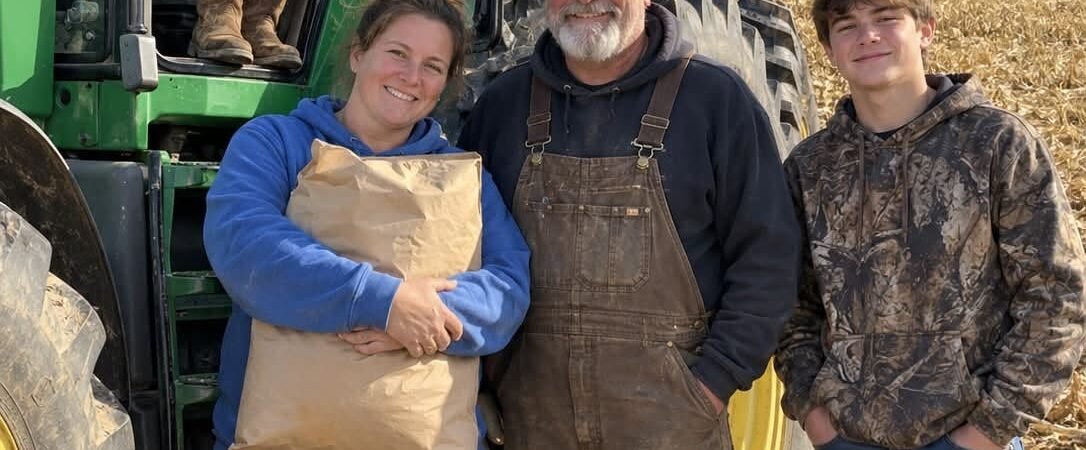
I was standing beside that green tractor in my ball cap and my canvas chore coat, with a paper seed sack in my arms. The little white farmhouse was behind me. Abby was up in the cab. And across the road, their big tractor was making its passes, with dust drifting behind it in the low sun.
Scott was driving it.
Randy and Luke had walked out to the edge of their field. They were standing there side by side, not talking. Watching me lift that sack.
I didn’t look at them for long.
I lifted the bag and poured it in. Then I lifted the next one. Then I got back in the cab.
I planted maybe twenty acres that first day. Jeff would have done sixty, easy.
When I finally shut the tractor off after dark, my hands were shaking. My shoulders burned so bad I couldn’t lift a gallon of milk out of the refrigerator.
Abby made us scrambled eggs. She burned them on one side.
Then she went to the bathroom cupboard and came back holding a little glass jar. The liniment her dad used to keep for his bad knee.
She stood behind my kitchen chair. And she rubbed it into my shoulders with her small hands until the whole kitchen smelled like wintergreen.
“Is this how he did it?” she asked.
“Just like that,” I said.
And I put my face down on the kitchen table so she wouldn’t see it.
That night, I went back outside and filled the planter boxes again under the yard light. So I’d be ready at daylight.
I was so tired that when I was done, I sat down on the planter hitch to rest for a second. I fell asleep sitting up, with my back against the big tractor tire.
When I woke up, I looked across the road.
The kitchen light was on in the home place. My old kitchen. I could see a figure standing at the window, looking out toward my yard light.
I couldn’t tell who it was.
Then the light went off.
The second morning, it was barely light. I was carrying seed bags from the trailer to the planter when I heard boots on the gravel.
I turned around.
Luke was crossing the road. Walking, not driving. His hands were shoved in the pockets of his jacket.
Behind him, at the edge of their field, his dad was standing beside the pickup. Watching him go.
Randy didn’t call him back.
I remember that. He could have. And he didn’t.
Luke stopped at the end of my rows. He looked at my planter. At my tractor. At the stack of seed bags on the trailer.
Then he looked at me.
He had his dad’s face. But he had his Uncle Jeff’s way of standing, with all his weight on one leg.
“Aunt Melissa,” he said.
“Morning, Luke.”
“Number six is skipping,” he said. “I could see it from over there yesterday. You’ve got a gap every few feet on that row.”
“I fixed it,” I said. “Bent finger.”
“Okay.” He looked at the seed bags again. Then he said, “Let me run the tractor. You haul seed. You’ll get twice as far.”
“Your dad needs you.”
“Uncle Scott’s running ours this morning,” he said. “Dad can run it after dinner. They’ll be fine.”
He swallowed hard.
“I didn’t know about the funeral thing,” he said. “The check. I didn’t know they were going to do it that day, or I’d have said something. I found out after.”
“I believe you.”
“And I didn’t ask for the house,” he said. “I want you to know that. Dad offered it, and I said yes. Because I didn’t think about where you’d go. I just didn’t think.”
He looked down at his boots.
“Uncle Jeff taught me to run a planter,” he said. “This exact same model. I was eleven.”
“I know,” I said. “I packed your lunch.”
He laughed. Sort of.
Then he climbed up into the cab. Abby was already sitting in the buddy seat, waiting. She looked up at him from under the brim of that green cap. And he looked at her.
“That’s his,” Luke said quietly.
“I know,” Abby said.
“It looks good on you,” he said.
And he started the tractor.
Luke ran my planter all that morning. I hauled seed.
I drove the pickup and the trailer down to the end of the field whenever he signaled. He’d climb down, and I’d lift bags, and he’d lift bags. We filled those planter boxes faster than I would have believed.
He planted straighter than I did. If I’m honest, he planted straighter than Jeff did. And Jeff would have been the very first to say so.
Around noon, I heard a diesel engine coming down the gravel road from the east.
I looked up.
It was Scott. Pulling the partnership’s seed tender behind his pickup.
The big gray one with the conveyor arm. The one Jeff bought at a dealer auction four years earlier. The one I’d written the check for, at my kitchen table, for $14,500.
Scott turned right into my field without stopping at the house. He pulled up alongside my planter. He got out of the pickup. He swung the conveyor arm over the first planter box. And he started filling it.
He didn’t say a word to me.
He didn’t even look at me.
He filled every single box on that planter. Then he got back in his pickup. He pulled the seed tender over to the end of my field, unhooked it right there and left it.
He was walking back toward his pickup when I caught up to him.
“Scott.”
He stopped. He didn’t turn around right away.
Scott was always the quiet one of the three brothers. The one who stood at the back of every room. The one who let Randy do the talking.
“You’ll need that the rest of the week,” he finally said, still facing his pickup. “Bring it back when you’re done. Bags’ll kill you.”
“Thank you, Scott.”
He turned around then.
His eyes were red.
“I should have said something in that basement,” he said. “Randy had it all worked out, and I let him do the talking. Because I always let Randy do the talking. And I sat there. And Jeff’s not even cold yet. And I’m telling his wife to get out of his house.”
He shook his head slowly.
“I’ve been sick about it since March,” he said. “I’m sorry, Melissa.”
“I know you are,” I said.
“That’s all,” he said.
And he got in his pickup and drove back across the road.
With that seed tender, Luke and I planted almost forty acres that day.
Abby rode with him the whole afternoon. When I brought them ham sandwiches at four o’clock, she was explaining to him how her dad liked to do the end rows first. And Luke was nodding, very seriously. Like she was teaching him something he didn’t already know.
It rained on Friday.
A slow, soft, all-day rain. The kind you pray for on fresh-planted ground. I stood at the kitchen window of that little white farmhouse and watched it come down on my forty acres. I said a prayer for every single seed.
Saturday was too wet to run.
I had about twenty acres left to plant. Across the road, they had their last field on the north end.
On Saturday evening, the phone rang.
It was Lori.
“Sunday dinner’s at twelve-thirty,” she said. “Like always. I expect you and Abby.”
I didn’t answer right away.
“I’m setting your places, Melissa,” she said. “Whether you come or not, I’m setting them. So you might as well come and eat.”
We went to church in the morning. Pastor Lindgren shook my hand at the door and held on to it longer than usual.
Afterward, we drove across the road to the house I’d lived in for twenty years. I parked in the yard, in the same spot I’d parked a thousand times.
It was strange walking in that back door as a guest.
Lori had put out a fresh tablecloth. The white one with the blue stitching around the edges. The roast was resting on the stove. The whole house smelled like gravy and fresh rolls.
Scott was there with his wife, Deb. Luke was there. And Randy was sitting at the head of the table, where he’d always sat at family dinners since his dad passed.
There were two places set on the left side of the table.
At one of them sat my old coffee cup.
The white one with the chip in the handle. I’d left it behind in the cupboard the day we moved because I didn’t have room in the box.
Randy stood up when we came in. That wasn’t like him. He stood there and waited until I sat down before he sat back down.
We bowed our heads, and Scott said grace.
Then Randy didn’t pick up his fork.
“Melissa,” he said. “I need to say something before we eat. Or I won’t be able to eat.”
The whole table went quiet.
“The bank was on me,” Randy said. “That’s true. Kyle Hoffman wanted the books cleaned up before he’d renew the line. But that’s not the real reason.”
He stared down at his plate.
“The reason is, I wanted Luke to have a place to come home to,” he said. “I wanted it settled before planting so he’d stay. And I told myself the check was the kind thing. That you’d be glad to be done with it. That a widow wouldn’t want to be farming with her husband’s brothers anyway.”
He looked down at his big hands on the tablecloth.
“That was a lie I told myself,” he said. “Because it made it easier. It was the wrong day. And it was the wrong way. Lori told me so, and I didn’t listen.”
He stopped. Lori put her hand on his arm.
“Then I watched you lift those bags,” Randy said. “That first day. And I stood out there at the edge of the field with Luke, and I thought, that’s Jeff’s wife. Out there by herself. And I’m standing here watching. And I couldn’t think of one single thing to say for myself.”
I sat there with my hands folded in my lap.
“I’m sorry,” Randy said. “If you want the house back, it’s yours. Luke and I already talked about it. He’ll find something in town.”
Across the table, Luke nodded.
I looked at them. The whole table full of them.
These were the people I’d spent my whole grown-up life with. These were the people who came to the hospital the night Abby was born. Who sat with me in the emergency room the night Jeff broke his wrist falling off a grain bin. Who stood around his grave with me seven weeks earlier.
“I don’t want the house back,” I said.
Randy looked up.
“I have a house,” I said. “It’s across the road, and it’s got eighty acres with it. And I’m going to finish planting it tomorrow.”
Randy nodded slowly.
“But I’d like to come to Sunday dinner,” I said. “And I’d like Abby to keep riding with Luke, if he’ll have her. And when that eighty needs harvesting this fall, I’d like to rent your combine. At a fair rate. Instead of hiring somebody from Superior.”
“You’ll use it free,” Randy said.
“I’ll pay what it’s worth,” I said. “Jeff would have. You know he would have.”
And for the first time since March, Randy laughed.
“He would have argued with me about the rate for an hour,” he said. “Then he’d have paid it and bought me supper.”
That’s when Abby, who hadn’t said one word, reached up and took off her dad’s green seed cap.
She set it down on the tablecloth beside her plate.
Randy looked at that cap.
He went very still.
Then he reached over and touched the brim with one finger. Gently. The way you’d touch something in a museum.
“I gave him that,” he said. And his voice broke right in half. “The year he started planting on his own. I bought it at the seed meeting in Hastings. He was sixteen. He wore it every spring for thirty years.”
“He still had it on the hook,” Abby said. “Mom almost forgot it. But Aunt Lori remembered.”
Randy picked up his napkin and pressed it against his face.
Nobody said anything for a long time.
Lori got up and went to the stove and stood there with her back to all of us.
Luke reached over and put his hand on his dad’s shoulder. The same way the man behind him put a hand on his shoulder at the funeral.
Then Randy took the napkin down from his face. He cleared his throat.
“Well,” he said. “The roast is getting cold.”
And we ate.
After dinner, Luke said he had something for Abby. He took her down the hallway to the pantry.
When they came back, he was carrying a long, narrow piece of painted wood. About six feet of door trim, white, with the old nail holes still in the ends.
It was the inside of the pantry door frame.
Every birthday since she could stand up, Jeff had stood Abby against that door frame. He’d put a book flat on top of her head and marked her height with a carpenter’s pencil. And the date.
There were twelve marks on that piece of wood.
The very last one, in Jeff’s blocky handwriting, said: “Abby, 12, last Nov.”
“I pried it off this morning,” Luke said. “Real careful. I’ll put a new piece up for me. You should have this one.”
Abby held it in both arms.
She ran her finger up the marks, one at a time. All the way from the bottom to the top. Age one. Age two. Age five, with a little drawing of a star next to it. Age twelve.
Then she set it gently against the wall.
She walked over to Luke and hugged him around the middle. Hard.
He stood there with his arms out for a second. Like he didn’t know what to do with them. Then he put them around her.
I looked over at Randy. He was watching his son with an expression I’d never seen on his face before. I think he was proud, and ashamed, and grateful. All at once. And didn’t know which one to feel first.
We finished planting the eighty on Monday.
Luke came across the road at daylight without being asked. He ran the tractor. I ran the seed tender. Abby rode in the buddy seat in her father’s cap.
Around four o’clock, Scott walked across the road with a box of donuts from the gas station in Blue Hill. He stood at the end of my field eating a long john, watching the last passes. Like a man watching a ball game.
Across the road, Randy was planting their last field on the north end himself.
We both ran late. The light was going. The sky over the Wiebe barn went orange, then pink, then purple. The meadowlarks quit singing for the night.
Luke flipped on the tractor lights.
Across the road, I saw Randy’s lights come on too.
I stood at the edge of my field with the last empty seed bag folded under my arm.
Abby climbed down out of the cab. She came and stood next to me. She leaned her head against my side.
And we watched.
On our side of the road, Luke was running the last rows, the planter lights swinging slowly around at the end of each pass. On the other side, Randy’s lights were doing the same thing. Back and forth. Back and forth. Across Jeff’s ground.
“Count the passes,” I said.
Abby reached up and held the green cap on with one hand. Even though there wasn’t any wind.
And we stood there together at dusk and watched two sets of planter lights moving back and forth, on either side of the gravel road.