PART 2
The moment the hospital door closed, my son whispered something that nearly stopped my heart.
“Mommy, please don’t let Daddy come back.”
I looked down at him.
His face was pale, his small body curled against mine. One hand pressed against his stomach while the other gripped my shirt so tightly that his little knuckles had turned white.
“Oh, sweetheart.”
I brushed the damp hair away from his forehead.
“I’m right here.”
He looked toward the door.
Then back at me.
“Daddy said I’d get better if I took the medicine.”
My throat tightened.
“What medicine, baby?”
He swallowed.
“The one that makes everything feel sleepy.”
Before I could respond, the doctor approached the bedside.
“Mrs. Bennett, I need to examine your son again.”
I moved aside immediately.
My daughter, Lily, remained close enough that her shoulder touched mine. Her eyes followed every movement as the medical team checked her brother’s breathing, heart rate, and blood pressure.
The doctor asked a few questions about when his symptoms had started.
I tried to answer.
But my mind kept returning to those words.
The one that makes everything feel sleepy.
A nurse adjusted the monitor beside the bed.
Another brought a small cart into the room.
Then my son, Noah, looked up at the doctor.
“Am I going to die?”
The question hit me harder than anything that had happened that afternoon.
I reached for his hand.
The doctor bent closer.
“We’re taking very good care of you, Noah. Right now, we’re watching your body closely and giving you the treatment you need.”
His eyes filled.
“Okay.”
Then he whispered, “I didn’t want to take it.”
My entire body went cold.
I looked toward Lily.
She had begun crying silently.
And when the doctor gently asked Noah what he meant, my little boy said something that changed everything.
“Daddy told me Mommy would be angry if I didn’t behave. He said the medicine would make me good.”
I pressed my hand against my mouth.
Because suddenly I understood that this wasn’t simply about an adult medication ending up in the wrong hands.
My husband had convinced our children that something dangerous was necessary to make them obedient.
And my son believed he’d done something wrong by becoming sick.
The doctor asked me to step into the hallway while another nurse remained with the children.
I hesitated.
Lily immediately grabbed my arm.
“Mommy, don’t go.”
I knelt in front of her.
“I’m only going right outside the door, sweetheart. You can see me through the window.”
Her lower lip trembled.
“Promise?”
I kissed her forehead.
“Promise.”
The doctor led me a few steps away from the room.
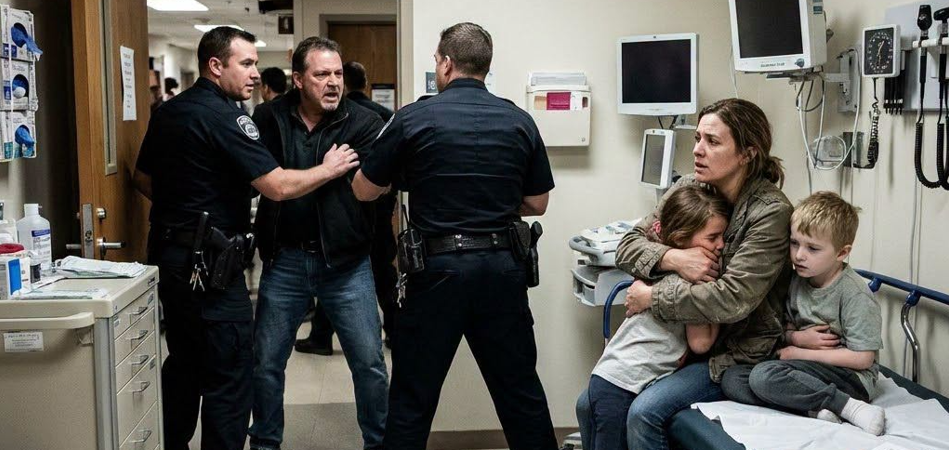
A police officer remained stationed nearby.
I could hear my husband’s voice farther down the corridor, still demanding explanations from someone.
Then a door closed, and his shouting became muffled.
The doctor spoke carefully.
“The medication recovered from your daughter appears to be a prescription drug intended for adult use. We are evaluating whether your son was exposed to it and whether that exposure explains his symptoms.”
I felt dizzy.
“Is it dangerous?”
“It can be dangerous for a child, depending on the medication, the amount involved, and other factors. That’s why we’re monitoring him closely and consulting the appropriate specialists.”
I stared at him.
“Will he be okay?”
The doctor paused.
“We’re treating this seriously. His condition is stable at the moment, but I don’t want to give you certainty before we have the necessary information.”
My knees weakened.
He guided me toward a chair.
I sat down.
For several seconds, I couldn’t speak.
Then I whispered, “I didn’t know.”
The doctor waited.
“I didn’t know he was giving them anything.”
My voice broke.
“I thought Noah had a stomach virus. He complained yesterday that he felt tired, but I thought it was because he’d been awake late.”
I covered my face.
“Lily said she didn’t feel well last week. I thought they were just passing something around at school.”
The doctor pulled up another chair.
“Right now, the most helpful thing you can do is tell us what you’ve observed, even if it seemed ordinary at the time.”
I nodded through my tears.
Then I remembered something.
Three weeks earlier, Noah had fallen asleep at the dinner table.
Not gradually.
One moment he’d been talking about a dinosaur book.
The next, his head had dropped forward.
My husband had laughed.
“Guess somebody played too hard today.”
I’d carried Noah to bed.
He’d been difficult to wake the following morning.
And when I mentioned it, my husband said the twins were probably going through a growth spurt.
I had believed him.
Why wouldn’t I?
He was their father.
The man who helped pack their school lunches.
The man who read bedtime stories when I worked late.
The person I trusted most to keep our children safe.
Now I was sitting in a hospital hallway wondering how many times he’d given them something I knew nothing about.
When I returned to the examination room, Lily was sitting beside her brother.
Her small hand rested over his.
The nurse smiled gently as I entered.
“They’ve been asking for you.”
I sat between them.
Lily immediately leaned against my shoulder.
Then she whispered, “Mommy?”
“Yes, baby?”
“Are you mad at Daddy?”
I took a slow breath.
“I am very upset about what happened.”
She looked down.
Then asked, “Are you mad at me too?”
My heart broke.
“No, Lily.”
I turned toward her.
“Look at me, sweetheart.”
She raised her tear-filled eyes.
“You haven’t done anything wrong.”
“But I hid the bottle.”
“I know.”
“And I didn’t tell you right away.”
I brushed her hair away from her face.
“You told me when you were ready. That was very brave.”
She sniffled.
Then whispered, “Daddy said you’d leave if we told.”
I froze.
For a moment, I couldn’t speak.
“What?”
Lily looked frightened.
“He said you’d get so angry that you wouldn’t want to live with us anymore.”
I felt something inside me shatter.
My husband hadn’t simply asked the children to keep a secret.
He’d used the possibility of losing their mother to frighten them into silence.
I pulled Lily closer.
“Oh, sweetheart.”
She began crying.
“He said it was our special secret.”
My eyes filled.
I held her carefully.
“Lily, adults should never make children keep secrets about medicine or things that hurt them.”
She nodded against my shoulder.
“And nobody gets to make you responsible for keeping our family together.”
Her little body trembled.
Then she asked, “Even Daddy?”
I swallowed.
“Even Daddy.”
Beside us, Noah whispered, “I told him my tummy hurt.”
I turned.
He was looking at the ceiling.
“I told him.”
My chest tightened.
“What did he say, sweetheart?”
Noah’s eyes filled.
“He said I was being dramatic.”
I covered my mouth.
Then he added something that made me feel physically sick.
“He said if I kept complaining, he’d give me more medicine so I could rest.”
The next several hours passed in fragments.
A nurse checking Noah’s vital signs.
A doctor explaining another test.
Lily falling asleep with her head against my arm.
My phone vibrating repeatedly inside my purse.
And every time it did, I felt a rush of fear.
My husband.
He called eleven times.
Then the messages began.
Where are the kids?
You are overreacting.
Tell the police this is a misunderstanding.
I’m their father. You can’t keep them from me.
I didn’t answer.
Instead, I showed the messages to the officer assigned to the case.
He asked whether I wanted them documented.
I nodded.
Then he said something I desperately needed to hear.
“Mrs. Bennett, you don’t need to confront your husband tonight. Let the medical team focus on your children, and let us investigate what happened.”
I looked toward Noah.
He was finally resting more comfortably.
Lily had moved into the chair beside his bed, clutching the stuffed rabbit she’d carried to the hospital.
I took a breath.
“Okay.”
But there was something else I couldn’t stop thinking about.
Why?
Why would my husband give our children his prescription medication?
Why would he tell them to hide it?
Why would he threaten them with losing me if they spoke?
I wanted an answer so badly that it almost hurt.
And I had no idea that the answer would come from something my seven-year-old daughter remembered about Thursday nights.
Just before midnight, Lily woke and asked for water.
I helped her sit up.
She took a few sips.
Then looked toward her brother.
“Is Noah better?”
“He’s getting the care he needs.”
She nodded.
For a while, she stared at the blanket.
Then she whispered, “Mommy, can I tell you something else?”
I put down the water.
“Of course.”
She looked toward the door.
“Daddy said we had to take the medicine when you worked late.”
My stomach tightened.
“When I worked late?”
She nodded.
I worked as an office administrator at a medical supply company. Twice a week, I stayed until seven or eight to finish reports and coordinate orders.
My husband worked remotely.
He was usually home when the twins finished school.
It was an arrangement we’d made together.
I thought it meant the children were spending their afternoons with someone who loved them.
Lily continued.
“Daddy said he had important things to do.”
I leaned closer.
“What things?”
She shrugged.
“He said grown-up things.”
I swallowed.
“And what happened after he gave you the medicine?”
She looked uncertain.
I kept my voice calm.
“It’s okay if you don’t remember everything.”
She thought for a moment.
Then whispered, “Sometimes he went away.”
My heart stopped.
“Went away?”
She nodded.
“He told us to stay in bed and not open the door.”
I felt cold.
“Did he leave the house?”
Lily nodded again.
“Sometimes.”
I stared at her.
“For how long?”
She shrugged.
“I don’t know.”
Then she looked down.
“Noah cried once because he couldn’t wake me up.”
My hands began trembling.
Lily continued.
“He got scared and called Daddy, but Daddy was angry.”
I couldn’t speak.
She looked up at me.
“Mommy, I tried to stay awake after that.”
My eyes filled.
“Why, sweetheart?”
Her voice became smaller.
“Because if Noah needed help, somebody had to be awake.”
I pulled her into my arms.
And that was the moment I realized how much responsibility my little girl had been carrying.
She was seven.
She should have been worrying about spelling tests and which stuffed animal to bring to bed.
Instead, she’d been trying to protect her twin brother because the adult responsible for them had made her believe nobody else would.
The investigators handled the children’s accounts carefully.
After Lily disclosed that their father sometimes left them alone, the officer explained that a trained child interviewer would need to speak with them in an appropriate setting once their medical needs were addressed.
I was grateful.
I didn’t want to pressure them into repeating frightening memories or accidentally influence what they said.
But the information she’d shared was serious.
The officers began examining whether my husband had left the twins unattended while they were potentially affected by medication.
They requested relevant records and worked through the proper process to obtain evidence.
I gave them the dates I’d worked late.
The messages my husband had sent.
The times I’d come home and found the children unusually sleepy.
And details about the household routine.
I also remembered something that had bothered me for months.
Whenever I arrived home unexpectedly early, my husband seemed irritated.
Not pleased.
Not surprised in a happy way.
Irritated.
Once, I’d returned at six instead of eight and found the children already in bed.
He’d met me in the hallway.
“Why didn’t you tell me you were coming home?”
I’d laughed.
“Since when do I need an appointment?”
He hadn’t laughed back.
“I’m trying to keep them on a schedule.”
I’d accepted that explanation.
Now I wondered what I’d interrupted.
And what I might have discovered if I’d looked more closely.
By the following afternoon, Noah’s condition had improved enough that the doctors were cautiously optimistic.
His color was returning.
He could speak without seeming exhausted.
And he asked whether he could have crackers.
I almost cried with relief.
The medical team continued observing him while evaluating the suspected exposure. They also examined Lily, because we could not assume she’d never taken the medication simply because she’d hidden the remaining vial.
Both children were frightened.
But they were safe in the hospital.
And for the first time since we’d arrived, I began to believe we might get through the immediate danger.
Then a detective came to speak with me.
He introduced himself as Daniel Foster.
He was calm and careful, choosing his words deliberately.
“Mrs. Bennett, we’ve obtained additional information about your husband’s activities on some of the evenings you were working.”
My heart began pounding.
I looked toward the children.
A nurse was helping Noah with his meal.
Detective Foster suggested we speak in the consultation room.
I agreed.
Once we sat down, he opened a folder.
“Your husband appears to have been leaving the residence on some of those evenings.”
My stomach tightened.
“Where was he going?”
The detective hesitated.
“We’re still establishing the full pattern. But some of the records we’ve reviewed place him at a nearby gaming lounge and other locations during periods when he was supposed to be supervising the children.”
I stared at him.
For several seconds, I couldn’t speak.
“A gaming lounge?”
He nodded.
My husband had told me he was working extra hours on consulting projects.
He said the additional income would help us pay down our mortgage.
Sometimes he complained about how exhausting the work was.
I had thanked him.
I’d actually thanked him for working so hard.
The detective continued.
“We also have indications that he was aware the children might be asleep or difficult to wake during some of these absences.”
My chest tightened.
“Did he admit giving them the medication?”
“He has made statements acknowledging that he provided them with something intended to make them sleep. We’re evaluating those statements alongside the medical findings and other evidence.”
I covered my mouth.
Then I whispered, “Why?”
Detective Foster looked at me.
“We can’t tell you everything he was thinking. What we can establish is what he did.”
I stared at the table.
He continued.
“And what we’ve learned raises serious concerns about their safety.”
I closed my eyes.
My husband hadn’t been trying to help the twins recover from an illness.
He’d apparently been trying to make them sleep so he could leave.
And he’d convinced them to keep the secret by making them afraid I’d abandon them.
I began crying.
Not because I missed him.
Because I finally understood why my children had been so frightened.
My sister, Caroline, arrived that evening.
I’d called her shortly after the police first intervened, but she lived nearly four hours away.
She came straight from work, still wearing her navy scrubs.
The moment she entered the hospital room, Lily ran toward her.
“Aunt Carrie!”
Caroline dropped her bag and knelt.
“Oh, sweetheart.”
Lily wrapped both arms around her neck.
Caroline looked over my daughter’s shoulder.
Our eyes met.
And for the first time in nearly two days, I let myself cry in front of someone who knew me well enough not to ask whether I was okay.
She held Lily with one arm and reached for me with the other.
We stayed like that for a long time.
Later, while the children watched a cartoon, Caroline sat beside me.
“I spoke with the nurse,” she said.
I nodded.
“She said they’re both being monitored carefully.”
I swallowed.
“Yes.”
Caroline looked toward Noah.
Then she took my hand.
“Have you eaten?”
I almost laughed.
I couldn’t remember.
She opened her bag.
“I brought sandwiches.”
I stared at her.
She smiled sadly.
“Mom would’ve done the same thing.”
Our mother had died six years earlier.
For a moment, the memory of her nearly broke me.
She’d always said that when someone was facing a terrible problem, the first thing you could do was make sure they had food, water, and somewhere safe to sit.
Caroline handed me a sandwich.
“Eat something.”
I took it.
Then I whispered, “I trusted him.”
She looked at me.
“I know.”
“He was their father.”
“I know.”
I stared toward the children.
“I was at work. I thought they were safe.”
My voice broke.
Caroline squeezed my hand.
“You had every reason to expect the person caring for them to protect them.”
I looked down.
Then she said something I would remember for a long time.
“The person responsible for what he did is the person who chose to do it.”
I covered my face.
And finally, I ate.
The children were discharged once the medical team determined it was safe for them to go home with me under a clear follow-up plan.
But I didn’t take them back to the house we’d shared with their father.
I couldn’t.
Not yet.
Every room contained something that made me uneasy.
The children’s beds.
The kitchen where he’d prepared their dinners.
The living room where he’d assured me everything was fine.
I didn’t know which memories were ordinary and which concealed something I hadn’t understood.
Caroline offered us her guest rooms.
I accepted.
We packed only what the children needed.
Clothes.
School things.
Medications prescribed for them.
Favorite books.
Stuffed animals.
Lily insisted on bringing the little blue night-light from her bedroom.
Noah wanted his dinosaur blanket.
I made sure we had both.
When we arrived at Caroline’s house, she had prepared two beds with clean sheets.
There were crayons on the desk.
Fresh towels in the bathroom.
And a plate of cookies on the kitchen counter.
Lily looked around.
Then whispered, “Are we staying here?”
I knelt beside her.
“For a little while.”
She glanced toward the front door.
“Does Daddy know?”
I took a breath.
“We’re safe here. The adults helping us are making sure we know what to do if anything changes.”
She nodded.
Then asked, “Can we sleep with you?”
My eyes filled.
“Of course.”
That first night, we pushed the two mattresses close together.
Lily slept on my left.
Noah slept on my right.
At three in the morning, I woke to the sound of Lily crying.
I turned toward her.
“Sweetheart?”
She was sitting upright.
Her hands were trembling.
“I thought Daddy was coming.”
I pulled her close.
“He isn’t here.”
She looked toward the door.
“Promise?”
I held her.
“I’m here with you, and Aunt Carrie is here too. We’re going to keep working with the people helping us so you can stay safe.”
She leaned against me.
Then whispered, “I don’t want any more secrets.”
My throat tightened.
“Neither do I, sweetheart.”
The following weeks were exhausting.
The investigation continued.
I cooperated with the authorities and provided the information requested.
A child protection professional helped assess the twins’ safety and ongoing needs.
My attorney assisted me with the family court process, including requests for immediate protective custody arrangements and restrictions on contact while the allegations were investigated.
There were hearings.
Documents.
Interviews.
And more difficult conversations than I can count.
I didn’t get everything resolved overnight.
Real life rarely works that way.
But I had support.
And the children were no longer being placed in their father’s unsupervised care.
As the evidence developed, the authorities pursued criminal charges relating to the alleged administration of prescription medication to the children and their endangerment. The eventual legal proceedings took time, and I learned not to measure my children’s recovery by the pace of the court system.
I also learned something else.
My husband had maintained the appearance of an ordinary, involved father for years.
He attended school conferences.
Remembered birthdays.
Helped build a cardboard castle for the twins’ school project.
To neighbors, he looked dependable.
To me, he’d seemed dependable.
But being charming in public didn’t excuse what he did when nobody was watching.
That was a difficult truth to accept.
And it made me more determined to listen carefully when my children spoke.
Not only when they were frightened.
All the time.
The hardest part wasn’t the paperwork.
It was the ordinary moments.
Noah refusing to drink apple juice because it reminded him of the medicine.
Lily asking whether she was allowed to tell her teacher if something at home made her uncomfortable.
Both children becoming anxious whenever someone mentioned a doctor’s appointment.
At first, Noah didn’t want to take even the medicine the pediatrician prescribed for an unrelated illness.
He pushed the cup away.
“No.”
I sat beside him.
“Okay, sweetheart. Tell me what worries you.”
He looked at the cup.
“What if it makes me sleepy again?”
My throat tightened.
I put the medicine down and contacted his care team for help explaining his treatment in a way that felt safe.
We began making sure the children knew the name and purpose of any medication they were prescribed, in simple language appropriate for their age, and that they could ask questions before taking it.
We didn’t pressure them to pretend the fear had disappeared.
We worked through it with professional guidance.
Sometimes Noah still became anxious.
Sometimes Lily wanted to inspect every bottle in the bathroom.
And sometimes they just wanted to play.
On those afternoons, I let them.
Because they were seven.
They deserved ordinary afternoons.
A few months later, Lily told me something during a counseling appointment that stayed with me.
Her therapist had invited us to draw pictures of places where we felt safe.
Lily drew Caroline’s house.
A yellow sun above the roof.
Three stick figures holding hands.
And a fourth person standing near the door.
“Who’s that?” the therapist asked.
Lily pointed.
“Aunt Carrie.”
Then she added a small animal beside the house.
“And that’s the dog I want.”
I laughed softly.
We didn’t have a dog.
Caroline didn’t either.
But Lily had been campaigning for one since kindergarten.
The therapist smiled.
“That sounds like a nice house.”
Lily nodded.
Then she drew something else.
A small blue rectangle near the front door.
I leaned closer.
“What’s that?”
She looked at me.
“My shoe.”
For a moment, I couldn’t speak.
Her therapist asked gently, “What made you put your shoe there?”
Lily shrugged.
“Because that’s where I hid the bottle.”
My chest tightened.
She continued.
“I thought if I kept it, Daddy couldn’t give Noah any more.”
I felt tears filling my eyes.
The therapist waited.
Then Lily whispered, “I was scared he’d find it.”
I moved closer.
“Sweetheart, that was a frightening thing to have to worry about.”
She nodded.
I reached for her hand.
“You did the right thing by telling us. But I want you to understand something very important.”
She looked up.
“Keeping Noah safe was never supposed to be your job.”
Her forehead wrinkled.
I continued.
“That was the adults’ responsibility. Yours is to be a kid and tell a trusted grown-up when something doesn’t feel right.”
She thought about that.
Then asked, “So I don’t have to watch him anymore?”
My heart broke all over again.
I squeezed her hand.
“You can love your brother and help him, but you don’t have to stay awake making sure he’s safe. That’s my job now.”
Lily stared at me.
Then she leaned forward and hugged me.
And whispered:
“Good. Because I was really tired.”
The first time Noah laughed without looking over his shoulder, I nearly cried.
It happened on an ordinary Sunday morning.
Caroline was making pancakes.
Lily had decided that every pancake needed a face made from blueberries.
Noah insisted that his pancake should look like a dinosaur.
Caroline tried.
The result looked more like a lopsided turtle.
Noah stared at it.
Then burst out laughing.
“That’s not a dinosaur!”
Caroline pretended to be offended.
“Excuse me. That is a highly respected prehistoric creature.”
Lily giggled.
“No, Aunt Carrie. That’s a potato.”
Noah laughed so hard he slid sideways in his chair.
I stood beside the kitchen counter watching them.
For months, I’d heard my son cry in his sleep.
I’d watched him become frightened whenever somebody raised their voice.
I’d worried about every headache and stomachache.
And now he was laughing at a ridiculous pancake.
Something ordinary.
Something I’d once taken for granted.
I turned toward the sink and wiped my eyes.
Caroline noticed.
She didn’t say anything.
She simply placed another pancake on the plate.
This one was shaped like a star.
“For Mom,” she announced.
The children cheered.
And for the first time in months, breakfast felt like breakfast again.
Eventually, I returned to our house.
Not with the children at first.
I went with Caroline to collect documents and belongings.
The property was quiet.
My husband’s things were still there, though his access was subject to the temporary legal restrictions then in effect.
I walked through the living room slowly.
The family photographs were still on the walls.
One showed the twins at their fifth birthday party.
Another showed us at the beach.
In the photographs, we looked happy.
I stared at them.
For a long time, I wondered whether happiness we’d experienced together had somehow been fake.
Then I realized it didn’t have to be.
There had been real laughter.
Real holidays.
Real moments when the children felt loved.
Those memories could exist alongside the truth that their father had seriously betrayed their safety.
One didn’t erase the other.
I went into the twins’ bedroom.
Lily’s stuffed animals were arranged along the pillow.
Noah’s dinosaur books were stacked beside his bed.
On the wall was a drawing they’d made of our family.
Four figures beneath a bright yellow sun.
I stared at it.
Then gently took it down.
Caroline appeared in the doorway.
“You okay?”
I shook my head.
“Not really.”
She stepped beside me.
I looked at the drawing.
“I thought I was giving them a good childhood.”
My voice broke.
Caroline put her arm around me.
“You’re still giving them one.”
I looked at her.
She continued.
“It’s just going to look different from what you imagined.”
I cried for a long time.
Then I packed the children’s books.
Their photographs.
Their little keepsakes.
And the things that would help their new bedrooms feel familiar.
I left the drawing in a folder.
Not because I wanted to erase their father.
But because I wanted the children to decide what memories they were ready to keep close.
A year passed.
Then another.
The twins turned nine.
The legal proceedings eventually established the restrictions and responsibilities that would govern their father’s future contact with them. Those decisions followed the evidence, professional assessments, and the court’s determination of their welfare.
I couldn’t rewrite what had happened.
I couldn’t make the investigation faster.
And I couldn’t guarantee that the children would never have another frightening memory.
But I could keep listening.
I could follow their treatment plans.
I could create predictable routines.
And I could make sure they knew they were never responsible for an adult’s choices.
We moved into a smaller house closer to Caroline.
It had three bedrooms, a tiny backyard, and a kitchen that needed painting.
It wasn’t as impressive as our old home.
The floors creaked.
The garage door stuck in winter.
And the dining table barely fit beside the window.
But it was peaceful.
We chose the paint colors together.
Lily picked pale green.
Noah chose blue.
They argued for two hours about whether the living room should have a yellow rug.
Eventually, we bought a gray one.
Both complained.
Then forgot about it a week later.
Ordinary childhood disagreements.
I had never been so grateful for them.
One afternoon, Noah came home from school carrying a permission slip.
“Mom?”
“Yes, sweetheart?”
“Can I go on the science museum trip?”
I looked at the paper.
“Of course. Let me check the details.”
He sat beside me while I read it.
Then asked, “Will you be there?”
I smiled.
“No, honey. Your teachers will be supervising.”
He became quiet.
I recognized the look.
“Are you worried?”
He nodded.
“What if something happens?”
I put the paper down.
We talked through the school’s plans, the adults responsible, and how he could ask for help.
I didn’t tell him nothing bad could ever happen.
That wouldn’t have been honest.
But I reminded him that trustworthy adults have a responsibility to protect children and to listen when something feels wrong.
He thought about that.
Then nodded.
“Okay.”
A week later, he went on the trip.
He came home talking nonstop about planets, dinosaurs, and a machine that made artificial lightning.
I listened to every word.
Then he asked whether we could build a model solar system over the weekend.
I smiled.
“Absolutely.”
And as he ran upstairs to tell Lily, I realized something.
For a long time, Noah’s world had been organized around fear.
Now it was beginning to make room for curiosity again.
Lily’s recovery looked different.
She remained protective of her brother.
If he fell on the playground, she hurried over before anybody else.
If he looked sad, she tried to cheer him up.
Those things were part of their bond.
But sometimes she still behaved as though she had to anticipate every possible danger.
Her counselor worked with her on recognizing the difference between being caring and feeling responsible for another person’s safety.
One evening, Lily came into my room carrying her favorite book.
“Mommy?”
“Yes?”
“Can I ask you something?”
I smiled.
“Always.”
She climbed onto the bed.
Then asked, “Do you still think I was brave?”
My throat tightened.
“Of course.”
She looked down.
“Even though I was scared?”
I brushed her hair from her forehead.
“Especially because you told the truth when you were scared.”
She smiled faintly.
Then whispered, “Sometimes I wish I’d told you sooner.”
My heart tightened.
I took her hand.
“Lily, you were seven years old. A grown-up told you to keep a secret and frightened you about what would happen if you didn’t.”
She nodded.
I continued.
“That was not your fault.”
She looked at me.
“And you do not have to spend the rest of your life making up for something you were never responsible for.”
Her eyes filled.
Then she asked, “Can I stop thinking about it all the time?”
I smiled sadly.
“You don’t have to force yourself to forget. But you can keep doing the things you love, and we’ll keep helping you when the memories feel scary.”
She nodded.
Then she opened her book.
“Can we read?”
I smiled.
“Of course.”
And for the next twenty minutes, we read about a little girl who found a mysterious garden behind an old stone wall.
No medicine.
No police.
No hospitals.
Just a story.
And my daughter curled safely beside me, being a child.
Last Christmas, Caroline came over with a huge bag of presents.
She insisted she hadn’t bought very much.
Then proceeded to unload enough gifts to fill half the living room.
Noah laughed.
“Aunt Carrie, you said only two presents each!”
Caroline grinned.
“I have trouble counting.”
Lily rolled her eyes.
“You’re a nurse!”
We all burst out laughing.
After dinner, the children went outside to look at the Christmas lights along our street.
Caroline and I remained in the kitchen washing dishes.
She looked through the window.
“They seem happy.”
I smiled.
“They are.”
Then I became quiet.
Caroline noticed.
“What?”
I hesitated.
“Sometimes I wonder whether they’ll remember the hospital more than everything else.”
She dried her hands.
“They might always remember it.”
My throat tightened.
She continued.
“But they’ll remember other things too.”
I looked toward the window.
Noah was trying to catch snowflakes on his tongue.
Lily was laughing at him.
Caroline smiled.
“They’ll remember this Christmas. Their birthdays. Their friends. Their teachers. The trips you take. The pancakes I keep ruining.”
I laughed softly.
She continued.
“One terrible chapter doesn’t have to become their entire story.”
My eyes filled.
I looked at my children again.
And for the first time, I allowed myself to believe that fully.
Now, almost three years after that frightening afternoon at the hospital, the twins are ten.
Noah loves astronomy.
His bedroom ceiling is covered with glow-in-the-dark stars.
He wants to become a scientist, though last week he announced he might also become a professional soccer player.
Lily loves animals.
She volunteers with me at a local rescue organization on some Saturdays and has decided that our house desperately needs a dog.
We still haven’t agreed on that.
She has prepared a detailed presentation explaining why I’m wrong.
I suspect she inherited my stubbornness.
Our lives aren’t perfect.
Some days are difficult.
The children still attend counseling when needed.
Certain memories occasionally surface.
And there are legal arrangements we continue to take seriously.
But our home is no longer organized around keeping someone else’s secrets.
The children can ask questions.
They can say when they’re uncomfortable.
They can tell me when something frightens them.
And they know that being honest won’t make me stop loving them.
That matters more to me than almost anything else.
A few weeks ago, Lily came home from school with an assignment.
Her teacher had asked the class to write about someone they admired.
I assumed she’d choose Caroline.
Or a teacher.
Or perhaps the veterinarian at the animal rescue center.
Instead, she handed me two pages of carefully written sentences.
At the top was the title:
“The Person Who Taught Me I Could Tell the Truth.”
I looked at her.
“Is this about Aunt Carrie?”
She shook her head.
“No.”
I began reading.
When I was little, I had a secret that made me scared.
I thought telling it would make bad things happen.
But one day I told my mom, and she listened.
My eyes filled.
I continued.
She didn’t yell at me.
She didn’t tell me I was bad.
She hugged me and told me I wasn’t in trouble.
Sometimes kids are scared to tell grown-ups things because they think the grown-ups will be angry.
My mom taught me that I can tell her when something is wrong.
I stopped reading.
My vision blurred.
Lily shifted beside me.
“Mom?”
I looked up.
“Yes, sweetheart?”
“Are you crying?”
I laughed softly.
“A little.”
She looked worried.
“Did I make you sad?”
I pulled her close.
“No, baby.”
I kissed her forehead.
“You reminded me how important it is to listen.”
She smiled.
Then whispered, “I didn’t put all the scary details in my assignment.”
I nodded.
“You didn’t need to.”
She looked relieved.
Then said something that made me hold her a little tighter.
“I wanted to write about what happened after I told you, not just what happened before.”
For a moment, I couldn’t speak.
Because that was exactly what I’d hoped for.
Not that she’d forget.
Not that we’d pretend nothing terrible happened.
But that she would grow up knowing the frightening secret wasn’t the most important thing about her life.
The most important thing was that she’d spoken.
Someone had listened.
And she’d been protected.
That evening, Noah found us sitting together on the sofa.
He climbed beside Lily.
“What are you doing?”
“Reading my assignment,” she said.
He looked interested.
“Is it good?”
She grinned.
“Very good.”
He rolled his eyes.
Then looked at me.
“Mom, can I ask something?”
“Of course.”
He hesitated.
“Was it really dangerous what Daddy gave us?”
The room became quiet.
I took a breath.
“Yes, sweetheart. It was dangerous because it was medication that wasn’t prescribed for you, and you were given it without proper medical care.”
He looked down.
Then whispered, “I thought I was getting sick because I wasn’t behaving.”
My heart tightened.
I reached for his hand.
“Noah, you were sick because something harmful happened to your body. It had nothing to do with whether you were a good boy.”
His eyes filled.
I continued.
“You didn’t cause it.”
He nodded slowly.
Then he asked, “And Lily didn’t either?”
I looked toward my daughter.
She was watching us carefully.
“No,” I whispered.
“Neither of you.”
Noah reached across me and took his sister’s hand.
For a moment, they looked at each other.
Then he said quietly, “I’m glad you hid the bottle.”
Lily smiled.
“Me too.”
He hesitated.
Then added, “But you don’t have to take care of me anymore.”
She frowned.
“What?”
He grinned.
“I can take care of myself.”
Lily laughed.
“You couldn’t even find your shoes this morning.”
Noah looked offended.
“They were under my bed!”
“Exactly!”
They both burst out laughing.
I sat between them, listening.
And something inside me finally relaxed.
Because for years, I’d worried about whether Lily would ever stop feeling responsible for her brother.
Now they were arguing about shoes like ordinary siblings.
It was the most beautiful sound in the world.
Sometimes I still think about that hospital room.
The bright lights.
The disinfectant.
The examination paper rustling beneath Noah.
Lily standing beside me with one sneaker half-removed.
The small vial she’d hidden inside it.
And the officer’s face changing as he examined the prescription information.
I remember my husband’s voice in the hallway.
His anger.
His demands.
The way my daughter clung to me when she heard him approaching.
But the moment I remember most clearly is quieter.
Lily looking up at me.
Her eyes filled with tears.
Her little voice trembling.
Am I in trouble?
She’d been carrying a secret too heavy for a seven-year-old.
She’d been frightened of her father.
Frightened of losing me.
And frightened that telling the truth would somehow make everything worse.
What she needed in that moment wasn’t a lecture.
It wasn’t anger.
And it wasn’t a thousand questions about why she’d waited.
She needed to know she was safe enough to speak.
So I held her.
And I told her she wasn’t in trouble.
That was the beginning of our new life.
Not the police investigation.
Not the court hearings.
Not even the day we moved into our own house.
The beginning was the moment my little girl discovered that telling the truth didn’t mean losing the person she loved.
Last Sunday, I took the twins to the park.
It was a beautiful afternoon.
Noah brought his soccer ball.
Lily brought a notebook full of sketches of the dog she still insists we should adopt.
We sat beneath a large oak tree while the children ate sandwiches.
At one point, Noah ran toward the playground.
Lily started to follow him.
Then stopped.
She turned toward me.
“Mom?”
“Yes, sweetheart?”
“Can you watch Noah for a minute? I want to go on the swings.”
I smiled.
“Of course.”
She grinned.
Then ran toward the swings without looking back.
I watched her go.
For a moment, I didn’t understand why my eyes were filling with tears.
Then it struck me.
Three years earlier, Lily believed she had to stay awake to make sure her brother was breathing.
She thought she had to hide dangerous medicine.
She thought she had to protect him from an adult.
She thought if she made one mistake, our family would fall apart.
Now she was asking me to watch Noah because she wanted to play.
She was trusting me to be the parent.
And giving herself permission to be a child.
I looked toward my son.
He was kicking his soccer ball across the grass, laughing as he chased it.
Then I looked toward Lily.
Her legs stretched forward as the swing rose higher.
Her hair flew behind her.
She threw her head back and laughed.
And I began crying.
Not because I was afraid.
Because for the first time, I could see how far we’d come.
My daughter once believed she had to protect her brother by keeping a secret from me.
Now she believed she could leave him in my care and go enjoy the afternoon.
That was the recovery I had prayed for.
I don’t know what every part of our future will look like.
I don’t know which memories the children will carry into adulthood or what questions they’ll ask as they grow older.
But I know what I want them to remember about me.
Not that I always had the right answer.
I didn’t.
Not that I could protect them from everything.
I couldn’t.
And not that our family looked the way I’d imagined when they were born.
It doesn’t.
I want them to remember that when they came to me frightened, I listened.
When they told me something difficult, I believed they deserved to be heard.
And when the truth required me to change our entire life, I didn’t ask them to keep suffering so things could look normal from the outside.
My husband told our seven-year-old twins that the medicine he gave them was a secret they could never tell Mommy.
My daughter hid the vial in her shoe because she was afraid of what might happen to her brother.
And when she finally told the truth, the doctors and police uncovered a pattern of dangerous decisions that had placed both children at risk.
For a long time, I wished I could return to those evenings when I came home from work and found them already sleeping.
I wished I could walk into their bedrooms, ask more questions, and recognize what was happening sooner.
But I can’t change those nights.
What I can do is make sure the years afterward are different.
Our home is smaller now.
Our lives are quieter.
We have fewer expensive things.
But the children laugh more.
They sleep peacefully most nights.
They ask questions without whispering.
And they no longer believe that loving someone means hiding something dangerous to protect that person’s feelings.
Last night, Lily came downstairs after bedtime.
She was holding her stuffed rabbit.
“Mommy?”
I looked up from my book.
“Yes, sweetheart?”
“Can I tell you something?”
I smiled.
“Always.”
She climbed beside me.
Then whispered, “I accidentally broke your blue flowerpot.”
I stared at her.
The flowerpot Caroline had given me for my birthday.
The one that sat beside the kitchen window.
I took a breath.
“Is anyone hurt?”
She shook her head.
“No. I cleaned up the big pieces, but I didn’t touch the little ones.”
I nodded.
“Good. Thank you for telling me. I’ll take care of the glass.”
She looked nervous.
“Are you mad?”
I thought about the hospital.
The little vial.
The trembling hands.
The fear in her eyes.
Then I looked at my daughter.
“No, sweetheart. I’m disappointed the pot broke, but accidents happen. I’m glad you told me so we can make sure nobody gets hurt.”
Her shoulders relaxed.
Then she hugged me.
“Love you, Mommy.”
I held her close.
“Love you too.”
She climbed off the sofa and went back upstairs.
And I sat there for a long time, smiling through my tears.
Because my daughter had broken something.
She knew I might be disappointed.
And she’d still come straight to me.
No hiding.
No secret.
No fear that the truth would make me abandon her.
Just a little girl trusting her mother.
The most important thing I saved that day wasn’t the medicine bottle, our marriage, or even the home we once shared.
It was my children’s belief that when something frightening happens, they can tell me the truth and still be loved.
And that is the promise I intend to keep for the rest of my life.