Vern Dahl called on a Wednesday afternoon in February. And the first thing he said was, “Gordon, I hate to bother you down there.”
I was standing outside our rented park model in Mesa, Arizona, with a cup of coffee going lukewarm in my hand. It was eighty-one degrees. Somebody two lots over was playing a Charley Pride record on a little radio.
Vern is seventy-five. He’s lived across the street from us in Iowa since 1981.
And Vern does not call Arizona to talk about the weather. Because the weather in Iowa in February is not news.
“You’re no bother, Vern,” I said. “Is the house all right? Did a pipe go?”
“The house is fine,” he said. “That’s not it.”
Then he went quiet. Quiet so long I pulled the phone away from my ear and checked whether the call had dropped.
“Gordon,” he said. “There’s a fella living in your basement.”
I set my coffee down on the little railing by the step. I remember that, because a grackle landed right next to it, bold as you please, and I didn’t even shoo it.
“Brett’s girlfriend moved in around Christmas,” Vern went on. “The girl with the dark hair. Works over at the care center. That part I figured you knew about. But now her brother’s in there too. Since the first of the year.”
“In the house,” I said.
“In the basement. He told me so himself at the Casey’s. Nice enough young man. Polite. Said he pays Brett six hundred dollars a month for it, and it’s the best deal in the county.”
I didn’t say anything for a while.
Vern let me not say anything. That’s one of the reasons he’s been my neighbor for forty-five years.
“I went back and forth on calling you,” he said finally. “Two days I went back and forth. I didn’t want to be the old busybody across the street. But Ardis’s mother sat with my Arlene when she was dying. Every afternoon for three weeks. And I figured I owed your family the truth more than I owed anybody my good manners.”
“You did right, Vern.”
“I hope so,” he said. “I’ll keep an eye on things. I won’t say a word to Brett.”
I thanked him and hung up.
Then I sat down on the step of a trailer that wasn’t mine, in a state that wasn’t mine, and looked down at my own two hands for a long, long time.
Ardis and I had been wintering in Mesa for six years by then.
We rented the same park model every year. A little white one with green trim, at a resort full of Iowa and Minnesota license plates. The biggest argument all winter long was about the shuffleboard schedule.
Going down there was Ardis’s idea the first time.
I retired from the grain elevator at sixty-three, after forty years. And that first winter home, my knees got loud about January. Louder than they ever were when I was working. I’d sit at the kitchen window every morning watching the snow and wishing for something to fix.
Ardis finally put her coffee cup down one morning and said, “Gordon, I’m tired of watching you sit at that window. We’re going someplace warm.”
So we went. November to May. Home for Mother’s Day, every year.
And every year, somebody had to watch the house.
The first four winters, it was Vern, with a neighbor boy to do the shoveling.
Then Brett’s marriage ended.
He moved into a little apartment over the old bakery on Main Street. Two rooms and a hot plate. And that fall, Ardis said, “Why should Brett be paying rent on that little place when our house sits empty half the year?”
I said that was a good point.
I also said it wasn’t how I would have done it.
We worked it out between us. Brett kept his apartment. He’d stop at the house every couple of days. Run the faucets on the north wall when it went below zero, so the pipes wouldn’t freeze. Check the furnace filter. Keep the walks shoveled for the mail carrier.
In return, he could park his truck in our garage during the bad weeks.
That was the whole deal. I wrote it down on an index card and stuck it on the refrigerator with a magnet, in my own handwriting.
I’m a man who likes things written down on index cards.
Ardis came back from the pool around four o’clock that afternoon. She had a towel around her neck and her library book tucked under her arm.
She read my face from all the way across the gravel lot. Forty-two years of marriage will do that.
“Is it Brett?” she said.
“How did you know?”
“Because you only look like that about Brett.”
I told her everything Vern said.
The girlfriend, whose name was Jade. The brother, whose name Vern thought was Austin. The basement. The six hundred dollars a month.
Ardis sat down on the step beside me.
She didn’t cry. She took the towel off her neck and folded it into a square on her knees. Very neat. Then she folded it again. Then again.
“Six hundred dollars,” she said. “For our basement. With the sump pump that hollers every time it rains.”
“That’s what he said.”
“Since January.”
“That’s what he said.”
She looked out across the lot at the lemon tree, where our neighbor from Mankato was picking lemons into an old coffee can.
“What are you going to do, Gordon?”
I’d like to tell you I had a plan right then. I didn’t.
What I had was a list of things I wasn’t going to do. And that list got longer and longer as the evening went on.
The first thing I thought about was the sheriff.
I thought about it for about a minute.
I knew exactly how that call would go. I’ve known the Winnebago County deputies most of their lives. Dale Herman would come out. He’d be kind about it. And he’d tell me what I already knew.
A grown man who’s been paying rent every month and keeping his things in a basement isn’t a burglar. Even if he paid it to the wrong person. That’s a civil matter. You give written notice. You wait. Nobody gets carried out into an Iowa March by a deputy just because his landlord turned out to be somebody’s son.
And even if the law was simple, I wasn’t going to do it.
I wasn’t going to send a man in uniform to my own son’s door. Not in a town of twenty-two hundred people. Where the sheriff’s log runs in the paper every Thursday, and it gets read out loud at the café before it ever gets read at home.
That night, we sat at the little table in the park model with a plate of saltine crackers nobody was eating.
“Call Brett,” Ardis said. “Just call him. Ask him.”
“And he’ll tell me what?”
“The truth, maybe.”
“On the phone?” I shook my head. “He’ll have a story ready before the second ring. And then he’ll have two days to empty out that basement and hide the whole thing. He’s had since Christmas to get one ready.”
Ardis didn’t like that. And she was right not to like it. It was a hard thing to say about our son.
But I’ve known Brett for thirty-six years. And on the telephone, he has always been somebody else. Smooth. Cheerful. Everything’s great, Dad. Everything’s fine.
“I want to see his face,” I said. “That’s all. I want to be standing right in front of him when he tells me.”
“Then what?”
“Then I’ll know what to do.”
Ardis looked at me for a long time over the plate of crackers.
Then she got up. She took the calendar off the wall. It was the one from the co-op, with a different John Deere tractor every month. She counted on her fingers.
“Our lease here runs through April,” she said. “We’ll lose the rest of it.”
“I know.”
“And Brett will see us coming, Gordon. Vern will tell somebody. Or somebody will see the Toyota at the Casey’s and mention it at church.”
“Then he’ll see us coming,” I said. “I’m not sneaking up on my own house.”
The next morning, we told the park manager we had a family matter back home.
She was nice about it. Everybody down there is nice about it. Because everybody down there has a family matter back home, sooner or later.
We spent three days shutting the place down.
Ardis cleaned out the refrigerator and wiped down every shelf. I drained the hoses, took in the folding chairs, and pulled the little welcome flag off the post. The one with the cardinal on it.
Our friends from Spirit Lake, Don and Lorraine, had us over for a goodbye supper on Saturday night. Tater tot hotdish and bars.
They didn’t ask us a single question. Not one.
That’s about the kindest thing one Iowa couple can do for another.
We pulled out of the park on Sunday morning at daybreak.
It’s 1,480 miles from that lot in Mesa to our driveway in Iowa. The way I drive it, anyway.
I’d done it twelve times. Down in November, up in May.
I’d never once done it in March.
PART 2 — My Son Rented Out Our Basement While We Were in Arizona. Then I Knocked on My Own Front Door.
I’d never once made that drive in March.
There’s a reason people from Iowa go to Arizona for the winter. It isn’t because we enjoy packing suitcases.
By the time we crossed into Kansas, the warm air was gone. The temperature kept dropping, and the wind pushed against our Toyota hard enough that I had to keep both hands on the wheel.
We spent Sunday night in Tucumcari and Monday night in Salina.
Ardis barely spoke.
That worried me more than if she’d spent the entire trip complaining about Brett.
My wife is a talker. She talks to waitresses, gas station clerks, and strangers standing beside her in the produce aisle. She once spent forty minutes discussing tomato plants with a woman she’d never met.
But for nearly fifteen hundred miles, she mostly looked out the passenger window.
Outside Concordia, she finally said something.
“He never asks us for a dime.”
I glanced at her.
“Brett?”
She nodded.
“Even after the divorce. Even when he moved into that little apartment.”
I thought about it.
“You’re right.”
She twisted her wedding ring.
“Maybe that’s the trouble.”
I didn’t answer.
Because I’d been thinking the same thing.
Brett was thirty-six years old, and somewhere along the way, he’d decided that not asking us for money meant he wasn’t taking anything from us.
Apparently, helping himself to our house was different.
We reached our street Tuesday afternoon at 2:30.
The snowbanks were gray with road salt.
The Hendersons had their Christmas wreath hanging on the garage again. They do that every winter and forget it until Easter.
Vern’s curtain moved when we pulled into our driveway.
Ardis got out and looked toward the house.
Her African violets were blooming in the front window.
“Somebody’s been watering them,” she said.
I didn’t know whether that was supposed to make us feel better.
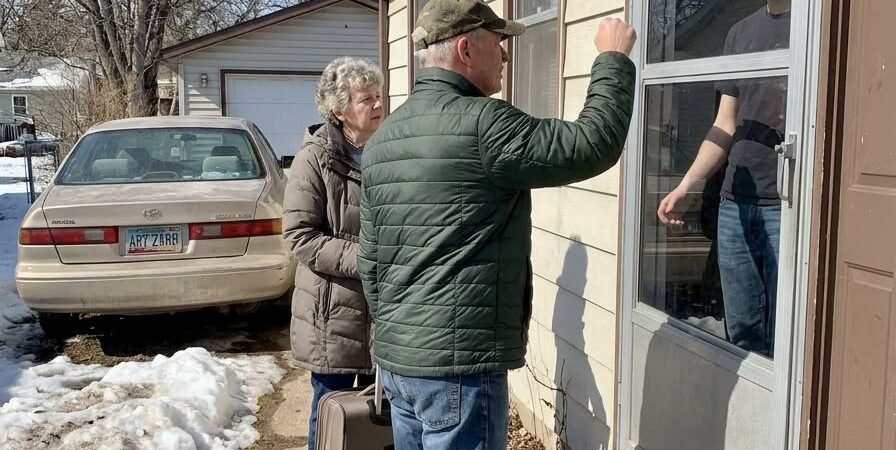
I took our suitcase from the trunk, carried it up the walkway, and placed it beside the front steps.
My house key was in my coat pocket.
I could have unlocked the door.
But I knocked.
Three times.
Exactly the way my father used to.
A young man came down the hallway.
Dark T-shirt.
Jeans.
Bare feet.
Maybe twenty-eight.
He opened the storm door halfway.
“Can I help you?”
I looked at him.
“You Austin?”
He blinked.
“Yeah.”
“I’m Gordon. This is my wife, Ardis.”
He stared.
Then looked at our suitcase.
Then back at me.
“Oh.”
He swallowed.
“Brett said you weren’t coming home until May.”
“I know.”
Austin opened the door a little wider.
“Is something wrong?”
I looked past him.
Our hallway rug had been moved.
A pair of men’s work boots sat beside the coat closet.
There was a baseball cap hanging from the hook where Ardis always kept her winter scarf.
I looked at Austin.
“Son, I think we’d better have a conversation.”
He stepped aside.
And I walked into my own house.
The first thing I noticed was the smell.
Not a bad smell.
Bacon.
Coffee.
And the lemon furniture polish Ardis likes.
Somebody had been cleaning.
The second thing I noticed was our wedding photograph.
It wasn’t on the hallway table anymore.
In its place was a framed picture of Brett and a dark-haired woman standing beside a Christmas tree.
Ardis stopped behind me.
She looked at the photograph.
Then looked toward the living room.
Her lips pressed together.
Austin shut the door.
“Look, if this is about me being here, Brett said everything was arranged.”
I turned.
“What exactly did he tell you?”
Austin looked genuinely confused.
“That he was managing the place while you were in Arizona.”
“Managing?”
“Yeah.”
I waited.
He continued.
“He said you folks wanted somebody staying here during the winter. Keeping the furnace running and making sure the pipes didn’t freeze.”
I almost laughed.
That part was true.
I glanced toward Ardis.
She was standing beside the staircase, looking up at the family photographs on the wall.
I turned back to Austin.
“And the six hundred dollars?”
He frowned.
“What about it?”
“You pay Brett six hundred dollars a month.”
Austin nodded.
“First of every month.”
I took a slow breath.
“Did he tell you the money was going to us?”
Austin’s expression changed.
“No.”
“Who did he say it was going to?”
Austin hesitated.
Then answered.
“Him.”
I nodded.
“That’s what I thought.”
He began looking worried.
“Sir, I don’t understand. Am I not supposed to be here?”
I studied his face.
There are people who lie with the confidence of a man selling you a used car.
Austin wasn’t one of them.
He looked frightened.
Not guilty.
Just frightened.
I asked whether he had anything in writing.
He nodded quickly.
“Sure. I’ve got a lease.”
My stomach dropped.
“A lease?”
“Brett wrote it up.”
He reached into the pocket of his jeans and pulled out his phone.
A few seconds later, he showed me a photograph.
There it was.
A one-page rental agreement.
Our home address.
Austin’s name.
Six hundred dollars per month.
A six-hundred-dollar security deposit.
And beneath the words Property Manager, Brett had signed his name.
The agreement said Austin could occupy the basement until the following January.
Not May.
January.
I looked at that page for a long time.
Then handed the phone back.
“Does Brett know you’re showing me this?”
Austin shook his head.
“No.”
“Good.”
He swallowed.
“Am I in trouble?”
I looked at him.
And suddenly, I felt sorry for the young man.
He had rented what he believed was a legitimate place to live.
Paid his money.
Moved his belongings.
And now two elderly strangers had turned up at the door.
“No, Austin,” I said. “You’re not in trouble with me.”
His shoulders relaxed slightly.
“But we do have a problem.”
He nodded.
“I figured.”
Then Ardis spoke.
“Gordon.”
I turned.
She was standing beside the hallway closet.
Holding something.
My old index card.
The one I’d written before we left for Arizona.
Run faucets during cold snaps.
Check furnace.
Shovel walks.
Call if anything goes wrong.
Ardis had found it tucked behind a stack of mail.
She held it up.
“This is what we asked him to do.”
I nodded.
“I know.”
She looked toward Austin.
“And what did Brett tell you about us?”
Austin shifted his weight.
“He said you were basically retired in Arizona.”
My wife went very still.
“What does that mean?”
Austin hesitated.
“He said you didn’t really want to come back to Iowa anymore.”
Ardis stared at him.
“He said that?”
Austin nodded.
“He told Jade you were planning to stay down there permanently. Said the house would probably become his eventually.”
I felt something tighten in my chest.
Ardis looked toward the front window.
The African violets were still blooming.
For forty-two years, she’d taken care of those plants.
Some were cuttings from her mother’s collection.
She’d wrapped the pots carefully before every winter and given Brett written instructions about watering them.
Now he’d apparently told people we’d abandoned the house.
She lowered herself onto the hallway bench.
Then said quietly, “I see.”
That frightened me more than if she’d shouted.
I turned toward Austin.
“Where’s Jade?”
“At work. She gets off at four.”
“And Brett?”
“He’s at the shop.”
“What shop?”
“The tire place on Highway Nine.”
I frowned.
Brett worked for an agricultural equipment supplier outside town.
At least, that was where he’d worked when we left in November.
Austin noticed my expression.
“Oh.”
He hesitated.
“Maybe you didn’t know.”
“Know what?”
“Brett lost that job before Christmas.”
The hallway seemed to get smaller.
I looked toward Ardis.
She closed her eyes.
Then opened them again.
“Gordon,” she said, “I think we’d better put the coffee on.”
That was my wife.
When life became complicated, she made coffee.
When her mother died, she made coffee.
When our basement flooded in 2008, she made coffee while I stood ankle-deep in water wondering which tool to pick up first.
And now our son had apparently turned our house into a rental property without telling us, and she wanted coffee.
I helped carry our suitcase into the living room.
Then Austin surprised me.
“Mr. and Mrs. Jensen?”
I turned.
“Yeah?”
“Would you like me to take my shoes off?”
I looked down.
He wasn’t wearing any.
Then he realized what he’d said.
His face turned bright red.
“I mean, I don’t want to make a mess.”
For the first time in three days, I laughed.
A real laugh.
Ardis smiled too.
“Son, if you’re barefoot already, I think we’re safe.”
Austin gave a nervous smile.
Then he asked whether we wanted him to leave.
I shook my head.
“Not today.”
His expression changed.
“Really?”
I nodded.
“You paid rent in good faith. We’re going to straighten this out properly.”
Ardis looked at him.
“And you can have some coffee.”
He smiled faintly.
“Thank you, ma’am.”
I sat at my own kitchen table.
Across from a stranger who’d been sleeping beneath my feet for nearly three months.
And began learning what my son had been doing while we were away.
Austin worked nights at a manufacturing plant thirty miles south.
He’d been living with two roommates until their landlord decided to sell the house.
Jade knew he needed somewhere affordable.
Brett offered the basement.
Six hundred dollars a month.
Utilities included.
Austin paid the first month and security deposit in cash.
Then sent the next payments electronically.
He showed me the records.
Every single payment went to Brett.
I wrote the amounts in a little notebook.
January.
February.
March.
Plus the deposit.
Twenty-four hundred dollars altogether.
Ardis watched me write.
Then asked Austin something.
“Has Brett been taking care of the house?”
Austin looked toward the kitchen.
“Mostly.”
“Mostly?”
He hesitated.
“The furnace quit one night in January.”
My stomach tightened.
“What happened?”
“Brett had somebody come look at it.”
“Who?”
“Fella from the heating company in Forest City.”
I nodded.
I knew him.
“Did they repair it?”
“Yeah. Said something was wrong with the igniter.”
I wrote that down.
Ardis looked at me.
“Did Brett call us about that?”
“No.”
Austin shifted in his chair.
“He said he was paying for everything.”
I stared at him.
“Everything?”
“He said the rent helped cover expenses.”
That was interesting.
Very interesting.
Because we’d paid the utility bills automatically from our own account for years.
The mortgage had been paid off in 2016.
Property taxes came out of our savings.
Insurance too.
The only unexpected expense I knew about was that furnace repair.
And Brett hadn’t mentioned it.
I took another sip of coffee.
Then asked, “Austin, has anybody been staying upstairs besides Brett and Jade?”
He shook his head.
“No.”
“Anybody else paying rent?”
“No, sir.”
I nodded.
“Good.”
I was beginning to understand the situation.
Not all of it.
But enough.
At four-fifteen, Jade came home.
She opened the back door carrying a grocery bag and wearing pale blue scrubs.
When she saw Ardis sitting at the table, she stopped so suddenly that one of the apples fell out of the bag.
“Oh my gosh.”
Ardis stood.
“Hello, Jade.”
Jade looked at me.
Then at Austin.
“What happened?”
Austin raised both hands.
“They came home.”
She stared.
“From Arizona?”
I nodded.
“Afternoon.”
Jade closed her eyes.
“Oh, Brett.”
I watched her carefully.
She set the groceries on the counter.
Then looked at Ardis.
“Mrs. Jensen, I’m so sorry.”
My wife studied her.
“For what?”
“For being here.”
Jade’s eyes filled.
“Brett told me you knew.”
Ardis nodded slowly.
“I thought that might be the case.”
Jade wiped her face.
“He said you wanted somebody around the house during the winter.”
“We did,” I said.
She looked relieved.
“Right.”
Then I added, “We wanted Brett to stop in every couple of days. That’s all.”
Her expression fell.
She looked toward Austin.
Then back at me.
“Oh.”
There was silence.
Then Jade asked quietly, “Do you want me to pack?”
I looked at Ardis.
My wife shook her head.
“Not this minute.”
Jade started crying.
“I can leave tonight.”
“Jade,” Ardis said gently, “sit down.”
She did.
Ardis pushed a box of tissues toward her.
Then asked, “Did you know Austin was paying Brett rent?”
Jade nodded.
“Yes.”
“Did Brett tell you we’d agreed to it?”
“Yes.”
My wife closed her eyes.
Jade continued.
“He told me he was handling everything for you. That you were happy to have someone taking care of the property.”
She looked around.
“I watered your violets.”
Ardis opened her eyes.
“You did?”
Jade nodded.
“Brett kept forgetting.”
My wife looked toward the front window.
Then back at Jade.
“Thank you.”
It was a small moment.
But it mattered.
Because in the middle of everything Brett had done, there was a young woman who’d taken care of my wife’s flowers.
And Ardis wasn’t going to forget that.
Jade looked toward the clock.
“Brett gets off at five.”
I nodded.
“Then we’ll wait.”
She swallowed.
“Mr. Jensen, he’s going to be upset.”
I looked at her.
“So am I.”
At 5:23, Brett’s truck pulled into the driveway.
I watched through the kitchen window.
He sat in the truck for a moment.
Then got out.
He was wearing his work jacket.
The same brown one we’d given him for Christmas three years earlier.
He glanced toward our Toyota.
Stopped.
Looked again.
Then slowly walked toward the back door.
I could see him trying to decide what face to put on.
That hurt.
More than I expected.
Because I realized I’d been waiting years for a moment when my son would simply tell me the truth.
No prepared explanation.
No cheerful voice.
No Everything’s fine, Dad.
Just the truth.
He opened the door.
“Mom? Dad?”
I looked at him.
“Hello, Brett.”
He stared.
“What are you doing home?”
Ardis answered.
“We live here.”
He winced.
Then looked toward Jade.
Then Austin.
Then back at me.
“You guys came back early?”
I nodded.
“About two months.”
He swallowed.
“Why didn’t you call?”
I looked at him.
“Would it have changed anything?”
His face reddened.
“What?”
I gestured toward the kitchen table.
“Sit down.”
He looked irritated.
“Dad, I just got off work.”
“Sit down, Brett.”
He sat.
I slid the rental agreement across the table.
His eyes widened.
Then I placed my notebook beside it.
January.
February.
March.
Security deposit.
Twenty-four hundred dollars.
I pointed to the numbers.
“Tell me about this.”
He stared at the page.
Then gave a little laugh.
“Oh. That.”
I waited.
He continued.
“It’s not what you think.”
I looked toward Ardis.
She folded her hands in front of her.
“Then tell us what it is, Brett.”
He sighed.
“Austin needed somewhere to stay.”
I nodded.
“That’s what Austin told us.”
“And I figured the basement wasn’t being used.”
“No,” I said. “We weren’t using it while we were in Arizona.”
He looked relieved.
“Exactly.”
I leaned forward.
“That isn’t the same as saying you could rent it out.”
His expression hardened.
“Dad, come on.”
I waited.
“The place was empty.”
“It wasn’t empty.”
He stared at me.
“People weren’t here.”
“Our belongings were.”
He waved a hand.
“I’m taking care of it.”
I looked at the rental agreement.
“By charging six hundred dollars a month?”
He crossed his arms.
“That’s cheap rent.”
I nodded.
“For Austin, maybe.”
Then I asked the question I’d been waiting to ask.
“Where’s the money?”
Brett looked away.
I waited.
“Where is it?”
He rubbed his forehead.
“I used some of it.”
“For what?”
“Bills.”
“What bills?”
He stared at me.
“Dad, seriously?”
I didn’t move.
Ardis spoke quietly.
“Brett, answer your father.”
He looked at her.
And something changed.
For the first time since entering the kitchen, he seemed embarrassed.
“Truck payments,” he muttered.
I nodded.
“How far behind?”
He didn’t answer.
“Brett?”
“Three months.”
Ardis lowered her eyes.
I looked at him.
“And the job?”
He became still.
I continued.
“Austin told us you lost your position before Christmas.”
He shot Austin an angry look.
I put one hand on the table.
“Don’t look at him.”
Brett turned back toward me.
“You lost your job?”
He nodded.
“Why didn’t you tell us?”
He shrugged.
“Didn’t want you worrying.”
I stared at him.
For thirty-six years, my son had used that sentence whenever he wanted to avoid an uncomfortable conversation.
Didn’t want you worrying.
He’d used it when his first marriage was falling apart.
When he borrowed money for a truck he couldn’t afford.
When he got behind on bills.
And now he’d used it to justify turning our house into an unauthorized rental.
I took a slow breath.
“Brett, when you tell us nothing is wrong and then make decisions with our property, you’re not protecting us from worry.”
He stared at the table.
“You’re taking away our chance to make our own decisions.”
He didn’t answer.
Ardis finally spoke.
“Son, if you’d told us you’d lost your job, what do you think we would have done?”
Brett looked at her.
She waited.
He swallowed.
“Probably helped me.”
“Yes,” she whispered.
Tears filled her eyes.
“We would have helped you.”
For a moment, I thought that might finally break through.
Then Brett said something that made the room go cold.
“But you weren’t using the house anyway.”
I stared at him.
Ardis went very still.
I looked at my son.
“Say that again.”
He rubbed his face.
“Dad, you spend six months a year in Arizona.”
“Five and a half.”
“Whatever.”
He gestured toward the rooms around us.
“It’s a big house. You two barely need all this space anymore.”
My stomach tightened.
There it was.
The same kind of thinking I’d heard from men at the elevator when somebody suggested selling a farm that had been in a family for generations.
They don’t need it anymore.
It’s just sitting there.
Someone ought to make use of it.
As though getting older meant other people could start deciding what belonged to you.
I looked at Brett.
“Son, I spent forty years working at the grain elevator.”
He sighed.
“I know, Dad.”
“Your mother worked twenty-eight years at the school.”
“I know.”
“We paid for this house. We maintained it. We replaced the roof, furnace, windows, and driveway.”
He looked away.
“And we decided we’d like to spend part of our retirement somewhere warm.”
I paused.
“That does not mean we’re finished living here.”
Ardis wiped her cheek.
Brett stared at the table.
Then I asked something else.
“What was your plan when we came home for Mother’s Day?”
He didn’t answer.
I waited.
“Brett?”
He swallowed.
“I figured we’d work something out.”
“Like what?”
He looked toward Jade.
Then back at me.
“Maybe Austin could stay in the basement until his lease was up.”
I stared.
“Next January?”
He nodded weakly.
I leaned back in my chair.
“You were going to tell your mother and me that a man we’d never met had a right to stay in our basement for another eight months?”
Brett’s face reddened.
“I wasn’t going to say it like that.”
I looked at him.
“How were you going to say it?”
He had no answer.
And that was when Ardis began crying.
Not loudly.
She simply covered her mouth and stared at the table.
Brett looked toward her.
“Mom?”
She shook her head.
He reached toward her.
She moved her hands into her lap.
Then asked one question.
“Brett, when did this stop being our home in your mind?”
My son went completely still.
Ardis continued.
“You can live here with permission.”
“You can visit.”
“You can bring Jade to dinner.”
“We would’ve listened if you needed help.”
She looked at him.
“But you told strangers we were staying in Arizona permanently.”
Brett swallowed.
“Mom, I didn’t mean—”
“You rented the basement.”
Her voice broke.
“You made plans for when we were supposed to come home.”
Tears slipped down her cheeks.
“And you never once asked whether we still wanted to live here.”
Brett covered his face.
For a long time, nobody spoke.
Then Austin quietly stood.
“I think I’ll go downstairs.”
I shook my head.
“No, son. Stay a minute.”
He looked worried.
I turned toward him.
“I want you to hear something.”
Austin sat down slowly.
I looked around the table.
At Jade.
At Brett.
At my wife.
Then I said, “Nobody’s being put out in the snow tonight.”
Austin exhaled.
Jade began crying again.
Brett looked up.
“Dad—”
I raised my hand.
“But we’re going to get this straightened out properly.”
I pointed toward the rental agreement.
“Austin, you rented in good faith. We’ll have someone qualified review what rights and obligations exist under that agreement. We’re not going to pretend your payments or your belongings don’t matter.”
He nodded.
“Thank you, sir.”
“Jade, you’re welcome to collect your things without anybody giving you trouble.”
She nodded through tears.
Then I turned toward Brett.
“And you and I are going to have a separate conversation.”
He swallowed.
“Okay.”
I stood.
“First thing tomorrow, we’re calling an attorney.”
Brett looked startled.
“Dad, do we really need to do that?”
I looked at him.
“You already put a legal document in my house with your name on it.”
He lowered his eyes.
“Yes.”
“I think we’re past solving this with a handshake.”
That night, Ardis and I slept in our own bedroom.
I checked every room before we turned in.
Nothing was broken.
Nothing had been stolen.
But small things had changed.
Our towels were in different cupboards.
Our favorite quilt had been folded and placed on a closet shelf.
Somebody had moved the old rocking chair from the living room into the basement.
And the photograph of my parents was missing from the hallway table.
I found it in a drawer beneath a stack of magazines.
I put it back where it belonged.
Ardis stood watching me.
Then she said, “It’s strange, isn’t it?”
I looked at her.
“What?”
“Nothing looks all that different.”
I nodded.
She continued.
“But it doesn’t feel like ours.”
I walked toward her.
She began crying.
I held her for a long time.
Then she whispered, “I never thought we’d have to ask permission to come home.”
My throat tightened.
“Neither did I.”
The following morning, we called a local attorney named Paul Jensen.
No relation.
In Iowa, every third person seems to be a Jensen, Anderson, or Larson.
Paul had helped us review some property paperwork years earlier.
He listened carefully while I explained everything.
The arrangement with Brett.
The girlfriend.
The basement.
The rent.
The written agreement.
Then he asked to see the documents.
We met him that afternoon.
Paul examined the rental agreement and the payment records.
Then he looked at me.
“Gordon, Brett appears to have presented himself as someone authorized to rent the property.”
I nodded.
“That’s about the size of it.”
Paul continued.
“The fact that he lacked your permission creates serious questions. But Austin has been living there and paying rent under a written arrangement, so we need to handle his situation carefully.”
I looked toward Ardis.
She nodded.
“We don’t want to hurt the boy.”
Paul smiled faintly.
“Good. Then we’ll start by establishing everyone’s rights and discussing a practical resolution.”
He explained that we couldn’t simply change the locks or carry Austin’s belongings outside because Brett had made an arrangement he had no authority to make.
There were legal procedures to consider.
And there was the very real fact that Austin had trusted what Brett told him.
I appreciated that.
Because for all my anger, Austin hadn’t done anything to us.
He’d paid rent.
Gone to work.
Kept his room clean.
And somehow managed to be more honest about the situation than my own son.
Paul asked whether I wanted to pursue the money Brett had collected.
I thought about it.
Then nodded.
“Yes.”
He wrote something down.
“And what about Brett’s continued access to the house?”
I looked toward Ardis.
She stared at her hands.
Then she said something that surprised me.
“I don’t want him having a key anymore.”
I turned toward her.
She looked up.
“Not until I can trust him.”
My heart hurt.
But I understood.
Paul nodded and explained how to address access and occupancy lawfully once the immediate situation had been resolved.
We left his office with a plan.
Not a dramatic one.
No police cars.
No screaming match on the front lawn.
Just paperwork.
Deadlines.
Written agreements.
And the kind of uncomfortable conversations adults should have before they start moving other people into houses that don’t belong to them.
When we returned, Brett was waiting in the driveway.
He’d taken the day off work.
He looked nervous.
“Dad, can we talk?”
I glanced toward Ardis.
She went inside.
I stayed beside the car.
“What is it?”
Brett swallowed.
“I know I messed up.”
I said nothing.
He continued.
“I shouldn’t have rented the basement.”
“No.”
“I shouldn’t have told Jade you knew.”
“No.”
“And I shouldn’t have let people think the house was going to be mine.”
I stared at him.
That last sentence interested me.
“Why did you tell them that?”
He looked down.
For a while, he didn’t answer.
Then he whispered, “Because I was embarrassed.”
I frowned.
“About what?”
“My job.”
He rubbed his forehead.
“The divorce.”
“Living in that apartment.”
He stared at the house.
“Everybody I knew was moving forward, and I felt like I was going backward.”
I listened.
He continued.
“Jade has a good job. Austin works hard. And I was thirty-six years old, sleeping in a room above the bakery with a hot plate and a bathroom I shared with the guy next door.”
His voice cracked.
“So when Jade needed a place to stay, I told her I could help.”
I nodded.
“And then?”
“I brought her here.”
“Without asking us.”
He lowered his head.
“Yes.”
I waited.
He continued.
“At first I figured it wouldn’t matter. The house was empty. I was checking on it anyway.”
“And Austin?”
“Jade told me he needed a place. I thought if I could rent the basement, I’d have some money coming in while I looked for work.”
He looked at me.
“I didn’t think it would turn into all this.”
I stared at my son.
And something in his expression reminded me of when he was fourteen.
He’d once borrowed my lawn mower without asking and broken the blade on a rock.
Instead of telling me, he pushed the mower back into the shed and hoped I’d forget about it.
When I discovered it, he looked at me with the same bewildered expression.
As though the real problem was that his plan had failed.
Not that he’d made the decision in the first place.
I took a breath.
“Brett, I need to ask you something.”
He nodded.
“If Vern hadn’t called, would you have told us?”
He stared at the driveway.
For a long time, he said nothing.
Then he whispered, “Probably not.”
That hurt.
But I was grateful he finally told the truth.
I nodded.
“Thank you.”
He looked surprised.
“For what?”
“For answering honestly.”
I paused.
“But I need you to understand why your mother is hurt.”
He began crying.
“I know.”
“Do you?”
He nodded.
I shook my head.
“Brett, we’ve never needed you to be rich.”
I gestured toward the house.
“We never expected you to become the president of a company. We never asked you to impress anybody.”
My voice tightened.
“We wanted you to be decent.”
He wiped his eyes.
“And if you’d called us from that apartment and said you needed help, we would’ve listened.”
He covered his face.
“But you didn’t ask for help.”
I swallowed.
“You helped yourself.”
For a moment, we stood in silence.
Then Brett whispered, “I’m sorry, Dad.”
I nodded.
“I believe you.”
He looked up.
“But believing you’re sorry doesn’t mean everything goes back to normal.”
His eyes filled again.
“I know.”
I pointed toward the house.
“You need to account for the rent you collected. You need to cooperate with whatever arrangements are necessary to resolve Austin’s housing situation. And you need to find somewhere else to live.”
Brett stared at me.
“Dad—”
I raised one hand.
“I’m not abandoning you. I’ll help you understand your options.”
Then I said something I’d been thinking about since Arizona.
“But I’m not handing you the keys to our retirement because you haven’t figured out yours.”
He lowered his head.
For the first time, he didn’t argue.
The following weeks weren’t easy.
There was more paperwork than I expected.
More phone calls.
More conversations with Paul.
Austin continued living in the basement while we worked out an agreed resolution of his occupancy.
I could have spent every day resenting him.
Instead, Ardis started inviting him upstairs for supper on Sundays.
The first time she did it, I looked at her.
“Are you sure?”
She nodded.
“He works twelve-hour shifts and eats microwave noodles.”
I raised an eyebrow.
“He pays six hundred dollars a month. He can afford a pork chop.”
Ardis gave me a look.
Forty-two years of marriage, and that look still works.
So Austin came upstairs for supper.
He brought a pie from the grocery store.
Not a particularly good one.
But he brought it.
We ate pork chops, potatoes, and green beans.
And after dinner, Austin insisted on doing the dishes.
Ardis liked him immediately.
I took a little longer.
But eventually, I did too.
He reminded me of the young men I used to supervise at the grain elevator.
Hardworking.
A little unsure of himself.
Trying to make a decent living.
One evening, he asked whether he could show me something in the basement.
I followed him downstairs.
He’d kept the room neat.
His bed was made.
A small desk stood beside the window.
He had a collection of model cars lined up on a shelf.
Then he pointed toward the utility room.
“The sump pump was making a funny noise.”
I frowned.
“What kind?”
He demonstrated.
A low grinding sound.
I looked at him.
“How long?”
“Couple of weeks.”
I opened the utility-room door.
He’d placed a towel beneath the pipe to catch a small drip.
I stared at it.
Then looked at him.
“Why didn’t you tell Brett?”
“I did.”
“What did he say?”
Austin shrugged.
“He said he’d get around to it.”
I sighed.
Of course he did.
I grabbed my flashlight.
Austin followed me.
We spent twenty minutes looking at the pump.
Then I called a plumber the next morning.
Turned out a connection needed repair.
Nothing major.
But it could have become expensive if we’d ignored it.
That afternoon, Austin came upstairs.
“Mr. Jensen?”
I looked up from the newspaper.
“Yeah?”
“I’m sorry about the basement.”
I folded the paper.
“Son, you didn’t know.”
He nodded.
“I just feel bad.”
I looked at him.
“Then do me a favor.”
“What?”
“Next time you rent someplace, ask who actually owns it.”
He laughed nervously.
“Yes, sir.”
I smiled.
“And if the landlord tells you his parents are permanently living in Arizona, ask to see that in writing.”
Austin burst out laughing.
So did I.
It felt good to laugh in my own house again.
By April, we’d reached an agreement.
Austin found an apartment closer to his job.
The financial issues involving his rent and deposit were addressed with legal assistance, including Brett’s responsibility for the money he’d collected.
Austin moved out on a Saturday.
I helped him carry a dresser upstairs.
He shook my hand beside his pickup.
“Mr. Jensen, thank you for not making this worse.”
I nodded.
“You paid for a place to live. You deserved to know what you were getting.”
He smiled.
Then looked toward Ardis.
“Mrs. Jensen, thanks for the suppers.”
She hugged him.
“Take care of yourself.”
He drove away.
And just like that, our basement was empty again.
Or almost empty.
I went downstairs later that afternoon.
Austin had left a small envelope on the workbench.
My name was written across the front.
Inside was a thank-you card.
Mr. and Mrs. Jensen,
I’m sorry things started the way they did. You treated me fairly when you didn’t have to. I won’t forget that.
Austin.
I smiled.
Then tucked it into the drawer beside my tools.
Funny thing.
The stranger who rented our basement left us a thank-you note.
Our own son had taken three months to figure out how to apologize.
Brett moved out that same month.
He returned the house key he’d been using.
Ardis held out her hand for it.
He placed it in her palm.
For a moment, neither spoke.
Then he said, “Mom, I’m sorry about the house.”
She looked at him.
“I know.”
He swallowed.
“Are you ever going to trust me again?”
My wife closed her fingers around the key.
Then answered quietly.
“I hope so.”
Brett began crying.
She didn’t immediately hug him.
Instead, she said something I think he’d needed to hear for years.
“Brett, you’re my son. I love you. But I need to know that loving you doesn’t mean I have to keep my doors unlocked.”
He wiped his eyes.
Then nodded.
“I understand.”
She stepped forward and hugged him.
Not because everything had been fixed.
But because she was still his mother.
And she was allowed to love him while expecting him to change.
I stood beside the truck and watched.
For a moment, I remembered the little boy who used to fall asleep in the back seat after we’d spent a Saturday fishing.
He’d wake up when we reached the driveway and ask me to carry him inside.
I would.
Even when he was getting too big.
Even when my back hurt.
Because he was my son.
But Brett wasn’t six anymore.
And there comes a time when carrying someone stops helping them learn to stand.
Over the next several months, he began paying back the money he’d collected.
Not all at once.
Small payments.
Sometimes one hundred dollars.
Sometimes two hundred.
Every time, he gave me a receipt from the bank transfer.
I kept a record on an index card.
Ardis teased me about that.
“Gordon, you and your index cards.”
I shrugged.
“Worked for forty years at the elevator.”
She smiled.
“I know.”
Then her expression softened.
“He’s trying.”
I nodded.
“Yes.”
She looked toward the window.
“Do you think it’ll last?”
I considered that.
Then answered honestly.
“I don’t know.”
And for once, that was enough.
Because we didn’t need to predict the future.
We needed to see what Brett chose to do next.
By summer, he had a steady job again.
Jade moved into a small apartment with him.
They were still together.
She occasionally called Ardis to ask about her African violets.
My wife showed her how to take cuttings.
One afternoon, Jade came by to pick up a plant.
She stood on the porch holding the little pot.
Then looked at Ardis.
“Mrs. Jensen, I need to say something.”
Ardis smiled.
“What’s that?”
Jade swallowed.
“I’m sorry I moved into your home without asking you.”
My wife studied her.
Then nodded.
“Thank you.”
Jade looked down.
“I should’ve called.”
“Yes,” Ardis said gently. “You should have.”
There was a pause.
Then my wife handed her the violet.
“Keep it away from drafts.”
Jade smiled through her tears.
“I will.”
Sometimes forgiveness begins with something as small as a potted plant.
Not because the past disappears.
But because people finally start treating one another with care.
The following November, Ardis and I went back to Arizona.
Same park model.
Same green trim.
Same little welcome flag with the cardinal.
Don and Lorraine came over on our first evening.
We sat outside with coffee and talked about the drive.
Nobody brought up Brett.
Nobody asked about the basement.
And I appreciated that more than I can explain.
The next morning, I stood outside watching the sun rise over the park.
It was warm.
Quiet.
Somebody down the lane was playing an old country song.
Then my phone rang.
Brett.
I hesitated.
Then answered.
“Morning, son.”
“Hey, Dad.”
“How’s Iowa?”
“Cold.”
I smiled.
“That’s why we’re down here.”
He laughed.
Then said, “I stopped at the house yesterday.”
My stomach tightened.
He must have heard the change in my silence.
“Dad, I didn’t go inside.”
I relaxed slightly.
He continued.
“I noticed the walk needed shoveling, so I cleared it.”
I looked toward the little cardinal flag.
“Thank you.”
“And I checked the outside furnace vent like you asked.”
I nodded.
“Good.”
He hesitated.
“Dad?”
“Yeah?”
“Can I ask you something?”
I took a breath.
“Go ahead.”
“Would you and Mom be comfortable with me checking the house again this winter?”
I looked out toward the warm Arizona sky.
For a moment, I remembered driving home in March.
The black pickup at the curb.
Our suitcase beside the front steps.
Austin opening our door.
And the way Brett had looked when he discovered we’d come home early.
I thought about it carefully.
Then answered.
“Brett, Vern is helping us this year.”
There was a pause.
“Oh.”
I continued.
“Maybe another time.”
He was quiet.
Then said, “Okay, Dad.”
No argument.
No offended silence.
No cheerful excuse.
Just okay.
I smiled.
“Thanks for asking.”
He took a breath.
“Yeah.”
Then he added something that surprised me.
“I should’ve asked last year.”
I closed my eyes.
“Yes, son.”
He swallowed.
“I know.”
When we hung up, Ardis came outside carrying her library book.
“Was that Brett?”
I nodded.
“What did he want?”
“To check the house.”
She looked at me.
“And?”
“I told him Vern was doing it.”
She sat beside me.
For a while, neither of us spoke.
Then she smiled faintly.
“He asked, though.”
I nodded.
“He asked.”
That was something.
A small thing.
But after everything, I was willing to appreciate small things.
The following spring, we came home on Mother’s Day.
Just as we’d always planned.
We pulled into the driveway around three in the afternoon.
The snow was gone.
The grass needed mowing.
Vern had left a note on the front door telling us he’d brought our mail inside.
I got out of the Toyota.
Ardis stood beside me.
Then she looked toward the house.
Her African violets were blooming in the front window.
“Still doing well,” she said.
I smiled.
“Jade must have taught Vern how to water them.”
Ardis laughed.
“Vern couldn’t keep a cactus alive.”
We walked up the steps.
Our suitcase rolled behind us.
This time, I didn’t knock.
I took my key from my pocket.
Unlocked the door.
And went inside.
Everything was where we’d left it.
The hallway rug.
Our wedding photograph.
Ardis’s winter scarf.
The old rocking chair.
Even the index card on the refrigerator.
Run faucets during cold snaps.
Check furnace.
Shovel walks.
Call if anything goes wrong.
I stood looking at it.
Then Ardis came up beside me.
“You know,” she said, “we should probably make a new one.”
I smiled.
“What would it say?”
She thought for a moment.
Then laughed softly.
“Maybe just two words.”
I looked at her.
She reached for the pencil beside the telephone.
Turned the old card over.
And wrote:
ASK FIRST.
I laughed.
Then kissed her cheek.
“That’s a good one.”
We left it on the refrigerator.
Not for Brett.
Not really.
For ourselves.
A reminder of something we’d learned later in life than we expected.
Trust is a wonderful thing.
But trust isn’t permission to stop asking questions.
And being somebody’s parent doesn’t mean your house, money, or retirement automatically becomes theirs to manage.
Today, I’m seventy-four.
Ardis is seventy-two.
We still spend our winters in Arizona.
We still come home for Mother’s Day.
The Toyota has more miles than I’d like to admit.
And my knees complain every time I carry something heavy down the basement stairs.
Brett is doing better.
He and Jade have their own place.
He has a steady job.
And when he visits, he calls first.
Sometimes he comes over for Sunday supper.
Sometimes he helps with the yard.
Sometimes he just sits with me in the garage while I work on something that doesn’t particularly need fixing.
We talk more honestly now.
Not always easily.
But honestly.
Last fall, he helped me replace a section of fence along the backyard.
We worked most of the morning.
At lunchtime, Ardis brought sandwiches outside.
Brett sat beside me on an overturned bucket.
For a while, we ate without speaking.
Then he looked toward the house.
“Dad?”
“Yeah?”
“Do you ever think about that day you came home from Arizona?”
I took a sip of coffee.
“Sometimes.”
He nodded.
“I think about it a lot.”
I looked at him.
He stared down at his hands.
“I can’t believe I did that to you and Mom.”
I didn’t rush to reassure him.
He continued.
“You trusted me with the house.”
I nodded.
“Yes.”
“And I treated it like it belonged to me.”
I looked toward the backyard.
“Yes.”
His voice cracked.
“I think I was so worried about looking like a failure that I became one.”
I turned toward him.
“Brett, losing a job doesn’t make you a failure.”
He looked up.
I continued.
“Getting divorced doesn’t make you a failure either.”
He swallowed.
“But lying to people who trust you?”
I paused.
“That’s something you’ve got to take responsibility for.”
He nodded.
“I know.”
I looked toward the house.
Then added, “And you’ve been doing that.”
His eyes filled.
For a moment, he couldn’t speak.
Then he whispered, “Thanks, Dad.”
I nodded.
“Pass me that hammer.”
He laughed.
Then handed it to me.
And we finished the fence.
It wasn’t a dramatic reconciliation.
No speeches.
No grand promises.
Just a father and son working together on a Saturday.
But that’s how I knew something had changed.
Brett wasn’t asking me to forget.
He was showing me, over time, that he understood.
Sometimes people ask whether I regret driving home early.
I don’t.
We lost two months of Arizona sunshine.
Spent money on motels and gas.
Missed the shuffleboard tournament.
And Ardis never did finish the book she brought to the pool that February.
But we learned something important about our son.
And about ourselves.
We learned that helping family doesn’t mean giving up the right to decide what happens in your own home.
We learned that good intentions don’t excuse dishonesty.
And we learned that sometimes the hardest thing a parent can do is stop fixing a grown child’s problems long enough for that child to understand what needs fixing.
I still think about Austin.
The young man who answered my door barefoot on that Tuesday afternoon.
He’d paid six hundred dollars a month for a basement he believed he had every right to occupy.
He wasn’t trying to take advantage of two elderly people.
He was simply trying to find somewhere affordable to live.
And when the truth came out, he handled it better than anybody had a right to expect.
I think about Jade too.
The young woman who watered Ardis’s African violets.
She’d been told the house was available.
She believed the man she loved.
And she discovered, along with us, that trusting someone doesn’t mean you know everything they’re doing.
Mostly, though, I think about Ardis.
My wife of forty-two years.
Sitting on the steps of that little park model in Arizona, folding her towel into smaller and smaller squares while she tried to understand what our son had done.
I remember her standing in our hallway, looking at the family photographs.
And I remember her asking Brett one question.
“When did this stop being our home in your mind?”
I think that was the question that mattered most.
Because Brett hadn’t just rented out a basement.
He’d begun treating our house as though we were finished needing it.
As though our retirement meant our lives were slowly becoming his to organize.
As though two people who’d spent decades working for what they had should be grateful that somebody younger had found a use for it.
But we weren’t finished.
Not then.
And not now.
We still had places we wanted to visit.
Friends we wanted to see.
Gardens we wanted to plant.
And ordinary Sunday mornings we wanted to spend in our own kitchen.
A house doesn’t stop being someone’s home simply because they go somewhere warm for the winter.
And parents don’t stop deserving respect simply because their children become adults.
Last Mother’s Day, Brett came over carrying flowers.
Not expensive ones.
Just a little pot of purple African violets from the grocery store.
He handed them to Ardis.
She laughed.
“Son, I already have more violets than windows.”
He smiled.
“I know.”
Then he looked at her.
“But I figured one more couldn’t hurt.”
She hugged him.
I stood by the doorway watching.
Then Brett turned toward me.
“Dad?”
“Yeah?”
“Could I borrow your ladder next weekend?”
I raised an eyebrow.
He looked embarrassed.
Then smiled.
“I’m asking first.”
I laughed.
“So you are.”
And I told him he could.
Because that’s what had changed.
Not the ladder.
Not the house.
Not even the six hundred dollars.
My son had finally learned that loving his parents didn’t give him permission to take what belonged to them.
And I’d learned that I could love my son without handing him the keys to everything I’d spent a lifetime building.
That Tuesday in March, I knocked on my own front door because I wanted to see the truth for myself.
What I found hurt more than I expected.
But it also gave our family a chance to stop pretending everything was fine.
And sometimes, at my age, that’s worth more than two extra months in the Arizona sunshine.
We asked Brett to look after our house.
He decided that meant he could become its landlord.
What he eventually learned was that taking care of something isn’t the same as owning it.
And after forty-two years of marriage, forty years at the grain elevator, and a lifetime spent raising our son, Ardis and I had earned one simple thing.
The right to come home whenever we pleased—and find that it was still our home.