PART 2
I turned the document to its final page.
Then I held it up so my son could see.
“Cullen, would you like to tell everyone whose signature is supposed to be here?”
He stared at the paper.
His expression changed.
“What?”
I pointed toward the bottom.
There was a blank line.
Beneath it were the words:
Signature of Property Owner.
My name was printed below.
But I had never signed it.
Cullen took a step closer.
“Mom, that can’t be right.”
I looked at him.
“Why not?”
“Because I saw the deed!”
“Yes. You saw a draft.”
His eyes widened.
I continued calmly.
“A document my attorney prepared months ago. A document that was never signed, delivered, or recorded.”
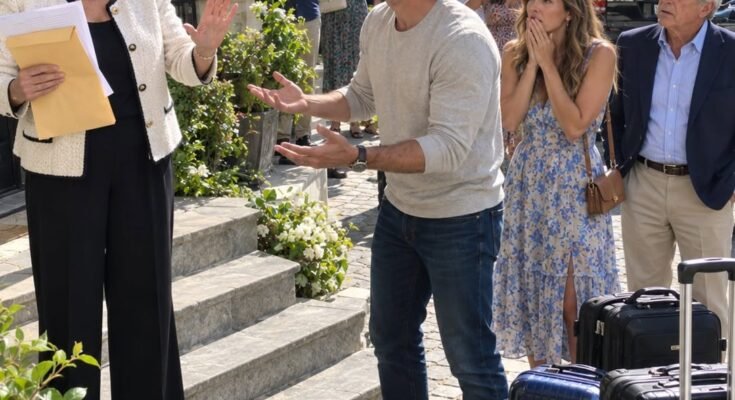
I turned toward the twenty-nine people standing in my front yard.
Several were still holding champagne glasses.
A woman near the driveway slowly lowered her phone.
Laurelai stood beside the folding chairs she’d arranged, looking as though someone had slapped her.
I held the paper a little higher.
“My son invited thirty-four people here to celebrate receiving a house I never agreed to give him.”
Nobody spoke.
Then Cullen reached for the document.
“Give me that.”
I moved it out of his reach.
“No.”
His jaw tightened.
“Mom, stop embarrassing me.”
I looked at him for a long moment.
Then asked, “Were you embarrassed by me at your wedding?”
His face went pale.
“That’s different.”
“Is it?”
He glanced toward Blythe.
She stood beside their luggage, her beautiful white sandals sinking into the grass.
“Mom, please. We can talk about this inside.”
I shook my head.
“You decided to make this a public celebration. I’m simply making sure your guests understand what they’re celebrating.”
Laurelai stepped forward.
“Mrs. Whitmore, I think you’ve made your point.”
I turned toward her.
“My name is Evelyn Whitmore,” I said. “And you are standing on my property.”
Her cheeks flushed.
I continued.
“You organized a party at my house without asking me. You invited people to watch me hand over keys I never promised to hand over. And now you’re telling me I’ve made my point?”
Laurelai opened her mouth.
Then closed it.
For the first time since I’d met her, she seemed to understand that her voice wasn’t the most important one in the conversation.
Cullen looked around nervously.
“Mom, everyone came a long way for this.”
I nodded.
“I know.”
He spread his hands.
“Then what are we supposed to do?”
I looked toward the driveway.
“Find somewhere else to celebrate.”
A quiet gasp traveled through the crowd.
And that was when Blythe’s father, Miles, stepped forward.
He had been standing near the back of the gathering, looking increasingly uncomfortable.
“Cullen,” he said quietly, “I need you to answer something.”
My son turned.
“What?”
Miles folded his arms.
“Back in June, you told me the transfer was complete.”
Cullen swallowed.
“I thought it was.”
Miles shook his head.
“No. You told me you’d seen the signed deed.”
For a moment, Cullen said nothing.
Then he looked at me.
And I understood.
He hadn’t simply misunderstood the envelope.
He’d lied.
He’d told Blythe’s family that the property was already his, even though he’d never seen my signature.
Miles turned toward me.
“Evelyn, did you ever authorize these two to move into your home?”
“No.”
“Did you promise them the property?”
I hesitated.
Then looked at the cream-colored envelope in my hand.
“I was going to.”
The words changed the entire atmosphere.
Cullen’s eyes widened.
Blythe took a step forward.
“What?”
I looked toward the house.
The gray shingles.
The white porch railings.
The blue front door Nile had painted with his own hands.
Then I said something that made my son stop breathing.
“I had intended to give Cullen an extraordinary wedding present. But apparently, I wasn’t important enough to be invited to the wedding where I planned to give it.”
I watched the realization spread across his face.
And for the first time that afternoon, he looked frightened.
Not angry.
Not offended.
Frightened.
Because he was beginning to understand exactly what he’d thrown away.
Three months earlier, I’d made an appointment with my attorney, Caroline Reeves.
Caroline had handled my estate planning for almost twenty years.
She’d known Nile before he died.
She’d helped us arrange our finances when we bought the beach house and continued advising me after I became a widow.
That afternoon, I sat across from her with a photograph of Cullen in my handbag.
It was taken during the second summer of rebuilding the house.
He was sixteen.
His hair was sun-bleached.
He stood beside Nile on the porch, holding a paintbrush and smiling as though he’d just accomplished something magnificent.
I remembered how proud Nile had been.
Our son had spent three days helping him replace damaged porch railings without complaining once.
At the end of the weekend, Nile told him, “One day, this place might be yours. Just remember how much work goes into keeping a home standing.”
I had never forgotten that.
After Nile died, the beach house became even more precious to me.
I couldn’t bear to sell it.
Some mornings, I’d drive down with nothing but a thermos of coffee and sit on the porch listening to the waves.
For a little while, I could almost imagine Nile was still inside, complaining that I’d left the kitchen light on.
As Cullen got older, I hoped he’d come to love the house the way we did.
And when he announced his engagement to Blythe, I thought I’d found the perfect occasion to give him something meaningful.
Not immediate possession.
Not the right to push me out.
But a carefully arranged future interest in the property, with my right to live there and control its use protected for the rest of my life.
Caroline had explained several options.
We discussed a trust.
A lifetime occupancy arrangement.
The responsibilities of property ownership.
And the importance of making sure I retained control of my home.
Eventually, she prepared draft documents for me to review.
I took them home in the cream-colored envelope.
Alongside them, I placed a handwritten note from Nile.
A note I’d found years earlier in the back of his old woodworking notebook.
It was the one thing I’d intended to read aloud to Cullen on his wedding day.
But the day never came.
Instead, I learned about my only son’s marriage from a telephone call made at an airport.
And the first thing he wanted to discuss after announcing his wedding was moving into my house.
As if the place where Nile and I had built our happiest memories was simply a prize Cullen had finally become old enough to collect.
I looked at the crowd.
Then at my son.
“Cullen, do you remember the summer your father taught you to repair the porch?”
He frowned.
“Mom, what does that have to do with anything?”
“Do you remember?”
He sighed.
“Yes.”
“You were sixteen.”
“I know.”
“You complained that replacing the damaged boards was taking forever.”
A few guests smiled uncertainly.
I continued.
“Your father told you that a house didn’t remain beautiful because someone owned it. It remained beautiful because somebody cared enough to maintain it.”
Cullen looked away.
I touched the porch railing.
“Nile and I spent six summers rebuilding this place.”
My voice began to shake.
“We didn’t hire a designer. We didn’t have a million dollars. We repaired what we could afford, saved for the next job, and slowly made the house livable.”
I swallowed.
“Your father worked on this porch with a broken finger because he was too stubborn to admit he needed help.”
A faint laugh escaped Miles.
I smiled sadly.
“He would come home exhausted, then drive out here on Saturdays because he wanted us to have somewhere beautiful.”
My eyes filled.
“And after he died, I kept coming because I could still feel him here.”
Cullen’s expression changed.
For the first time, he looked toward the house instead of the documents.
But Laurelai interrupted.
“Evelyn, nobody is trying to erase your memories. We’re simply trying to help the newlyweds begin their lives.”
I turned toward her.
“By removing my husband’s photograph from the mantel?”
The silence was immediate.
Blythe froze.
Miles looked at his daughter.
“What photograph?”
I took my phone from my purse.
Then showed him the picture I’d taken when I discovered Nile’s framed portrait face down in the drawer.
Miles stared.
Blythe’s cheeks turned bright red.
Laurelai looked away.
I asked quietly, “Who moved it?”
Nobody answered.
I looked toward Cullen.
“Was it you?”
He swallowed.
“No.”
I turned to Blythe.
She began crying.
“I thought you wouldn’t mind.”
For a moment, I couldn’t speak.
Then I asked, “Why would you think that?”
She looked toward her mother.
“Laurelai said the house needed to feel like ours.”
Miles closed his eyes.
Blythe continued.
“She said keeping photographs of people who had passed away in the main living room would make the place feel old.”
I stared at her.
Old.
My husband.
Our marriage.
The memories that made the house worth keeping.
All reduced to something that didn’t suit a young couple’s decorating plans.
I took a slow breath.
“Blythe, you didn’t ask me.”
Her eyes filled.
“I know.”
“You moved your belongings into my bedroom.”
She looked down.
“You took my robe out of the closet.”
A tear slipped down her cheek.
“And you put my husband’s photograph in a drawer because it didn’t suit the atmosphere you wanted.”
She began sobbing.
“I didn’t realize how much it meant to you.”
I looked at her for a long time.
Then said quietly, “That was the problem.”
Nobody spoke.
Then I added, “You never tried to find out.”
Behind us, someone cleared his throat.
A woman in a pale green dress approached.
I recognized her from the wedding photographs.
She’d been standing beside Blythe during the ceremony.
“Excuse me,” she said hesitantly. “Mrs. Whitmore?”
“Yes?”
“My name is Daphne. I’m a friend of Blythe’s.”
I nodded.
She looked uncomfortable.
“I just wanted to say I thought you were ill.”
I felt my stomach tighten.
“What?”
Daphne swallowed.
“At the wedding. Cullen told everyone you were too sick to travel.”
I looked directly at my son.
He closed his eyes.
Daphne continued.
“We asked whether we could send flowers. He said you didn’t want anyone bothering you.”
I stared at him.
For several seconds, I couldn’t speak.
Then I asked one question.
“Cullen, did you tell forty-six people your mother was ill because you didn’t want them asking why I wasn’t there?”
He didn’t answer.
I waited.
Finally, he whispered, “Yes.”
Something inside my chest gave way.
Not loudly.
Not dramatically.
Just a quiet breaking.
For weeks, I’d been trying to understand how my son could exclude me from his wedding.
Now I knew he’d made arrangements to hide the exclusion.
He’d told the guests I was sick.
He’d told Blythe’s parents he already owned the house.
He’d invited strangers to celebrate receiving property that still belonged to me.
And he’d moved into my bedroom before asking whether I agreed.
I looked at him.
“Why?”
He stared at the ground.
“Mom—”
“Why, Cullen?”
His voice cracked.
“Because you wouldn’t have fit in.”
The words hung in the air.
Somewhere beyond the porch, a gull cried.
Cullen swallowed.
“The wedding was formal. Blythe’s family has important connections. There were investors, business owners, people who could help my career.”
I stood very still.
He continued.
“You don’t like those kinds of events.”
I stared at him.
“Did I ever tell you that?”
He shook his head.
“You always say people put too much importance on appearances.”
“Because they do.”
He looked frustrated.
“That’s exactly what I mean!”
His voice rose.
“You would’ve talked about Dad fixing the house, or how we used to eat sandwiches on the porch. Everyone else would’ve been discussing investments and property values.”
I couldn’t believe what I was hearing.
He was embarrassed because I might have told people how his father and I had built the home he wanted to inherit.
I looked down at my hands.
Age spots.
A few scars.
Fingers that weren’t as strong as they used to be.
These were the hands that packed Cullen’s school lunches.
Washed his clothes.
Helped him with homework.
Held his father’s hand through the final months of his illness.
And apparently, they weren’t sophisticated enough to appear in his wedding photographs.
I took a breath.
“Cullen, do you remember what your father said when we first bought this house?”
He shook his head.
I looked toward the ocean.
“He said, ‘Someday, we’ll have something money can’t buy.’”
My son frowned.
“But you bought the house.”
I smiled sadly.
“Yes.”
I looked back at him.
“We bought the building. We spent years creating the home.”
The crowd was silent.
Then Miles stepped forward.
He looked at Cullen.
“Son, I need to say something.”
Cullen looked relieved.
Perhaps he expected another wealthy man to take his side.
But Miles’s expression was grave.
“You told me your mother had already given you this house.”
Cullen swallowed.
“Yes.”
“You asked me to help finance the renovations you wanted to make.”
My eyes widened.
“What renovations?”
Miles looked toward me.
“I was told they were planning to replace the porch, redesign the kitchen, and build a large outdoor entertainment area.”
I stared at Cullen.
“The porch?”
The very porch Nile and I had spent two summers restoring?
Cullen looked away.
“Mom, it’s old.”
I looked at the white wooden railings.
They needed paint in a few places.
One step had a slight creak.
But they were sturdy.
Beautiful.
Full of memories.
I whispered, “So was your father.”
My son flinched.
Miles shook his head.
Then he turned toward Laurelai.
“We need to stop this.”
She looked horrified.
“Miles, think about the guests.”
He stared at her.
“I am thinking about them.”
Then he looked toward the folding chairs.
“We brought these people here under the impression we were celebrating a lawful gift.”
Laurelai lowered her voice.
“Don’t make a scene.”
Miles gave a short, humorless laugh.
“We’ve already made one.”
He turned toward the guests.
“Everyone, I’m sorry. There has been a serious misunderstanding, and this celebration is canceled.”
A few people began collecting their belongings.
Others looked toward me apologetically.
Daphne approached and took my hand.
“Mrs. Whitmore, I’m sorry about the wedding.”
I nodded.
“Thank you.”
She hesitated.
“Your son told us you didn’t want to attend.”
I closed my eyes.
Of course he had.
Not only had I supposedly been ill.
I had apparently refused the invitation.
My absence had been turned into my own decision.
Daphne squeezed my fingers.
“For what it’s worth, I think it’s awful.”
Then she left.
One by one, the guests departed.
The folding chairs were gathered.
Empty glasses were collected.
The people who had come to watch a seventy-one-year-old widow hand over her house began driving away.
But my son stayed.
He stood beside the suitcases with Blythe.
And when the last guest disappeared down the road, he turned toward me.
“Mom, can we please talk now?”
I looked at him.
“We can.”
He exhaled.
“Thank God.”
Then he stepped toward the front door.
I raised one hand.
“Not inside.”
He stopped.
“What?”
“We can talk on the porch.”
His face hardened.
“Mom, seriously?”
I looked toward Nile’s blue door.
“Yes.”
Cullen stared at me.
Then let out a bitter laugh.
“You’re treating me like a stranger.”
My throat tightened.
I thought about the wedding.
The hidden photograph.
The suitcases.
The lies.
Then I answered quietly.
“Cullen, for the past few weeks, you’ve behaved like someone I don’t recognize.”
He looked away.
Blythe began crying again.
I gestured toward the porch chairs.
“Sit down.”
They did.
For a while, nobody spoke.
Then Cullen leaned forward.
“Mom, I know we made mistakes.”
I nodded.
“Yes.”
“But we’ve already given up our apartment.”
“I know.”
“And we can’t afford another place immediately.”
I looked at him.
“Where did you plan to live before you decided this house was yours?”
He frowned.
“We’d already made the arrangements.”
“With whom?”
He stared at me.
“With Dad’s old house.”
I shook my head.
“Your father’s house is now my house, Cullen.”
He looked irritated.
“You know what I mean.”
“No,” I said calmly. “I don’t think you understand what that means.”
He sighed.
“Mom, you’re seventy-one. You don’t need a house this big.”
I looked around.
Three bedrooms.
A small kitchen.
A living room facing the ocean.
A porch.
Hardly a mansion.
Just a house made valuable by its location and the years of care Nile and I put into it.
“Cullen, do you intend to tell me where I should live too?”
He hesitated.
Then looked at Blythe.
She wiped her cheeks.
“We thought you might enjoy a smaller condominium.”
I stared at her.
A condominium.
They had planned my future.
Without telling me.
Without asking.
Exactly as they had planned the wedding, the move, and the welcome-home party.
I took a breath.
“Did either of you consider that I might want to stay here?”
Cullen looked confused.
“But you’ve got your place in town.”
I nodded.
“I do.”
“Then why do you need two houses?”
I looked toward the ocean.
“Because this is where I come to remember your father.”
My voice trembled.
“And because after forty-eight years of marriage, I think I’ve earned the right to decide where I spend my mornings.”
Cullen lowered his eyes.
For a moment, he looked almost ashamed.
Then he asked, “So what happens to us?”
I studied him.
There was something terribly familiar about the question.
When Cullen was six and lost his bicycle, he’d asked me what we were going to do.
When he failed a college course, he’d asked me how we were going to fix it.
When he got behind on his car payments, he’d called asking whether I could help.
I’d spent thirty-nine years solving problems for my son.
Sometimes I helped when I should have let him figure things out himself.
Maybe that was one of my mistakes.
But it didn’t mean I had to keep making it.
“Cullen,” I said gently, “you and Blythe need to make a plan.”
He stared at me.
“You’re really not going to help?”
I took a slow breath.
“I can help you locate temporary lodging. I can explain what needs to happen before you rent another apartment. But I’m not giving you my house because you’ve already promised it to other people.”
He covered his face.
For a moment, I felt the familiar urge to soften everything.
To offer him the guest room.
To tell him he could stay a few weeks.
To pretend this was all a misunderstanding.
Then I remembered his voice at the airport.
People with status.
And I stayed quiet.
Blythe finally spoke.
“Mrs. Whitmore?”
I looked at her.
“Yes?”
She swallowed.
“Can I ask you something?”
“Of course.”
“Were you really going to give Cullen the house?”
I glanced at the cream-colored envelope.
“Yes.”
Her eyes widened.
“On our wedding day?”
“That was my intention.”
She began crying harder.
For a moment, I almost felt sorry for her.
Then she asked, “What changed?”
I stared at her.
“Blythe, you moved my belongings out of my own bedroom.”
She looked down.
“You packed away my husband’s photograph.”
Her shoulders began shaking.
“You helped arrange a celebration where I was expected to hand over keys without being asked whether I wanted to.”
I paused.
“And you never once called to ask why your husband’s mother wasn’t at her only son’s wedding.”
She covered her face.
I continued gently.
“I didn’t change my mind because you wore an expensive dress or married at a fancy venue.”
I looked toward Cullen.
“I changed my mind because you both behaved as though the things I’d spent a lifetime building were already yours.”
Neither spoke.
Then I opened the cream-colored envelope again.
I removed a smaller folded page.
It was yellowed along the edges.
Nile’s handwriting stretched across the front.
FOR CULLEN, WHEN HE’S READY.
My son stared at it.
“Is that Dad’s?”
I nodded.
He reached for it.
I hesitated.
Then handed it to him.
Cullen unfolded the paper.
His eyes moved across the page.
And almost immediately, his expression changed.
I watched him read.
Son,
If your mother is giving you this letter, it means she believes you’re ready to understand what this house represents.
When we bought it, we didn’t have much money.
The roof leaked. The porch was half-rotten. Your mother cried the first night because there was sand in the bedsheets and the plumbing barely worked.
I smiled through my tears.
That was true.
I’d cried.
And Nile had tried to comfort me by saying we could always sleep in the truck.
The letter continued.
You probably remember helping me paint the front door blue.
You thought I chose the color because it matched the ocean.
Actually, your mother chose it because she said the house needed something cheerful.
Cullen gave a small, broken laugh.
Then he kept reading.
I hope this house gives you the same happiness it gave us.
But I want you to remember something important.
You don’t inherit a home simply by receiving the keys.
You inherit the responsibility of caring for what other people built before you.
His hands began trembling.
Your mother sacrificed more than you’ll ever know to keep this place in our family.
She worked, saved, painted, repaired, and loved this house through every storm.
If you ever become its owner, I hope the first thing you do is thank her.
And if she’s still alive when you read this, I hope you understand that the house is hers before it is ever yours.
Cullen stopped reading.
Tears filled his eyes.
But he continued.
Don’t confuse wealth with character, son.
The people worth keeping in your life won’t care whether your house is worth twenty thousand dollars or two million.
They’ll care whether you’re the kind of man who opens the door when someone needs you.
Love, Dad.
Cullen lowered the paper.
For several seconds, he stared at it.
Then he looked toward the blue door.
His lips trembled.
“Mom…”
I wiped my cheeks.
He looked at me.
“You were really going to give it to me?”
I nodded.
“Yes.”
His face crumpled.
“And I didn’t even invite you.”
I looked down.
“No.”
Then he began crying.
Not the angry tears of someone who had lost something expensive.
Something different.
He looked like a little boy who had finally realized how badly he’d hurt his mother.
For a moment, I wanted to hold him.
But I stayed in my chair.
Because his sadness didn’t erase mine.
Cullen wiped his face.
“Dad would’ve been ashamed of me.”
I thought about Nile.
His patience.
His stubbornness.
His fierce love for Cullen.
I took a breath.
“I think your father would’ve been very hurt.”
Cullen nodded miserably.
Then he looked at the suitcases.
“Can we at least take our things?”
I stood slowly.
“Of course.”
The suitcases and boxes had been stored safely while they were away and brought outside shortly before their arrival. I’d already checked with my attorney about how to handle their belongings and unauthorized use of the property.
I wasn’t interested in destroying anything.
I simply wanted my house back.
Cullen gathered the luggage.
Miles returned from his car and helped load it.
Laurelai sat in the passenger seat of their SUV, staring straight ahead.
She hadn’t spoken another word to me.
Before leaving, Miles approached.
“Evelyn.”
I turned.
“Yes?”
He removed his sunglasses.
“I owe you an apology.”
I shook my head slightly.
“You didn’t know what Cullen had told me.”
He nodded.
“But I should have asked you directly before arranging anything involving your property.”
I appreciated that.
He continued.
“And I should have questioned why you weren’t at the wedding.”
My eyes filled.
“Thank you.”
Miles hesitated.
“Blythe and Cullen can stay with us while they work things out.”
I nodded.
“I’m glad they have somewhere safe to go.”
He glanced toward the house.
Then said something unexpected.
“For what it’s worth, Nile sounds like he was a remarkable man.”
I smiled sadly.
“He was.”
Miles looked toward the blue door.
“And you two built something beautiful.”
My throat tightened.
“Yes.”
He shook my hand.
Then went back to his car.
When everyone finally left, the house became quiet.
The folding chairs were gone.
The champagne glasses had been collected.
The suitcases had disappeared from the lawn.
And the only sound was the ocean beyond the dunes.
I sat on the porch.
Held Nile’s photograph against my chest.
And cried.
Not because I’d won.
Not because my son had been embarrassed in front of twenty-nine people.
I cried because I had never imagined I’d need to defend my home from my own child.
I cried because my husband wasn’t there.
And because, after seventy-one years of living, I was finally realizing that loving someone doesn’t always mean giving them what they want.
Sometimes it means allowing them to live with the consequences of their choices.
The following Monday, I visited Caroline.
My attorney examined the cream-colored envelope.
Then the draft deed.
Then the strip of tape someone had used to reseal it.
She looked up.
“Evelyn, I’m glad you didn’t sign this without reviewing it again.”
I nodded.
“So am I.”
She placed the papers aside.
“The draft never became an effective transfer. The house remains titled in your name.”
I looked down.
“Cullen thought he’d already inherited it.”
Caroline gave a sad little smile.
“An inheritance doesn’t happen simply because someone expects one.”
I sighed.
Then asked, “What should I do now?”
She studied me.
“What do you want to do?”
For a moment, I couldn’t answer.
I was so accustomed to thinking about Cullen’s future that I hadn’t considered my own.
Finally, I said, “I want to keep my home.”
Caroline nodded.
“Then let’s make sure your documents reflect that.”
We reviewed my estate plan.
I kept ownership of the beach house and updated the instructions concerning what would happen to it after my death.
I didn’t make irreversible decisions out of anger.
But I removed the assumption that Cullen would automatically receive the property.
We also discussed protections for my future care and financial decisions.
When Caroline asked whether I wanted to tell Cullen about the changes, I shook my head.
“No.”
She looked at me.
“Why not?”
I thought about the wedding.
The miniature beach house on the cake.
The lie about my illness.
Then I answered.
“Because I want to know whether my son is interested in having a mother when there isn’t a two-million-dollar house waiting at the end.”
Caroline became quiet.
Then nodded.
“I understand.”
For the next six weeks, Cullen didn’t call.
Blythe sent one short message apologizing for moving Nile’s photograph.
I replied that I appreciated her apology.
Laurelai sent nothing.
Miles called once to make sure the matter had been settled without further conflict.
But my son remained silent.
At first, that silence hurt terribly.
Every morning, I checked my phone.
Every evening, I wondered whether Cullen was waiting for me to apologize.
Then one afternoon, I received a package.
There was no return address.
Inside was a small wooden frame.
And a photograph.
Nile and Cullen painting the front door blue.
Cullen was sixteen.
Nile had one hand on his shoulder.
Both were laughing.
I’d forgotten that photograph existed.
Attached was a note.
Mom,
I found this in an old box while we were sorting our things.
I remembered Dad telling me to hold the paintbrush properly because I kept getting blue paint on the hinges.
I also remembered you bringing us lemonade and sandwiches because we were too stubborn to stop working.
I’m sorry I forgot what this place meant to you.
Cullen.
I sat at the kitchen table holding the photograph.
Then I cried.
It wasn’t a complete apology.
He hadn’t addressed the wedding.
Or the lies.
Or the way he’d treated my house as his own.
But it was the first time he’d contacted me without asking for something.
I placed the photograph beside Nile’s portrait on the mantel.
And waited.
Two weeks later, Cullen called.
“Mom?”
I swallowed.
“Hello, sweetheart.”
He became quiet.
Then said, “Can we talk?”
I took a breath.
“Yes.”
“Could I come see you?”
I looked toward the ocean.
“Here?”
He hesitated.
“I don’t want the house. I just want to see you.”
My eyes filled.
Those were the words I’d been hoping to hear.
But I needed to know whether they were true.
“Cullen, I need you to understand something.”
“Okay.”
“I am not giving you the beach house.”
Silence.
“I don’t know what will happen to it after I’m gone. I’ve made arrangements, and those arrangements are my decision.”
He swallowed.
“I understand.”
“Do you?”
“Yes.”
He took a shaky breath.
“Mom, I don’t want to talk about the house.”
I closed my eyes.
“Then come by Sunday.”
He exhaled.
“Thank you.”
That Sunday, Cullen arrived alone.
No expensive clothes.
No suitcases.
No expectation of being given a key.
He wore jeans and an old college sweatshirt.
The same one he’d worn when he visited during Thanksgiving years earlier.
He stood at the front door holding a grocery bag.
“Hi, Mom.”
I smiled faintly.
“Hello, Cullen.”
He looked nervous.
“Are you hungry?”
I almost laughed.
That was usually my question.
He lifted the bag.
“I brought sandwich stuff.”
I stepped aside.
“Come in.”
For a moment, he hesitated at the doorway.
Then he looked at me.
“Is it okay?”
I felt tears filling my eyes.
He was asking permission.
In a house he’d once treated as his own.
I nodded.
“Yes.”
We made sandwiches.
Sat at the kitchen table.
And talked.
At first, about ordinary things.
His work.
The weather.
How Blythe was adjusting to their new apartment.
The repairs the beach house needed before winter.
Then Cullen put down his sandwich.
“Mom.”
I looked up.
“There’s something I need to say.”
I waited.
He swallowed.
“I lied about you.”
My chest tightened.
“I know.”
He looked down.
“I told everyone at the wedding you were sick because I didn’t want them asking why you weren’t invited.”
His voice cracked.
“I was ashamed that I cared more about impressing Blythe’s friends than having my own mother there.”
Tears rolled down my cheeks.
Cullen continued.
“I also knew the deed wasn’t finished.”
I stared at him.
He nodded miserably.
“I saw the unsigned page.”
I felt something inside me sink.
“You knew?”
“Yes.”
“Then why did you tell everyone the house was yours?”
He covered his face.
“Because I’d already told them it would be.”
He shook his head.
“And I thought if enough people expected you to give it to me, you’d feel too embarrassed to refuse.”
I stared at him.
For several seconds, I couldn’t speak.
There it was.
The truth.
He hadn’t misunderstood.
He’d used an audience to pressure me.
Just as he’d used the wedding guests to hide his decision not to invite me.
I took a slow breath.
“Cullen, that’s a cruel thing to do to anyone.”
He nodded.
“I know.”
“But especially to your mother.”
He began crying.
“I know.”
I looked toward Nile’s photograph.
Then asked something I’d been carrying for weeks.
“Why wasn’t I good enough for your wedding?”
Cullen raised his head.
His face crumpled.
“Mom, you were.”
I shook my head.
“Then why?”
He wiped his eyes.
“Because I was trying to become someone I thought other people would admire.”
I sat quietly.
He continued.
“Blythe’s friends have successful families. Her parents know business owners and investors. Everybody seemed to have more than I did.”
I frowned.
“Cullen, you have a good job. You’ve built a life.”
“I know.”
His voice broke.
“But I started feeling like it wasn’t enough.”
He looked around the kitchen.
“And then people found out about this house.”
I felt cold.
He continued.
“Suddenly, everyone treated me differently. They asked about the property. They wanted to know what it was worth.”
He stared at the table.
“I liked feeling important.”
I closed my eyes.
He added quietly, “And somewhere along the way, I started believing I deserved it.”
I thought about Nile.
The man who used to patch his work boots rather than buy new ones.
The man who taught our son to save part of every paycheck.
The man who never cared what kind of car someone drove.
I took a breath.
“Your father would have wanted you to be proud of the life you’ve built, Cullen.”
My voice cracked.
“Not ashamed of the people who helped you build it.”
He began sobbing.
For several minutes, neither of us spoke.
Then he whispered, “I’m sorry, Mom.”
I looked at him.
“I believe you’re sorry.”
His face lifted.
“But I’m still hurt.”
He nodded.
“I know.”
“And I need time.”
“I understand.”
I reached across the table.
He took my hand.
For a moment, he looked like the little boy who used to come home from school with scraped knees and ask me to make everything better.
But I couldn’t make this better for him.
Not entirely.
He had to learn how to live differently.
When Cullen left that afternoon, he hugged me.
I hugged him back.
Then he stepped away.
And for the first time in months, I felt the faint possibility that our relationship might survive without the house becoming part of the bargain.
It wasn’t instant forgiveness.
It wasn’t a perfect reconciliation.
But it was a beginning.
Over the following year, Cullen made changes.
Some were small.
He started calling without asking for money or favors.
He visited on ordinary Sundays.
Sometimes he brought groceries.
Sometimes he helped carry heavy things.
And when I told him I didn’t need assistance, he accepted it.
Blythe apologized to me in person.
She admitted she’d enjoyed the attention that came from telling her friends she was moving into a nearly two-million-dollar beach house.
She’d imagined hosting parties.
Redecorating.
Showing people photographs of the ocean view.
She hadn’t imagined the woman who had spent a lifetime caring for the property.
I appreciated her honesty.
But I didn’t pretend it erased what happened.
Blythe and I became civil.
Then gradually friendlier.
She asked about Nile.
About the rebuilding.
About how we’d chosen the paint colors.
And one afternoon, she brought me a framed copy of the photograph Cullen had found.
It showed Nile holding a paintbrush beside the blue front door.
“I thought you might like this for the hallway,” she said.
I smiled.
“Thank you.”
She looked embarrassed.
“I know I can’t make up for putting his picture away.”
I nodded.
“No.”
Then I looked at the frame.
“But I appreciate you trying.”
Our relationship grew slowly from there.
Not because I was expecting it.
But because she began treating me like a person rather than an obstacle between her and a beautiful house.
The following summer, a storm damaged part of the porch.
Nothing catastrophic.
Just several loose boards and a broken railing.
I called a contractor.
Before he arrived, Cullen called.
“Mom, I heard about the storm.”
“I’m fine.”
“I know.”
He hesitated.
“Would you like me to come help with the porch?”
I looked toward the damaged railing.
For a moment, I remembered him at sixteen.
Holding the paintbrush.
Arguing with Nile about whether the blue was too bright.
Then I said, “You can come Saturday.”
He sounded surprised.
“Really?”
“Yes.”
“But Cullen?”
“Yeah?”
“I’ve already hired a contractor for the structural repairs. I don’t want you climbing around doing something dangerous.”
He laughed.
“Okay, Mom.”
“You can help me sand and repaint the railing when it’s ready.”
He became quiet.
Then said softly, “I’d like that.”
A few weeks later, we spent a Saturday painting the repaired porch.
Cullen arrived early.
He wore old jeans.
Brought paintbrushes.
And a cooler filled with sandwiches and lemonade.
I stood watching him work.
He was forty now.
Older than Nile had been when we first bought the house.
His hair had begun thinning slightly.
He complained about his knees when he crouched too long.
I smiled.
“You sound like your father.”
Cullen laughed.
“He always said this porch would be the death of him.”
I shook my head.
“He said that about every repair.”
We worked for several hours.
At lunchtime, Cullen sat beside me on the steps.
The ocean stretched blue and endless beyond the dunes.
For a while, we simply ate.
Then he looked toward the front door.
“Mom?”
“Yes?”
“Do you remember when Dad let me paint that door?”
I smiled.
“Of course.”
He looked embarrassed.
“I thought I’d done a great job.”
“You did.”
He laughed.
“Dad told me afterward that you had to go back and fix half of it.”
I started laughing.
“He told you that?”
Cullen nodded.
“He said you didn’t want to hurt my feelings.”
I wiped my eyes.
“Well, you did get paint on the hinges.”
He laughed harder.
Then his expression softened.
“I miss him.”
My throat tightened.
“So do I.”
He looked down.
“I think I forgot what losing him did to you.”
I stared at the ocean.
Cullen continued.
“I was so busy thinking about what Dad left behind that I stopped thinking about who was missing.”
My eyes filled.
He swallowed.
“And I treated you like you were already gone too.”
For a long moment, neither of us spoke.
Then I reached for his hand.
He squeezed mine.
“I can’t change what happened at the wedding,” he whispered.
“No.”
“I can’t give you that day back.”
My voice broke.
“No.”
He looked at me.
“But I want to be your son again. Not someone waiting for an inheritance.”
I smiled through my tears.
“Then just be my son.”
He began crying.
And that afternoon, sitting on the porch we’d once rebuilt as a family, something between us finally began to heal.
Not because I’d promised him the house.
I hadn’t.
Not because he’d apologized enough times.
But because he’d stopped asking what I could give him.
And started asking how I was doing.
That was all I’d wanted from the beginning.
Two years after the wedding, Cullen and Blythe bought a small townhouse.
Nothing fancy.
Two bedrooms.
A little fenced yard.
A kitchen that needed new cabinets.
They’d saved carefully.
Worked with a lender.
Made a budget.
And chosen a place they could afford.
When Cullen called to tell me, he sounded happier than I’d heard him in years.
“Mom, we did it!”
I smiled.
“Congratulations, sweetheart.”
He laughed.
“It’s not exactly the point.”
I looked toward the ocean.
“No.”
Then I added, “But it’s yours.”
He became quiet.
“Yeah.”
I could hear the smile in his voice.
“It is.”
A few weeks later, he invited me over.
When I arrived, Blythe was unpacking dishes.
Cullen stood in the doorway holding a set of keys.
He smiled.
“Welcome to our house, Mom.”
I laughed.
“Thank you.”
Then he looked at the keys.
For a moment, his expression changed.
He remembered.
So did I.
The lawn.
The suitcases.
The folding chairs.
The day he’d demanded keys to my house.
Cullen swallowed.
“Mom, can I tell you something?”
“Of course.”
He looked down at the keys.
“Two years ago, I thought having your house would make me successful.”
I waited.
He continued.
“But standing here, knowing we saved for this place ourselves…”
His voice cracked.
“I don’t think I’ve ever been prouder of anything.”
My eyes filled.
I hugged him.
And for the first time in a long while, I felt proud of him too.
Not because he’d bought a house.
Because he’d finally understood what it meant to build something that belonged to him.
Today, I’m seventy-four.
I still own the beach house.
The gray shingles need occasional maintenance.
The porch has been repainted.
And the blue front door still makes me smile every time I see it.
Nile’s photograph is back on the mantel.
Exactly where it belongs.
Beside it is another picture.
Cullen at sixteen, holding a paintbrush while his father laughs beside him.
Some mornings, I sit on the porch with my coffee and watch the waves.
I think about all the years Nile and I spent working on this place.
The leaky roof.
The broken windows.
The evenings we ate sandwiches because we’d spent too much money on lumber to go out for dinner.
And I remember how happy we were.
Not because the house was worth nearly two million dollars.
We never imagined it would be.
We were happy because we’d built it together.
Sometimes people ask whether I ever gave Cullen the deed.
I tell them no.
My estate plan is private, and I review it with my attorney when circumstances change.
But I no longer treat the house as something I must promise anyone to secure their affection.
I have made arrangements for my own care and for the property’s future.
Those decisions are mine.
Cullen knows that.
And, to his credit, he no longer asks.
Last September, on the anniversary of that disastrous welcome-home gathering, Cullen called me.
“Mom?”
“Hello, sweetheart.”
He sounded cheerful.
“Blythe and I were wondering whether you’d like to come over Sunday.”
I smiled.
“For what?”
“Dinner.”
I raised an eyebrow.
“Any special occasion?”
He laughed.
“No.”
Then he added something that made me sit very still.
“We just want to see you.”
I looked toward Nile’s photograph.
Tears filled my eyes.
“Sunday sounds lovely.”
After we hung up, I sat on the porch for a long time.
The ocean was calm.
A warm breeze moved through the railings.
And I thought about the day my son called from an airport to announce he’d married without me.
I remembered how carefully I’d hidden my hurt.
How I congratulated him.
Wished him a safe flight.
Then drove to the beach house and discovered he’d already begun taking over.
I remembered finding Nile’s photograph face down in the drawer.
I remembered changing the locks.
The wedding cake with a miniature version of my house.
The message claiming I was sick.
The thirty-four invitations.
And the twenty-nine people standing in my yard waiting for me to give away something I had never promised.
At the time, I thought the worst part was being excluded from the wedding.
But that wasn’t quite true.
The worst part was realizing my son had stopped seeing me as his mother.
He saw me as the person standing between him and a valuable property.
A seventy-one-year-old widow whose home had become more important than her presence.
That hurt more than I knew how to explain.
But the day I refused to hand over the keys was also the day something began to change.
Not immediately.
Not painlessly.
There were months of silence.
Difficult conversations.
Apologies.
And the slow, uncomfortable work of rebuilding trust.
But eventually, Cullen learned that loving his mother didn’t require owning her house.
And I learned something too.
I could love my son without giving him everything he wanted.
I could help him without solving every problem.
I could invite him into my home without surrendering my right to decide who lived there.
And I could protect the memories Nile and I had built without feeling guilty for enjoying them while I was still alive.
One afternoon, I found myself rereading Nile’s old letter.
Don’t confuse wealth with character, son.
The people worth keeping in your life won’t care whether your house is worth twenty thousand dollars or two million.
I smiled.
Nile had written those words long before the property became so valuable.
Long before Cullen met Blythe.
Long before anyone imagined serving a three-tier wedding cake topped with a miniature beach house.
Yet somehow, he’d understood the lesson our son would eventually need.
I folded the letter and placed it back in its envelope.
Then I looked toward the blue front door.
The same one Nile painted.
The same one Cullen helped repair.
The same one I’d locked against my own son when he tried to claim a home that wasn’t his.
And I realized something.
A door can be closed to protect what matters without remaining closed forever.
Sometimes people need to understand why they can no longer enter before they’re ready to respect an invitation.
Cullen eventually learned.
And when I invited him back, he came as my son.
Not as a future owner.
Not as someone expecting a gift.
Just my son.
That was worth more to me than any document Caroline had ever prepared.
I still have the unsigned deed.
It’s tucked away with the old wedding invitation I never received, the photograph of Nile, and the letter he wrote for Cullen.
Sometimes I think about how differently everything might have happened.
If Cullen had invited me to his wedding, I would have stood proudly beside him.
I would have worn the blue dress I’d bought for the occasion.
I would have cried when he exchanged his vows.
I would have hugged Blythe.
And at the reception, I would have taken out that cream-colored envelope.
I would have told them about Nile.
About the summers we spent rebuilding the house.
About the importance of protecting what had been entrusted to us.
Then I would have revealed the extraordinary gift I’d spent months planning.
Instead, Cullen decided I wasn’t important enough to attend.
He chose the people he thought had status.
And in doing so, he nearly lost something no amount of money could replace.
Not the beach house.
His relationship with his mother.
Fortunately, that was something we eventually found a way to repair.
But it required something neither a deed nor a set of keys could provide.
Respect.
Last Sunday, Cullen and Blythe came to visit.
We sat on the porch eating sandwiches.
Just as Nile and I used to.
At one point, Cullen looked around.
“Mom, this place really is beautiful.”
I smiled.
“Yes, it is.”
He looked toward the ocean.
Then said quietly, “Dad would’ve loved seeing us all here.”
My throat tightened.
“He would have.”
Cullen reached over and took my hand.
“Thanks for letting us come.”
I smiled through my tears.
“Thank you for asking.”
And as we sat there watching the waves, I realized that was all I’d ever wanted.
Not a fancy wedding invitation.
Not a public apology.
Not people applauding me for owning an expensive property.
I wanted my son to remember that before I was the owner of a $1.94 million beach house, I was the woman who raised him.
The woman who loved his father.
The woman who helped build the home he wanted so badly.
My son thought a beach house would give him status.
But the day he tried to take it without asking, he nearly lost the one person who would’ve gladly shared it with him.
In the end, I didn’t need to prove I was wealthier or more powerful than anyone at that wedding.
I simply needed to remember something Nile had taught me years earlier.
A home isn’t valuable because important people want to visit.
It’s valuable because the people inside it know how to treat one another with love and respect.
And after seventy-four years of living, I know one thing for certain.
The keys to my house are mine to give.
But the way my son treats me will always matter more than whether I give them to him.