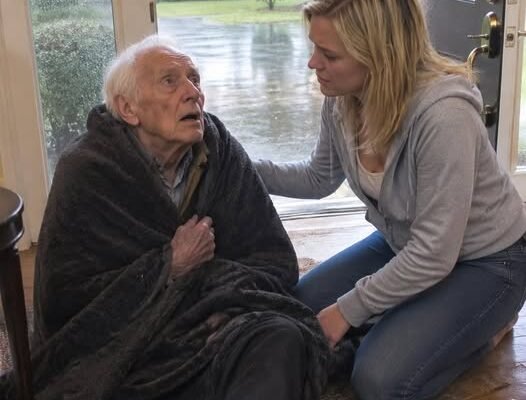
The first thing I did after Victor told me about the three-million-dollar trust was call for emergency medical help.
The second was photograph the note my husband had left on the kitchen counter.
I wanted to remember every word.
Mom and I decided to take a last-minute Carnival cruise. We both needed a break. Since you’re coming home, you can look after Victor.
For eleven years, I’d served in the Army. I’d learned to keep my head during emergencies, make decisions under pressure, and recognize when a situation was beyond what I could safely manage myself.
But nothing in my military career had prepared me for the sight of my seventy-two-year-old father-in-law sitting in a freezing house, too weak to reach a glass of water.
When the paramedics arrived, one of them took a single look at Victor and became serious.
“How long has he been like this?”
I swallowed. “I don’t know. His wife and son left for a cruise, and I found him when I came home.”
The paramedic looked toward the empty medication tray.
“Has he had his prescribed medicine?”
“I can’t confirm that. I found a bottle that concerns me, so I haven’t given him any of it.”
He nodded and continued assessing Victor.
Within minutes, they were preparing to transport him to the hospital. Victor’s temperature was dangerously low, and he showed signs of significant dehydration.
As they lifted him onto the stretcher, he reached for my hand.
“Jenna?”
“I’m here.”
His fingers trembled.
“Don’t let them tell you I’m confused.”
I leaned closer.
“I won’t.”
He swallowed.
“Brady knows what he did.”
My stomach tightened.
Before I could ask what he meant, the paramedics moved him toward the ambulance.
I followed in my SUV.
At the hospital, I stayed until a physician confirmed that Victor was receiving treatment for hypothermia, dehydration, and complications associated with his advanced cancer.
The medical team also arranged an appropriate pain-management plan.
Only then did I allow myself to sit down.
My hands were shaking so badly that I spilled half a cup of coffee across the waiting-room table.
I stared at the mess.
Then I started crying.
Not because I was frightened of Brady.
Not because of the three million dollars.
I cried because the man who had welcomed me into his family had nearly died in a freezing house while his wife and son were enjoying cocktails on a cruise ship.
And neither of them had bothered to call.
The following morning, I received my first message from Brady.
Hope you got Dad settled. Mom says he was being dramatic about the heating. We’ll be home Monday.
I read it twice.
Then took a screenshot.
I didn’t answer.
Ten minutes later, he sent another.
Don’t start anything, Jenna. This was supposed to be a relaxing vacation.
I looked through the hospital-room window.
Victor was asleep beneath warm blankets.
A nurse had just helped him drink some water.
His face was pale, and the loose skin around his neck made him look far older than seventy-two.
I looked back at my phone.
Don’t start anything.
My husband had left a dying man without adequate care in a house without heat.
And apparently, the real problem would be my reaction.
I put my phone away.
For the first time in our marriage, I wasn’t interested in making Brady comfortable.
By Friday afternoon, three people had entered Victor’s hospital room who would change everything.
The first was a hospital social worker named Monica Hayes.
The second was an adult protective services investigator.
And the third was a woman in her late sixties wearing a navy suit and carrying a leather briefcase.
She introduced herself as Margaret Collins.
“Mr. Flores, I’m glad Jenna called me.”
Victor opened his eyes.
“Margaret.”
She pulled a chair beside his bed.
“I’ve been worried about you.”
He gave a tired smile.
“I’ve had better Thanksgivings.”
Margaret looked toward me.
“Jenna, I’m Victor’s estate-planning attorney. I’ve represented him for nearly fifteen years.”
I nodded.
Victor had mentioned her name the night before, and with his permission, I’d contacted her.
Margaret opened her briefcase.
“Victor, before we discuss anything financial, I need to make sure you understand that nothing has to be decided today. Your health comes first.”
He smiled faintly.
“Still giving orders, Margaret?”
“Someone has to.”
He managed a quiet laugh.
Then looked at me.
“Jenna, sit down. It’s time you understood something.”
I pulled up a chair.
Victor took a slow breath.
“Brady thinks I spent everything after my cancer diagnosis.”
I frowned.
“He told me your medical expenses were enormous.”
“They are.”
Victor nodded.
“But I planned carefully.”
He looked toward Margaret.
“My retirement accounts, investment portfolio, and proceeds from the sale of my old manufacturing business are held through arrangements we established years ago.”
Margaret continued.
“Victor has a revocable living trust with substantial assets held at Vanguard and other institutions. The most recent valuation was approximately three million dollars.”
I stared at her.
Three million.
The number sounded even more extraordinary coming from an attorney than it had from Victor’s trembling lips.
“But Brady said you had almost nothing left.”
Victor’s expression darkened.
“My son says a lot of things.”
Margaret placed a folder on the bedside table.
“Victor retains control of the trust while he has capacity. His existing documents also establish how financial decisions should be handled if he becomes unable to make them.”
She looked at Victor.
“We’ve already discussed reviewing your current arrangements in light of what happened.”
He nodded.
“I want that done.”
Then he turned toward me.
“Do you know what Brady asked me six months ago?”
I shook my head.
“He wanted me to make him sole trustee immediately.”
My stomach tightened.
“Why?”
“He said I was getting too old to manage money.”
Victor gave a bitter little laugh.
“Apparently, seventy-two is old enough to lose your mind but young enough to be left alone in a freezing house.”
Margaret’s expression remained serious.
Victor continued.
“Elaine kept telling me I needed to trust Brady. Said the money should stay in the family.”
He closed his eyes.
“So I asked one question.”
I leaned forward.
“What?”
“What would happen to my medical care if I gave them control?”
He looked at me.
“Neither one answered.”
The room fell silent.
I remembered how Brady had spoken about Victor over the past year.
How much trouble it was to arrange appointments.
How expensive his prescriptions were.
How difficult his father had become.
I’d been away on military assignments and training for much of that time.
Whenever I called, Brady assured me everything was fine.
Dad’s being stubborn.
Mom has it handled.
You know how he gets.
Now I wondered how long those words had been hiding something terrible.
Margaret gently closed the folder.
“Victor, I also need to ask about the medication Jenna found.”
His expression changed.
He looked toward the window.
“Elaine handled all of it.”
“Did you ever receive medication directly from the pharmacy?”
“Not recently.”
“Did you know what she was giving you?”
He hesitated.
“Some days it helped. Other days I could barely feel any relief.”
My chest tightened.
Margaret nodded.
“We won’t speculate about what happened. The medical team and investigators can review the prescription records and the bottle Jenna preserved.”
Victor looked at me.
“Do you think she took my medicine?”
I wanted to say yes.
I wanted to tell him everything I suspected.
But suspicion wasn’t proof.
So I took his hand.
“I don’t know, Victor. But we’re going to find out.”
He studied my face.
Then nodded.
“Good.”
A few minutes later, Margaret asked whether he wanted to review his estate documents once his doctors confirmed he was well enough to make those decisions.
Victor smiled weakly.
“I’ve been thinking about that for months.”
He looked at me.
“Jenna, I want you to know something. I’m not changing anything because you rescued me and earned some reward.”
My eyes filled.
“I don’t want your money, Victor.”
“I know.”
He squeezed my hand.
“That’s exactly why I trust you.”
Then he said something that made me cry.
“You’ve been more of a daughter to me than I ever expected when Brady brought you home.”
I lowered my head.
Victor continued.
“When my cancer got worse, you called from training. Sent letters. Remembered my appointments. You even mailed me those terrible crossword puzzle books because you thought I’d get bored.”
I laughed through my tears.
“You complained about every one.”
“They were impossible.”
He smiled.
“But you remembered I liked crosswords.”
His expression softened.
“That’s what family is supposed to do, Jenna. Remember each other.”
I held his hand until he drifted to sleep.
That evening, I went back to the house.
The heating system was working again.
The kitchen had been cleaned enough to eliminate the immediate health hazards, but I had documented the original conditions before changing anything.
The photographs were already with the appropriate investigators.
The note remained preserved.
So did the medication bottle.
I walked into the living room and stood beside Victor’s rocking chair.
For years, he’d sat there watching football with Brady.
Sometimes the two of them argued so loudly about the Carolina Panthers that I had to turn up the television in the bedroom.
Victor used to laugh whenever Brady became frustrated.
“Boy, if you can’t handle losing a football game, you aren’t ready for real life.”
I remembered those afternoons.
The laughter.
The teasing.
The way Victor always asked whether I wanted the last piece of pie.
Then I looked at the stained carpet beneath his chair.
And I wondered when my husband had become someone who could leave his own father like that.
I found myself crying again.
Then my phone rang.
Brady.
I let it go to voicemail.
A minute later, Elaine called.
I didn’t answer that either.
But I listened to her message.
“Jenna, honey, I hope you’re not making a big deal out of the house being cold. Victor insists on keeping the windows open sometimes. You know how confused he gets with all those medications.”
I stared at the phone.
She continued.
“We’ll be home Monday. Please don’t upset him with unnecessary doctors or hospital visits. He’s very fragile.”
I saved the message.
Then sat at the kitchen table.
They were still on vacation.
Still enjoying themselves.
Still assuming I would clean everything up before they returned.
And they had no idea Victor had already spoken to an attorney, social worker, and investigator.
Saturday morning brought another surprise.
I was reviewing our household accounts when I noticed several recent transactions.
A charge from the cruise line.
A large travel-related payment.
And multiple purchases at a luxury shopping center.
All connected to an account Brady and I had used for household expenses.
The account contained money I’d inherited from my grandmother.
I’d deposited part of that inheritance there because Brady and I had agreed it would serve as our emergency reserve.
Not a vacation fund.
Not a shopping allowance for Elaine.
And certainly not money to spend while abandoning his terminally ill father.
I printed the statements.
Then requested the underlying records from the bank so I could establish what had actually happened.
By Saturday afternoon, I’d identified more than fourteen thousand dollars in travel-related spending and transfers I had never approved.
I sat staring at the total.
Fourteen thousand dollars.
Victor had been left without adequate care.
Yet Brady and Elaine had somehow found money for a balcony cabin, premium drinks, shopping, and excursions.
I called Margaret.
She referred me to a family-law attorney named Claire Donovan, who agreed to review my financial documents and advise me about my marriage.
When Claire asked what outcome I wanted, I sat quietly for a moment.
Then I answered.
“I want to know exactly what my husband has been doing with our money.”
She nodded.
“And what about the marriage?”
I looked toward the wedding photograph hanging above the hallway table.
Brady and me.
Eleven years earlier.
Smiling beneath an archway covered with white flowers.
I’d loved him.
I had loved the man who wrote me letters during my first deployment, who drove three hours to surprise me on my birthday, and who cried when he proposed.
But I could no longer reconcile that man with the person who left his dying father in a freezing house.
“I think my marriage is over,” I whispered.
Claire didn’t try to change my mind.
She simply said, “Then we’ll make sure you understand your rights and options before you make any legal decisions.”
I nodded.
For the first time in days, I felt something other than anger.
I felt clearheaded.
Sunday afternoon, the hospital called.
Victor had improved enough to sit upright and eat a proper meal.
His body temperature was stable.
His dehydration was being treated.
The doctors were adjusting his medications and arranging appropriate support for when he could eventually leave the hospital.
But his cancer remained advanced.
That part hadn’t changed.
I drove over immediately.
When I entered his room, he was sitting in bed watching a football game.
“Sergeant Flores,” he announced.
I smiled.
“Marine.”
He pointed at the television.
“Your Panthers are embarrassing themselves.”
I laughed.
“Some things never change.”
He smiled.
Then his expression softened.
“Come sit.”
I pulled up a chair.
He looked at me for a long moment.
“You look tired.”
“I’ve had a busy weekend.”
He nodded.
“Brady called you?”
“Several times.”
“Did you answer?”
“No.”
Victor smiled faintly.
“Good.”
I looked at him.
“Victor, I need to ask something.”
“Go ahead.”
“Did Brady know you couldn’t take care of yourself?”
His smile disappeared.
He looked toward the television.
Then he nodded.
“Yes.”
My stomach tightened.
“How do you know?”
“Because I told him.”
The room became very still.
Victor continued.
“Two days before they left, I asked him to arrange someone to stay with me.”
I felt cold.
“He said you were coming home Thursday.”
My hands clenched.
“I told him Thursday wasn’t soon enough.”
Victor swallowed.
“He said I was exaggerating.”
I closed my eyes.
Then he said something that broke my heart.
“I asked him not to turn the heat down because I was cold all the time.”
A tear slipped down my cheek.
“He said heating an empty house was expensive.”
I looked at him.
“An empty house?”
Victor nodded.
“That’s what he called it.”
I covered my mouth.
Victor reached for my hand.
“Jenna, I’ve made mistakes with my son.”
I shook my head.
“Don’t.”
“No. Let me say it.”
He took a slow breath.
“When Brady was younger, I worked too much. I thought being a good father meant earning money and giving him whatever he wanted.”
He stared at the ceiling.
“When I retired, I thought I could make up for the time I’d missed.”
His voice cracked.
“So I kept giving.”
“A car.”
“Help with the mortgage.”
“Money when he got behind.”
He looked at me.
“And now he treats me like an account he’s waiting to inherit.”
I began crying.
Victor wiped his eyes.
“I don’t know when that happened.”
For a while, neither of us spoke.
Then I leaned closer.
“Victor, what happened to you wasn’t your fault.”
He looked at me.
“You deserved proper care. You deserved heat. You deserved someone who checked whether you were safe before they got on a cruise ship.”
He nodded slowly.
I squeezed his hand.
“And you don’t have to earn those things by giving anyone money.”
He closed his eyes.
A tear rolled down his cheek.
“Thank you, Jenna.”
That evening, Margaret visited again.
Victor’s treating physician had confirmed he was sufficiently alert to discuss his affairs, and Margaret arranged an independent assessment of his decision-making capacity for the proposed legal changes.
Everything was done carefully.
No rushed signatures.
No dramatic transfer of three million dollars.
No attempt to punish anyone through paperwork that could later be challenged.
Victor reviewed his financial arrangements with his attorney and an independent fiduciary.
He revoked certain authorizations Brady had previously held and directed that the management of his investments remain with qualified professionals.
He also revised his estate instructions after receiving legal advice.
Margaret later explained to me that Victor had chosen to leave a substantial portion of his estate to support veterans and families facing serious illnesses.
He still made provisions for people he loved.
But the assumption that Brady and Elaine would eventually control everything was gone.
Victor didn’t ask me to manage his fortune.
He wanted me to remain his family.
That distinction meant more than any inheritance could have.
Monday morning arrived cold and bright.
Brady and Elaine’s cruise had ended.
At 9:16 a.m., my husband sent a message.
We’re driving home. Hope Dad hasn’t been too difficult.
I stared at the screen.
Then showed it to Margaret, who was sitting across from me at the dining table.
She shook her head.
“Do you want to be here when they arrive?”
I took a breath.
“Yes.”
She studied me.
“Then we’ll keep this orderly. You don’t need to argue with either of them.”
I nodded.
The home had been documented, and Victor was safely receiving medical care elsewhere.
After speaking with the investigator, we’d arranged for a visible security camera to cover the front entrance, consistent with the legal advice I’d received. My conversations would not be secretly recorded; any interview or statement needed to be handled properly.
I wasn’t trying to trap anyone into a dramatic confession.
I wanted a record of who came and went, and I wanted witnesses present in case the confrontation became hostile.
At 11:42 a.m., Brady’s SUV pulled into the driveway.
I watched through the front window.
Elaine climbed out wearing oversized sunglasses and a bright turquoise jacket.
She was carrying two shopping bags.
Brady removed three suitcases from the back of the vehicle.
They looked relaxed.
Tanned.
Well-rested.
Neither had any idea how close Victor had come to dying.
Brady opened the front door.
“Jenna?”
I stood in the living room.
“Hello, Brady.”
He smiled.
“Hey, babe.”
Then he noticed Margaret.
His smile faded.
“Who’s this?”
Elaine followed him inside.
She took off her sunglasses.
“Where’s Victor?”
I looked directly at her.
“In the hospital.”
Her face changed.
“What?”
Brady dropped his suitcase.
“Dad’s in the hospital?”
“Yes.”
He stared at me.
“Why?”
For a moment, I couldn’t believe the question.
Then I said quietly, “Because when I arrived, he was dangerously cold, dehydrated, and unable to care for himself.”
Elaine immediately shook her head.
“Oh, that’s ridiculous. Victor always makes things sound worse than they are.”
I watched her.
She hadn’t asked whether he was alive.
Hadn’t asked what hospital he was in.
Hadn’t asked whether he’d recovered.
She simply began defending herself.
Margaret stood.
“Mrs. Flores, my name is Margaret Collins. I’m Victor’s attorney.”
Elaine froze.
Brady looked confused.
“Dad has an attorney?”
Margaret’s expression remained calm.
“Yes.”
Brady gave a nervous laugh.
“For what?”
“His estate planning and other legal affairs.”
Elaine quickly set down her shopping bags.
“Victor doesn’t need a lawyer. I’m his wife.”
Margaret nodded.
“You are his wife. He’s also an adult who has the right to independent legal representation.”
Elaine’s face reddened.
“I don’t like your tone.”
Margaret didn’t react.
“I understand.”
Brady turned toward me.
“Jenna, what exactly have you been doing while we were gone?”
I stared at him.
“Keeping your father alive.”
He flinched.
“Come on.”
I didn’t move.
He continued.
“Mom said Dad was being dramatic. You know how he gets.”
I took the note from the table.
Then placed it in front of him.
“Did you write this?”
He looked down.
“Yeah.”
“Did you arrange a caregiver for Victor?”
He hesitated.
“You were coming home.”
“Thursday evening.”
“So?”
I felt my chest tighten.
“Brady, you left earlier in the week.”
He looked away.
“He was fine when we left.”
I took a breath.
“Your father says he told you he couldn’t manage alone.”
Brady’s expression hardened.
“Dad says a lot of things.”
I looked at him.
“He also says he asked you not to turn down the heat.”
Elaine stepped forward.
“Jenna, enough. We’re not going to be lectured in our own home.”
Margaret quietly intervened.
“The ownership and occupancy questions concerning this home can be addressed separately. Right now, Victor’s welfare and the circumstances of his care are being investigated.”
Elaine stared at her.
“Investigated?”
“Yes.”
Brady’s face changed.
“What kind of investigation?”
I answered.
“Adult protective services has been notified. Medical professionals have documented his condition, and law enforcement is reviewing the information provided.”
Elaine took a step backward.
“You called the police on us?”
I looked at her.
“I called for help because Victor was in danger.”
Brady turned toward me.
“Are you insane?”
I stared at him.
Eleven years.
Eleven years of marriage.
And that was what he chose to say.
Not I’m sorry.
Not Is Dad going to be okay?
Not I should have handled this differently.
He called me insane.
I took a breath.
“Brady, I’ve also spoken to an attorney about our marriage.”
His expression shifted.
“What?”
I looked him directly in the eyes.
“I’m filing for divorce.”
He laughed.
A sharp, disbelieving laugh.
“Over this?”
I nodded.
“Over what you’ve become.”
For several seconds, he simply stared at me.
Then Elaine stepped forward.
“Jenna, don’t be dramatic. Brady has been under a lot of stress.”
I looked at her.
“So has Victor.”
She opened her mouth.
I continued.
“He has stage-four cancer. He is frightened, in pain, and physically dependent on other people.”
My voice cracked.
“And the two people he trusted most decided he was too inconvenient to care for.”
Elaine’s face hardened.
“You don’t understand what it’s like living with a sick person.”
I stared at her.
“No.”
I shook my head.
“I understand that being a caregiver can be exhausting. I understand needing respite.”
Then I looked toward Brady.
“But respite means arranging someone qualified to take over. It doesn’t mean leaving a person who cannot stand on his own in a freezing house.”
Brady looked away.
Elaine crossed her arms.
“Victor has plenty of money. He can pay for whatever care he wants.”
The room became silent.
Margaret looked at her.
“Are you aware of Victor’s financial arrangements?”
Elaine shrugged.
“He has his pension and whatever savings are left.”
Brady nodded.
“Exactly. We’re practically paying for everything.”
I stared at him.
Then I remembered the money missing from our account.
The cruise charges.
The shopping bags.
The expensive cabin.
I took another folder from the table.
“Brady, we also need to discuss the money spent on this trip.”
His face tightened.
“What about it?”
I showed him the statements.
“These payments came from our household account funded in part by my inheritance.”
He glanced at the papers.
“We’re married, Jenna.”
“I know.”
“So what’s mine is yours, and what’s yours is mine.”
I looked at him.
“That doesn’t mean you can avoid accounting for how the money was used.”
His eyes narrowed.
“Are you accusing me of stealing?”
“I’m asking for an accurate explanation.”
He laughed bitterly.
“You’re really going to make this a legal issue?”
“Yes.”
The word came out without hesitation.
For the first time, Brady seemed to understand that I wasn’t going to withdraw my concerns simply because he was angry.
Then Margaret spoke.
“There is another matter Victor authorized me to address with you.”
Elaine straightened.
“What?”
Margaret opened her folder.
“Victor has reviewed his financial authorizations and estate-planning documents with independent legal advice. Certain permissions previously granted to family members have been revoked, and his assets are being safeguarded through the appropriate fiduciary arrangements.”
Brady frowned.
“What assets?”
Margaret remained calm.
“Victor has substantial investments.”
Elaine laughed.
“Oh, please. He’s been complaining about medical bills for months.”
I looked at her.
“And you assumed that meant he was penniless?”
She didn’t answer.
Brady folded his arms.
“How substantial?”
Margaret glanced toward me.
Then looked back at him.
“Victor has authorized limited disclosure of the fact that his trust holds assets valued at approximately three million dollars.”
Brady’s face went completely white.
Elaine grabbed the back of a chair.
“Three million?”
Margaret nodded.
“Approximately.”
For a moment, nobody spoke.
Then Brady began laughing nervously.
“Dad has three million dollars?”
“Yes.”
“And he never told us?”
Margaret closed the folder.
“He was not obligated to.”
Elaine stared at her.
“But I’m his wife!”
Margaret nodded.
“Your legal rights are something your own attorney can advise you about. Victor’s rights and the applicable trust arrangements are also being respected.”
Brady took a step closer.
“Wait a minute. If Dad has that much money, why didn’t he pay for a full-time caregiver?”
I felt something inside me break.
That was his question.
Not whether Victor was recovering.
Not whether he had been frightened.
Not whether he’d suffered.
His first concern was why his father hadn’t spent his own money to solve the problem Brady and Elaine had created.
I looked at him.
“Because the people responsible for arranging his care kept telling him they had it under control.”
Brady stared at me.
Then he turned toward Margaret.
“So what happens to the trust when he dies?”
I couldn’t believe what I was hearing.
His father was alive.
Recovering in a hospital.
And Brady was already asking about his inheritance.
Margaret’s expression hardened slightly.
“Mr. Flores, Victor is alive and capable of discussing his affairs. Any information about future distributions will be provided only as required and appropriate.”
Elaine suddenly began crying.
“This is unbelievable. Victor is punishing us for taking one vacation.”
I stared at her.
“One vacation?”
My voice shook.
“Elaine, he was sitting in his own urine because nobody was there to help him.”
She covered her mouth.
I continued.
“He was cold. Dehydrated. In pain.”
Tears ran down my face.
“And you left him a few bananas.”
Brady looked toward the kitchen.
For a moment, something resembling shame crossed his face.
Then Elaine snapped, “We expected you to come home!”
I wiped my cheeks.
“And if my car had broken down?”
Neither answered.
“If the roads had closed because of the storm?”
Silence.
“If my commanding officer had changed my leave?”
Brady lowered his eyes.
I looked at both of them.
“What would have happened to Victor?”
Nobody spoke.
Then I said quietly, “That’s the question investigators are going to ask too.”
I stepped away from the table.
“I’ve said what I needed to say.”
Brady reached toward me.
“Jenna, wait.”
I moved back.
He stopped.
For the first time, he looked frightened.
“Can we talk privately?”
I shook my head.
“No.”
“Please.”
I looked at the man I’d married.
I remembered the letters he wrote when I was deployed.
The nights he waited up for my calls.
The promises he made about loyalty and family.
Then I remembered Victor shivering beneath that thin blanket.
“Brady, you had days to think about what you were doing.”
He swallowed.
“And you still got on that ship.”
I picked up my bag.
“My attorney will contact you.”
Then I walked out.
The investigation continued over the following weeks.
And the evidence became increasingly difficult for Brady and Elaine to explain.
The hospital records documented Victor’s condition when he was admitted.
The photographs showed the state of the house.
The note established that they had expected me to assume responsibility without confirming whether I would arrive in time.
Their messages and travel records established when they’d left and what arrangements they had—or had not—made.
Investigators also reviewed Victor’s account of asking for help before the trip.
But the most disturbing development involved the medication.
A laboratory analysis raised serious concerns about the contents of the bottle I’d preserved.
The solution contained substantially less active medication than would have been expected from the labeled concentration.
The lab result alone couldn’t establish who had altered it or when.
That required a separate investigation.
Pharmacy dispensing records were obtained through the appropriate process.
Investigators reviewed prescription pickups, communications, and the handling of Victor’s medication.
Additional evidence eventually supported allegations that prescribed medication had been diverted.
I remember sitting in my attorney’s office when she told me.
For several seconds, I couldn’t speak.
I’d suspected something was wrong.
But hearing that professionals had found evidence supporting those concerns made me physically sick.
Victor had been suffering.
And someone he trusted was suspected of interfering with the medication intended to relieve that suffering.
I drove to his care facility afterward.
By then, he had been discharged from the hospital to a medical setting where his pain and daily needs could be managed properly.
He was sitting near a window, wearing a navy cardigan.
His favorite Marine Corps cap rested on the table beside him.
When he saw me, he smiled.
“Sergeant.”
I forced a smile.
“Marine.”
He studied my face.
“Bad news?”
I sat beside him.
“Some difficult news.”
I explained what the investigators had found, carefully distinguishing what was confirmed from what was still being examined.
Victor listened without interrupting.
When I finished, he looked toward the window.
For a long time, he said nothing.
Then he whispered, “I thought Elaine was helping me.”
My heart tightened.
“I know.”
He closed his eyes.
“I thought when the medicine stopped working, it meant the cancer was winning.”
I reached for his hand.
He squeezed it.
Then tears began rolling down his cheeks.
“I was afraid, Jenna.”
I moved closer.
He continued.
“I’ve faced a lot in my life. I thought I knew what fear felt like.”
His voice cracked.
“But being in pain and not knowing whether anyone cares enough to help you…”
He couldn’t finish.
I wrapped my arms around him carefully.
And for several minutes, my once-commanding father-in-law cried against my shoulder.
I didn’t tell him to be strong.
I didn’t remind him he was a Marine.
I didn’t say everything would be fine.
I simply stayed.
Because that was what he needed.
Over the following months, the authorities pursued the matters they determined were supported by the evidence, including allegations involving elder neglect and medication diversion.
Brady and Elaine obtained attorneys.
There were interviews, hearings, and legal proceedings.
I cooperated when asked and let the professionals handle their work.
I had no interest in manufacturing a dramatic confrontation or using Victor’s money to influence anyone.
The evidence needed to speak for itself.
Meanwhile, Claire helped me separate my finances from Brady’s.
The money spent during the cruise became part of the financial accounting in our divorce.
Some of the disputed funds were addressed through the settlement.
I didn’t recover every dollar.
But I recovered enough to close that chapter without allowing it to consume the rest of my life.
The hardest part wasn’t the legal paperwork.
It was explaining to people why I was leaving my husband.
Some relatives insisted I was overreacting.
Others said Brady had been overwhelmed by his father’s illness.
A few suggested that I should understand how exhausting caregiving could become.
I agreed with that last part.
Caregiving can be exhausting.
Families need help.
They need breaks.
They need access to professional support.
But the answer to caregiver exhaustion is not abandonment.
And I refused to let anyone describe what happened as an ordinary family disagreement.
One afternoon, my aunt called.
“Jenna, marriage is supposed to survive difficult times.”
I sat quietly.
Then said, “I know.”
“So why not give Brady another chance?”
I thought about the man I’d found in that rocking chair.
Then I answered.
“Because I need to be able to trust the person I’m married to.”
My aunt sighed.
“Everyone makes mistakes.”
I nodded.
“Yes.”
Then I said something I hadn’t fully understood until that moment.
“But some choices tell you who a person is when nobody is watching.”
She became quiet.
I continued.
“If Brady could leave his father helpless and cold, how could I trust him to care for me if I ever became dependent on someone?”
She had no answer.
And neither did I.
My divorce was finalized the following year.
Brady and I had several difficult conversations during that time.
Some ended in arguments.
Others ended with him crying.
Once, he told me he’d never intended for his father to become seriously ill while they were gone.
I looked at him.
“Victor was already seriously ill.”
He lowered his eyes.
“I mean, I didn’t think he would deteriorate that quickly.”
I took a breath.
“Brady, your father told you he couldn’t manage alone.”
He said nothing.
“You knew.”
He wiped his face.
“Yes.”
It was the first time he’d admitted it to me without an explanation attached.
Then he whispered, “I thought you’d get there.”
I stared at him.
“And you didn’t care what happened before I did?”
He began crying.
“I didn’t think about it.”
I looked away.
That was perhaps the most painful answer of all.
He hadn’t thought about what might happen.
Not because he didn’t understand his father’s condition.
But because he’d convinced himself someone else would eventually handle it.
For years, that someone had been me.
I had arranged appointments.
Picked up medications.
Checked on Victor while I was on leave.
Sent supplies.
Made calls.
And tried to fill the gaps whenever Brady and Elaine complained that the situation was becoming too difficult.
They had grown accustomed to my taking responsibility.
So accustomed that they booked a cruise and assumed I would simply arrive in time to fix everything.
I looked at Brady.
“I can’t build a marriage with someone who treats my care for his father as a reason to stop caring himself.”
He covered his face.
“I know.”
I didn’t know whether he truly understood.
But I knew I was finished trying to explain.
Victor’s financial affairs also changed.
With independent legal advice and appropriate confirmation of his capacity, he completed the revisions he’d requested.
A professional fiduciary was appointed to handle certain administrative responsibilities, and he arranged for his medical care to be funded securely.
He established a charitable fund supporting veterans facing serious medical hardships and families struggling to afford respite care.
When Margaret explained the arrangements, I smiled.
“That sounds like Victor.”
He gave a tired laugh.
“Thought you might approve.”
I squeezed his hand.
“I do.”
He looked at me.
“Jenna, I also made a provision for you.”
I immediately shook my head.
“Victor—”
He lifted one finger.
“Let me finish, Sergeant.”
I stopped.
He smiled.
“You’ve never asked me for money.”
“I don’t want your money.”
“I know.”
His expression softened.
“But I want you to have something that comes from me, not from guilt or obligation.”
I looked down.
He continued.
“You’ve spent years serving your country and caring for other people. I’d like to help make sure you have a little more freedom to decide what comes next.”
I started crying.
“Victor, you don’t owe me anything.”
He squeezed my hand.
“I know.”
Then he smiled.
“That’s what makes it a gift.”
I didn’t ask how much.
I didn’t need to know.
What mattered was that he understood the difference between love and a transaction.
He wasn’t paying me for keeping him alive.
He was making a choice about his own life and legacy.
And for the first time in months, I felt grateful that someone was finally allowing him to make those choices for himself.
Victor lived another fourteen months.
They were not easy months.
His cancer continued progressing.
Some days he was alert and talkative.
Other days he slept for hours.
There were appointments, difficult conversations, medication adjustments, and moments when he was too exhausted to finish a sentence.
But he was warm.
He was clean.
His pain was treated by medical professionals.
And he was never abandoned.
When my military responsibilities allowed, I visited.
Sometimes I brought books.
Sometimes we watched football.
Sometimes I simply sat beside him while he slept.
He liked having someone there.
One afternoon, he asked me to bring his old Marine Corps dress photograph.
I found it in a box among his belongings.
He was barely twenty in the picture.
Standing straight.
Shoulders back.
Eyes full of confidence.
I placed it beside his bed.
Victor studied it.
Then laughed.
“Look at that handsome devil.”
I smiled.
“Very impressive.”
He nodded solemnly.
“Your government got its money’s worth.”
We both laughed.
Then his expression changed.
“Jenna?”
“Yes?”
“Do you think I was a good father?”
The question caught me off guard.
I looked at him.
“Victor…”
He stared at the photograph.
“I keep wondering where I went wrong with Brady.”
My heart tightened.
I pulled my chair closer.
“You loved your son.”
He nodded.
“I did.”
“You provided for him.”
“Yes.”
“You tried to give him opportunities.”
He swallowed.
“I did.”
I took a breath.
“But Victor, you couldn’t make every choice for him.”
He looked toward me.
“Some of the decisions Brady made were his own.”
His eyes filled.
I continued.
“You can regret mistakes you made as a father without accepting responsibility for everything your grown son chose to do.”
He was quiet for a long time.
Then whispered, “I wish he had been kinder.”
I felt tears filling my eyes.
“So do I.”
Victor looked down.
Then said something I’ve never forgotten.
“I could have survived having less money.”
He paused.
“I just wanted to know my family would stay when I needed them.”
I reached for his hand.
“I’m here.”
He smiled.
“I know, angel.”
And for a while, that was enough.
During his final weeks, Victor received hospice care.
His comfort became our priority.
He listened to old country music.
Asked for vanilla ice cream even when he could only manage a few bites.
And insisted someone put a small American flag on the table beside his bed.
One evening, he asked me to open the window slightly.
The air outside was cool.
“Smells like rain,” he whispered.
I smiled.
“It’s supposed to storm tonight.”
He nodded.
Then looked at me.
“Jenna, do you remember what I told you when you found me?”
I took his hand.
“The trust?”
He laughed softly.
“No.”
I frowned.
Then he smiled.
“A Marine doesn’t forget.”
I looked down.
“I remember.”
He squeezed my fingers.
“I was angry that night.”
“I know.”
“I wanted them to answer for what they’d done.”
I nodded.
Then he whispered, “But I’m glad you didn’t let me turn my last months into nothing but revenge.”
My eyes filled.
He continued.
“You made sure I was safe. You made sure the truth was documented. And then you helped me spend the time I had left living.”
I began crying.
Victor smiled.
“That’s what mattered most.”
I leaned forward and kissed his forehead.
“Thank you for letting me be part of your family.”
He looked surprised.
Then his eyes filled.
“Jenna, you didn’t become my family because you married Brady.”
I swallowed.
He continued.
“You became my family because you kept showing up.”
I cried so hard I couldn’t answer.
Victor passed away peacefully several days later.
I was beside him.
So was a hospice nurse.
His favorite country song played softly from a little speaker near the window.
I held his hand until the end.
Afterward, I sat quietly in the room for a long time.
I looked at the little Marine Corps photograph.
The folded flag.
The empty glass of water beside his bed.
Then I thought about the night I’d found him in that freezing house.
How frightened he’d looked.
How tightly he’d gripped my hand.
How he’d whispered that Brady and Elaine didn’t know what was waiting for them.
At the time, I thought he meant money.
Three million dollars.
A secret trust.
An inheritance that would shock everyone.
But by the end, I understood that the money wasn’t the most important part.
Victor had wanted his choices back.
His dignity.
His safety.
And the right to spend his final months surrounded by people who cared whether he was comfortable.
The trust helped make that possible.
But it wasn’t what made him feel loved.
At Victor’s memorial, I wore my Army dress uniform.
Several veterans attended.
A few old Marine friends told stories about Victor as a young man.
One remembered him sharing his last clean pair of socks during a miserable training exercise.
Another laughed about how Victor once drove forty miles to help a fellow Marine repair a broken truck.
I listened to every story.
Some made me laugh.
Others made me cry.
Then it was my turn to speak.
I stood at the front of the small chapel holding a folded page of notes.
For a moment, I couldn’t find my voice.
Then I looked toward Victor’s photograph.
“My father-in-law was a Marine,” I began. “And if you spent more than five minutes with him, he made sure you knew it.”
A few people laughed.
I smiled through my tears.
“He liked football, terrible coffee, and telling stories that became longer every time he repeated them.”
More laughter.
“But the thing I’ll remember most about Victor wasn’t his military service or his business success.”
I took a breath.
“It was that he never stopped believing people deserved dignity.”
My voice cracked.
“In his final months, that belief was tested. He went through things no elderly person should have to experience.”
I paused.
“But he also showed me something extraordinary.”
I looked toward the veterans sitting in the front row.
“He showed me that strength isn’t always standing tall and giving orders.”
“Sometimes strength is admitting you’re frightened.”
“Sometimes it’s asking for help.”
“And sometimes it’s allowing another person to sit beside you when you can no longer do everything yourself.”
I wiped my eyes.
“Victor gave me many things over the years.”
“Advice.”
“Laughter.”
“Some truly terrible football predictions.”
A few people chuckled.
Then I continued.
“But the greatest thing he gave me was the reminder that family is not simply who shares your name.”
I looked at his photograph.
“It’s who stays.”
When I finished, the room was silent.
Then several people stood.
Not because I’d delivered a perfect speech.
But because they knew the man I was speaking about.
And I realized that Victor had lived a life much larger than the final painful chapter his family had created.
His legacy wasn’t just a trust.
It was the people he’d helped.
The friendships he’d kept.
And the dignity he tried to preserve even when his body was failing.
The legal matters involving Brady and Elaine continued to be resolved through the appropriate processes.
Some consequences were criminal.
Others involved financial restitution, protective arrangements, and civil claims.
I didn’t attend every hearing.
I didn’t read every article or document.
By then, I had learned that justice did not require me to spend every waking hour watching what happened to them.
I had my own life to rebuild.
I continued serving in the Army.
Moved into a small apartment of my own.
Started saving again.
And eventually began sleeping through the night without waking up to check my phone.
I still had difficult days.
Sometimes I’d see a Marine Corps cap in a store and immediately think of Victor.
Sometimes football season made me unexpectedly sad.
And whenever a winter storm rolled through, I remembered that freezing Thanksgiving evening.
But gradually, the memories changed.
I stopped remembering only the stained carpet and the empty medication tray.
I remembered Victor laughing at the football game.
The way he called me Sergeant.
The sound of his voice when he complained about crossword puzzles.
And the afternoon he ate vanilla ice cream while telling me stories about his first deployment.
Those were the memories I wanted to carry forward.
A year after his death, Margaret invited me to her office.
The estate administration had progressed, and she needed to review some documents with me.
When I arrived, she handed me a small wooden box.
“Victor wanted you to have this.”
I stared at it.
“What is it?”
She smiled gently.
“Open it.”
Inside were three things.
His Marine Corps challenge coin.
A photograph of the two of us standing beside his backyard grill.
And a folded handwritten letter.
I recognized his writing immediately.
It had become shaky during his final months.
But the words were unmistakably his.
Dear Jenna,
If you’re reading this, I suppose I’ve finally reported for my last assignment.
I laughed through my tears.
That sounded exactly like Victor.
I know you never wanted anything from me.
You didn’t ask about my accounts.
You didn’t ask what I could leave you.
You asked whether I was warm, whether I was hurting, and whether I needed water.
My eyes filled.
When you found me that Thanksgiving, I was frightened.
I didn’t know how much longer I could sit in that chair.
But I knew one thing.
If anybody was going to come through that door and help me, I hoped it would be you.
I pressed the letter against my chest.
Then continued.
You once told me the Army taught you never to leave a soldier behind.
I want you to remember that you don’t have to be wearing a uniform to live by that principle.
You gave me something more valuable than another year of money in an investment account.
You gave me the chance to spend my remaining time with dignity.
And you reminded an old Marine that needing help doesn’t make a person weak.
Tears rolled down my cheeks.
I’ve arranged things so you can build the life you deserve. Use whatever I have left you wisely, but don’t spend your whole life taking care of everyone else.
Take a vacation.
Buy something unnecessary.
Laugh.
And when you find someone worth trusting again, don’t let what happened with Brady convince you that everyone will disappoint you.
I could barely see the words.
At the bottom, he’d written:
Semper Fidelis, Sergeant.
Your old Marine, Victor.
I cried for a long time.
Margaret sat quietly across from me.
Then she handed me another envelope containing the information about Victor’s gift and the arrangements he’d made.
I reviewed it carefully.
It was enough to give me meaningful financial security.
But the figure itself wasn’t what made me cry.
What mattered was knowing Victor had made his choices freely, thoughtfully, and with the help of people who respected his wishes.
Unlike the people who’d tried to take control of his life, he’d never treated money as a substitute for love.
He’d treated it as something that should be managed responsibly and used to help people.
That was the legacy I wanted to honor.
Today, several years have passed since that Thanksgiving.
I’m still in the Army.
I still wake before sunrise out of habit.
And I still hear Victor’s voice whenever somebody complains too much.
Quit whining, Sergeant. At least you’ve got two working legs.
He used to say that whenever I complained about morning physical training.
Now it makes me smile.
The charitable fund he established continues supporting veterans and families dealing with serious illness.
I receive occasional updates about its work.
One family received emergency assistance while a wounded veteran recovered from surgery.
Another received support for professional respite care when an elderly parent became dependent on help with daily activities.
I keep those updates in a folder.
Sometimes I take them out and read them.
And every time, I think about how different Victor’s final months might have been if someone had arranged proper care before taking that cruise.
It wouldn’t have erased his cancer.
It wouldn’t have made caregiving easy.
But it could have spared him fear, suffering, and neglect.
That’s why his fund matters.
Not because three million dollars is an impressive number.
But because he wanted his remaining resources to help families who understood that caring for someone requires planning, patience, and support.
Last Thanksgiving, I volunteered at a community meal for veterans.
An elderly man sat alone at the end of one table.
He wore an old Marine Corps jacket.
His hands shook as he tried to open a carton of milk.
I walked over.
“Need a hand, Marine?”
He looked up.
Then smiled.
“Only if you’re buying the next round of coffee.”
I laughed.
For a moment, I could almost hear Victor.
I opened the carton.
Brought him coffee.
Then sat beside him while he told me about his grandchildren.
Nothing dramatic happened.
There was no secret fortune.
No hidden inheritance.
No shocking revelation.
Just an old man who needed a little help.
And someone willing to give it.
That evening, I went home and took Victor’s challenge coin from its wooden box.
I held it in my palm.
Then looked at the photograph beside it.
Victor standing at the backyard grill.
Me laughing.
Both of us completely unaware of what the next few years would bring.
I smiled through my tears.
“Happy Thanksgiving, Marine.”
The apartment was quiet.
Outside, rain tapped softly against the windows.
For a moment, I thought about the night I found him.
The cold house.
The darkness.
The terrible smell.
The thin blanket.
Brady’s note.
And Victor whispering that his family had no idea what was waiting for them.
At the time, I believed the greatest surprise would be the three-million-dollar trust.
I imagined Brady and Elaine discovering they’d lost the fortune they expected to inherit.
And yes, the financial truth shocked them.
The evidence changed their lives.
Their decisions finally had consequences.
But as the years passed, I began seeing that Thanksgiving differently.
Brady and Elaine had treated Victor as though he was worthless because they believed he had nothing left to give them.
Yet the man they abandoned had enough money to secure his care, protect his dignity, and help countless other families after his death.
They had been so focused on what he might leave behind that they’d stopped seeing the person still sitting in front of them.
And that was what I could never understand.
Because when I found Victor, I didn’t see a millionaire.
I didn’t see an inheritance.
I didn’t see a man whose trust might change my future.
I saw a frightened seventy-two-year-old cancer patient who needed warmth, medical care, and somebody willing to stay.
So I stayed.
Not because I knew about the money.
Not because I expected anything.
But because he was family.
And family should never have to earn compassion by proving they have something valuable to leave you.
Sometimes I think about the note Brady left on the counter.
Mom and I decided to take a last-minute Carnival cruise. We both needed a break.
I understand needing a break.
I understand exhaustion.
I understand how caring for someone with a serious illness can overwhelm even people who love them deeply.
But I will never understand leaving someone helpless without arranging for their safety.
That wasn’t taking a break.
That was abandoning a responsibility.
And the difference matters.
Victor used to tell me that character wasn’t revealed when people were comfortable.
It was revealed when doing the right thing became inconvenient.
I didn’t fully understand that until Thanksgiving.
Brady and Elaine had chosen comfort.
A cruise.
A warm balcony.
A few days without responsibility.
They assumed someone else would handle the consequences.
And when they returned, they discovered the person they’d left behind was no longer under their control.
His care was being managed.
His finances were protected.
His decisions were being respected.
And the people he’d trusted with his life had finally been asked to account for what they’d done.
They thought the surprise waiting at home would be an angry daughter-in-law.
Instead, they found attorneys, documented evidence, a formal investigation, and the knowledge that Victor’s three-million-dollar trust was never theirs to control.
But I don’t remember that Monday as the day I defeated anyone.
I remember it as the day I refused to pretend cruelty was simply a family misunderstanding.
And if I could return to that freezing Thanksgiving evening, knowing everything I know now, I wouldn’t change the decision I made.
I’d still call for help.
Still keep Victor warm while the paramedics came.
Still preserve the evidence.
Still sit beside his hospital bed.
And when that old Marine reached for my hand and asked, “Will you help me, Sergeant?”
I’d give him exactly the same answer.
“I’m with you, Victor. But we’re going to do everything the right way.”
Because in the end, the greatest thing he left me wasn’t money.
It was the certainty that I could walk away from people who had forgotten what loyalty meant without losing that quality in myself.
A Marine doesn’t leave someone behind.
And when Victor needed somebody most, I was grateful I had been the one to come through the door.