And I knew exactly what I was going to do with it.
But first, I had to survive the night.
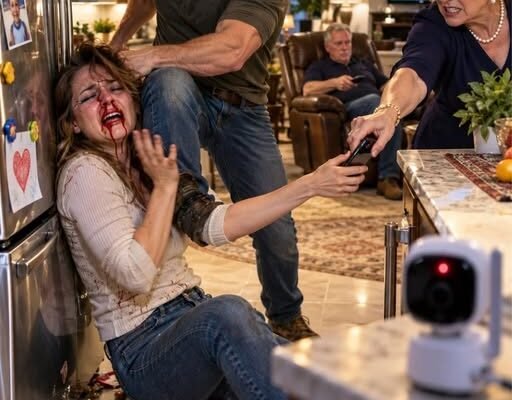
The little red light on the baby monitor blinked steadily from the shelf above the microwave. Jake had installed it six months earlier, back when his sister occasionally brought her toddler over. After one visit, nobody bothered to move it.
Jake had forgotten about it.
So had his parents.
But I hadn’t.
Three weeks earlier, I’d connected the camera to a cloud storage account under an email address Jake didn’t know existed. I’d done it after finding bruises on my upper arms and realizing I couldn’t remember how many times I’d told myself things would get better.
Now, standing in my kitchen with blood dripping through my fingers, I understood why I’d made that decision.
“Rachel.”
Jake snapped his fingers in front of my face.
“Are you listening to me?”
I lowered my eyes.
“Yes.”
“Then clean yourself up. You’re getting blood everywhere.”
Linda tossed my phone onto the counter, just out of reach.
“And don’t you dare tell your sister another ridiculous story,” she warned. “That girl has been trying to destroy this family since the day you married Jake.”
I nodded.
For the first time in seven years, I didn’t argue.
I didn’t defend myself.
I didn’t beg him to understand.
I simply reached for a dish towel, pressed it against my face, and walked toward the bathroom.
Behind me, Don turned up the television.
I heard Jake laugh at something his mother said.
That sound stayed with me longer than the pain.
Because it wasn’t the laugh of a man who had lost control.
It was the laugh of a man who believed he would never face consequences.
He was wrong.
I locked the bathroom door and sank onto the edge of the bathtub.
My reflection was almost unrecognizable.
My nose was swollen and crooked. One eye was already turning purple. Blood stained the collar of my blouse, the same blouse I’d worn to work that morning while smiling at customers and answering emails.
I was thirty-four years old.
I had a college degree, a steady job, and a savings account that Jake had gradually drained.
Yet I was sitting in my own bathroom, afraid to make a sound.
For a moment, the familiar voice returned.
Maybe I should have started dinner earlier.
Then I caught sight of myself again.
And something inside me revolted.
No.
There was no dinner late enough to justify this.
No argument serious enough.
No mistake I could make that would excuse a grown man driving his knee into my face.
I pulled a fresh towel from the cabinet and held it gently beneath my nose.
My hands were still trembling.
I wasn’t suddenly fearless.
I wasn’t some movie heroine who could stare down three people twice her size and deliver a perfect speech.
I was terrified.
But beneath the terror was something new.
Clarity.
I couldn’t safely confront Jake. I couldn’t count on Linda or Don to help. And I couldn’t gamble my life on the hope that tomorrow would be different.
I needed to get out.
I needed a doctor.
And I needed that recording.
A knock rattled the door.
“Rachel?” Jake called.
I froze.
“What are you doing in there?”
“Cleaning up.”
“You better not be calling anybody.”
“My phone’s in the kitchen.”
A pause.
Then he chuckled.
“Good girl.”
His footsteps retreated.
I stared at the door until I couldn’t hear him anymore.
Those two words almost made me sick.
Good girl.
As though I were a dog he’d finally trained.
I looked at the tiny silver wedding band on my finger.
Seven years earlier, Jake had slipped it on while promising to protect me, cherish me, and stand beside me through every hardship.
I remembered how he’d cried during his vows.
How Linda had hugged me and called me the daughter she’d always wanted.
How Don had raised a champagne glass and said, “Welcome to the family.”
I wondered when I had stopped being family and started being property.
Then I stopped wondering.
The answer didn’t matter anymore.
At eleven forty that night, Jake finally went upstairs.
His parents had left twenty minutes earlier, after Linda insisted I’d embarrassed everyone by being “hysterical.”
I sat on the couch, holding an ice pack wrapped in a towel against my face.
Every heartbeat sent pain through my nose.
Jake came downstairs once to get water.
He looked at me and rolled his eyes.
“You’re really going to sit there like that all night?”
I didn’t answer.
“Tomorrow, I expect you to apologize to Mom.”
I kept staring at the television.
“For what?”
“For making her uncomfortable.”
There it was.
I had been assaulted in my kitchen.
And somehow, Linda was the victim.
“I understand,” I whispered.
He seemed satisfied.
“Don’t come upstairs if you’re going to keep sniffling.”
When his footsteps disappeared, I waited.
Five minutes.
Ten.
Fifteen.
Then I heard his snoring through the bedroom door.
I retrieved my phone from the kitchen counter.
The screen had a small crack along one corner, but it still worked.
My first instinct was to call my sister, Emily.
Then I remembered what had happened the last time I’d told her about Jake.
She had begged me to leave.
I’d promised I would.
And two days later, I’d called her back to say everything was fine.
I had repeated Jake’s explanations almost word for word.
He’s stressed.
He didn’t mean it.
We’re working on our marriage.
Emily had gone quiet.
Not because she believed me.
Because she knew I didn’t believe myself.
Now I opened our message thread.
I typed five words.
I need you. Please come.
Her reply appeared almost immediately.
Where are you?
Home. Jake’s asleep. My nose is broken.
Three little dots appeared.
Disappeared.
Appeared again.
I’m calling 911. Can you get outside safely?
I stared at the message.
Then I typed:
Yes. Back door.
I pulled on my coat, grabbed my purse, and took my car keys from the hook beside the refrigerator.
At the back door, I paused.
My eyes went to the family portrait hanging above the dining table.
Jake and I stood beneath a maple tree, smiling in the autumn sunlight.
His arm was wrapped around my waist.
People always said we looked happy in that photograph.
I knew something they didn’t.
Two hours before it was taken, Jake had screamed at me for wearing the wrong shoes.
I left the photograph on the wall.
I didn’t need another reminder of the life I’d been pretending to have.
I stepped into the cold night air and didn’t look back.
The police arrived before Emily.
Two officers met me beside my car.
Officer Martinez was a woman in her forties with kind eyes and a voice that didn’t demand anything from me.
She looked at my face and immediately asked if I needed an ambulance.
I nodded.
The other officer spoke quietly into his radio.
I remember apologizing because my blood was getting on my coat.
Officer Martinez shook her head.
“You don’t need to apologize for bleeding.”
Such a simple sentence.
But I nearly fell apart hearing it.
When Emily arrived, she came running across the driveway in pajamas and sneakers, her hair twisted into a messy bun.
She took one look at me and stopped.
Her expression changed so completely that I barely recognized her.
“Oh, Rachel.”
That was all she said.
Then she wrapped her arms around me as carefully as if I were made of glass.
I started crying.
Not the quiet tears I’d learned to hide.
Real, ugly, shaking sobs that seemed to come from somewhere deep inside my chest.
“I’m sorry,” I kept saying.
Emily held me tighter.
“Don’t you dare apologize to me.”
“But I should’ve listened—”
“You’re here now.”
She pulled back and looked into my eyes.
“That’s what matters.”
Behind us, the front porch light came on.
Jake stood in the doorway wearing sweatpants and an annoyed expression.
“What the hell is going on?”
Officer Martinez stepped between us.
“Sir, we need to speak with you.”
Jake looked past her at me.
“Rachel, are you serious?”
His voice had that familiar edge.
The one that usually made my stomach tighten and my mouth go dry.
“You’re calling the cops over a little argument?”
For one terrifying second, I almost answered him.
Almost explained.
Almost tried to calm him down.
Then Emily took my hand.
And I said nothing.
At the hospital, a doctor confirmed what I’d already known.
My nose was fractured, and I had a concussion.
They examined my injuries, treated the bleeding, and explained what symptoms would require urgent attention.
A nurse asked whether I felt safe going home.
“No,” I answered.
It was the first time I’d said that word without softening it.
She nodded.
“Then we won’t make that your only option.”
A hospital social worker helped me arrange a safe place to stay while the police investigated. Emily offered her guest room, but because Jake knew where she lived, we agreed I would stay somewhere he couldn’t easily find me.
Before I was discharged, Officer Martinez returned to take my statement.
She asked me to describe exactly what had happened.
I told her about the refrigerator.
The knee.
The phone.
Linda blocking the door.
Don watching television.
I told her things I’d never said aloud before.
The shove in the garage last Christmas.
The time Jake grabbed my throat during an argument and then bought me flowers.
The way he checked my mileage.
The passwords he demanded.
The friends I’d stopped seeing because he always found a reason to hate them.
Officer Martinez listened without interrupting.
When I finished, she asked whether there might be any recordings of the assault.
My heart jumped.
“Yes.”
I showed her the camera application.
The recording was still there.
The timestamp read 7:18 p.m.
We watched it together.
There was Jake, storming across the kitchen.
There were his hands on my shoulders.
The sudden, violent movement.
My body hitting the refrigerator.
The sound of the impact.
Then my scream.
Linda’s voice followed.
“Stop overreacting. It’s just a scratch.”
And Don’s.
“Drama queen.”
The video continued long enough to capture Jake stepping toward me.
“You’re not calling anybody.”
Officer Martinez watched the screen without speaking.
When it ended, she looked at me.
“Rachel, we’ll need to preserve that recording as evidence.”
I nodded.
My hands were shaking again, but this time for a different reason.
For years, Jake had made me doubt my own memory.
He would say I’d exaggerated.
That I was emotional.
That things hadn’t happened the way I remembered.
Now there it was.
Not my version.
Not his version.
The truth.
And it had a timestamp.
By morning, Jake had been arrested.
The police told me the investigation was ongoing. The recording, my injuries, and my statement would all be reviewed by the prosecutor.
I was relieved.
Then I felt guilty for being relieved.
That was how deeply the years had changed me.
I worried whether Jake had eaten breakfast.
Whether he was cold.
Whether his mother was upset.
I caught myself wondering if I should call and explain that I hadn’t intended to cause so much trouble.
Emily noticed.
She sat beside my bed at the safe location arranged with the social worker and took the phone from my hands.
“Rachel, look at me.”
I did.
“He’s in trouble because of what he did. Not because you told the truth.”
I wanted to believe her.
But seven years of conditioning didn’t disappear in one morning.
My phone began ringing constantly.
Linda.
Don.
Jake’s cousin.
A woman from our church.
Messages poured in.
You are ruining his life.
Marriage is about forgiveness.
Think about what this will do to the family.
One message from Linda made my stomach turn.
If you loved my son, you would never have involved the police.
I showed it to Emily.
She read it twice.
Then she handed the phone back.
“Save every message.”
So I did.
I saved the voicemails.
The texts.
The threats disguised as concern.
And the promises that everything would go back to normal if I just came home.
Then, following the advice of the victim advocate assigned to my case, I stopped responding.
Two days later, Linda made her biggest mistake.
She called my workplace.
I was an accounts coordinator at a medical supply company, where I’d worked for nearly nine years.
My supervisor, Patricia, had known me longer than Jake had.
Linda told the receptionist I was experiencing a “mental health crisis.”
She claimed I’d been acting irrationally, that I’d falsely accused my husband, and that I might not be capable of performing my job.
Apparently, she thought one phone call could destroy my credibility.
What she didn’t know was that I’d already told Patricia what happened.
I’d shown her the hospital paperwork and explained that I needed time off for medical appointments and court proceedings.
Patricia had hugged me.
Then she’d said, “Your job is here when you’re ready.”
When Linda called, Patricia documented the conversation and informed her that my employment was none of her business.
Then she called me.
“Rachel, I thought you should know.”
I thanked her.
Before hanging up, she added something I’ll never forget.
“You’ve spent years taking care of everybody else. Let somebody look after you for a change.”
After the call, I sat quietly for a long time.
I’d believed Jake when he said nobody would support me.
I’d believed I was difficult.
Ungrateful.
Lucky that he tolerated me.
But here were people choosing to help without asking what I could give them in return.
I was beginning to understand how love was supposed to feel.
It didn’t leave bruises.
It didn’t demand silence.
And it certainly didn’t require permission to call for help.
The next few weeks were not easy.
People love stories where the abused woman walks out, the villain gets arrested, and everything becomes beautiful overnight.
Real life isn’t that tidy.
I had nightmares.
I flinched when doors slammed.
I checked the locks three times before going to bed.
Sometimes I missed Jake.
That was the hardest part to admit.
I missed the version of him who brought me coffee on Sunday mornings.
Who danced with me in the kitchen when we were newly married.
Who used to kiss my forehead and call me his favorite person.
My therapist helped me understand that missing those moments didn’t mean I wanted the abuse back.
I could grieve the marriage I’d hoped to have while refusing to return to the marriage I’d actually lived.
That distinction saved me more than once.
Because Jake began sending apologies through his attorney and relatives.
He said he loved me.
That he’d lost control.
That he’d start counseling.
He sent flowers to Emily’s house.
Red roses.
My favorite.
Emily photographed the delivery information for my records and handled them according to the advocate’s guidance.
Later, she found me staring at an old picture of Jake and me.
“Are you thinking about going back?” she asked gently.
I shook my head.
“No.”
Then I started crying.
“I’m just sad that the person I thought he was never really existed the way I needed him to.”
Emily sat beside me.
We didn’t talk for a while.
Some grief doesn’t need advice.
It just needs someone willing to sit through it with you.
The prosecutor eventually filed charges against Jake.
The investigation also examined Linda’s role in taking my phone and preventing me from contacting help.
Don’s behavior was documented as part of the incident, though prosecutors explained that his cruel remarks alone did not necessarily constitute a crime.
I had imagined justice would arrive like a thunderstorm.
One dramatic courtroom scene.
One devastating revelation.
Everyone finally admitting what they’d done.
Instead, it came through paperwork.
Medical records.
Interviews.
Evidence review.
Attorney meetings.
Court dates.
There were delays and difficult conversations about what could be proven.
I learned that the legal system could recognize something terrible had happened without resolving every part of my pain.
Still, the video mattered enormously.
Jake’s attorney could argue about context.
Linda could insist she’d only been trying to calm everyone down.
But neither could erase what the camera had captured.
At a preliminary hearing, the prosecutor played the recording.
I sat between Emily and a victim advocate.
Jake sat across the courtroom.
He looked smaller than I remembered.
Not because he’d changed.
Because he wasn’t standing over me anymore.
When the sound of my nose breaking came through the speakers, several people shifted in their seats.
I stared at my hands.
Then I heard Linda’s recorded voice.
“It’s just a scratch.”
The words sounded even uglier in that room.
For years, she’d treated my pain like an inconvenience.
Now strangers were hearing exactly what she’d dismissed.
Jake looked down at the table.
Linda sat rigidly behind him.
Don wouldn’t meet my eyes.
For once, none of them had anything to say.
Six months after the assault, Jake accepted a plea agreement.
He pleaded guilty to a domestic violence-related felony assault charge. The judge imposed a custodial sentence, supervised release conditions, and restrictions on contacting me.
Linda also faced legal consequences for her interference that night, resolving her case separately.
Don was never charged.
At first, that bothered me.
I wanted all three of them punished equally for the way they’d treated me.
But eventually I understood something important.
Accountability didn’t always look identical.
Jake had committed the physical assault.
Linda had actively obstructed my attempt to get help.
Don had watched and mocked me.
The law dealt with what prosecutors could prove under the applicable charges.
I was free to make my own decision about the rest.
And my decision was simple.
None of them would ever have access to my life again.
At Jake’s sentencing hearing, I gave a victim impact statement.
I’d rewritten it seventeen times.
The first draft was furious.
The second was full of apologies.
By the seventeenth, I’d finally found my voice.
I stood behind the podium with my hands resting on the edges.
Jake was seated beside his attorney.
His parents sat in the gallery.
I had spent nights imagining that moment.
In some versions, I screamed.
In others, I told Linda exactly what I thought of her.
But when I opened my mouth, my voice was steady.
“Your Honor, for seven years I believed that keeping my marriage together was my responsibility, no matter what happened inside our home.”
I paused.
“Every time my husband hurt me, I worked harder to make him happy. I changed how I dressed, who I talked to, how I spent money, and eventually what I believed about myself.”
The courtroom was silent.
“On the night he broke my nose, I reached for my phone because I was afraid he would hurt me again. His mother took it away. His father called me a drama queen.”
I looked toward the gallery.
Linda stared straight ahead.
“For a long time, I thought the worst part was the injury.”
I swallowed.
“But it wasn’t.”
My eyes filled with tears.
“The worst part was realizing that three people could watch me suffer and agree that my suffering didn’t matter.”
I took a breath.
“Today, I know that it matters.”
Then I turned toward Jake.
“I spent years trying to convince you that I deserved kindness. I’m not going to spend another minute doing that.”
His face tightened.
I didn’t look away.
“I hope you take responsibility for what you’ve done. But my future will not depend on whether you change.”
I glanced down at the final line of my statement.
“My life belongs to me.”
When I finished, I stepped away from the podium.
My knees felt weak.
Emily squeezed my hand as I sat down.
The judge addressed Jake directly.
He spoke about the seriousness of the assault, the violation of trust, and the importance of complying with every condition of the sentence.
I listened.
But something unexpected happened.
The outcome no longer felt like the center of my story.
I had come to court believing I needed the judge to give me my power back.
Standing there, I’d realized I’d already begun taking it back myself.
The divorce was finalized four months later.
I kept my retirement account and my car, and the marital finances were divided under the settlement.
I didn’t get everything I’d hoped for.
Years of financial damage couldn’t be reversed with a signature.
But my attorney helped ensure that the final agreement gave me a clear path forward without depending on Jake’s cooperation.
When the paperwork arrived, I sat at Emily’s kitchen table with a pen in my hand.
I stared at the line where I was supposed to sign.
Not because I wanted to remain married.
Because I remembered the girl who’d signed her marriage certificate seven years earlier.
She’d been so certain.
So hopeful.
I wished I could reach through time and tell her that loving someone should never require losing herself.
Then I signed.
Emily slid a mug of coffee across the table.
“How do you feel?”
I thought about it.
“Like I just put down something really heavy.”
She smiled.
“Good.”
I looked at the papers again.
“And a little scared.”
“Of what?”
I laughed through my tears.
“Everything. Living alone. Paying bills. Dating someday. Never dating again. Fixing the garbage disposal. All of it.”
Emily laughed too.
“Well, we can definitely figure out the garbage disposal.”
For the first time in months, my laughter didn’t feel borrowed.
It belonged to me.
A year after the assault, I moved into a small two-bedroom house on the edge of town.
It wasn’t fancy.
The paint needed touching up.
The backyard was mostly weeds.
The kitchen cabinets were an unfortunate shade of orange-brown that probably looked stylish sometime around 1994.
But it had tall windows.
A little front porch.
And a maple tree beside the driveway.
The first night there, I stood in front of my open refrigerator.
For a moment, the memory hit so hard I couldn’t breathe.
The cold air.
The fluorescent light.
The sound of magnets scattering across tile.
I gripped the handle until my knuckles turned white.
Then I looked around.
Nobody was coming home to demand dinner.
Nobody was going to criticize my choices.
Nobody was going to slam me into the door.
I could stand there for ten minutes if I wanted to.
An hour.
All night.
I started laughing.
Then I cried.
Then I took a carton of ice cream from the freezer, grabbed a spoon, and ate it for dinner.
Chocolate-chip cookie dough.
Straight from the container.
Sitting on the kitchen floor.
It was the best meal I’d had in years.
Healing came in strange little moments after that.
The first time I bought a bright yellow dress without wondering whether Jake would approve.
The first time I slept through an entire night.
The afternoon I invited coworkers over and didn’t spend three hours anxiously cleaning before they arrived.
The day I realized I hadn’t checked my phone for angry messages.
I adopted a rescue dog named Charlie, a scruffy brown terrier with enormous ears and absolutely no respect for personal space.
He followed me everywhere.
He especially loved sitting at my feet while I cooked.
Yes, cooked.
For myself.
Sometimes I made elaborate meals.
Sometimes I reheated leftovers three nights in a row.
And nobody complained.
I started taking pottery classes on Thursdays.
I wasn’t very good.
My first bowl looked like something a raccoon had made during an earthquake.
But I loved it.
It sat proudly on my kitchen counter, holding spare keys and a collection of mismatched buttons.
There was something wonderful about creating something imperfect and not being afraid of anybody’s reaction.
My therapist once asked when I’d started feeling safe again.
I thought for a long time.
Then I said, “I think it happened the day I stopped listening for footsteps.”
She smiled.
I understood why.
For years, I’d measured the mood of my home by the way Jake walked through it.
Heavy footsteps meant anger.
Quick footsteps meant impatience.
Silence meant I was supposed to worry.
Now the only footsteps I heard were my own.
And Charlie’s little claws clicking against the hardwood floors.
On the second anniversary of the assault, I received a letter.
It came through my attorney, who had screened the correspondence.
Jake had written it from prison.
My first instinct was to throw it away.
Then I decided to read it, with my therapist’s support, because I wanted to know whether I could do so without feeling pulled back into the past.
It was three pages long.
He apologized.
He said he’d been participating in counseling programs.
He admitted he’d blamed me for his own behavior.
He wrote that he understood why I wanted nothing to do with him.
For the first time, he didn’t ask me to come back.
I sat on the porch with Charlie asleep beside my chair and read the letter twice.
Then I folded it.
I didn’t cry.
I didn’t feel triumphant.
I felt a strange, quiet sadness.
Maybe he was changing.
Maybe he wasn’t.
I couldn’t know from three pages.
And I no longer needed to know.
I put the letter in a folder with the other legal documents and went inside to make dinner.
That was my answer.
Not forgiveness offered under pressure.
Not another chance.
Just the simple act of continuing my life.
Three months later, Patricia asked me to speak at a workplace event supporting a local domestic violence organization.
I almost said no.
Public speaking terrified me.
And the thought of strangers knowing what had happened made me feel exposed.
But the organization had helped me during the worst period of my life.
I’d met women there who reminded me of myself.
Smart women.
Funny women.
Women with careers, children, degrees, businesses, and families.
Women who had spent years believing they were the problem.
So I agreed.
On the night of the event, I stood in front of nearly a hundred people.
My hands trembled.
I took a breath.
Then I told them about the kitchen.
Not every detail.
Only the ones that mattered.
I talked about the broken nose.
The baby monitor.
The messages from Linda.
The fear that followed me even after I was physically safe.
And the people who helped me find my way through it.
When I finished, a woman approached me.
She looked about twenty-five.
She had dark circles under her eyes and a nervous habit of twisting the strap of her purse.
“Can I ask you something?” she whispered.
“Of course.”
She hesitated.
“How did you know it was time to leave?”
I looked at her.
Something in her expression broke my heart.
Because I knew that look.
I’d worn it for years.
“I wish I’d known sooner,” I answered. “But I think part of me had known for a long time.”
Her eyes filled.
“I’m scared.”
I nodded.
“I was too.”
She glanced toward the exit.
“What if I can’t do it?”
I wanted to promise her everything would be easy.
That she’d be safe immediately.
That the system would work perfectly.
That no one would ever frighten her again.
But she deserved more than comforting lies.
“You don’t have to figure everything out tonight,” I said. “And you don’t have to do it alone.”
I introduced her to one of the organization’s advocates.
Then I stepped back.
Her choices belonged to her.
All I could offer was proof that a life beyond fear was possible.
That evening, I drove home beneath a sky streaked pink and gold.
Charlie greeted me at the door like I’d been gone for six years instead of six hours.
I fed him, changed into sweatpants, and walked into the kitchen.
The room smelled faintly of cinnamon from a candle I’d lit that morning.
A magnet shaped like a sunflower held Emily’s latest postcard to the refrigerator.
Beside it was a photograph of us at the beach.
Both of us laughing.
My nose had healed.
There was a tiny bump along the bridge that hadn’t been there before.
I used to hate it.
Now, when I noticed it in the mirror, I didn’t see ugliness.
I saw a woman who had survived something she never should have experienced.
I opened the refrigerator.
Inside were leftovers from the night before.
Chicken parmesan.
My favorite.
I took the container out and smiled.
Then my phone rang.
Emily.
“Hey, stranger,” she said. “What are you doing?”
“Making dinner.”
“Ooh. What are we having?”
“Leftovers.”
She laughed.
“Living dangerously, I see.”
“Extremely.”
There was a comfortable silence.
Then she asked, “You doing okay today?”
I knew what she meant.
It had been an emotional evening.
My speech had brought back memories I usually kept at a distance.
I looked around my little kitchen.
At the sunflower magnet.
At Charlie sprawled across the floor.
At the half-painted cabinets I’d finally decided to turn white.
At the windows that looked out over my own backyard.
And I smiled.
“Yeah,” I said. “I really am.”
After we hung up, I warmed my dinner and carried it to the table.
Outside, the porch light glowed against the darkening sky.
The house was quiet.
Not the frightening silence I had once known.
Not the silence of waiting for someone’s anger to explode.
This quiet was different.
It was peaceful.
Safe.
Mine.
I thought about the night Jake broke my nose.
For a long time, I’d described it as the night my life fell apart.
But sitting there, I realized that wasn’t entirely true.
My life had been falling apart for years.
That night was the first time I stopped trying to hold the broken pieces together.
I hadn’t destroyed Jake’s life.
He had made choices, and those choices had consequences.
I hadn’t destroyed Linda’s family.
I’d simply refused to keep sacrificing myself to protect its image.
And I hadn’t become cruel or bitter, despite everything they’d put me through.
I’d become free.
I took another bite of dinner as Charlie rested his head against my knee.
Then I looked at the little red light on the security camera I’d installed beside my front door.
For a moment, it reminded me of the baby monitor in that old kitchen.
The camera that had captured the truth when nobody wanted to hear mine.
I smiled softly.
Back then, that blinking light had represented evidence.
A chance to escape.
A way to make people believe me.
Now this one represented something much simpler.
A home I could protect.
A life I could choose.
A future that belonged entirely to me.
And that, I finally understood, was the ending I’d wanted all along.
Not revenge.
Not their suffering.
My peace.
Because the greatest consequence for the people who had tried to control every moment of my life was this:
They no longer had a place in it.
And for the first time in seven years, I went to bed without being afraid of tomorrow.
THE END