For a moment, I thought the pain medication had made me misunderstand her.
“What?”
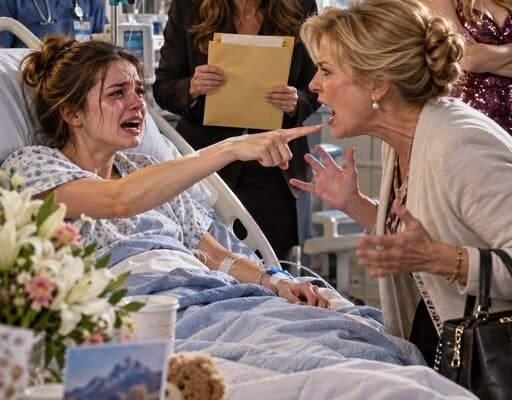
Aunt Sarah stepped farther into the hospital room and closed the door behind her.
“Your mother wasn’t at Chloe’s promotion party,” she repeated. “Neither was your father.”
I stared at her.
“Then where were they?”
She looked down at the manila folder in her hands.
And somehow, before she said another word, I knew the answer would hurt worse than anything the surgeons had done to my spine.
“They were at an attorney’s office,” she whispered.
I blinked.
“An attorney?”
Sarah nodded.
“With Chloe.”
The monitor beside my bed continued its steady beeping.
I could hear footsteps in the hallway. Somewhere nearby, a nurse laughed softly at something a coworker said.
The world kept moving.
Mine had stopped.
“I don’t understand.”
Sarah pulled a chair close to my bed.
“Sweetheart, I need you to listen carefully. And I need you to promise me you won’t try to get up.”
Something in her voice frightened me.
“Aunt Sarah, just tell me.”
She opened the folder.
Inside were several documents, a copy of a bank statement, and a photograph of a familiar two-story house with blue shutters.
My grandmother’s house.
The house where I had spent nearly every summer of my childhood.
The house where Grandma Evelyn had taught me how to bake peach cobbler, play gin rummy, and recognize the difference between someone who loved me and someone who merely liked having me around.
Grandma had died eleven months earlier.
I still missed her every day.
“Why do you have pictures of Grandma’s house?”
Sarah swallowed.
“Because your grandmother left it to you.”
I stared at her.
“What?”
“She left you the house, along with a trust account meant to help with your medical expenses.”
My heart began pounding.
“That can’t be right. Mom told me Grandma left everything to her and Dad.”
“I know.”
“She said the estate barely covered the funeral.”
“I know that, too.”
Sarah slid a document toward me.
At the top, beneath the letterhead of a law firm in Richmond, Virginia, was my grandmother’s name.
Evelyn Margaret Bennett.
Below it was mine.
Emily Rose Bennett.
I read the line three times.
Then I saw the amount.
$286,400.
My mouth went dry.
“What is this?”
“Your grandmother established a trust for you six years ago. She knew your back problems were getting worse. She wanted to make sure you could afford treatment, rehabilitation, and a place to live without worrying about money.”
I looked up.
“Then why didn’t anyone tell me?”
Sarah’s eyes filled.
“Because your mother was supposed to give you the paperwork.”
The room seemed to tilt.
I gripped the edge of my blanket.
“And she didn’t?”
“No.”
“Why?”
Sarah took a slow breath.
“Because Chloe wanted the house.”
I almost laughed.
Not because anything was funny.
Because the explanation sounded so horribly familiar.
Of course Chloe wanted the house.
Chloe always wanted whatever someone else had.
When we were children, she wanted my birthday presents.
When we were teenagers, she wanted my car.
When I graduated college, she wanted my parents to pay for her apartment because, according to Mom, she deserved something special too.
And somehow, every time, I was expected to understand.
To compromise.
To be the bigger person.
I was twenty-eight years old, and I had spent nearly my entire life being told that my younger sister’s happiness was a family responsibility.
Mine was a personal problem.
“What does this have to do with my surgery?”
Sarah looked at me for a long moment.
Then she turned over another page.
“Your mother and father were meeting with an attorney on the morning of your operation. They were trying to transfer your grandmother’s house into Chloe’s name.”
My stomach dropped.
“Without telling me?”
“Yes.”
“But if Grandma left it to me—”
“They couldn’t legally transfer it without your authorization. That’s why they were meeting with the attorney. They were trying to establish that you weren’t capable of managing your own affairs.”
I felt cold all over.
“Because of my surgery?”
Sarah nodded.
“They told him your condition had deteriorated so badly that you couldn’t make responsible financial decisions.”
I stared at her.
Then I whispered the question I was terrified to ask.
“Did they say I was mentally incompetent?”
Sarah’s silence answered me.
I turned my face toward the window.
Three days earlier, I had signed a surgical consent form with shaking hands.
I had listened while my surgeon explained the risks.
Nerve damage.
Infection.
Permanent disability.
There was a small but real chance that I might wake up unable to walk.
I had been so frightened that the nurse held my hand while the anesthesiologist prepared the medication.
And while I was being wheeled into an operating room, my parents were sitting in a lawyer’s office discussing how to take away my inheritance.
I pressed my palm against my mouth.
“Oh, God.”
Sarah reached for my hand.
“I’m so sorry, Emily.”
I shook my head.
“No. No, there has to be something else.”
I looked at the documents again.
“Maybe they misunderstood. Maybe Mom thought she was protecting the house.”
Sarah’s expression changed.
It was the saddest look I had ever seen on her face.
“Sweetheart, I wish that were true.”
She removed one final sheet.
It was a printed email.
The sender was my mother.
The recipient was the attorney.
The subject line read:
Urgent Estate Transfer — Medical Incapacity
And in the body, my mother had written:
Emily will be undergoing extensive spinal surgery on Thursday. Given her condition and the heavy medication she will require afterward, we believe this is the appropriate time to finalize the property arrangements before she becomes involved.
I read those words until they blurred.
Before she becomes involved.
Not before she gets worse.
Not before she needs help.
Before she becomes involved.
As though I were an inconvenience.
As though my grandmother’s final gift were something they needed to steal before I noticed.
A tear slipped down my cheek.
Then another.
And for the first time since waking up from surgery, I stopped trying to hold them back.
Sarah leaned forward and wrapped her arms around me as carefully as she could.
I cried against her shoulder.
Not loudly.
Not dramatically.
Just the quiet, exhausted crying of someone who had finally run out of excuses for the people who kept hurting her.
After several minutes, I pulled away.
“How did you find out?”
Sarah wiped her cheeks.
“Your grandmother named me successor trustee if your mother failed to carry out her responsibilities. Yesterday, the attorney contacted me because he had concerns about what your parents were asking him to do.”
“Why yesterday?”
“He had finally reviewed the original trust documents. Your mother had brought him a different set of papers, claiming your grandmother had changed her wishes.”
I felt my chest tighten.
“She forged something?”
“Possibly. The attorney hasn’t made that determination yet. But the signatures and dates raised serious questions.”
I stared at the folder.
“And Chloe knew?”
Sarah hesitated.
“She was there, Emily.”
That was all she needed to say.
My sister knew.
My parents knew.
And all three of them had chosen to sit in that office while I lay unconscious beneath surgical lights.
I closed my eyes.
Something inside me shifted.
Not my spine.
Something deeper.
Something that had been bending for twenty-four years.
And had finally broken.
When I opened my eyes again, I looked directly at Sarah.
“What happens now?”
She squeezed my hand.
“Now we protect what your grandmother left you.”
PART 3 — THE DAUGHTER THEY THOUGHT WOULD NEVER FIGHT BACK
The next morning, a woman named Rebecca Collins walked into my hospital room carrying a leather briefcase and wearing the expression of someone who did not tolerate nonsense.
She was an estate attorney.
More importantly, she was the attorney Grandma Evelyn had worked with when she created the trust.
Sarah had called her the night before.
Rebecca introduced herself, pulled a chair beside my bed, and spoke to me like an adult.
It was such a simple thing.
Yet after years of being talked over by my parents, I nearly cried again.
“Emily, your grandmother was very specific about her wishes,” Rebecca explained.
“She wanted you to have the house?”
“Yes. And the funds.”
“Why didn’t she tell me?”
Rebecca smiled sadly.
“She intended to. But during her final months, her health declined quickly. She believed your mother would carry out the instructions she had left.”
I looked down.
“That was a mistake.”
“It was a misplaced trust,” Rebecca said gently. “Those aren’t always the same thing.”
She explained that the house remained in the trust and that no transfer to Chloe had been completed.
My parents had not succeeded.
But they had tried.
And the attempted transfer had exposed a much larger problem.
“Your mother was responsible for certain estate-related accounts,” Rebecca continued. “We’re requesting a complete accounting of how those funds were handled.”
“Do you think she took money?”
“I don’t want to speculate before reviewing the records.”
I appreciated that.
For once, someone wasn’t telling me what I wanted to hear.
She was telling me what could be proven.
Rebecca placed several documents on the adjustable hospital table.
“Your grandmother also left a letter for you.”
My breath caught.
“A letter?”
She nodded.
“It was supposed to be delivered after her death.”
I stared at the envelope.
My name was written across the front in Grandma’s unmistakable handwriting.
Emily.
Just Emily.
No last name.
No formality.
The way she had always addressed my birthday cards.
My fingers trembled as I opened it.
Inside was a single folded page.
My darling Emily,
If you are reading this, I hope you are somewhere safe, surrounded by people who understand how precious you are.
I have watched you spend too many years making yourself smaller so that others can feel bigger.
You apologize when you have done nothing wrong. You give when you have nothing left. You smile when your heart is breaking because you don’t want anyone else to feel uncomfortable.
I wish I could have taught you sooner that love should never require you to disappear.
The house is yours because it was the place where you were always allowed to be yourself. I hope it remains that kind of place for you.
And the money is there because I know how hard you have fought through your medical problems. I want you to have the freedom to heal without being afraid of what comes next.
You do not owe anyone your suffering just because they share your blood.
Be brave enough to choose yourself.
All my love,
Grandma.
I couldn’t finish reading it aloud.
I pressed the letter against my chest and sobbed.
Rebecca quietly looked away.
Sarah held my hand.
And for a few precious moments, I could almost feel Grandma sitting beside me, rubbing circles against my back the way she had when I was little.
She had known.
Maybe not everything.
But enough.
She had seen the way my family treated me.
And she had tried to leave me something they couldn’t take.
When I finally stopped crying, Rebecca asked a question.
“Emily, would you like us to communicate directly with your parents from this point forward?”
I thought about my mother’s cheerful voice on the phone.
Her carefully rehearsed apology.
The way she had expected me to understand.
Again.
“Yes,” I said.
Then I added something I had never said before.
“And I don’t want them making any decisions about my medical care.”
Rebecca nodded.
“That’s entirely your choice.”
With help from the hospital’s patient advocate, I updated my emergency contacts.
Sarah became the person the hospital could call if I needed assistance.
My parents were removed from the list of people authorized to receive medical updates.
I also changed the passwords on my accounts and asked my bank to flag unusual activity.
They were small actions.
Paperwork.
Phone calls.
Signatures.
But each one felt like a door unlocking.
That afternoon, my mother called eleven times.
I didn’t answer.
My father sent four messages.
Your mother is very upset.
You need to stop being dramatic.
Family matters should stay inside the family.
Then came one from Chloe.
Seriously, Emily? You’re making Mom cry over a stupid house?
I stared at the screen.
A stupid house.
The house Grandma had left me.
The house where I had spent the only summers of my childhood when I hadn’t felt like an afterthought.
I typed a response.
Then deleted it.
Instead, I forwarded the message to Rebecca.
She replied ten minutes later.
Thank you. Please preserve any additional communications.
I set the phone aside.
For the first time in my life, I didn’t rush to defend myself.
I didn’t explain.
I didn’t apologize.
I simply rested.
And strangely enough, that silence felt better than winning an argument.
PART 4 — THE VISIT
My parents showed up at the hospital two days later.
I was sitting upright for the first time, supported by pillows, when a nurse knocked on the door.
“Emily? There are three people downstairs asking to see you.”
I already knew who they were.
“My parents and my sister?”
She nodded.
“They say there’s been a misunderstanding.”
I almost smiled.
Of course there had.
In my family, every betrayal became a misunderstanding the moment someone got caught.
“Tell them I’m not accepting visitors.”
The nurse nodded.
Then she hesitated.
“Your mother says she’s worried about your condition.”
I looked at the walker beside my bed.
At the surgical drain that had only recently been removed.
At the physical therapy schedule taped to the wall.
“She knows where I am,” I said quietly. “She just didn’t care until now.”
The nurse’s expression softened.
“I’ll handle it.”
Twenty minutes later, my phone rang.
Mom.
I let it go to voicemail.
Then another call.
Dad.
Then Chloe.
Finally, a message appeared.
Emily, this is ridiculous. We’re downstairs. Your mother deserves to see her daughter.
I read it twice.
Then I called Rebecca.
She told me not to argue with them and reminded me that I had every right to refuse visitors.
The hospital staff took care of the rest.
But that evening, a voicemail arrived from my mother.
And curiosity got the better of me.
I pressed play.
“Emily, sweetheart, I don’t understand why you’re doing this to us.”
Her voice cracked.
“We’ve always tried to do what’s best for this family. Your sister is at a very important point in her life, and we were only trying to make sure she had a stable future.”
There was a pause.
Then she said something that made my blood run cold.
“You have a good job, Emily. You don’t need Grandma’s house. Chloe does.”
I sat perfectly still.
She continued.
“And after everything we’ve done for you, I think it’s very unfair that you’re treating us like criminals.”
I stopped the recording.
There it was.
The truth.
Not buried in legal documents.
Not hidden behind complicated explanations.
My mother believed Chloe deserved the house because Chloe wanted it.
And she believed I should surrender it because I had always surrendered everything else.
I forwarded the voicemail to Rebecca.
Then I opened a new message to my mother.
For twenty-four years, I had tried to find the perfect words that would finally make her understand.
That night, I realized no perfect words existed.
So I wrote something simple.
Mom, I needed you when I was terrified I might never walk again. You chose to spend that day trying to give away something Grandma left me. I am not discussing this with you anymore. My attorney will handle the estate. Please do not come to the hospital again.
I read it once.
Then I pressed send.
My hands were shaking.
But I didn’t regret it.
Not even when my father replied:
You are tearing this family apart.
I looked at the message for a long time.
Then I whispered to the empty room.
“No, Dad. I’m just refusing to hold it together by myself.”
PART 5 — WHAT THE RECORDS REVEALED
Recovery was harder than I expected.
Some mornings, the pain was so intense that I couldn’t imagine standing.
Other mornings, I woke up convinced something had gone wrong during surgery.
My physical therapist, Daniel, was a patient man with a dry sense of humor.
On my first attempt to walk down the hospital corridor, I managed only twelve steps before my legs began trembling.
“That’s twelve more than yesterday,” he said.
“I used to run five miles.”
“And one day, you may be able to run again. Today we’re walking twelve steps.”
I hated how reasonable he sounded.
But he was right.
Healing didn’t happen because I demanded it.
It happened slowly.
One painful, ordinary day at a time.
Sarah came every afternoon.
Sometimes she brought soup.
Sometimes crossword puzzles.
Sometimes she just sat beside me while I slept.
She never made a speech about sacrifice.
She never reminded me how much trouble she had gone through.
She simply showed up.
It was a kind of love I wasn’t accustomed to receiving.
Three weeks after surgery, I moved into a rehabilitation facility.
That was when Rebecca called with the results of the estate accounting.
“Emily, we found something important.”
I sat on the edge of my bed, my walker within reach.
“What?”
“Your mother used money from an estate account to pay several personal expenses that weren’t authorized under your grandmother’s instructions.”
My stomach tightened.
“How much?”
“Approximately forty-two thousand dollars.”
I closed my eyes.
“What did she spend it on?”
Rebecca paused.
“Part of it went toward Chloe’s credit card balances. There were also payments connected to her apartment and a vehicle.”
Of course.
Chloe’s apartment.
Chloe’s car.
Chloe’s life.
Even after Grandma died, the family money had somehow continued flowing toward my sister.
“Can we get it back?”
“We’ve made a formal demand for repayment and supporting records. If they don’t cooperate, we’ll pursue the appropriate legal remedies.”
I looked out the window.
Autumn leaves were beginning to turn gold along the parking lot.
“What about the house?”
“It’s secure. No transfer has occurred. We’re taking the necessary steps to ensure the trust is administered properly.”
I released a breath I hadn’t realized I was holding.
Then Rebecca said something unexpected.
“There’s one more thing.”
My pulse quickened.
“What?”
“The attorney your parents met with has provided copies of the documents they submitted.”
“And?”
“The signature on the proposed authorization doesn’t appear to match yours.”
I went very still.
“Are you saying they forged my signature?”
“I’m saying we have a document that purports to contain your signature, and you’ve told me you never signed it. That needs to be investigated.”
I stared at the wall.
My own parents.
My own name.
My grandmother’s house.
There was a time when I would have begged Rebecca to keep things quiet.
I would have worried about my mother’s reputation.
My father’s blood pressure.
Chloe’s career.
I would have convinced myself that pursuing the matter made me cruel.
But something had changed.
Maybe it was the surgery.
Maybe it was Grandma’s letter.
Or maybe I had finally grown tired of being the only person in my family expected to endure consequences.
“Do whatever is legally necessary,” I said.
Rebecca was quiet for a moment.
“Are you sure?”
“Yes.”
My voice didn’t shake.
“Because if I let them do this, they’ll never stop.”
Over the following weeks, Rebecca worked with the trust’s legal and financial professionals to preserve records and recover the missing funds.
My parents initially denied everything.
Then they blamed a misunderstanding.
Then they claimed Grandma had promised Chloe the house verbally.
When that argument failed, they offered to repay part of the money if I agreed to keep the matter private.
Rebecca advised me not to accept their first proposal.
Eventually, through a formal settlement, my parents agreed to repay the misused funds, cover certain associated costs, and relinquish any role they still held in administering the trust.
The disputed authorization was withdrawn, and the questions surrounding its preparation were referred to the appropriate authorities for review.
I didn’t celebrate.
I didn’t feel triumphant.
I just felt tired.
Because no amount of money could change what had happened.
My parents had known I might wake up unable to walk.
And they had still chosen the attorney’s office.
That truth would never disappear.
But at least it no longer controlled my future.
PART 6 — THE SISTER WHO FINALLY HEARD NO
Six weeks after surgery, Chloe called from a number I didn’t recognize.
I answered without thinking.
“Emily?”
I froze.
Her voice was smaller than usual.
“Chloe.”
“Please don’t hang up.”
I stared at the phone.
“What do you want?”
She exhaled sharply.
“Mom and Dad are furious. Dad says the settlement is going to wipe out most of their savings.”
I said nothing.
“And now they’re saying I have to pay them back for the money they spent on my apartment.”
“Okay.”
“Okay?” she repeated. “Emily, I can’t afford that.”
I looked down at the scar beneath my loose shirt.
A long, angry reminder of everything I had survived.
“I’m sorry you’re having financial problems.”
She made an incredulous sound.
“You’re sorry? That’s all you have to say?”
“What would you like me to say?”
“That you’ll help me!”
There it was.
The familiar expectation.
The automatic assumption that my resources existed to rescue her from her choices.
I closed my eyes.
“Chloe, I’m still learning how to walk normally.”
A pause.
“I know.”
“No, I don’t think you do.”
She went quiet.
“I had major spinal surgery. I spent days in intensive care. I was terrified I might lose the use of my legs.”
“I know, Emily.”
“Then why are we talking about your apartment?”
Silence.
I continued.
“Did you know Mom and Dad were trying to transfer Grandma’s house into your name?”
She hesitated.
“Mom said Grandma wanted me to have it.”
“Did you know the trust documents said otherwise?”
Another pause.
“Not at first.”
“At first?”
Chloe sighed.
“Emily, I didn’t think it was such a big deal. You were always Grandma’s favorite. I thought this was just a way to make things fair.”
I felt something inside me settle.
Fair.
That was what she called it.
My grandmother leaving me something after years of watching my family favor Chloe was unfair.
But Chloe receiving everything else was normal.
“Do you remember my sixteenth birthday?” I asked.
“What?”
“The one where Mom canceled my dinner because you got invited to a dance?”
Chloe groaned.
“Are we seriously doing this?”
“Do you remember when Dad sold my old car to help pay for your college expenses?”
“Emily—”
“Or when I paid your rent for three months after you quit your first job?”
She didn’t answer.
“I kept telling myself you’d grow up. That one day you’d realize I was your sister, not your backup plan.”
Her breathing changed.
For a moment, I thought she might cry.
Then she whispered, “I didn’t know you felt that way.”
I looked toward the window.
“That’s because you never asked.”
There was a long silence.
Finally, Chloe said, “So you’re really not going to help me?”
“No.”
The word was quiet.
Simple.
Complete.
She inhaled sharply.
Then she hung up.
I placed my phone on the table.
And waited for the guilt.
It came, of course.
Years of conditioning didn’t vanish in a single conversation.
But beneath the guilt was something stronger.
Relief.
For the first time, I had said no without leaving a door open for negotiation.
PART 7 — THE HOUSE WITH BLUE SHUTTERS
Four months after my surgery, I stood in front of Grandma Evelyn’s house.
It was a cool Saturday morning.
The grass needed cutting.
The porch railing needed fresh paint.
A few leaves had collected beneath the old wooden swing.
But the blue shutters were exactly as I remembered them.
Sarah stood beside me holding a grocery bag.
“Ready?”
I looked at the front steps.
There were only three.
Three ordinary wooden steps.
Before surgery, I would have climbed them without thinking.
Now they looked like a mountain.
My physical therapist had cleared me to use stairs carefully, with support.
So I took the railing.
Placed one foot on the first step.
Then the other.
Slowly, I climbed.
When I reached the porch, I was breathing hard.
Sarah didn’t clap or make a fuss.
She just smiled.
“Your grandmother would have been proud.”
I swallowed.
“I wish she were here.”
“I know.”
Sarah handed me the key.
I unlocked the front door.
The familiar scent of old wood and lavender greeted me.
Sunlight streamed through the living room windows.
The furniture was covered with white sheets, but everything else was almost exactly as Grandma had left it.
Her books.
Her little porcelain birds.
The grandfather clock that had always run five minutes fast.
I walked slowly into the kitchen.
And there, hanging beside the pantry door, was the faded yellow apron Grandma used whenever she baked.
I touched the fabric.
For a moment, I could hear her voice.
Emily, sweetheart, don’t forget the cinnamon.
I laughed through my tears.
Sarah set the groceries on the counter.
“There’s something I should tell you.”
I turned.
“What?”
She smiled.
“Your grandmother talked about you constantly.”
My throat tightened.
“She did?”
“Oh, yes. She was always telling me how proud she was of you.”
I looked down.
“I didn’t do anything special.”
Sarah stepped closer.
“Emily, you worked your way through college. You built a career. You managed years of pain without giving up. And somehow, through all of it, you remained kind.”
She squeezed my shoulder.
“Your grandmother didn’t think kindness made you weak. She just wished you’d learn to give some of it to yourself.”
I began crying again.
But this time, the tears felt different.
They weren’t the tears of someone begging to be chosen.
They were the tears of someone realizing she had been loved all along.
Just not always by the people she expected.
Over the following months, I made the house my own.
I hired someone to repair the porch and install a safer handrail.
I turned Grandma’s downstairs guest room into my bedroom so I wouldn’t need to use the stairs every day.
I replaced the old mattress.
Bought new curtains.
Planted hydrangeas beside the front walkway.
And on the kitchen wall, I framed Grandma’s letter.
Not because I wanted to remember what my parents had done.
But because I wanted to remember what Grandma had taught me.
Love should never require you to disappear.
The trust funds helped pay for my rehabilitation and medical expenses.
I continued working remotely while I recovered.
Some days were frustrating.
Some days I still needed medication.
And some mornings, I woke up frightened by a new ache or unfamiliar sensation.
But gradually, the good days began to outnumber the bad ones.
I could walk around the block.
Then two blocks.
Then half a mile.
The first time I completed a full mile without my walker, I sat on Grandma’s porch and cried.
Not because the journey was finished.
Because I finally believed I had a future worth fighting for.
PART 8 — THE LAST CALL
Eight months after surgery, my mother sent me a letter.
Not a text.
Not a voicemail.
An actual handwritten letter.
It arrived on a rainy Tuesday afternoon.
I recognized her handwriting immediately.
For several minutes, I simply held the envelope.
Then I opened it.
Emily,
I know you are angry with us.
Your father and I have had a very difficult year. We never intended for things to go this far.
I hope someday you will understand that parents sometimes make decisions they believe are best for everyone.
Chloe has been struggling, and we were trying to help her get established.
We miss you.
Please call us.
Love, Mom.
I read it twice.
Then a third time.
There was no apology for missing my surgery.
No acknowledgment of the disputed documents.
No recognition of the money that had been taken.
Only another request that I understand.
I folded the letter.
Placed it back inside the envelope.
And set it in a drawer.
I didn’t call.
A few days later, Sarah asked whether I had heard from my parents.
I told her about the letter.
She listened without interrupting.
Then she asked, “What do you want to do?”
I considered the question.
It was strange how unfamiliar those words still felt.
What did I want?
Not what would make Mom happy.
Not what would calm Dad down.
Not what Chloe needed.
What did I want?
“I don’t want to hate them,” I said finally.
Sarah nodded.
“But I don’t want to go back.”
“Then don’t.”
I looked at her.
“Is it really that simple?”
“Simple doesn’t mean easy.”
She smiled gently.
“You can forgive someone without handing them the keys to your life again.”
I sat with those words for a long time.
Eventually, I wrote my parents a letter.
I told them I was recovering.
That the house was safe.
That I was grateful for the good memories we had shared, but I could no longer ignore the harm they had caused.
I told them I wasn’t ready for a relationship.
And that if they ever wanted to rebuild one, it would require honesty, accountability, and respect for my boundaries.
I didn’t promise forgiveness on a schedule.
I didn’t ask them to understand.
I simply told the truth.
Then I mailed it.
And went on with my day.
EPILOGUE — THE PEOPLE WHO SHOW UP
One year after my surgery, I hosted Thanksgiving dinner at Grandma Evelyn’s house.
Nothing extravagant.
Just a small gathering.
Sarah came early to help with the turkey.
Rebecca stopped by with a pumpkin pie and stayed for dinner.
Daniel, my former physical therapist, came with his wife after I invited them as a thank-you for helping me through the hardest months of my recovery.
A few close friends filled the remaining chairs.
There were eight of us around the dining room table.
Eight people who had shown up for me in different ways when I needed them.
I had spent years believing family meant the people whose names appeared beside mine on a birth certificate.
That Thanksgiving, I understood something different.
Family was the person who held your hand when you were afraid.
The person who drove you to physical therapy.
The person who brought groceries without being asked.
The person who celebrated twelve painful steps because they understood what those steps had cost.
Before dinner, Sarah raised her glass.
“To Evelyn,” she said softly.
Everyone lifted their glasses.
“To Evelyn,” we repeated.
I looked around the room.
At the warm lights.
The mismatched plates.
The people laughing over the gravy.
And suddenly, I remembered the night after surgery when I had stared at a hospital ceiling, convinced I had been abandoned by everyone who mattered.
I had been wrong.
Not about my parents.
They had abandoned me when I needed them.
But I had been wrong about being alone.
Love had been there.
In Sarah’s steady hands.
In Grandma’s careful planning.
In the friends who checked on me.
In the people who didn’t need me to earn their attention by giving up pieces of myself.
After dinner, I stepped onto the porch.
The air was cold.
The sky was clear.
I wrapped a cardigan around my shoulders and watched the leaves move across the yard.
My phone buzzed.
A message from Chloe.
Happy Thanksgiving, Emily. I hope you’re doing okay.
I stared at it for a moment.
There was no request for money.
No accusation.
No mention of the house.
Just a greeting.
I didn’t know whether it meant she had changed.
Maybe she had.
Maybe she hadn’t.
But I no longer felt responsible for figuring that out.
I typed:
Happy Thanksgiving, Chloe. I’m doing well. I hope you are too.
Then I put my phone away.
That was enough for today.
Inside, someone called my name.
“Emily! We’re cutting the pie!”
I smiled.
“Coming!”
I turned toward the door.
And before stepping inside, I looked once more at the blue shutters, the porch swing, and the house my grandmother had protected for me.
A year earlier, I had been terrified I would never walk again.
Now I was standing on my own porch, surrounded by people who loved me, living a life I had finally stopped apologizing for.
I still had scars.
Some visible.
Some not.
My back would never be exactly what it had been before.
And my relationship with my parents might never become what I had once desperately wanted it to be.
But neither truth made my life incomplete.
I had learned to stop confusing being needed with being loved.
I had learned that saying no did not make me selfish.
And I had learned that sometimes the most important recovery isn’t the one doctors perform in an operating room.
It’s the one that happens afterward, when you finally stop allowing other people to decide how much you’re worth.
I opened the door.
Warmth spilled across my face.
Laughter drifted from the kitchen.
And for the first time in longer than I could remember, I wasn’t walking into a room hoping someone would make space for me.
There was already a place waiting.
My place.
At my table.
In my home.
In a life that finally belonged to me.
And as I stepped inside, I could almost hear Grandma Evelyn whispering the words she had written in her final letter.
Be brave enough to choose yourself.
I smiled.
“I finally did, Grandma.”
Then I closed the door behind me.
THE END.