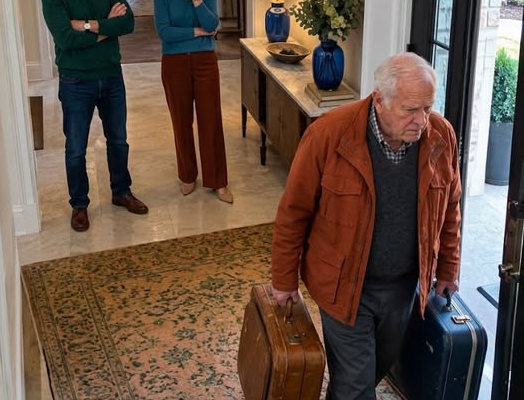
“Albert, why don’t you stay in your room tonight?”
My daughter-in-law said it in the middle of the living room, with a tray of shrimp cocktail in her hands and twelve guests standing around her holding wineglasses.
She said it brightly. The way you’d tell a dog to go lie down.
“It’s just going to be a lot of noise. Couples stuff. You’d be bored.”
The room went quiet. One of her friends, a woman in a green dress, looked down at the carpet.
I looked at my son.
Logan was standing by the kitchen island holding a glass of bourbon. He looked at me for one second.
Then he looked down into his drink.
And he didn’t say anything at all.
I set my glass of iced tea down on the end table. I said, “Of course. Enjoy your evening, everyone.”
And I walked down the hallway to the small room at the back of the house that I’d been living in for six years.
I closed the door.
I sat down on the edge of the bed. Through the wall I could hear the party start up again. Laughter. Music. Somebody asking Chelsea where she got her new kitchen backsplash.
I paid for that backsplash.
I sat there for a long time listening.
My name is Albert Higgins. I’m seventy-one years old. I was a certified public accountant in Dallas for forty-two years.
And that night, sitting on that bed with the party going on through the wall, I finally understood something I’d spent six years refusing to see.
I wasn’t family in that house.
I was furniture. Useful furniture. The kind you move into a back room when company comes.
The next morning, at six a.m., before anybody else was awake, I packed two suitcases.
I left my house key on the kitchen counter, right next to Chelsea’s new backsplash.
And I left.
My wife, Margaret, died seven years ago. Ovarian cancer. She taught second grade at Lakewood Elementary for thirty-one years. Half the grown adults in East Dallas learned to read in her classroom.
After she died, I couldn’t stand our house. Every room had her in it.
So when Logan called and said, “Dad, why don’t you come live with us for a while,” I said yes.
I sold my house. I moved into the small bedroom at the back of theirs.
And I started helping.
It started small. Groceries. A water heater. The property taxes one year when Logan’s construction business had a slow spring.
Then it got bigger.
Logan runs a home renovation company. Higgins Remodeling. Four employees and two trucks. He’s a good carpenter. He’s not a good businessman. He takes on jobs that are too big and underbids them.
Three years ago, he needed a business line of credit from the bank to keep the company going. The bank wanted collateral. Logan didn’t have any.
So I pledged my investment account.
I explained it to him at the bank, in front of the loan officer. My securities were backing his credit line temporarily. It was support. Not a permanent guarantee. I could withdraw the pledge.
He nodded. He signed. I don’t think he heard a single word.
Then there was the house.
Their house needed a new roof. New electrical. Chelsea wanted a new kitchen. They didn’t have the money.
So I lent it to them.
A real loan. A promissory note. Written and signed. One hundred eighty-six thousand, four hundred dollars. At a very low interest rate. No payments due until the business was more stable.
I called it family help. That was my mistake.
And on top of all of that, I set up a separate account for household expenses. I put money in it every month. Logan and Chelsea were authorized users. Groceries. Utilities. Whatever they needed.
For six years, I paid. And I paid. And I paid.
And somewhere along the way, I stopped being Logan’s father living in his house.
I became the old man in the back bedroom.
I rented a furnished apartment in Irving. Two chairs. A narrow sofa. A small table. A bedroom with white walls.
Nothing in it belonged to a shared history.
That’s why I liked it.
The second day, I called Fiona Cartwright.
Fiona was my attorney for twenty years. She did Margaret’s will and mine. She’s sharp, calm, and she’s never once told me what I wanted to hear just because I wanted to hear it.
I told her everything. The party. The six years. The collateral. The loan. The household account.
She listened. Then she took off her reading glasses.
“Albert,” she said. “What do you want?”
Nobody had asked me that in six years.
“I want to stop being responsible for their lives,” I said. “I want to stop being afraid that if I stop paying, my son stops needing me.”
She nodded.
“Then we do it properly. Legally. With reasonable notice. Nothing cruel. Nothing sneaky. You don’t empty a joint account. You don’t take anything that belongs to them. You just stop carrying obligations you were never required to carry.”
Over the next two weeks, Fiona prepared three envelopes.
They went out by certified mail on the same day.
I let Logan’s first call go to voicemail.
A minute later, he called again.
Then Chelsea.
Then Logan one more time.
I was sitting in the small conference room at Fiona’s office in Uptown when the calls came. Fiona sat across from me with her reading glasses on the end of her nose. She didn’t look at my phone.
She kept her eyes on the copies of the three envelopes.
“You don’t have to answer today,” she said.
“I know.”
“Or tomorrow.”
“I know that too.”
The phone stopped ringing. For several seconds, the only sound in the room was the air conditioning.
Fiona sorted the papers into three neat piles.
“The first envelope was from the bank,” she said. “It confirms that your pledge of securities against Logan’s business credit line has been withdrawn. The bank is giving him thirty days to replace the collateral or refinance.”
I nodded.
“The second is the formal demand for repayment of the family loan. One hundred eighty-six thousand, four hundred dollars, plus interest. You gave them until the end of the quarter.”
“I’m not trying to take their house.”
“I know you’re not.”
“And the third?”
Fiona’s face softened.
“That one’s from the investment custodian. It removes Logan and Chelsea as authorized users on the household expense account. And it confirms no more transfers will be made.”
I looked down at my hands.
For six years, I’d let myself be treated like a guest in a house I helped make possible. And yet, the minute I put boundaries around my own money, the paperwork made it sound so cold.
Withdrawn. Revoked. Demanded. Terminated.
Words with no room in them for hurt.
“Are you sure we did this right?” I asked.
“Every step,” Fiona said. “You gave them reasonable notice. You didn’t touch anything that legally belongs to them. You just stopped providing.”
She paused.
“Albert. You are not punishing them by refusing to stay financially responsible for their lives.”
I gave her a tired smile.
“It’s going to feel like punishment to them.”
“That might be because they confused your generosity with a permanent arrangement.”
I looked out through the glass wall at the reception area. People walking between offices with coffee cups and folders. Ordinary lives that had nothing to do with mine.
“I never wanted them to need me,” I said. “I just wanted them to know I was there.”
Fiona’s voice got gentler.
“Those aren’t always the same thing, Albert.”
That sentence stayed with me all afternoon.
I’d spent years believing that helping Logan meant staying useful. Paying a bill before he asked. Signing a document because the bank wanted an older, more stable name on it. Transferring money when Chelsea said the timing was hard.
I called it love.
Because the other word, fear, was harder to admit.
I was afraid that if I stopped helping, my son would stop needing me.
When I got back to my apartment in Irving that evening, the sky over Highway 183 was going pale orange.
I set my keys on the counter and checked my phone.
Seven missed calls. Three from Logan. Two from Chelsea. One from a number I didn’t recognize.
And one voicemail. From Logan. 9:17 that morning.
“Dad, please call me. I don’t understand what’s happening.”
His voice was strained. But not angry.
I played it twice.
Then I deleted it.
Not because I didn’t care. Because I cared enough to know that if I called him back while my heart was still raw, I might say something meant to wound him.
And I’d spent six years swallowing my words. I didn’t want the first honest ones to come out like weapons.
The next morning, Logan called again.
I answered on the fifth ring.
“Dad?”
“Yes.”
For a moment, neither of us said anything.
“Where are you?”
“Somewhere quiet.”
“Are you safe?”
“I’m fine.”
“Why didn’t you tell us you were leaving?”
I looked out my window. A woman was walking a dog along the sidewalk. The dog stopped to sniff some grass. She waited patiently.
“You knew I was leaving,” I said.
“No, I didn’t.”
“You heard Chelsea tell me to stay in my room.”
“That’s not the same thing as knowing you were going to disappear.”
“No,” I said. “It isn’t.”
He let out a long breath.
“I came home the next morning and your room was empty.”
“That room was never really mine, son.”
“Dad…”
The word had irritation in it. Confusion. And something that sounded like shame.
I sat down at the little table.
“What do you want, Logan?”
“I want to understand these notices.”
“They’re straightforward.”
“The bank says I have to replace collateral on the credit line. You were the collateral?”
“My investment account was.”
“I didn’t know that.”
“You signed the documents. At the bank. With me sitting next to you.”
Silence.
I could picture him standing in the kitchen with one hand pressed flat on the counter. He’s done that since he was a little boy, whenever he’s trying to solve a problem he doesn’t want to admit is too big for him.
“Why would you do this now?” he said.
“Because I don’t live in your house anymore.”
“That doesn’t explain anything.”
“It explains everything.”
His voice got sharper.
“You helped us for years. You never complained. You never once said you wanted any of it back.”
“I don’t want the money back.”
“Then why are you demanding it?”
“I’m not asking for the loan to be repaid because I’m angry, Logan. I’m asking because it was a loan.”
“You called it family help.”
“That doesn’t mean it turned into a gift.”
I heard a voice in the background. Chelsea.
“Is that him?”
Logan covered the phone. Not fast enough.
“Dad. Chelsea wants to talk to you. She says she needs to explain.”
I stood up and walked to the window.
“No,” I said.
“Dad, please.”
“I’m not ready to talk to her.”
“She didn’t mean—”
“Logan.”
He stopped.
I hardly ever used his name like that. Not loud. Not harsh. Just firm enough to remind him I wasn’t asking permission.
“I’ll meet you,” I said. “Alone. Somewhere public. Tomorrow afternoon.”
I gave him the name of a coffee shop near the Irving library.
Right before he hung up, he said something so quiet I almost missed it.
“I’m sorry, Dad.”
I closed my eyes.
“Come prepared to tell me what you’re sorry for,” I said.
The coffee shop was busy the next afternoon. College kids with laptops by the windows. An old couple sharing a pastry. A young mother trying to keep her toddler from dumping sugar packets on the floor.
I got there early and took a table in the back.
Logan came in twelve minutes late.
He looked older than he had three weeks before. His shirt was wrinkled. His hair needed cutting. Dark circles under his eyes.
He held himself like a man carrying something fragile.
“Hi, Dad.”
“Hello, son.”
He sat down across from me.
“I didn’t know how to find you,” he said. “I called your old bank. They wouldn’t give me your address.”
“They shouldn’t have.”
“I called Aunt Miriam.”
“She didn’t know.”
He nodded. He looked down at the table.
“I was worried.”
“I believe you.”
His eyes came up.
“That’s all you’re going to say?”
“What else should I say?”
“That you were worried about us too.”
“I was.”
“Then why are you doing this?”
The question came out half angry and half pleading.
I folded my hands on the table.
“Because worrying about you had become more important to me than taking care of myself.”
He looked away.
“I never asked you to leave.”
“You let Chelsea ask me to disappear into a back bedroom in front of twelve people.”
“Chelsea asked. Not me.”
“And you agreed.”
“I didn’t know what to say.”
“You could’ve said, ‘Dad, stay for dinner.’ Four words, Logan.”
His jaw got tight.
“I was embarrassed,” he said.
That surprised me.
“Of me?”
“No.” He stared at the sugar container between us. “Of the whole situation. You and Chelsea. The tension. The way she talked to you. And the way I kept avoiding it.”
“Why were you embarrassed?”
“Because I knew it was wrong.”
The words were simple. But they landed heavy.
I’d expected him to defend himself. To say Chelsea was stressed, or I’d misunderstood, or everybody was tired.
Instead, he admitted he’d known.
“I thought if I stayed out of it, it would calm down,” he said. “She’d be nicer. You’d stop feeling hurt. I kept telling myself it wasn’t serious.”
“It was serious to me.”
“I know that now.”
“No,” I said quietly. “You know it because I left.”
He flinched.
I regretted how sharp it came out. But I didn’t regret it being true.
A waitress came by. We ordered coffee. Neither of us ordered food.
“Chelsea thinks you planned all this,” he said when she left. “To leave and cut us off. To make us panic.”
“I planned to protect myself. The rest just followed.”
“Then why send all three notices at once?”
“Because they’re all connected.”
He rubbed his forehead.
“Without your collateral, the bank might call the whole credit line. That’s almost four hundred thousand dollars.”
“I know.”
“We don’t have that.”
“I know.”
His eyes got hard.
“How could you let us sign something like that without telling us you could just pull out?”
“I didn’t let you sign it. You signed it. I explained, in front of the loan officer, that my pledge was temporary.”
“You said it was a formality.”
“I said the paperwork was routine if the company performed well.”
He leaned back. He looked hurt.
“You really kept track of everything.”
“I’m an accountant.”
“You kept track of us.”
“I kept track of my obligations.”
He lowered his voice.
“Were we an obligation?”
I looked at my son for a long time.
“No,” I said. “You were my son. That’s why I kept saying yes.”
His face changed then. Not much. But enough for me to see that sentence reach him.Pages:8
The waitress brought our coffee. Logan wrapped both hands around his cup.
“Chelsea thinks you have money you never told us about,” he said.
I didn’t say anything.
“She says those notices could only happen if you had some kind of big account.”
“I have savings.”
“How much?”
“That’s not the question.”
“It is to me.”
“No,” I said. “The question is why you believed I was obligated to keep paying for your life after you made it clear I wasn’t welcome in it.”
His mouth opened. Then closed.
The noise of the coffee shop filled the space between us.
“I didn’t know you felt that way,” he finally said.
“You knew enough to look away, Logan.”
He sat with that.
When we stood up to leave, he offered to drive me home.
“I’ll take a cab.”
“Dad. Let me do one thing for you.”
“You can do something for me.”
“What?”
“Go home and decide what kind of man you want to be when this is over.”
He looked at me, startled.
“I’m not asking you to choose between Chelsea and me,” I said. “I’m asking you to stop choosing silence.”
His eyes went glassy. He blinked it away.
“I don’t want to lose you, Dad.”
“You already lost the version of me who stayed quiet to keep the peace.”
He nodded slowly.
“I understand.”
“I hope you do.”
What happened next, I only found out later. Logan told me himself, months afterward.
He drove home. Chelsea was sitting at the kitchen island surrounded by unopened mail. The three envelopes were lined up in a neat row on the granite. Like putting them in order might make what was inside less frightening.
“What did he say?” she asked.
“He said the agreements are legal. He won’t talk about how much money he has.”
“So he admitted there’s an account.”
“Of course there’s an account. He’s an accountant. He had investments.”
“Not like this,” Chelsea said. “The bank officer called me this afternoon. He said your father’s collateral file is being reviewed.”
“Did he say how much?”
“No.”
“Then stop guessing.”
She turned away. But not before Logan saw the fear on her face.
“He made us look cruel,” she said.
“You told him to stay in his room, Chelsea.”
“I was trying to avoid an argument in front of everybody.”
“You said it in front of everybody.”
“I know what I said.”
“And I just sat there.”
Chelsea folded her arms. “You didn’t defend him either.”
“I know.”
That took the fight right out of her.
“We’ll have to refinance the credit line,” Logan said. “Or sell something.”
“We don’t have anything to sell. And the family loan? One hundred eighty-six thousand dollars?”
“He gave us that money for the house.”
“He said it was a loan.”
Chelsea stared at him.
“You never told me it was a loan. I thought it was his contribution. To the family.”
Logan stared back at her.
And for the first time, he understood that Chelsea may never have known the real arrangement. She’d accepted the new kitchen, the new roof, the new electrical as things his father had chosen to give.
And Logan had never corrected her.
Not because she asked him to hide it.
Because he was ashamed to admit how much help they needed.
After Chelsea went upstairs, Logan stayed in the kitchen. He looked at the old gray filing cabinet next to the pantry.
It was mine. I left it behind because it held copies of the renovation invoices and his business paperwork.
He opened the second drawer. Near the back was the folder for the renovation loan.
He spread everything out on the counter. The promissory note. Copies of the bank transfers. And a statement from my investment firm, dated four years earlier. Included as proof of collateral when his credit line was renewed.
He almost set it aside.
Then he saw the number in the bottom right corner.
He read it once. Then again.
Verified liquid securities: $803,417.29.
Account owner: Albert Higgins. Sole owner. No joint beneficiaries.
Logan stood in his kitchen with one hand flat on the counter.
Upstairs, Chelsea called his name. He didn’t answer.
He just kept staring at that page. Realizing that the father he’d treated like a dependent houseguest had never been dependent on them at all.
Under that statement, at the very bottom of the folder, was an envelope. Old. Soft at the corners.
It was addressed to me. In his mother’s handwriting.
Margaret wrote it to me in the hospital, three weeks before she died. I’d put it in that folder years ago for safekeeping and forgotten it was there.
Logan read it at the kitchen counter at midnight. Chelsea came downstairs and read it over his shoulder.
Albert,
You’ll want to give the boy everything. I know you. Don’t. Give him enough to stand on and then let him stand.
And if there’s ever money left over that nobody truly needs, find a teacher who’s retired and can’t afford her rent. There are more of us than you’d think. We spent our whole lives giving away our time, and nobody ever saved any of it for us.
I love you. Stop worrying so much.
Margaret.
Chelsea sat down at the kitchen table holding that letter for a long time.
The next morning, Logan called Fiona’s office. Her assistant told him I was in a meeting. At the North Texas Community Housing Foundation.
So he called the foundation.
A woman named Miriam Alvarez answered. The director.
“Can I speak with my father? Albert Higgins?”
“I’m sorry,” Miriam said kindly. “Your father asked not to be interrupted during the board meeting.”
“I’m not trying to interrupt. I just need to see him.”
“He said you might call.”
That unsettled him.
“He expected this?”
“He said if you ever learned about the transfer, you might want answers.”
“Then I’ll be there tomorrow morning.”
When he hung up, Chelsea was still sitting at the table with Margaret’s letter in her hands.
“He’s at a housing foundation,” Logan said. “He’s giving away the money.”
“How much?”
“She wouldn’t say.”
Chelsea looked out the window.
“Maybe he should,” she said.
Logan stared at her. “You don’t mean that.”
“I do,” Chelsea said. “If it’s his money, he should do whatever he wants with it. Even if what he wants is to make sure neither of us ever touches it.”
“He isn’t doing this to punish us.”
“I know,” she said.
The answer came too fast to be defensive.
“What are you going to do tomorrow?” Logan asked.
“I’m coming with you.”
“You don’t have to.”
“Yes, I do,” Chelsea said. “I owe him an apology. Not one where I explain I was stressed or embarrassed or trying to keep the party organized. Those things might be true. But they aren’t an apology.”
She looked down at Margaret’s letter.
“I told him to hide in a back room in a house he helped pay for.”
“And I sat there,” Logan said.
“You did.”
She nodded, accepting it.
“I don’t know if he’ll forgive me,” she said. “If he isn’t ready, then I’ll wait.”
The North Texas Community Housing Foundation is in an old renovated brick schoolhouse near downtown Dallas. Tall bright windows. A painted sign by the front door.
A Home Is More Than a Roof.
They got there at a quarter to nine. The receptionist sent them upstairs to a conference room.
Fiona was waiting by the window in a navy suit.
“Thank you for coming,” she said. “Your father’s finishing the board meeting.”
“Did he know I’d be here?”
“I told him you’d called the foundation.”
“And?”
“He said, ‘Then he’s ready to hear it.’”
Chelsea looked down at the floor.
Fiona set a folder on the table.
“Before Albert joins us, there are some things you should understand.”
They sat.
“The investment account held eight hundred and three thousand dollars when we began this process,” Fiona said. “After taxes, legal fees, and the transfer your father authorized last week, the remaining balance is about two hundred and fourteen thousand.”
“How much did he give away?” Logan asked.
“Five hundred seventy-five thousand dollars.”
Chelsea’s eyes went wide. She didn’t say anything.
“The money is going into a housing fund for retired schoolteachers,” Fiona said. “Rental help. Accessibility repairs. Emergency housing. Your mother taught for thirty-one years.”
“I know,” Logan said quietly. “I read her letter last night.”
Fiona paused at that. Then she went on.
“Albert is keeping a reserve for himself. He plans to move into an independent living apartment in a few months. It’s enough. If he lives modestly. Which he always has.”
“He could’ve kept all of it,” Logan said.
“Yes.”
“Why didn’t he?”
Fiona looked at him carefully.
“Because he decided that leaving you an inheritance while you were still depending on him wouldn’t be love. It would be an invitation to keep avoiding hard decisions.”
Logan felt the old shame rise up in his chest.
“Is there anything left for me?”
“That’s not the right question, Logan.”
He looked away.
Fiona’s voice got gentler.
“He hasn’t disinherited you. But he’s removed the beneficiary designation that would’ve given you immediate access to his account when he dies. Whatever’s left will go into a trust. After his care is covered.”
“Why?”
“Because he wants you to inherit something that doesn’t control your choices.”
“What about the loan?” Logan asked.
“The one hundred eighty-six thousand four hundred is still due.”
Chelsea’s fingers tightened in her lap.
“Even after he gave all that money away?”
“Those are separate matters.”
“We can’t pay it all at once,” Chelsea said.
“Albert knows that. He’s willing to restructure the note over five years at a reduced rate. The payments aren’t optional. But they’re manageable.”
“And the business line?” Logan asked.
“The bank agreed to give you sixty days instead of thirty.”
“We might have to sell the house.”
Fiona didn’t blink.
“Then you might have to sell the house.”
The calmness of it made the decision feel real. Not cruel. Not the end of the world. Just real.
“Your father doesn’t want you homeless,” Fiona said. “He also doesn’t want to stay tied to a life you can’t afford.”
The conference room door opened.
I walked in.
I was wearing my gray jacket and a clean blue shirt and the same old brown leather shoes I’ve owned for twelve years.
My son stood up. So did Chelsea.
For a moment, nobody said anything.
Then Chelsea spoke.
“Mr. Higgins—”
“Albert,” I said.
She nodded. “Albert.”
I waited.
“I’m sorry,” she said.
Her voice trembled. But she didn’t look away from me.
“I’m sorry I made you feel unwelcome in your own home. I’m sorry I treated your help like something I was owed. And I’m sorry I used being busy and embarrassed as excuses not to see what I was doing.”
I didn’t say anything.
“I don’t expect you to forgive me today,” she said. “I just wanted you to hear me say it. Without asking you for anything.”
Something in my chest moved.
“That matters,” I said.
Her eyes filled up.
“I was afraid you’d think I was only sorry because the money’s gone.”
“I did wonder.”
“I understand.”
“But I don’t think that now,” I said.
She lowered her head. Relieved and ashamed at the same time.
I turned to Logan.
“I’m sorry too, Dad,” he said.
“I know.”
“No. I need to say it right.”
His voice caught. He kept going.
“I saw what was happening. I knew Chelsea was disrespectful to you. And I kept telling myself it wasn’t serious, because I didn’t want to deal with it. And when you needed me to say something, I looked down at my drink.”
My eyes stung.
“That’s the part I remember,” I said.
“I know.”
“I didn’t need you to choose me over your wife, son.”
“I understand.”
“I needed you to choose what was right.”
“I should have.”
“Yes,” I said.
The simple answer hurt him more than anger would’ve.
I sat down across from them.
For a few minutes, we weren’t a father and son and daughter-in-law surrounded by legal documents.
We were just three people trying to talk honestly after years of avoiding what honesty costs.
“Why didn’t you ever tell me about the money?” Logan asked.
“Because I wanted you to build your own life. Without measuring every decision against what I might give you.”
“You could’ve told me the collateral was temporary.”
“I did. At the bank.”
He looked down. “Yeah. You did.”
“It wasn’t a test,” I said. “I wasn’t waiting for you to fail. I thought you were a grown man making a grown man’s decision.”
“I was acting like a kid.”
“You were acting like somebody who’d gotten used to being rescued.”
He didn’t argue.
I looked at Chelsea.
“You weren’t wrong to feel uncomfortable about my help. I should’ve made the arrangements clearer. I shouldn’t have let either of you believe my support had no limits.”
“I thought you were judging us,” she said.
“Sometimes I was disappointed.”
She flinched.
“But I never thought you were bad people,” I said. “I thought you were scared people making expensive choices.”
Chelsea gave a small, pained smile.
“That might be worse.”
“It’s more accurate.”
Fiona slid the papers across the table.
“The restructured note is ready to sign today. First payment due in thirty days. If you sell the house, the balance gets paid from the proceeds.”
Logan looked at Chelsea.
They’d stayed up the night before going through every account. If they sold the house, they could pay me back and clear most of the business debt. But they’d have to move into something much smaller.
Their life would get less impressive. And a lot more manageable.
“We’re going to sell,” Logan said.
Chelsea nodded. “We already called a realtor.”
“Are you sure?” I asked.
“No,” Logan said. “But we’re sure we can’t keep living like this.”
He picked up the pen. His hand was steady.
Chelsea signed after him.
“I’m not taking your home away from you,” I said.
“I know, Dad,” Logan said. “We’re choosing to stop pretending we can afford it.”
When the meeting was done, I asked Logan to take a walk with me.
We went outside into the late morning sun. Somewhere down the block, a construction crew was jackhammering a sidewalk.
“Are you angry with me?” he asked.
I thought about it.
“I was.”
“Are you now?”
“Less than I was.”
“That isn’t the same thing as no.”
“No,” I said. “It isn’t.”
We stopped by a bench under a young oak tree.
“I love you, Logan,” I said. “But I’m not moving back into that house.”
“I’m not asking you to.”
“I’m not paying your bills.”
“I understand.”
“And I’m not signing anything you haven’t read carefully.”
He almost smiled.
“I’ll read everything.”
“And if you don’t understand it?”
“I’ll ask.”
I nodded.
“That’s all I ever wanted from you.”
He looked across the street at the foundation’s sign.
“Did you really plan to give away the money before I found that statement?”
“Yes.”
“Why didn’t you tell me?”
“Because then you might’ve thought the donation was a lesson meant for you.”
“Wasn’t it?”
I smiled. A little sadly.
“It was a decision about me. You’re allowed to learn from it. But I didn’t make it to teach you anything.”
He stood there under that oak tree for a long time thinking about that.
Three months later, the house sold.
The money paid off the family loan in full. It cut the business credit line down enough that the bank agreed to refinance the rest without any collateral from me.
Logan and Chelsea moved into a small three-bedroom house in Garland, close to his shop. No fancy kitchen. No back room anybody could be sent to when company came.
They furnished it slowly. They only bought what they could pay for.
I moved into an independent living apartment in Richardson. Second floor. A window that looks out over a courtyard full of potted herbs and bright metal chairs.
I hung one photograph of Margaret above my desk.
Next to it, I put a small brass plaque the foundation gave me.
The Margaret Higgins Teacher Housing Fund.
The first Sunday Logan came to visit, he noticed it right away.
“You named it after Mom.”
“She gave me the idea,” I said. “You read the letter.”
“She’d have liked it.”
“She’d have said I should’ve done it ten years sooner.”
Logan laughed. “She probably would’ve.”
He comes every other Sunday now. He brings groceries. Not expensive groceries. Never more than I need.
Sometimes Chelsea comes too. Sometimes she stays home to work. She took a bookkeeping course at the community college. She does the books for Logan’s company now.
The company’s actually making money. For the first time.
We sit by my window with coffee.
There’s still some awkwardness between us. Some wounds don’t vanish just because people apologize.
But the silence is different now.
It’s not the silence of avoiding things anymore.
It’s the quiet of people learning how to stay in the same room……