Part One — The Empty Chair
My name is Jennifer, and my son, Caleb, is twelve.
Three years ago, we lost his father, my husband David, after a long illness.
It wasn’t sudden.
We watched him become weaker over many months, and somehow that made saying goodbye even harder.
Caleb took his father’s death quietly.
Maybe too quietly.
He stopped inviting friends to the house.
Some nights, he wouldn’t come to the dinner table and would eat alone in his room instead.
His teachers contacted me more than once because he had become withdrawn in class.
I tried talking to him.
I tried giving him space.
I tried reminding him that he could tell me anything.
But I never felt like I was truly reaching him.
Recently, it had become even worse.
Caleb could go almost an entire day without saying more than a few words to me.
Whenever I asked,
“Are you okay?”
He gave me the same answer.
“I’m fine.”
Then his school announced a Father’s Day assembly.
I had been dreading it from the moment the email arrived.
Parents were invited.
Students would perform.
Children would give speeches and presentations about their fathers.
I almost suggested that Caleb stay home.
But he surprised me.
“I want to go,” he said.
So we went.
I sat in the school gym surrounded by families.
Everywhere I looked, fathers were sitting beside their children.
There was an empty chair beside Caleb and me.
A chair that should have belonged to David.
I tried not to stare at it.
Then the performances began.
One child read a poem.
Another showed photographs of a fishing trip.
There were jokes, speeches, and songs.
Then Caleb’s name was announced.
I looked at him in surprise.
He stood.
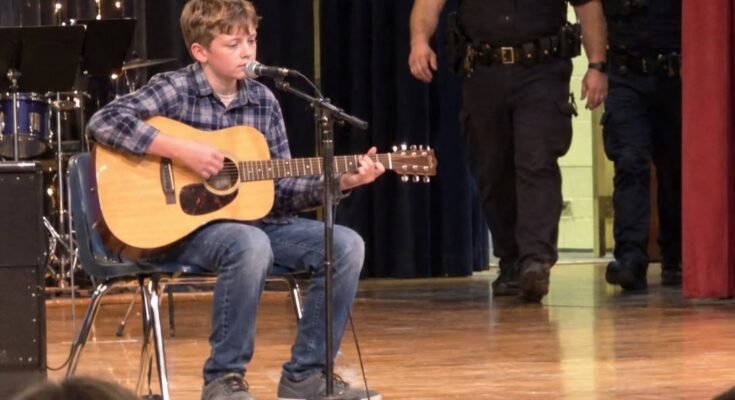
And that was when I noticed the old acoustic guitar in his hands.
David’s guitar.
The one he had used to teach Caleb his first chords before he became too sick to play anymore.
My throat tightened.
Caleb had never told me he was performing.
He walked onto the stage by himself and sat beneath the lights.
For a few seconds, he said nothing.
Then he looked through the audience until his eyes found mine.
After that, he glanced upward.
“This one is for my dad,” he said softly.
Then he began to play.
I recognized the song almost immediately.
David used to hum it around the kitchen on Saturday mornings.
Sometimes while making coffee.
Sometimes while burning pancakes.
Sometimes simply because he was happy.
Caleb started singing.
His voice shook during the first few lines.
Then it became stronger.
By the second verse, people throughout the gym were wiping their eyes.
A woman in front of me covered her mouth.
Several teachers stood silently against the wall.
I could barely see through my own tears.
For the first time in three years, it felt like Caleb was finally saying everything he had kept locked inside.
Then something happened at the back of the gym.
The double doors opened.
Two uniformed police officers walked inside.
At first, nobody seemed to know what was happening.
One teacher stepped toward them.
But they kept walking.
Straight down the center aisle.
Straight toward the stage.
My stomach dropped.
I looked at Caleb.
He had stopped playing.
The entire gym went silent.
Then one of the officers climbed the steps onto the stage.
The second followed him.
Caleb stared at them.
I stood halfway out of my chair, terrified that something had happened.
Then the first officer removed his hat.
He looked at Caleb.
And what he said next made my son drop his guitar pick and burst into tears.
━━━━━━━━━━━━━━━━━━━━
Part Two — “Your Dad Saved My Life”
The officer looked to be in his early thirties.
His voice shook when he spoke.
“Caleb, you don’t know me. But I knew your dad.”
Caleb stared at him.
So did I.
David hadn’t been a police officer.
He’d been an auto mechanic.
He owned a little two-bay repair shop on the edge of town and came home most evenings smelling like motor oil.
The officer continued.
“My name is Officer Ryan Keller. Twelve years ago, before I wore this uniform, I was nineteen years old.”
He paused.
“I was in a bad place.”
The second officer put a hand on his shoulder.
Ryan looked directly at Caleb.
“One night, I was sitting alone in my car behind your dad’s repair shop. Your father found me there.”
The gym was completely silent.
“He could’ve told me to leave. Instead, he sat on the curb beside me.”
Ryan swallowed.
“He stayed there for almost three hours. Then he called my brother because I wasn’t safe to be alone.”
My hand went to my mouth.
David had never told me.
“Your dad checked on me the next morning. Then the next week. He helped me get my car running so I could keep my job. When I couldn’t pay him, he told me to pay him when my life was worth paying attention to again.”
Ryan smiled through tears.
“I never forgot that.”
Caleb was crying openly now.
Ryan knelt so they were almost eye level.
“I heard about today’s assembly from your school resource officer. When I heard your name, I asked if I could come.”
Then he said:
“I wanted you to know that your father’s life didn’t end only with the people who knew him best. Some of us are still here because he stopped long enough to notice us.”
The second officer stepped forward.
“My name’s Marcus Hill. David helped my family too.”
His story was simpler.
Years earlier, when Marcus was a rookie officer with two small children, his wife’s car had broken down.
David repaired it.
When Marcus admitted he couldn’t afford the whole bill until payday, David tore the invoice in half.
“He told me,” Marcus said, “‘Your babies need a safe car more than I need this money today.’”
Marcus paid him later.
David had never mentioned that either.
Caleb wiped his face with his sleeve.
Then he looked at me.
“Mom, did you know?”
I shook my head.
“No.”
That seemed to matter.
His father hadn’t been secretly building a legend.
He’d simply been kind when nobody was watching.
Ryan picked up Caleb’s guitar pick and placed it back in his palm.
“Would you finish the song?”
Caleb looked down at David’s guitar.
Then he nodded.
The officers didn’t leave the stage.
They moved to the side.
Caleb sat down again.
His first chord was terrible.
His fingers were shaking too badly.
A few people laughed softly—not at him, but with the tenderness people sometimes use when everyone is trying not to cry.
Caleb tried again.
This time the chord rang clear.
And he finished the song.
━━━━━━━━━━━━━━━━━━━━
Part Three — The Things He Never Told Us
Something changed after that afternoon.
Not everything.
Grief doesn’t disappear because two policemen walk onto a stage and tell you your father was a good man.
Caleb still missed David.
So did I.
There were still nights when his bedroom door stayed closed.
There were still Father’s Days.
Birthdays.
Christmas mornings.
There were still moments when something funny happened and I turned instinctively toward the person who wasn’t there.
But Caleb started talking.
A week after the assembly, he came into my room carrying David’s guitar.
“Mom?”
“Yes?”
“Dad knew he was going to die, right?”
I put down the laundry I was folding.
“Yes.”
“Was he scared?”
There are questions mothers desperately want to answer beautifully.
Sometimes honesty is better.
“Yes.”
Caleb nodded.
“Did he ever cry?”
“Yes.”
That surprised him.
“He cried?”
“Of course.”
“But Dad never—”
“He tried not to do it in front of you.”
Caleb looked down at the guitar.
“Why?”
“Probably because he thought protecting you meant looking strong.”
Caleb was quiet.
Then he said:
“I think I did that too.”
There it was.
Three years of silence in seven words.
He told me he’d stopped talking about David because every time he mentioned him, he saw my face change.
He thought he was protecting me.
I had been avoiding certain memories because I thought I was protecting Caleb.
We had spent three years loving each other so carefully that we’d accidentally become lonely in the same house.
After that, we started saying David’s name again.
We talked about good things.
Bad things too.
The ridiculous mustache he’d grown one winter.
His terrible pancakes.
How he’d sing the wrong words to songs with complete confidence.
How sick he’d been near the end.
How angry Caleb had sometimes felt at him for dying.
That last one was hardest.
Caleb whispered it like a confession.
“I was mad at Dad.”
I told him:
“So was I.”
His head snapped up.
“You were?”
“Yes.”
“But he couldn’t help it.”
“I know.”
“Then why were you mad?”
“Because grief doesn’t always care what’s fair.”
For the first time, he seemed to understand that missing his father didn’t require turning David into someone too perfect to be honest about.
Ryan stayed in touch.
Carefully.
He wasn’t trying to become Caleb’s replacement father.
Nobody could do that.
Sometimes he attended one of Caleb’s school concerts.
Once he brought his own brother to our house, and I learned the rest of the story about that night behind David’s shop.
But mostly, Ryan simply became one more adult who could tell Caleb:
Your father mattered here too.
The following Father’s Day, the school held the assembly again.
I asked Caleb whether he wanted to attend.
“Yeah.”
“Perform?”
“No way.”
I smiled.
Then he added:
“Maybe next year.”
We sat together in the gym.
There was still an empty chair beside us.
This time I didn’t hate it.
An empty chair isn’t always evidence that somebody has been forgotten.
Sometimes it’s evidence that somebody had a place.
After the assembly, Caleb and I went home.
He made pancakes.
They were awful.
Too much flour.
Not enough milk.
One was burned black around the edge.
I took one bite and said:
“Your father would be proud.”
Caleb grinned.
“Because they’re good?”
“Because they’re terrible.”
He laughed so hard he nearly dropped the spatula.
That laugh filled our kitchen.
And suddenly I remembered something David had told me during one of his last weeks.
He was weak by then.
Caleb had just left the hospital room.
David watched the doorway for a long time.
Then he said:
“I’m scared he’ll think losing me means he has to stop being happy.”
At the time, I promised him Caleb wouldn’t.
But for three years, neither of us knew how to keep that promise.
Now I did.
Years later, when Caleb was preparing to leave for college, we cleaned his room together.
Behind a stack of books, I found the guitar pick he’d dropped on the school stage.
He’d written something on it in tiny black marker.
I had to put on my glasses to read it.
FINISH THE SONG.
I looked at him.
“Officer Keller?”
Caleb shook his head.
“No. Me.”
He took the pick from my hand.
“I wrote it after the assembly.”
“Why?”
He shrugged.
Then he said:
“Because Dad didn’t get to finish everything.”
I felt my throat tighten.
Caleb turned the little pick between his fingers.
“But that doesn’t mean I shouldn’t.”
Three years earlier, I thought my son needed someone to tell him it was okay to miss his father.
I was wrong.
Caleb already knew how to miss him.
He needed to understand that grief wasn’t the only thing his father had left behind.
There were stories.
Kindnesses.
People David had helped without telling us.
Burned pancakes.
An old guitar.
A song that stopped when two police officers walked onto a school stage.
And a twelve-year-old boy who picked up his father’s guitar pick, wiped his eyes, and started playing again.
David couldn’t finish the song.
But Caleb could.