Part One — The Last Lesson
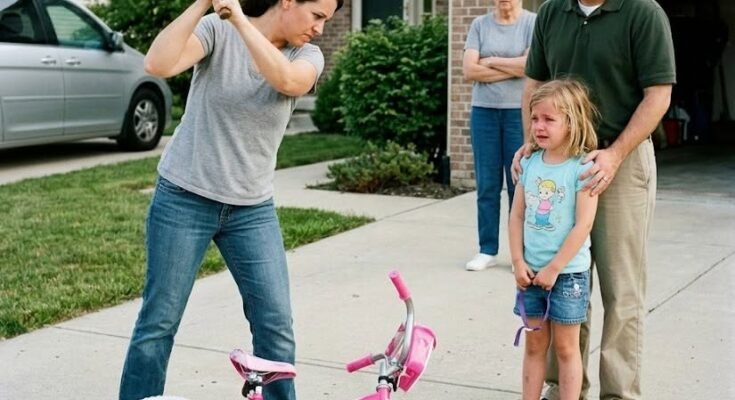
My sister smashed my six-year-old daughter’s new bike with a hammer, right in front of her eyes.
It wasn’t an accident. It wasn’t a burst of anger she regretted two seconds later. Claire walked into my garage, picked up the hammer, crossed the driveway, and raised it while Lily was still standing beside the bike.
That bike was pink, with streamers hanging from the handlebars and a little silver bell Lily had been ringing all afternoon. I had saved for months to buy it. When I finally brought it home, she hugged me so hard I nearly dropped the box.
For one afternoon, she had been completely happy.
Then Claire brought the hammer down.
The first strike bent part of the frame. The second sent the little bell spinning across the driveway. On the third, one of the pink streamers caught beneath the hammer and tore loose.
Lily didn’t scream.
That somehow made it worse.
She just stood there with her hands hanging at her sides, staring at her aunt as if she was waiting for an adult to explain why this was happening.
Claire lowered the hammer and looked at her.
“That should be a lesson for her,” she said.
I was still trying to understand what kind of person could look at a six-year-old child after doing that when my mother, Susan, folded her arms beside her.
“You shouldn’t have bought it for her,” Mom said. “She’s getting spoiled.”
Lily finally looked at me.
Not at the bike.
At me.
And that look nearly broke something inside me, because she wasn’t asking whether the bike could be fixed. She was watching my face to learn what happened next when someone you trusted deliberately hurt you and the other adults decided you deserved it.
I walked to her and knelt down.
Her hands were trembling when I took them.
“Go inside, sweetheart,” I told her. “Put your cartoons on for me.”
She glanced once more at the crushed bike.
“But Mom—”
“I know.”
That was all I could manage without letting my voice change.
She trusted me enough to walk inside.
I watched the door close behind her, and for a few seconds nobody said anything.
Claire still had the hammer in her hand.
My mother was suddenly studying the driveway instead of looking at me.
And standing there between them, I understood something I should have understood years earlier.
This wasn’t really about a bike.
Claire had always been allowed to go one step too far, because Mom would immediately explain why someone else had caused it. If Claire insulted me, I was too sensitive. If she ruined something, I shouldn’t have cared so much about possessions. If she crossed a boundary, keeping the peace somehow became my responsibility.
So I had learned to swallow things.
I had learned to smooth things over.
I had learned that speaking up created more trouble than staying quiet.
But Lily was six.
She had not signed up for the family rules I had spent years surviving.
And I suddenly realized that if I stayed quiet now, I would be teaching her exactly what Claire and my mother wanted her to learn: that people who claim to love you can humiliate you, destroy what matters to you, and then demand that you accept their explanation for why you deserved it.
Claire gave the broken bike a small glance and shrugged.
“She’ll get over it.”
That was the moment everything inside me settled.
I didn’t yell.
I didn’t threaten her.
I didn’t ask my mother to understand.
I looked at the hammer in Claire’s hand, then at the bike she had destroyed, and finally at both of their faces.
Then I smiled.
“You just taught my daughter the last lesson either of you will ever get to teach her.”
Claire’s grip on the hammer loosened.
My mother’s face went pale.
And for the first time, neither of them had an answer ready.
━━━━━━━━━━━━━━━━━━━━
Part Two — What the Bike Was Really About
Claire recovered first.
“Oh, please. You’re being dramatic.”
“No.”
“You’re going to cut off your own family over a bicycle?”
I looked at the bent pink frame.
“No. I’m changing our relationship because you deliberately frightened my six-year-old daughter to punish her.”
Claire’s expression changed.
“She needed to learn she can’t always get what she wants.”
That finally explained it.
Earlier that afternoon, Claire’s eight-year-old son, Mason, had asked to ride Lily’s new bike.
Lily had said no.
Not cruelly.
Not teasingly.
She simply wasn’t ready to share the birthday present she’d owned for less than three hours.
Mason complained.
Claire told Lily that cousins shared.
Lily still said no.
So Claire decided a six-year-old saying no to her son was disrespectful.
Mom agreed.
I hadn’t even known they’d been arguing about it.
“You destroyed her bike because she wouldn’t give it to Mason?”
“She was being selfish.”
“She was six.”
“She has to learn.”
“No, Claire. You wanted to teach her that saying no to you has consequences.”
Mom stepped forward.
“Enough. Claire will replace it.”
“No.”
That surprised her.
“What do you mean, no?”
“I mean replacing the bike doesn’t fix what happened.”
Claire laughed.
“So now money isn’t good enough?”
“This isn’t about money.”
I pointed toward the house.
“My daughter watched her aunt pick up a hammer and destroy something she loved because she wouldn’t surrender it when told. Then she watched her grandmother say she deserved it.”
Mom’s face changed.
“I never said she deserved—”
“You said I shouldn’t have bought it for her.”
Silence.
For once, I didn’t let her rewrite what had happened while we were still standing beside the evidence.
I told them to leave.
Claire called me ridiculous.
Mom said we’d discuss it when I’d calmed down.
I said:
“No. You’ll hear from me when I’m ready.”
Then I closed the garage.
Inside, Lily was sitting on the couch.
The television was on.
She wasn’t watching it.
“Are Aunt Claire and Grandma mad at me?”
That question hurt more than seeing the bike destroyed.
I sat beside her.
“No.”
“But I didn’t share.”
“You’re allowed to say no sometimes.”
Her eyes filled.
“Even to family?”
“Especially about something that belongs to you.”
She leaned against me.
Then she whispered:
“Is Aunt Claire coming back?”
I understood what she was really asking.
“Not until I know you feel safe with her.”
That night, after Lily went to bed, I checked my doorbell camera.
It had recorded the driveway.
Claire walking into the garage.
Claire returning with the hammer.
Lily backing away.
Three strikes.
Mom standing there.
Everything.
I saved the footage.
Not because I wanted revenge.
Because I had spent my entire life being told things hadn’t happened quite the way I remembered them.
This time, I wasn’t going to let anybody rewrite the afternoon.
━━━━━━━━━━━━━━━━━━━━
Part Three — One Pink Bell
Claire did offer to buy another bike.
I declined.
I replaced it myself.
That distinction mattered to me.
I didn’t want Lily’s new bike to become something Claire could point to later and say:
See? I fixed it.
Some things are repaired with money.
Trust isn’t one of them.
Mom called repeatedly.
At first, every conversation began with a version of the same sentence.
“Your sister shouldn’t have done it, but—”
I stopped her every time.
“There is nothing after but.”
Eventually, I stopped answering.
For two months, neither Claire nor Mom saw Lily.
I didn’t announce that they were banished forever.
I didn’t recruit relatives to choose sides.
I simply stopped giving people access to my daughter while they were still defending the behavior that had frightened her.
Claire hated that.
She sent messages accusing me of using Lily as a weapon.
I answered once.
Lily is not a weapon. She’s the person you hurt.
Then I stopped responding.
The strangest change happened in me.
Once I stopped spending all my energy managing Claire and Mom’s reactions, I started remembering things from childhood.
The sweater Claire cut because Mom said I looked prettier in it.
The birthday money Claire “borrowed” and never returned.
The diary she read aloud to her friends.
Every time, Mom had found an explanation.
Claire was jealous.
Claire was going through something.
Claire hadn’t meant it that way.
And eventually:
You’re the older one. Be mature.
I had mistaken endurance for maturity.
I didn’t want Lily learning the same lesson.
Months passed.
Mom was the first one to change.
Not perfectly.
But enough for me to notice.
She asked to meet me alone.
We sat in a coffee shop for almost an hour before she finally said:
“I keep seeing Lily’s face.”
I waited.
“When Claire hit the bike.”
Mom stared into her coffee.
“I knew it was wrong before she even swung the hammer.”
“Then why didn’t you stop her?”
Her answer came quietly.
“Because I’ve spent so many years preventing Claire from being angry that I stopped noticing who else had to pay for it.”
That was the first real apology she’d ever given me.
No excuses.
No request to forget.
I didn’t immediately invite her back into Lily’s life.
Instead, we started slowly.
Short visits with me present.
No Claire.
No lectures about forgiveness.
No asking Lily to hug anyone.
Mom had to rebuild the relationship at the speed of the child she’d helped frighten.
Claire took longer.
Almost a year.
Her first apologies were terrible.
I shouldn’t have broken the bike, but Lily was being selfish.
Then:
I lost my temper.
Neither was true enough.
Eventually, after counseling of her own and months without access to us, she asked to speak with me.
“I didn’t lose my temper,” she said.
I looked at her.
“I was angry, but I knew exactly what I was doing.”
That was different.
She continued.
“I wanted Lily to regret telling Mason no.”
My throat tightened.
Claire started crying.
“I thought because she was a kid, I had the right to overrule her. And when she wouldn’t listen, I wanted to show her I could.”
I nodded.
“Yes.”
“I scared her.”
“Yes.”
“And Mom defending me made it worse.”
“Yes.”
She wiped her face.
“I’m sorry.”
I believed she finally understood what she was apologizing for.
Believing an apology did not mean restoring everything.
Claire never again watched Lily alone.
For a long time, family gatherings happened only when I was comfortable attending.
Eventually Lily stopped being nervous around her.
That was enough.
Three years later, Lily was nine.
She had long since outgrown the replacement bike.
One Saturday, we cleaned the garage together.
At the back of a drawer, she found something small.
A silver bicycle bell.
The original one.
I’d picked it up from the driveway that afternoon and forgotten I’d kept it.
Lily turned it over in her hand.
“Is this from my pink bike?”
“Yes.”
She remembered.
Of course she remembered.
“Why did Aunt Claire break it?”
Children grow old enough to ask old questions differently.
I didn’t tell her Claire was evil.
I didn’t tell her Grandma was weak.
I said:
“You told Aunt Claire no, and she thought being an adult meant she didn’t have to respect your answer.”
Lily looked at the bell.
“That’s stupid.”
I laughed.
“Pretty much.”
“Can I keep this?”
“It’s yours.”
She attached that battered silver bell to her new bicycle.
It looked ridiculous.
The bike was purple and sleek.
The bell was scratched and slightly dented.
But it still worked.
The first time she rode down the driveway, she rang it twice.
Ding. Ding.
I stood there watching her disappear around the corner.
Three years earlier, Claire thought she’d taught my daughter a lesson by destroying something Lily loved.
She did teach her something.
Just not what she intended.
Lily learned that no is a complete answer even when somebody dislikes it.
She learned that being family does not give anyone permission to frighten you.
She learned that apologies matter only when behavior changes.
And most importantly, when she looked at me that afternoon beside the shattered pink bike, waiting to see what happened next, she learned something I had needed forty years to learn myself:
Keeping the peace is not your job when somebody else is the one breaking it.
The little silver bell is still on her bike.
It’s dented.
It’s scratched.
But when Lily presses it, it rings perfectly.
And every time I hear it, I remember the last lesson my sister ever got to teach my daughter:
Not how to surrender.
How to know when she shouldn’t.