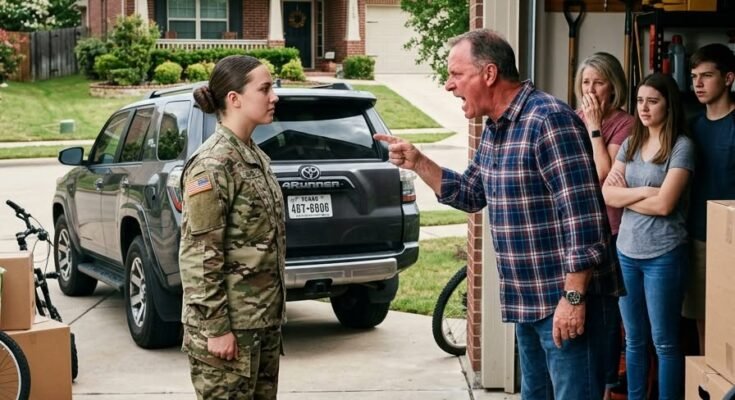
Part One — The House They Thought I Had Surrendered
My father expected me to argue.
He expected the same daughter who had spent most of her life trying to earn his approval to finally break down in front of him.
Instead, I looked around the villa I had paid for, the place where I had rebuilt my life after losing my husband, and nodded.
“Okay.”
That frightened him more than shouting would have.
Three weeks earlier, I had left for emergency readiness duties.
When I returned, exhausted and desperate for a shower, there were four unfamiliar cars in my driveway.
Inside, my father, my sister Brianna, her husband Cole, and my stepmother Diane were drinking champagne on my terrace.
Suitcases lined the staircase.
Children’s toys were already scattered across the living room.
Brianna had put family photographs on my sideboard.
One of mine was lying facedown beneath them.
“What’s going on?”
Dad barely glanced at me.
“Brianna and Cole need the house.”
I actually laughed.
“What?”
“Their lease is ending. They’ve got three children. You barely use this place.”
“I live here.”
“You’re deployed half the time.”
“That’s not the same thing.”
Brianna lifted her champagne glass.
“Come on, Natalie. Look at this place. Four bedrooms, a pool, an acre of land—and you’re one person.”
One person.
That phrase landed harder than she knew.
My husband Nathan had died four years earlier.
He wasn’t military. He was a civil engineer who somehow managed to make every room feel warmer just by walking into it.
We bought the villa together.
After he died, I refinanced it in my name and poured everything I had into keeping it.
The library still held his books.
His old coffee mug remained on the highest kitchen shelf.
Beside the fireplace was a brass compass he’d carried on hiking trips.
Sometimes, after difficult weeks, I’d sit beside that compass and remember the man who once told me:
“Home isn’t where people assign you. It’s where you can finally exhale.”
My father pointed toward my uniform.
“The government takes care of you.”
I stared at him.
“What does that have to do with my house?”
“You have housing options. Brianna doesn’t.”
“Then Brianna needs to find housing.”
Her face hardened.
“You’ve always been selfish.”
That almost impressed me.
I had paid Mom’s medical deductible twice.
Covered Dad’s roof repair.
Loaned Brianna $18,000 when Cole’s business failed.
Apparently generosity had an expiration date shorter than memory.
Dad stepped closer.
“I’ve made my decision.”
I looked at him.
That old voice.
The one that used to make twelve-year-old me apologize before I even understood what I’d supposedly done.
Then he said:
“Go back to your base, Commander. This villa belongs to your sister’s family now.”
Brianna smiled.
Dad added:
“You are not allowed here anymore.”
For years, that sentence would have reduced me to a child.
This time I saw something different.
A sixty-seven-year-old man issuing an order he had absolutely no authority to give.
So I asked:
“How much have you moved in?”
Brianna laughed.
“Enough.”
“Furniture?”
“Saturday.”
“Anything changed in the house?”
Cole shrugged.
“We’re turning your office into the boys’ room.”
My office.
Nathan’s old drafting room.
I looked toward the hallway.
Then I nodded.
“Okay.”
Dad relaxed.
Brianna’s smile widened.
They thought I’d surrendered.
I walked upstairs and packed a small bag.
But before leaving, I took Nathan’s compass.
His letters.
My passport.
Property documents.
A hard drive.
The jewelry that had belonged to his mother.
Anything irreplaceable.
Dad watched from the foyer.
“See? This doesn’t have to be ugly.”
I looked at him.
“No.”
I smiled.
“It doesn’t.”
Then I left.
From my car, I called my attorney.
Her name was Rachel Kim.
She had handled the refinancing after Nathan died.
I said:
“My family has taken over my house.”
She asked the only question that mattered.
“Whose name is on the deed?”
“Mine.”
“Any lease?”
“No.”
“Any ownership interest held by your father or sister?”
“No.”
“Have you given them permission to live there?”
“No.”
She paused.
“Then don’t improvise. Let me handle this properly.”
The next two days were very boring.
Which made them devastating.
We confirmed title.
Documented the condition of the property.
Preserved the security-camera footage showing when everyone entered.
I sent a written revocation of any permission to access the home.
Rachel notified them that they had no right to occupy, alter, sell, rent, or remove property from the villa.
I arranged for a licensed locksmith and security company to secure the house when it was vacant.
I also learned something I hadn’t expected.
Cole had already contacted a contractor about removing a wall.
Brianna had changed the mailing address on one utility account.
And Dad had told neighbors the villa had been “transferred within the family.”
It hadn’t.
No deed.
No gift.
No trust amendment.
No transfer.
Just four people repeating a lie until they hoped it would become furniture.
Then Saturday came.
The moving trucks arrived at 8:06 in the morning.
And the surprise began.
━━━━━━━━━━━━━━━━━━━━
Part Two — “Please Make It Stop”
I wasn’t standing in the driveway waiting dramatically.
I was having coffee five miles away with Rachel.
My phone showed the security cameras.
Two moving trucks stopped outside the gate.
Brianna’s SUV pulled behind them.
Dad arrived next.
The electronic gate code no longer worked.
Brianna tried again.
Then Dad.
Then Cole.
They began calling me.
I didn’t answer.
Instead, Rachel said:
“Give it a minute.”
At 8:13, Dad climbed through the pedestrian side entrance after ignoring the posted notice instructing them not to enter.
The exterior alarm activated.
Not some booby trap.
A normal monitored security system.
Lights flashed.
A siren began sounding.
Dad called again.
I finally answered.
“Natalie!”
“Good morning.”
“Turn this damn thing off!”
“Are you inside my property?”
“This is ridiculous!”
“Dad.”
The alarm continued.
Behind him, I could hear children crying and Brianna shouting.
Then Dad yelled:
“PLEASE MAKE IT STOP!”
I looked at Rachel.
She nodded.
I disarmed the audible alarm remotely.
Silence.
Dad exhaled.
Then I said:
“Now leave the property.”
“What?”
“You received the attorney’s notice.”
“You can’t lock us out!”
“You don’t live there.”
“We moved things in!”
“You left a few suitcases during an unauthorized visit.”
“This is Brianna’s home now.”
“No.”
“Natalie—”
“It never was.”
A security representative arrived first.
A sheriff’s deputy arrived shortly afterward because the monitoring company had received an unauthorized-entry alert and there was an active property dispute.
Nobody was dramatically arrested.
Nobody needed to be.
The deputy looked at the documents.
Asked questions.
Checked identification.
My attorney spoke with him by phone.
Dad kept insisting:
“I’m her father.”
The deputy answered:
“That doesn’t establish ownership.”
Then Dad tried:
“She told us we could have it.”
I was still on speaker.
“No, I didn’t.”
Silence.
Brianna shouted:
“You said okay!”
“I said okay after Dad told me I was forbidden from entering my own property.”
“You nodded!”
“Yes.”
“That means you agreed!”
Rachel leaned toward my phone.
“No, Ms. Harris. Real property is not transferred because someone nods during a family argument.”
I almost smiled.
The moving-company supervisor was already looking uncomfortable.
He asked Brianna:
“Do you have proof you’re authorized to move into the property?”
She had none.
Dad finally understood that his confidence wasn’t a legal document.
His voice changed.
“Natalie, open the gate. We can talk like adults.”
“We had that opportunity Thursday.”
“You’re humiliating your sister.”
“No. I’m not discussing humiliation.”
I looked at the camera feed.
“I’m discussing my home.”
Eventually, the moving trucks left.
So did my family.
But that wasn’t the surprise that mattered.
The surprise was what happened next.
My parents assumed I’d calm down.
Mom sent:
Your father only wanted to help Brianna.
Brianna sent:
You have no idea what you’ve done to my children.
Cole sent nothing.
Then Rachel called.
“Your father’s attorney contacted me.”
“My father’s attorney?”
“He apparently had a document he planned to use if you resisted.”
My stomach tightened.
“What kind of document?”
“A property authorization.”
She emailed it.
My name was at the bottom.
So was a signature that looked almost like mine.
Almost.
I had never signed it.
The document supposedly authorized my father to manage, lease, and temporarily occupy the property while I was away on duty.
The date was from six months earlier.
On that date, I had been in another state.
Rachel’s voice became very careful.
“Do not accuse anybody publicly. We’re going to preserve the document and determine where it came from.”
That changed everything.
The disagreement was no longer:
Should a single woman let her sister have a bigger house?
Now there was a document using my name without my authorization.
My father claimed it was a misunderstanding.
Said I’d signed “a stack of family papers.”
I hadn’t.
The notary listed on the page didn’t recognize me.
Records raised additional questions.
The issue went to the appropriate professionals.
Not my command.
Not my military connections.
Not some fantasy where wearing a uniform made laws bend around me.
An attorney.
The notary.
Investigators.
Ordinary processes.
And suddenly Dad stopped calling me selfish.
He started calling me scared.
“Natalie, this has gone far enough.”
“Then tell your lawyer the truth.”
“I was trying to keep the family together.”
“You were trying to give away something that wasn’t yours.”
“I didn’t think you’d mind.”
“You told me I wasn’t allowed inside my own home.”
Silence.
Then:
“Your sister needed it.”
I closed my eyes.
There it was again.
Need as permission.
My family had spent years confusing those two things.
━━━━━━━━━━━━━━━━━━━━
Part Three — The Compass on the Mantel
The property issue took months to resolve.
The questionable authorization was investigated separately.
I won’t pretend everyone involved went to prison or lost everything.
Real consequences are rarely that neat.
What mattered to me was simpler.
The document could not give my father rights he didn’t legitimately have.
The villa remained mine.
Brianna and Cole rented a townhouse.
It was smaller.
Their children survived beautifully.
That shouldn’t sound sarcastic.
Children do not need villas.
They need stability.
For almost a year, I had very little contact with Dad.
Mom kept asking me to “be the bigger person.”
I finally answered:
“I was the bigger person for twenty years. That’s how everyone got comfortable taking pieces of me.”
She stopped asking.
Brianna was angrier.
At first.
Then something happened I didn’t expect.
Her marriage began having financial trouble.
Cole had hidden how badly his business was doing.
The villa wasn’t merely somewhere beautiful to raise children.
It had been their solution to eliminating housing costs.
Suddenly the urgency made sense.
Not the entitlement.
But the desperation beneath it.
Brianna called one night.
“I should’ve told you.”
“Yes.”
“We were drowning.”
“I would’ve helped you make a plan.”
“I know.”
“No, I don’t think you did know.”
She cried.
“We thought you’d say no.”
I sat quietly.
“So you decided my no shouldn’t count.”
The line went silent.
That was the same problem beneath all of it.
They didn’t believe I had the right to refuse if their need was large enough.
Months later, Brianna apologized.
Not for getting caught.
Not because the house remained mine.
She said:
“I walked into the place where you lived with Nathan and started assigning bedrooms like your grief was empty space.”
That was when I believed her.
She continued:
“I kept telling myself you didn’t need the house because you don’t have children. I didn’t think about the fact that a family can be two people, even after one of them dies.”
I cried then.
Quietly.
She had finally understood the part I couldn’t explain when they were drinking champagne on my terrace.
Nathan was gone.
But that didn’t mean what we’d built together had become available inventory.
Brianna and I rebuilt slowly.
Dad took longer.
Two years after everything happened, he asked whether he could visit.
Not arrive.
Visit.
I almost said no.
Then I remembered Nathan.
Home wasn’t where people assigned you.
It was where you could exhale.
I realized I could say yes without surrendering anything.
So I wrote:
Sunday. 2 p.m. Come alone.
Dad arrived at 1:58.
He stood outside the gate.
He did not try the keypad.
He called.
“I’m here.”
I opened it remotely.
When he entered the living room, the first thing he saw was Nathan’s compass back beside the library.
He stared at it.
“I remember that.”
“Nathan’s.”
Dad nodded.
Then:
“I didn’t understand.”
“What?”
“What this place was to you.”
I folded my arms.
“You didn’t ask.”
“No.”
We sat.
For a while neither spoke.
Then he said:
“I kept thinking because you were the successful one, you needed less.”
I laughed softly.
“That’s been the family theme.”
“Brianna needed rescuing.”
“So you rescued her with my things.”
He closed his eyes.
“Yes.”
No defense.
That mattered.
Then he said:
“I was wrong to tell you that you weren’t allowed in your own home.”
“Yes.”
“Wrong to treat your service like it meant you didn’t need a home.”
“Yes.”
“Wrong to think being your father gave me some authority over what you owned.”
That one took longer.
Then:
“Yes.”
He looked toward the compass.
“I think I still expected you to obey me.”
I said:
“I know.”
“Even at forty-two.”
“Especially at forty-two.”
He almost smiled.
Then his eyes filled.
“I am sorry.”
I accepted the apology.
I did not give him a gate code.
Both things could exist together.
Years later, people in my family still tell the story about the Saturday the moving trucks couldn’t get through my gate.
They make the alarm sound funnier than it was.
Dad sometimes even jokes:
“Please make it stop!”
I laugh now.
But the part that changed me wasn’t watching my family discover they couldn’t simply claim my property.
It happened three days earlier.
When my father stood inside my home and told me I was forbidden from returning.
Old me would have argued.
Explained.
Listed everything I’d paid.
Reminded him of every sacrifice.
Begged him to see me as equally deserving as my sister.
Instead, I finally understood something.
I did not need my father’s agreement to own what was already mine.
So I smiled.
Nodded.
Walked away.
And let the deed, the law, and the truth do the arguing for me.
The villa still stands.
I still travel for work.
Sometimes I’m gone for weeks.
That does not make the house abandoned.
It does not make it excess.
And it certainly does not make it available to whoever believes they need it more.
Nathan’s compass remains beside the library.
When I’m home after a long assignment, I sometimes put my hand over it before I sit down.
Not because the house is sacred.
Because what it represents is.
A life I built.
A love I survived losing.
And the boundary I finally learned far too late:
You can help your family without handing them ownership of your life.
And if someone only respects your generosity when it has no limit, they never respected the generosity.
They respected the access.