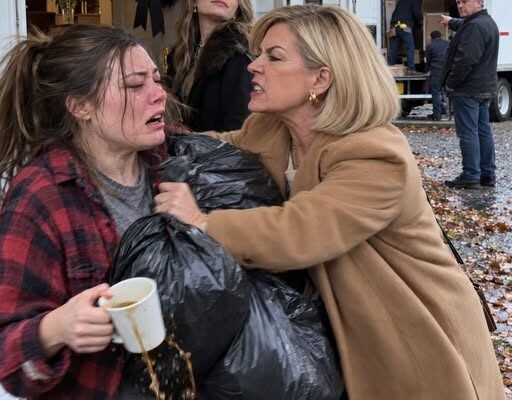
Mom came up behind her and pushed two garbage bags into my arms.
“You were Grandpa’s responsibility,” she said. “He’s gone now, so this house belongs to us.”
I didn’t argue. I set the bags down by the door and waited.
They had been gone for seventeen years. I was five when they left me at Grandpa’s, saying I would stay for the weekend. No one came to pick me up. There were no birthday calls or Christmas cards, and no explanation I could make sense of as a child.
Grandpa raised me. He used his pension, his garden, and what he could manage to give me a steady home. The day before my parents returned, I had buried him.
Mom looked me over on the porch. “You look terrible, Emily.”
Dad didn’t hug me or ask if I was all right. He glanced toward the movers. “Start with the upstairs furniture.”
Brianna was already inside. She looked around the foyer and wrinkled her nose.
“Seriously? It smells like an old man in here.”
“Brianna,” Dad said, not sharply enough to stop her.
She was looking up the stairs again. “I’m still taking the master bedroom.”
The black funeral wreath was hanging on the front door. Mom stepped around it without looking at it. I was holding a cup of coffee that had gone cold. I remember that because I had meant to drink it before the funeral, and then the day got away from me.
“Pack whatever is yours,” Mom said, nodding at the bags. “Clothes, toothbrush, that old quilt. Whatever you need.”
I looked at her. “You want me to leave?”
“I want you to be reasonable.”
“You left me here.”
Her mouth tightened. “We thought this was best at the time.”
Dad came in behind her. “Don’t make things harder than they need to be.”
From upstairs, Brianna called, “Can I paint the bedroom? All this dark wood is depressing.”
“Let’s get the furniture sorted first,” Dad called back.
Then he turned to me. “Your grandfather wanted this property to stay with the family.”
The word family sat between us. I had spent most of my childhood trying not to ask why mine had disappeared. I was old enough now to recognize that they still expected me to make things easy for them.
“You were Grandpa’s burden, Emily,” Mom said. “He’s dead now. This house belongs to us.”
I didn’t answer. Grandpa had told me not to argue with them at the door.
A few days before he died, I had been sitting beside his hospital bed. His hand felt thin inside mine, but his voice was clear.
“When they come back, don’t fight with them at the door.”
I had frowned. “Who?”
“Your parents.”
“Why would I let them in?”
“Let them talk,” he said. After a pause, he added, “Give them enough time to show everyone exactly who they are.”
I asked what I was supposed to do afterward.
“Open my study.”
That was all. He didn’t explain what I would find or who might be there. I wanted to ask more, but he was tired, and I didn’t want his last days to become an argument about people who had already taken enough from him.
So I let my parents walk in. I let Dad direct the movers. I let Brianna claim the bedroom. I let Mom put the bags in my arms.
Then I heard a quiet click from the hallway.
The people in the entry stopped talking. Grandpa’s study door swung open.
A man stood inside. He was in his sixties, dressed in a dark suit, with a folder held at his side. Mom recognized him before I did.
The garbage bags slipped from her hands.
“Mr. Shaw,” she said.
He nodded to her, then looked at Dad. “I’m sorry for your loss.”
Dad took a step toward the study. “What are you doing here?”
“I was asked to be here today.”
“By whom?” Mom asked, though she knew.
Mr. Shaw didn’t answer her right away. He turned to me instead. “Emily, your grandfather asked me to make sure you weren’t put out of your home.”
Mom let out a short, disbelieving laugh. “This is a family matter.”
“Then it should be easy to discuss in front of everyone,” I said.
My voice sounded steadier than I felt. Dad looked at the movers, who had stopped with a chair between them. Brianna came down two steps, still wearing her sunglasses.
“Why is a lawyer here?” she asked.
Mr. Shaw held out a sealed envelope. My name was written across the front in Grandpa’s handwriting. He said Grandpa had left it with him and asked that I open it if my parents returned and tried to make me leave.
I took it from him. Mom watched me open it.
The letter was short. Grandpa wrote that he knew my parents might come back after his death and claim the house as family property. He said I had been left in his care as a child, and that no one should treat me as a guest who could be sent away. He had asked Mr. Shaw to stand with me and make clear that I did not have to leave because my parents had arrived with a truck.
It wasn’t a deed or a court order. Mr. Shaw said that plainly. It was Grandpa’s own letter, written before he died, and an explanation of the help he had asked his lawyer to provide. If anyone wanted to make a legal claim about the house, that would need to be handled properly. No one could settle it by showing up and ordering me out.
Dad’s eyes stayed on the letter. “He told you we were coming?”
“He told me he was worried Emily would be pressured,” Mr. Shaw said.
Mom crossed her arms. “We’re not pressuring her. We’re trying to sort out what happens now.”
“You handed me garbage bags,” I said.
She looked at the bags on the floor. “I was trying to be practical.”
“You called me a burden.”
“I didn’t mean it the way you’re taking it.”
Brianna came down the rest of the stairs. “I thought we were all staying here.”
“No one asked me,” I said.
She lifted her sunglasses onto her head. “I figured it was obvious.”
“What was obvious?”
“That it’s our family house.”
Mr. Shaw waited, saying nothing. That seemed to make it harder for them to speak.
Dad pointed toward the letter. “Your grandfather wanted the house to stay in the family. That’s what I said.”
“He wrote that I shouldn’t be forced out,” I replied.
“That doesn’t mean he wanted you to keep everything for yourself.”
“I didn’t say it did.”
Mom’s expression changed, but only briefly. “We’ve been through a lot, too.”
I looked at her. “I was five.”
“I know how old you were.”
“You left me here.”
Her eyes moved toward the movers, then back to me. “We thought he could take care of you.”
“For a weekend?”
Dad cut in. “We don’t need to go over all that today.”
“We’re already here,” I said. “You’ve already told me to pack.”
For a moment, no one answered. One of the movers lowered his end of the chair carefully to the floor.
Dad turned to him. “Just wait a minute.”
The mover glanced at the other man. “Do you want us to keep going?”
“No,” I said.
Dad looked at me. “Emily.”
“They’re not taking anything upstairs.”
He shook his head. “You don’t have to make this a scene.”
“I didn’t bring the truck.”
Brianna looked from Dad to Mom. “Are we actually moving in or not?”
Mom said, “We’re trying to figure it out.”
“You told me I could have the master bedroom.”
“I said we’d discuss it.”
“No, you didn’t.”
Brianna’s voice had lost its certainty. She took the sunglasses off and held them in one hand. “Dad said the house would be ours.”
Dad didn’t answer her.
Mr. Shaw spoke quietly. “No one should move or remove anything while there’s a dispute. I recommend you leave today and get your own advice before making decisions about the property.”
Mom’s face hardened. “You’re taking her side.”
“I’m here because her grandfather asked me to be here for her,” he said. “I’m not asking you to take my word for anything. I’m telling you not to turn a family argument into a move you may regret.”
Dad looked at the letter again. “You can’t tell us we have no rights.”
“I haven’t,” Mr. Shaw said. “I’m telling you to stop acting as though you’ve already established them.”
That was the first thing anyone said that Dad didn’t answer immediately. He looked around the foyer, at the movers and the bags and Brianna standing on the stairs. The house had not changed hands because he had given directions.
Mom came closer to me. “You could have called us before this got out of hand.”
I nearly laughed. “You could have called me before today.”
“We didn’t know how to start.”
“You could have started when I was five.”
She looked down at the floor. “That’s not fair.”
“I know,” I said. “It wasn’t fair to me either.”
Dad rubbed his forehead. “We came because there was a lot to sort out. We thought we could all deal with it together.”
“You thought you could move in,” I said.
He glanced at the truck visible through the open door. “We thought there was room for everyone.”
“Brianna had already picked a bedroom.”
“She was excited,” Mom said.
“She said she wanted to paint Grandpa’s room.”
“She didn’t know him the way you did,” Mom replied, then seemed to realize what she had said. She pressed her lips together.
That was the closest she came to an apology. It wasn’t one.
I looked at the letter again. Grandpa hadn’t written it to punish them. He hadn’t filled it with accusations or listed every birthday they missed. He had written it because he knew they of hand.”
I nearly laughed. “You could have called me before today.”
“We didn’t know how to start.”
“You could have started when I was five.”
She looked down at the floor. “That’s not fair.”
“I know,” I said. “It wasn’t fair to me either.”
Dad rubbed his forehead. “We came because there was a lot to sort out. We thought we could all deal with it together.”
“You thought you could move in,” I said.
He glanced at the truck visible through the open door. “We thought there was room for everyone.”
“Brianna had already picked a bedroom.”
“She was excited,” Mom said.
“She said she wanted to paint Grandpa’s room.”
“She didn’t know him the way you did,” Mom replied, then seemed to realize what she had said. She pressed her lips together.
That was the closest she came to an apology. It wasn’t one.
I looked at the letter again. Grandpa hadn’t written it to punish them. He hadn’t filled it with accusations or listed every birthday they missed. He had written it because he knew they might arrive confident, and he didn’t want me standing alone while they told me I had no place there.
I said, “You can’t ask me to pack and call that sorting things out.”
Mom looked toward the front door. “So what do you want us to do?”
“Stop moving anything. Leave today. If you believe you have a claim, get advice and deal with it properly. Don’t decide it for me in the doorway.”
Dad’s jaw worked as though he wanted to object. Then he looked at the movers.
“Take the chair back out,” he said.
The men lifted it again. One of them asked where to put it, and Dad told him to return it to the truck. Brianna stayed on the stairs.
“What about my things?” she asked.
“You haven’t brought anything in,” I said.
She looked at me, then at the upstairs landing. “I was just saying.”
“You said you were taking the room.”
“I didn’t know you were going to make this so serious.”
“It’s my home.”
The words surprised me. I had not said them before, not even to myself. I didn’t mean that a sentence could settle who owned the property. I meant I had lived there, and I was not going to let them treat me as an inconvenience they could carry out in two bags.
Dad said, “We’ll go for now.”
Mom looked at him. “For now?”
“We need to talk before we do anything else.”
She turned to me. “We can talk later.”
I didn’t promise that we would. I said, “Not today.”
The movers carried the chair back to the truck. Dad followed them outside, speaking in a low voice. Brianna came down the stairs and walked past me without meeting my eyes. At the threshold she stopped.
“I didn’t know he’d left you a letter.”
“I didn’t either.”
She seemed to want to say more. Instead, she followed Mom out.
Mom paused beside the funeral wreath. “You could have told us Mr. Shaw was here.”
“I didn’t know he was coming until he opened the door.”
That was true. Grandpa had said to open the study. He had not told me what would be waiting there.
Dad called her from the truck. She went.
I watched from the doorway as they left with the things they had brought. The movers took the chair. No one carried my bags. When the truck pulled away, Mom’s two black garbage bags were still on the floor inside Grandpa’s house.
Mr. Shaw stayed long enough to explain that he wasn’t there to decide ownership in the foyer. Grandpa had asked him to make sure I was not pressured out, and that was what he had done. He advised me to get independent legal advice before making decisions about the property. I told him I would. Then he left, and I was alone in the house.
My parents had arrived believing they could claim it by announcing that it belonged to them. They left without moving in, without taking Grandpa’s furniture, and without making me leave. If they wanted to pursue anything further, they would have to do it through proper channels, not by handing me trash bags and calling me a burden.
I carried the bags to the bin. I kept my clothes and the old quilt. Then I went back inside and closed the door.
Grandpa had asked me not to fight at the door. I hadn’t.