PART 3
Two weeks later, at exactly ten in the morning, Sarah Mitchell knocked on the front door with a second attorney beside her, carrying a thick file.
“Who are these people?” Meadow asked, appearing over my shoulder.
“My attorneys.”
We moved into the living room. I remained standing, the sealed envelope Sarah handed me still in my grip.
“Three weeks ago, you called me the maid,” I said to Meadow. “You laughed,” I told Blaine. “And last week, I heard you discussing how long I might live before you could collect whatever you thought I’d leave behind.”
Meadow went pale. Blaine looked down at the floor.
“You’ve both spent years believing I had nothing,” I said. “Tell them about Morrison’s Market first.”
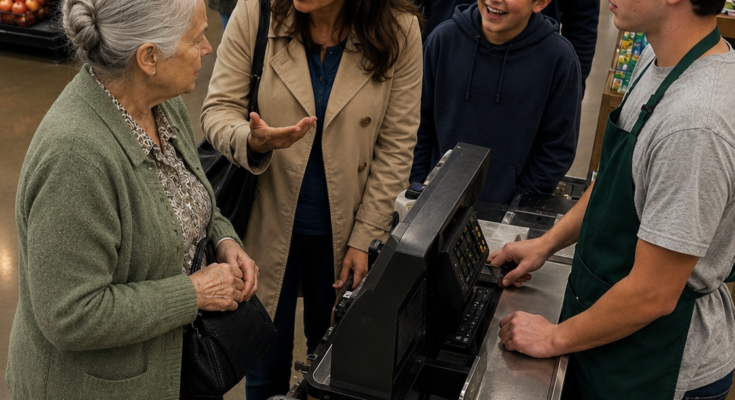
Bill had come with the attorneys, standing quietly by the door, and stepped forward to explain, plainly, that I’d held majority ownership of the store — the same store where his own daughter-in-law had humiliated me at the checkout counter — for nearly four years.
“That’s not possible,” Meadow said. “You don’t even have a bank account we know about.”
“That was rather the point,” I said.
Sarah laid out the rest calmly. My total estate, once fully accounted for — the Morrison’s stake, the investment portfolio built quietly over three decades, two rental properties I’d purchased and managed without ever mentioning them at a single family dinner — came to just over $50 million.
“And as of this morning,” Sarah said, “none of it is designated for either of you.”
Meadow’s face went through several expressions at once — disbelief, then something closer to panic. “You can’t just cut us out. We’re his family.”
“Jud is my family,” I said. “The trust benefits him directly at twenty-five, structured so neither of you can access or control it in the meantime. The rest is going to several causes I care about — including, as it happens, a scholarship fund for caregivers returning to their own careers after years of unpaid family labor.”
Blaine finally spoke, his voice smaller than I’d heard it in years. “Mom, I didn’t know. I swear I didn’t know any of this.”
“You didn’t ask,” I said. “For five years, you didn’t ask what happened to my catering business, where I went on Tuesday afternoons, or why I never seemed to need anything from either of you. You just assumed I had nothing, because it was convenient to assume that, and because I let you.”
I didn’t stay to watch the rest of their reaction. I had a flight booked for the following week — Rome first, then a villa outside Florence I’d quietly purchased two years earlier through the same holdings nobody in my family had ever bothered to investigate.
I called Jud before I left, just the two of us, and told him honestly, in language a twelve-year-old could understand, that none of what happened was his fault, that I loved him completely, and that someday, when he was older, the trust would be there for him regardless of anything happening between the adults in his life.
Bill still runs Morrison’s Market with me as a silent but very active partner. I stopped by the checkout counter myself, the week before my flight, and introduced myself properly to the young cashier who’d once looked embarrassed on my behalf.
“I own this store,” I told her. “I just wanted you to know that the maid comment wasn’t true, and that you were kind to me when you didn’t have to be.”
She cried a little. So did I.
I’m writing this from a small café table in Florence, sunlight on stone streets that have never once called me the help. I don’t know yet whether Blaine and I will find our way back to something resembling a relationship. I know, for the first time in five years, that whatever happens next will be entirely my own decision.
Sometimes the people who dismiss you the most completely are the ones who never bothered to ask what you’d quietly built while they weren’t paying attention — and sometimes the kindest thing you can do for yourself is finally let them find out.
— The End —