
Part One — Beneath the Drift
My radio cracked twice before I understood what DeShawn Parker was saying.
“Lena, stop the blower.”
The engine behind me was loud enough to rattle the windows of the closed laundromat on Bryant Avenue. Ice crystals swept through the yellow beam of the truck lights, and the wind had erased most of the sidewalk we had cleared twenty minutes earlier.
“Repeat that.”
“Shut it down. There’s something alive in the snow.”
I hit the emergency switch.
The blower coughed once and stopped. Silence did not follow. The wind scraped loose ice across the pavement, a backup alarm sounded two blocks away, and somewhere beneath the white wall beside a bus shelter, DeShawn was speaking in the low voice he used around frightened animals.
“Easy. I see you.”
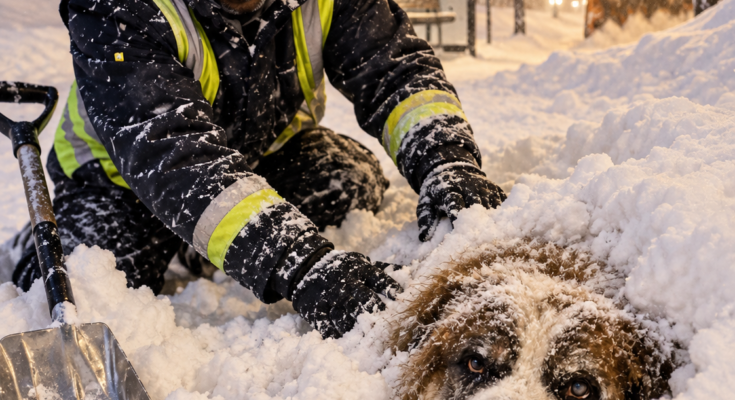
I climbed down and found him kneeling without his gloves.
DeShawn was fifty-two, six feet tall, and built like someone who had carried furniture for half his life before joining our winter street crew. That morning he looked small. He had both hands pressed into the snowbank, scooping frozen layers away from two eyes and the top of a gray muzzle.
The right eye tracked his movement.
The left one was clouded pale blue.
At first I thought we were looking at a dead animal whose eyelid was moving in the wind. Then the visible nostril widened, and a grain of ice rolled away from it.
One breath.
Then nothing.
“Call dispatch,” DeShawn said.
I already had the radio in my hand. I gave our location, requested animal control and an emergency veterinary response, then pulled the wool liner from my hood and placed it between DeShawn’s knees and the ice.
He kept digging.
The snow had hardened around the animal in layers. Fresh powder lay on top, but underneath it sat a packed ridge thrown from the street by earlier plows. DeShawn could not use the metal shovel without risking the body, so he broke the crust with his fingertips and removed it one handful at a time.
His knuckles turned red.
The eyes remained open.
“Stay with me,” he said. “You don’t have to do anything else.”
We uncovered one ear first. It was broad, brown, and edged with silver fur. Then came the crown of an enormous head, a soaked leather collar, and part of a white neck that should have been thick but felt narrow beneath my palm.
A Saint Bernard.
An old female.
She had been lying on her right side in a shallow recess beside the shelter, and the drifting snow had covered her so completely that the morning crew ahead of us had passed within six feet without noticing.
I pressed two fingers behind her front leg when we exposed enough of her chest.
Her heartbeat was there, but it came slowly, with long spaces between beats.
Too slowly.
DeShawn pulled more snow away from her shoulder. Her coat should have hidden the shape of her body, yet I could see where her ribs rose beneath the wet fur. The points of her hips made two hard angles near her back.
She was not merely old.
She was dangerously thin.
A shallow trench appeared beneath her body as we worked, as if she had shifted in the same narrow space more than once before becoming too cold to move. Pressed under her front legs was a faded green glove with a torn thumb.
I reached for it.
The Saint Bernard made a sound so faint I felt it before I heard it. Her chest tightened. Her right paw moved less than an inch and settled over the glove.
DeShawn looked at me.
“She’s guarding that.”
The dog could not lift her head. She could barely breathe. Yet when my fingers approached the glove again, she used what little strength remained to pull it closer.
That was the first detail that did not fit.
The second was her collar.
Beneath the buckle sat a narrow strip of reflective orange tape, weathered but carefully stitched. Someone had also tied a blue shoelace through the metal ring where an identification tag should have been.
No tag remained.
No phone number.
No name.
The animal-control officer arrived at 6:04, followed eight minutes later by a veterinary technician in a four-wheel-drive clinic van. Neither tried to make the dog stand. We slid a rigid transfer board beneath her while DeShawn supported her head and I held the glove against her chest.
When the last of her body came free, everyone stopped.
She was enormous in frame but hollow beneath the coat. Her ribs were visible. Her back legs trembled without lifting. Frozen clumps hung from the fur along her belly, and the white hair around her muzzle had gone almost completely silver.
The technician placed a probe against her ear, waited, checked it again, then said, “I’m not trusting that reading.”
“What does that mean?” DeShawn asked.
“It means her temperature is below what this device measures well.”
The clinic van was warming ten feet away.
We wrapped her in dry fleece, placed warmed packs outside the blankets instead of directly against her skin, and carried her toward the open doors. She did not resist. She did not look at us.
She looked past us toward the road.
DeShawn climbed into the van long enough to settle the green glove beside her face. The dog pressed her nose against it and released one long breath.
The technician checked her gums.
“Drive now.”
Before the doors closed, I noticed a third detail in the trench where she had been buried: three separate layers of paw prints, each partly filled by different snowfalls.
She had not become trapped there once.
She had returned.
More than once.
And as the van disappeared through the blowing snow, DeShawn remained beside the empty trench, staring at the marks as if they had answered a question neither of us had known to ask.
━━━━━━━━━━━━━━━━━━━━
Part Two — The Man Who Never Came Back
We finished our route at eleven that morning.
DeShawn immediately drove to the veterinary hospital.
I went with him.
The Saint Bernard had survived the first hours.
Barely.
Her temperature had risen gradually. She was receiving warmed fluids, oxygen, and careful monitoring. Bloodwork showed dehydration and other problems the veterinarian said could not be blamed on one night in the snow.
“She has been losing weight for a while,” Dr. Patel explained. “That doesn’t necessarily mean someone neglected her. At her age, illness, dental disease, stress—there are several possibilities. Right now we’re treating what’s in front of us.”
“Will she live?” DeShawn asked.
Dr. Patel didn’t offer us false comfort.
“I think she has a chance.”
They had also found a microchip.
Her name was Mabel.
Registered owner:
Harold Jensen.
Age seventy-nine.
Address four blocks from the bus shelter.
The telephone number attached to the chip had been disconnected.
DeShawn stared through the glass at Mabel lying beneath blankets.
“What kind of person loses a dog like that and doesn’t look?”
Dr. Patel glanced at him.
“We don’t know that nobody looked.”
That sentence became important.
Animal control sent an officer to Harold’s address.
The apartment manager recognized the name immediately.
Harold had lived there for almost eighteen years.
So had Mabel.
But Harold wasn’t home.
He hadn’t been home for nearly a month.
On December 18, Harold had collapsed beside the same bus shelter where we found Mabel.
A woman waiting for the Number 4 bus had called 911.
By the time paramedics arrived, Harold was barely conscious.
Mabel had been beside him.
The woman who called for help had held onto the dog’s collar while the paramedics loaded Harold.
At some point during the confusion, Harold’s identification tag broke from Mabel’s collar.
The woman had nothing else to secure her with.
So she pulled the blue shoelace from one of her winter boots and tied it through the collar ring.
The shoelace we had found was not random.
Neither was the orange tape.
Harold had sewn reflective tape onto Mabel’s collar years earlier because his eyesight had begun failing and he wanted to be able to spot her outside at night.
And the green glove?
That had fallen from Harold’s hand while paramedics moved him onto the stretcher.
Mabel had picked it up.
The woman who had called 911 lived nearby. She agreed to keep Mabel until Harold’s family could be reached.
For three days, Mabel barely ate.
On the fourth, she slipped through a gate.
The woman found her six hours later.
At the bus shelter.
She brought her home.
Mabel escaped again.
Same place.
The third time was during the beginning of the storm.
The woman searched until weather made it dangerous and reported Mabel missing.
But by then the dog had disappeared into blowing snow.
Nobody realized she had returned to the bus shelter again.
DeShawn sat very still while the animal-control officer explained all of this.
“Where’s Harold?”
There was a pause.
“He survived.”
That was the first good news.
But only partly.
Harold had suffered a serious stroke.
He had spent more than two weeks in the hospital before being transferred to a rehabilitation facility.
His speech was badly affected.
His right side was weak.
And according to the granddaughter animal control eventually reached, Harold had been trying to ask about Mabel since the day he became alert enough to communicate.
Nobody understood him.
He would point toward the window.
Then make the same motion with his left hand.
Two fingers bent downward and moving.
Walking.
Again and again.
His granddaughter thought he wanted to go home.
A therapist thought he meant his shoes.
Harold could not say the word.
Mabel.
That afternoon, his granddaughter Nora came to the veterinary hospital.
She was thirty-six and had driven from Madison as soon as animal control called.
The moment she saw the green glove in a clear belongings bag, she covered her mouth.
“That’s Grandpa’s.”
DeShawn looked toward Mabel.
“So she wasn’t guarding trash.”
Nora shook her head.
“My grandmother bought him those gloves. She died six years ago. He refused to replace them even after the thumb tore.”
Then she started crying.
“She waited where she last saw him.”
Nobody said anything after that.
There are moments when explaining something only makes it smaller.
━━━━━━━━━━━━━━━━━━━━
Part Three — Where Mabel Went Next
Mabel stayed in the veterinary hospital for nine days.
Her recovery was slow.
She had painful arthritis, severe dental disease, and significant weight loss that had apparently begun after Harold’s stroke. Before that, his neighbors said she had been heavy enough that Harold jokingly called her “the ottoman with legs.”
Stress had changed that quickly.
So had several days missing during brutal weather.
Her paw pads were injured.
The tips of two toes had frost damage.
Her left eye was mostly blind from an old cataract.
But she started eating.
First from a technician’s hand.
Then from a bowl.
On the fourth day, DeShawn visited and called her name from the doorway.
“Mabel.”
Her head lifted.
It was the first time we had seen her move quickly.
DeShawn laughed so loudly a technician shushed him.
“Sorry.”
Mabel’s tail thumped once against the blanket.
The harder question was what happened after she recovered.
Harold could not return to his apartment yet.
Even if he eventually did, he was no longer physically able to safely manage a hundred-pound Saint Bernard alone.
Nora lived four hours away in a building that did not allow large dogs.
For several days, it seemed possible that after surviving the snow, Mabel would still lose the person she had been waiting for.
Then DeShawn said:
“I’ll take her.”
I looked at him.
He shrugged.
“My wife already said yes.”
“You asked your wife?”
“I’m not stupid.”
His wife, Camille, had laughed when she heard that later.
“He sent me a picture of that dog under six blankets and wrote, ‘Hypothetically, how do you feel about Saint Bernards?’”
Mabel went home with the Parkers as a foster.
The arrangement was supposed to last two weeks.
It lasted much longer.
But before DeShawn took her home, Nora arranged something else.
Harold’s rehabilitation facility agreed to a controlled visit once Mabel’s veterinarian cleared it.
The day we brought her there, I carried the green glove.
Mabel walked slowly between DeShawn and Nora, a support harness beneath her belly in case her back legs weakened.
The rehabilitation staff had Harold waiting in a small visiting room.
He sat in a wheelchair beside the window.
He looked thinner than the photograph attached to Mabel’s microchip registration.
His right hand rested motionless in his lap.
When the door opened, Mabel stopped.
Harold looked up.
For several seconds, neither moved.
Then Harold made a sound.
Not a word.
Just air and effort.
Mabel pulled forward so suddenly DeShawn nearly lost the leash.
She crossed the room.
Put her enormous gray head into Harold’s lap.
And closed her eyes.
Harold bent over her.
His left hand moved across her ears again and again.
He was crying.
So was Nora.
So was Camille.
DeShawn was pretending he wasn’t.
I put the green glove on the table beside Harold.
He saw it.
Then looked at Mabel.
His face changed.
A speech therapist beside him whispered:
“Take your time.”
Harold tried once.
Nothing.
Then again.
“Mmm…”
Mabel lifted her head.
Harold’s mouth trembled.
“Mab…”
The dog pressed closer.
That was all he managed.
It was enough.
For the next several months, Mabel lived with DeShawn and Camille.
Every Sunday they drove her to see Harold.
Not because anybody believed a dog could cure a stroke.
She couldn’t.
Harold still had difficult therapy.
He still became frustrated when words refused to come.
Some abilities returned.
Others did not.
But Mabel gave him one familiar thing in a life where almost everything had changed.
And Harold gave her something too.
After their first reunion, she stopped trying to escape.
DeShawn could leave a gate open while carrying groceries and she wouldn’t even approach it.
She no longer needed to return to the bus shelter.
She knew where Harold had gone.
By spring, the rehabilitation facility helped Nora find an assisted-living community better suited to Harold’s long-term needs.
The place allowed pets after an individual assessment.
Nora called DeShawn before she told Harold.
“You’re going to hate me.”
“Why?”
“They said Mabel can live with him.”
There was a long silence.
Then DeShawn said:
“Good.”
His voice cracked on the word.
Mabel moved in with Harold in May.
By then she had gained seventeen pounds.
She had undergone dental treatment.
Her coat looked thick again.
She still moved like an elderly dog, because she was one.
No miracle made her young.
No amount of love fixed arthritis.
Harold couldn’t walk her independently, so staff and volunteers helped. Nora hired a dog walker for extra outings, and DeShawn visited often enough that Mabel reacted to his truck before he even entered the building.
That summer, I stopped by once.
Harold’s room had family photographs on one wall.
Beside the window was a framed object.
The green glove.
Underneath it Nora had placed a small card.
DECEMBER 18 — THE LAST THING SHE HAD OF HIM.
I stared at it.
Harold noticed.
His speech was better by then, though slow.
“She… kept it.”
“I know.”
He looked toward Mabel sleeping beside his chair.
“Stubborn.”
I laughed.
“So are you.”
He smiled.
When winter returned, our crew passed the bus shelter again.
The first heavy storm came in early December.
DeShawn stopped the truck there even though there was nothing unusual in the snow.
He climbed out.
I followed.
For a few seconds we stood beside the exact place where we’d found those two eyes.
“You ever think about what would’ve happened if you hadn’t seen her?” I asked.
He shook his head.
“Try not to.”
Then he pointed toward the shelter.
Someone had attached a small laminated photograph to the inside wall.
Mabel beside Harold’s wheelchair.
Both looking directly at the camera.
Underneath, Nora had written:
THANK YOU TO THE PEOPLE WHO STOPPED.
DeShawn read it twice.
Then climbed back into the truck.
Mabel lived another two years.
She died at an age the veterinarian estimated to be almost fourteen.
Harold was beside her.
So were Nora and DeShawn.
By then Harold could say her name clearly.
Afterward, Nora asked DeShawn whether he wanted the green glove.
He shook his head.
“That belongs with Harold.”
Harold kept it until he died the following year.
Nora eventually gave the glove to me and DeShawn.
For a while, neither of us knew what to do with it.
In the end, we didn’t frame it.
Didn’t put it in some city display.
Didn’t turn Mabel into a mascot.
We gave it back to Nora.
It belonged with family.
But every January, when a storm buries Minneapolis overnight and the plows build high white walls beside the road, I still find myself looking twice at the snowbanks.
So does DeShawn.
Not because we expect to find another Saint Bernard.
Because Mabel taught us something neither of us has forgotten.
At first, we thought we had found an abandoned old dog.
Then we thought we had found a lost one.
We were wrong both times.
Mabel knew exactly where she was.
She had returned to the last place she had seen the person she loved.
She carried the only thing he had left behind.
And she waited through one snowfall.
Then another.
Then another.
Until her body could wait no longer.
The morning we dug her out, DeShawn kept telling her:
“You don’t have to do anything else.”
He thought he was asking her to stay alive.
Years later, I think he was telling her something else too.
You have waited long enough.
We’ll find him now.