Part One — What James Had Been Hiding
I am Sarah Miller. Forty years old. Too many people nearly left behind, a mother who kept a stack of wedding magazines as if they were spare parts, and a quiet neighbor who fixed everything but never looked me in the eye.
“Sarah,” my mother said, pressing tea into my hands, “you don’t have to chase fireworks all the time. James Parker is a good man. And what about him with a limp? A good heart is stronger than two strong legs.”
James lived across the street in Burlington, Vermont—a white porch, a small American flag hanging from a pole, and a ramp he had built himself.
He was five years older than me. Everyone knew his right leg had been badly injured in an accident when he was seventeen. Electronics and computers were his domain. He could revive a dying toaster, repair a laptop nobody else understood, and somehow make my mother’s ancient television behave simply by standing beside it.
Rumor had it James had liked me for years.
Rumor also had it I was too picky.
I called it stubbornness mixed with fear.
On a damp autumn afternoon, I finally said yes.
There was no dramatic proposal.
No orchestra.
No passionate love story.
We were two lonely adults who trusted each other.
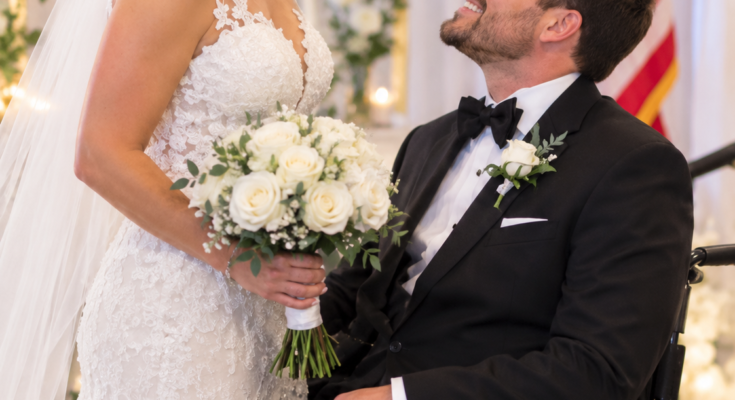
City Hall. Two witnesses. Rings ordered online. Dinner at a diner where the waitress called everybody “honey.”
That was our wedding.
Driving home afterward, the windshield wipers squeaked back and forth while silence sat between us like another passenger.
My new bedroom smelled of lemon oil and clean sheets.
Rain tapped softly against the roof.
James limped down the hallway carrying two glasses of water.
He set one on my nightstand.
“If you need anything, I’m here.”
It sounded less like something a husband says to his wife and more like a promise made to a frightened stranger.
I lay there thinking about why I had married him.
Because my mother worried about me.
Because I was forty.
Because loneliness had begun making ordinary Sunday mornings feel enormous.
Because James was gentle.
And because sometimes gentleness feels close enough to love when you’ve spent long enough without either.
James turned off the light.
A few minutes later, I heard him sit on the edge of the mattress.
“Are you okay?”
“Yes.”
It was a lie.
I heard a small metallic sound.
Then another.
Something being unclipped.
My fingers tightened around the blanket.
I reached toward the nightlight and switched it on.
Then I pulled back the covers.
And froze.
James’s right leg ended below the knee.
Beside the bed rested a prosthetic leg.
But that wasn’t what made my breath catch.
It was the scars.
They climbed well above his knee, across his thigh and hip—old grafted skin, uneven and pale, evidence of injuries far worse than the “bad leg” everyone in town casually mentioned.
James immediately pulled the blanket over himself.
“I should have told you.”
I stared at him.
“You said your leg was injured.”
“It was.”
“You never said—”
“That I lost part of it?”
He looked away.
“No.”
For several seconds, I couldn’t speak.
Then James said something I will remember for the rest of my life.
“You can sleep in the guest room if this changes things.”
I looked at him.
“What?”
“I’ll understand.”
“James, we got married six hours ago.”
“I know.”
“And you’re telling me you’re prepared for me to leave because I saw your leg?”
His jaw tightened.
Then he whispered:
“Someone did before.”
That was the real secret.
Not the prosthesis.
Not the scars.
The fear underneath them.
Years earlier, James had been engaged.
His fiancée knew he walked with a prosthetic but had never seen the extent of his injuries. The first time she did, she became distant.
Within weeks, she ended the engagement.
James never accused her of leaving because of his body.
But that was what he had come to believe.
“I thought if you knew everything beforehand,” he said, “you might start looking at me differently too.”
I sat beside him.
“And hiding it seemed better?”
“No.”
He gave a sad smile.
“It just seemed easier until tonight.”
I thought about my own reasons for marrying him.
Then something uncomfortable became clear.
James had hidden his body because he was afraid I might pity him.
And I had married him partly because I did.
Not cruel pity.
But pity all the same.
I had thought:
He’s alone. I’m alone. He’s kind. Maybe this is enough.
That wasn’t fair to either of us.
“James.”
He finally looked at me.
“I have something to admit too.”
His face tightened.
“I didn’t marry you because I was madly in love.”
“I know.”
That surprised me.
“You know?”
He smiled faintly.
“Sarah, you shook my hand after we got the marriage license.”
Despite everything, I laughed.
Then he said:
“I didn’t marry you because I thought you loved me either.”
“Then why?”
“Because I hoped maybe we could build something honest.”
I looked down at the prosthetic beside the bed.
“Well.”
He followed my eyes.
“We’re off to an excellent start.”
I laughed again.
So did he.
And that was how we spent our wedding night.
Not making love.
Not pretending.
We sat against the headboard until almost three in the morning and told each other things we should have said before signing a marriage certificate.
━━━━━━━━━━━━━━━━━━━━
Part Two — We Started the Marriage Over
The next morning, I took off my wedding ring.
James noticed immediately.
His face fell.
Then I placed it on the kitchen table between us.
“I think we did this backward.”
He stared at the ring.
“Are you leaving?”
“I don’t know.”
That was the truth.
“We barely dated. We let loneliness, my mother, and everybody else’s expectations push us into something neither of us understood.”
James nodded slowly.
“So what do you want?”
“I want to date my husband.”
He blinked.
“What?”
“Dinner. Movies. Arguments about stupid things. I want to actually know you.”
A smile appeared.
“Do I have to pick you up?”
“You live across the street.”
“I can drive around the block.”
And strangely, that was how our real relationship began.
After we were already married.
There were boundaries.
No pretending affection that wasn’t there.
No rushing physical intimacy.
No acting like his disability made him fragile.
James taught me how his prosthesis worked because I asked—not because I became responsible for it.
He hated help unless he requested it.
I hated people deciding what I needed too.
We had more in common than either of us realized.
Three months later, my mother asked:
“So? Are you happy?”
I said:
“We’re working on it.”
She looked disappointed.
I smiled.
For once, I didn’t care.
━━━━━━━━━━━━━━━━━━━━
Part Three — What I Found Under the Covers
Love didn’t arrive dramatically.
There were no fireworks.
It arrived on a February morning when my car battery died and James came outside in pajamas and one boot because he hadn’t finished putting on his prosthesis.
It arrived when I got the flu and woke to find soup outside the bedroom because he knew I hated being fussed over.
It arrived when his socket became painful and he finally said, “I need help today,” without embarrassment.
It arrived when my mother died three years into our marriage and James sat beside me on the kitchen floor without trying to make grief smaller.
Mostly, love arrived through repetition.
Showing up.
Listening.
Learning.
Staying.
We eventually moved into the same bedroom completely.
Not because marriage required it.
Because we wanted to.
The first time James removed his prosthesis in front of me without turning away, I realized how much had changed.
He caught me looking.
“What?”
“Nothing.”
“You’re staring.”
“I’m allowed. I’m your wife.”
He rolled his eyes.
Then I said:
“You know what I thought that first night?”
“What?”
“That your leg was the big secret.”
He laughed.
“It was pretty big.”
“No.”
I shook my head.
“The real secret was that both of us thought we had to hide something to be chosen.”
James became quiet.
He had hidden scars.
I had hidden fear.
He believed nobody would want his whole body.
I believed nobody would want me once youth stopped doing the work for me.
We had entered marriage trying to protect ourselves from rejection before giving the other person the chance to truly know us.
Years passed.
James never became “less disabled.”
That wasn’t our happy ending.
He still had painful days.
Repairs.
Medical appointments.
A replacement prosthesis every few years.
Sometimes stairs were annoying.
Sometimes winter ice terrified him.
Sometimes strangers talked to me instead of him when asking questions about his own body.
He hated that most.
But disability was never the tragedy people assumed it was.
The tragedy would have been spending our lives believing his body made him less deserving of being loved.
When I turned fifty, my mother’s old wedding magazines were still in a box in the attic.
I found them while cleaning.
Every cover showed perfect young couples.
Perfect clothes.
Perfect smiles.
Perfect bodies.
I carried the box downstairs.
James looked inside.
“What are those?”
“Evidence that my mother was relentless.”
He laughed.
I threw them away.
Then I found something beneath them.
Our City Hall wedding photograph.
James looked terrified.
I looked unconvinced.
Neither of us appeared particularly romantic.
I handed it to him.
“We look like we’re waiting for a dentist.”
“We basically were.”
I framed it anyway.
Because that uncomfortable little photograph captured something important.
We did not marry because we had found great love.
We married because we were afraid of ending up alone.
That was not the wisest beginning.
But beginnings don’t get the final vote.
What matters is what people choose afterward.
James chose honesty.
I chose to stop confusing pity with kindness.
We both learned that staying because you’re afraid to leave is not devotion.
And slowly, two people who had married for all the wrong reasons found a reason worth staying.
James died at sixty-eight after a sudden stroke.
We had been married twenty-three years.
On his last morning at home before the ambulance came, his prosthetic leg was resting beside our bed.
For a moment, I saw that first wedding night again.
The blanket.
The nightlight.
My shock.
His shame.
His quiet words:
You can sleep in the guest room if this changes things.
I sat beside him and held his hand.
Twenty-three years earlier, I had thought the unimaginable truth beneath those covers was that part of his leg was gone.
I know better now.
The unimaginable truth was how much of himself he had believed he needed to hide before anyone could love him.
And maybe mine was hidden too.
Because underneath all my fear of being forty, unmarried, and left behind was the same question James had been asking in his own way:
If somebody sees all of me, will they still stay?
Eventually, we answered it for each other.
Not on our wedding night.
Not with promises.
With twenty-three ordinary years.
And in the end, the strongest thing James ever gave me was never a perfect body, a dramatic romance, or even the marriage my mother had wanted for me.
It was the simple experience of being fully known—and discovering that neither of us had to hide under the covers anymore.