Part 1: The Accent and the Anger
The fluorescent lights in Exam Room 3 always seemed a little too bright on Monday mornings. I adjusted my navy blue scrubs, grabbed the chart, and took a deep breath before opening the door.
“Good morning, Mr. Miller,” I said, putting on the warmest smile I could muster. “I’m Maria. I’m here to check your vitals before Dr. Evans comes in.”
He didn’t look up from the floor. Arthur Miller was seventy-four years old, built like an old oak tree that had survived too many winters, with hands weathered by decades of hard labor. His shoulders were hunched, and his jaw was set tight.
“I can’t understand a word you’re saying,” he muttered gruffly, his voice gravelly and sharp. “Why can’t they ever hire someone from around here? Send in a real doctor who speaks plain English.”
I’ve lived in this small West Virginia town for over twenty years. My English is fluent, but my Filipino accent still carries the soft cadences of the island where I was born. I’ve heard comments like Arthur’s before. Usually, they hurt. But that morning, my heart was already heavy with its own weight.
Every month, half my paycheck goes back to the Philippines to support my aging sister’s medical care. The other half was currently keeping a roof over my thirty-two-year-old son, David, who was six months into his recovery from addiction. Every night after my twelve-hour shift, I went home to cook, pray, and watch David slowly rebuild his life, piece by painful piece. I didn’t have any energy left for anger.
“I’m sorry, Mr. Miller,” I said gently, keeping my tone steady and calm. “I’m just going to take your blood pressure now.”
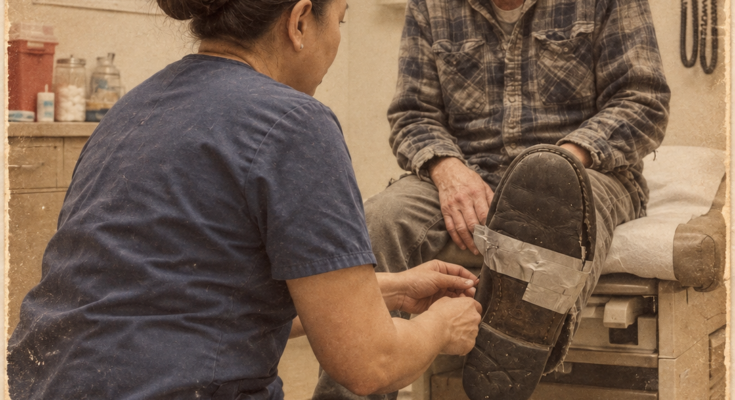
As I knelt down to place the cuff near his arm, my eyes dropped to his feet. He was wearing an old pair of black work shoes. The leather was cracked, the soles were entirely worn flat, and the right shoe had a wide split along the seam where his toes peeped through, wrapped tightly in silver duct tape.
While I pumped the cuff, I looked at his chart. Arthur was a widower. He lived alone at the end of a gravel road on the edge of town. His fixed income barely covered his monthly insulin and heart medication.
“Your blood pressure is a little high today,” I noted softly. “Have you been taking your daily dose with breakfast?”
He scoffed, turning his face toward the wall. “Breakfast is a luxury for people with extra money, nurse. I eat when I can.”
My heart squeezed. He wasn’t just angry at me. He was tired. He was cold, hungry, and fighting a quiet, lonely battle against a world that had forgotten him.
When the appointment was over, Arthur shuffled out without looking back. I watched him walk down the hallway. He walked with a heavy limp, favoring his right foot where the split shoe offered no support against the hard linoleum floor.
What would you do if you saw someone hurting and knew you could help? Keep reading to find out what happens next. 👇
I know you’re curious to see what happens next, so please be patient and continue reading in the comments below. Thank you for understanding the inconvenience. Please leave a “YES” below and give us a Like to get the full story. 👇to part 2.
—
Part 2: The Gift
That Friday, on my way home from the clinic, I stopped by the department store in town. I walked over to the men’s shoe aisle and searched until I found a pair of sturdy, cushioned black walking shoes with non-slip soles and easy Velcro straps. They were size eleven wide. It cost nearly seventy dollars—money I usually saved for David’s groceries or my sister’s medicine. But as I held the heavy box, I knew I couldn’t leave it there.
The following Tuesday, Arthur had a follow-up appointment. Before he was called back, I slipped into Exam Room 3 and placed a plain brown bag on the lower shelf under the side table. Inside was the shoe box, along with a pair of thick wool socks. I didn’t leave a card. I didn’t leave a note.
When I brought Arthur into the room, I took his vitals quickly, smiled, and stepped out to let the doctor do his examination.
Fifteen minutes later, Dr. Evans called me into his office. “Maria, did you leave something in Exam Room 3?” he asked with a puzzled look. “Mr. Miller is still in there. He’s asking for you.”
My heart did a quick flutter. I walked down the hall and opened the door.
Arthur was sitting on the edge of the examination table. The brown bag was open, and the brand-new shoes were sitting on his lap. His worn-out, taped shoes were sitting on the floor beside his feet.
He looked up as I walked in, but his eyes weren’t sharp or angry anymore. They were red-rimmed and filled with tears.
“Did you put these here?” he asked, his voice shaking.
“The clinic gets donations sometimes, Mr. Miller,” I lied softly, holding my hands behind my back. “We just want to make sure our patients are comfortable.”
Arthur looked down at the shoes, his rough, calloused thumb tracing the fresh leather. “The receipt was at the bottom of the bag, Maria,” he whispered. “Paid for in cash three days ago at the store on Main Street. There was no donation.”
The room went completely quiet, save for the hum of the overhead lights.
He swallowed hard, tears finally spilling over his weathered cheeks and slipping into his gray beard. “I was terrible to you,” he said, his voice cracking. “I yelled at you. I said terrible things about where you came from. I treated you like you didn’t belong here… and you bought me shoes.”
I stepped closer, pulled a tissue from the box on the counter, and gently placed it in his hands.
“Why would you do this for someone like me?” he wept, covering his face with his hands. “I didn’t deserve it.”
I looked at this lonely man who had been fighting the world all by himself, and I thought of my son, and my family, and how much grace we all need just to get through the day.
“Mr. Miller,” I said softly, placing a hand gently on his trembling shoulder. “Kindness isn’t a reward for perfect behavior. It’s just something we give each other because the road is hard for everyone.”
He cried quietly for a long time in that little exam room. Before he left that day, he put on the new shoes. They fit perfectly. As he reached the exit door, he turned around, looked back at me across the busy waiting room, and gave me a slow, silent nod.
What happened next would change both our lives. Keep reading to find out what happens next. 👇
I know you’re curious to see what happens next, so please be patient and continue reading in the comments below. Thank you for understanding the inconvenience. Please leave a “YES” below and give us a Like to get the full story. 👇to part 3.
—
Part 3: The Grace
Arthur Miller came back the following week. Not for an appointment—he didn’t have one. He walked into the clinic waiting room carrying a small paper bag. When he saw me at the nurses’ station, he walked over slowly, his new shoes quiet on the linoleum.
“I brought you something,” he said. His voice was still gravelly, but softer now. He handed me the bag. Inside was a handwritten card and a small wooden carving of a bird. The carving was smooth and detailed, made from a piece of oak. “I used to whittle,” he said. “Haven’t done it in years. But I wanted to say thank you.”
I turned the bird over in my hand. It was beautiful. “Mr. Miller, you didn’t have to do this.”
“I know,” he said. “That’s why I did.”
Over the next few months, Arthur became a familiar face at the clinic. He started coming in on Tuesdays, not as a patient but as a volunteer. He sat in the waiting room and talked to other patients. He held babies while their mothers filled out paperwork. He fixed the squeaky wheel on the blood pressure cart. He brought in a toolbox one day and repaired the loose arm on the waiting room chair.
The staff loved him. The patients loved him. And I loved him—not as a romantic love, but as a friend. As a reminder that people can change. As proof that kindness is never wasted.
One afternoon, Arthur asked if he could meet my son. I hesitated. David was still fragile, still rebuilding. But something told me it would be okay.
They met at a diner downtown. Arthur ordered coffee and pie. David ordered a glass of water. They talked about cars, about work, about the things men talk about when they don’t know how to talk about feelings. And then Arthur said something that made David cry.
“I know what it’s like to lose everything,” Arthur said. “I lost my wife. I lost my house. I lost my pride. But I didn’t lose my hands. And you haven’t lost yours either, son.”
David looked at him. “What do you mean?”
“I mean you can still build. You can still fix. You can still make something out of nothing. That’s what I do. That’s what I’ve always done. And if you want, I can teach you.”
David started working with Arthur the next week. They repaired furniture in Arthur’s garage. They built shelves for the clinic. They fixed a fence for a neighbor. And slowly, David started to believe in himself again.
Arthur became a grandfather figure to David. He came to David’s recovery meetings. He celebrated David’s six-month chip. He sat with him on the hard days and told him stories about the hard days he had survived.
And every time I saw them together, I remembered the duct tape shoes. I remembered the anger in Arthur’s voice. I remembered the way he looked at the floor. And I remembered the moment I decided to buy him shoes instead of arguing.
That decision changed everything. Not just for Arthur. For me. For David. For the clinic. For everyone whose life Arthur touched after that day.
We don’t always get to choose how people treat us, but we always get to choose who we are in response. True strength isn’t built by fighting back with noise. Sometimes, the quietest act of grace is the loudest thing a heart will ever hear.
Arthur passed away three years later. He left me the wooden bird, and a note that said, “You gave me more than shoes. You gave me a reason to keep going.” I still have the bird on my desk. And every time I look at it, I remember the man with the duct tape shoes who taught me that kindness is always worth it.
The End.