
Part One: The Quiet House
The quiet in our house was always the loudest thing in the room.
I stood in the doorway of the spare bedroom, watching fourteen-year-old Leo stare into the glowing blue light of a computer screen. His thumb was flying across a phone screen, his ears covered by massive black headphones, and his shoulders hunched over like he was trying to hide from the rest of the world.
I held a warm plate of meatloaf and mashed potatoes in my hands. The kind of meal my wife, Lord rest her soul, used to make when life got heavy.
“Dinner’s ready, son,” I said, keeping my voice soft.
He didn’t move. He didn’t even turn around. He just tapped his foot and muttered words into a little microphone attached to his headset—words I didn’t understand, slang that sounded like a foreign language to a man who spent forty years carrying a toolbox through Missouri mud.
I set the plate down on the edge of his desk. He glanced at it, tapped his phone, and sighed.
“Thanks, Grandpa,” he said, his voice flat. “You didn’t have to make this. I could’ve just ordered something on the app.”
I walked back down the hallway, my worn-out knees popping with every step, and sat alone at the kitchen table.
For forty years, I was Gordon Ellis, the man people called when their basements were flooding at three in the morning. I knew how to fix things. I knew how to trace a leak through three feet of concrete, how to sweat a copper pipe until the seal was tight enough to last fifty years, and how to sweat out a hard day’s work until your hands were raw.
But I had no idea how to fix a broken heart. And I had no idea how to reach a fourteen-year-old boy whose mother—my only daughter—had packed her life into a trash bag six months ago and entered an addiction treatment center three states away.
Every morning, I woke up at five o’clock, made two eggs and toast, and watched Leo leave for school with his head down. Every evening, we sat in the same house, separated by fifty years, three rooms, and a wall of silent technology I couldn’t comprehend.
I didn’t know what TikTok was. I didn’t know how to send a photo on a text message without asking the cashier at the hardware store for help. And every time I tried to talk to Leo about hard work, respect, or looking a man in the eye when you speak, he just rolled his eyes.
“You’re just old-fashioned, Grandpa,” he told me one night after we argued about him staying up until two in the morning on his computer. “The world doesn’t work like that anymore.”
That night, I sat on my front porch, listening to the crickets, and wiped a tear from my cheek before it could reach my mustache. I felt useless. I felt like a ghost from a century that everyone had left behind. I prayed to the Lord to show me how to be what this boy needed, because I was terrified that my quiet, old-fashioned life was failing him.
Then came the second Tuesday in November.
Leo had joined the high school robotics club a few weeks earlier. He hadn’t told me about it; I found the crumpled permission slip in his jacket pocket while doing the laundry. I signed it immediately and left a twenty-dollar bill on his dresser for snacks.
He came home that Tuesday and looked at me while I was cleaning the oil off my lawnmower blade in the garage.
“Our team made the regional showcase,” Leo said, looking at the concrete floor. “The teacher said parents and guardians can come watch the demonstration tomorrow night before the competition.”
He didn’t explicitly ask me to go, but the way his voice wavered at the end told me everything.
“I’ll be there,” I said. “Front row.”
—
Part Two: The Broken Pipe
The next evening, I put on my best button-down shirt, combed my hair, and walked into the high school’s new STEM wing. It looked like a spaceship. Bright fluorescent lights, glass walls, 3D printers humming in the corners, and rows of glowing screens.
The teacher in charge was a young man in his late twenties, wearing a crisp polo shirt and a smartwatch that never stopped buzzing. He was talking fast, pointing at laptop screens, and using words like “algorithms” and “pneumatic pressure variables.”
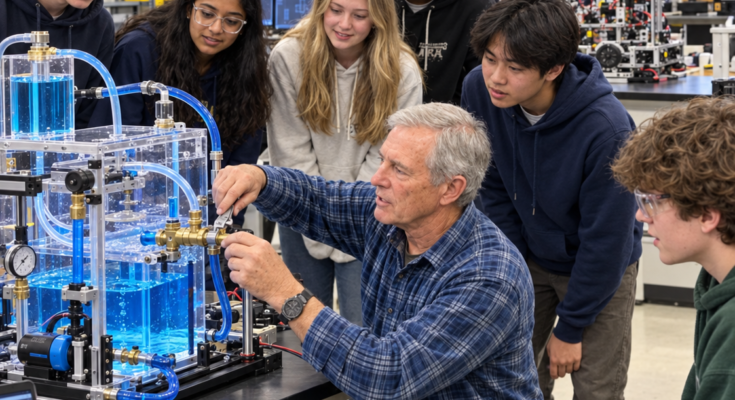
Beside him, the kids had built a massive, intricate machine designed to simulate automated fluid distribution—a fancy way of saying a robot that pumped liquid through complex tubes to cool a mock engine core. It was their championship entry.
I stood near the back, holding my jacket, feeling completely out of place. I watched Leo standing beside the teacher, nodding eagerly, his eyes brighter than I had seen them in months. He belonged in this brave new world. I was just an observer from an old one.
Suddenly, a loud, sharp hiss echoed through the room.
“Wait, stop the program!” the young teacher shouted, leaning over his laptop. “The pressure sensor is spiking. The liquid isn’t cycling!”
A tiny plastic tube burst off its fitting, spraying blue liquid across a table of circuit boards. The kids gasped. The teacher grabbed a handful of paper towels, his face pale as he frantically typed on his keyboard.
“Is it a coding error?” one student asked.
“No, the code is clean,” the teacher said, his hands shaking slightly as he pulled up lines of text on the screen. “The pump motor must be failing. We don’t have a replacement motor. The competition judges arrive tomorrow morning at eight. If we can’t show a closed-loop system, we’re disqualified.”
Leo looked devastated. He stared at the machine, his shoulders slumping in that familiar, heart-wrenching way.
I took a step forward. My boots made a heavy sound against the polished floor.
I didn’t know a thing about computer code. I didn’t know what an algorithm was. But I knew fluid, I knew pressure, and I knew how pipes behave when they’re trapped under heat.
“Excuse me, young man,” I said, my voice deep and calm, cutting through the panic in the room.
The teacher looked up, distracted. “Sir, please, we’re in the middle of a technical crisis—”
“You don’t have a motor problem,” I said gently, walking over to the glass tank and the tangle of clear tubing. “Your motor’s running fine. Listen to the pitch. It’s straining, not slipping.”
The young man blinked. “What?”
“Look right here,” I said, pointing a calloused, stained finger at a small brass fitting near the intake valve. “You used a ninety-degree sharp elbow right after a high-velocity intake. You’ve got an air pocket trapped in the line right at the turn. The pressure isn’t spiking because of a glitch in your computer. It’s spiking because air compresses, and water doesn’t.”
The room went completely silent. The high school kids stared at me.
The teacher leaned down, looking closely at where my finger was pointing. He tapped the brass valve. A tiny bubble flickered in the line.
“If you loosen that brass bleeder valve half a turn, release the air lock, and replace that sharp turn with a curved loop, your pressure will drop back to normal in five seconds,” I said quietly. “You don’t need a new computer program. You just need to let the physics work.”
The teacher pulled a small adjustable wrench from a desk drawer. Handing it to me, he took a step back. “Show us.”
I took the wrench. It felt familiar in my hand—a tool born from a century of sweat and basic truth. I leaned over the sleek, expensive machine, loosened the valve just enough to hear a tiny *psshhh*, adjusted the flexible tubing into a smooth curve, and tightened it back down.
“Turn your pump back on,” I told the teacher.
He hit a key on his laptop. The motor hummed. The blue liquid rushed smoothly through the tubes, silent, steady, and perfectly balanced. The digital gauge on the screen settled instantly into the green zone.
The kids erupted into cheers. The young teacher looked at the screen, then at the machine, and finally at me with wide, respectful eyes.
“That… that was incredible,” the teacher said, holding out his hand to shake mine. “I’ve been staring at the code for two hours. I never even thought to look at the mechanical physical flow.”
“Computers are smart,” I smiled softly, wiping my hands on my handkerchief. “But water has been running downhill since the creation of the world. It follows the same rules it always has.”
—
Part Three: The Ride Home
The teacher turned to the class. “Listen up, everyone. This is Mr. Ellis. He just saved our entry. I want all of you to gather around and let him show you how to properly bleed a fluid line.”
For the next thirty minutes, I didn’t feel useless. I stood in front of those bright, tech-savvy teenagers, teaching them about tension, seals, pressure, and the art of listening to a machine with your ears instead of reading it on a screen. They asked questions. They listened. They respected the work of an old man’s hands.
When we finally walked out to my old pickup truck in the cool November night air, the silence between Leo and me felt different. It wasn’t cold anymore. It was quiet, like the calm after a storm.
Leo climbed into the passenger seat and pulled off his seatbelt. He didn’t pull out his phone. He just looked out the windshield at the stars.
“Grandpa?” he asked softly.
“Yeah, son?”
“When the teacher asked who you were before you walked over to the table… I told the kid sitting next to me.”
I paused, my key in the ignition. “What’d you tell him?”
Leo turned his head and looked me straight in the eyes—no headphones, no distraction, just a grandson looking at his grandfather.
“I told him, ‘That’s my grandpa. He doesn’t need a screen to fix things. He knows how real things work.'”
I sat there in the dark cab of that truck, feeling the heavy weight I’d been carrying in my chest for six months finally melt away. I realized then that the world might change, technology might advance, and time might rush forward like a river, but the foundation never moves. Kindness, handwork, quiet patience, and showing up when someone is broken will never go out of style.
We don’t always need to understand the new world our children are growing up in. We just need to stand firm in the timeless truths that keep them grounded when everything else breaks.
Hands build homes, but love holds the roof up.
—