Part 1: The Note
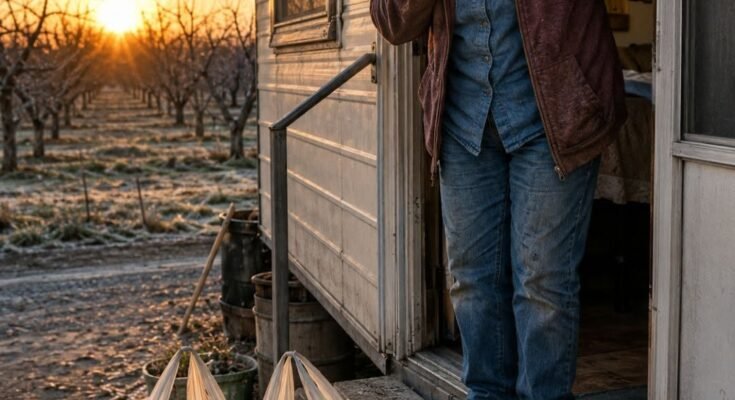
Marisol Vega opened her trailer door before sunrise and found a bundle of firewood, two grocery bags, and a handwritten note sitting on the frozen steps. She read the note twice. “Mrs. Vega, the cold is getting worse. Please don’t try to carry wood by yourself.” There was no name. Just a crooked little drawing of an apple at the bottom.
Marisol stood there in her worn slippers, holding that scrap of paper while the wind moved through the bare orchard behind her. She had spent most of her 68 years working with her hands. Those hands had picked cherries in California, pears in Oregon, and apples in Washington. They had packed school lunches, patched work shirts, held feverish children, and gripped her husband’s fingers during his final days. Now they trembled slightly when the mornings were cold.
Her children wanted her to retire. “You’ve worked enough, Mama,” her daughter told her over the phone. But Marisol always gave the same answer. “The trees don’t ask how old you are. They only ask whether you came ready to work.”
The truth was more complicated. After her husband, Tomas, died, the orchard was the only place where the silence didn’t feel so heavy. At home, there was one coffee cup on the counter. One coat by the door. One side of the bed that never needed making. But in the orchard, there were ladders scraping against branches, buckets filling with fruit, and workers calling to each other through the rows. There, Marisol still felt useful.
That morning, she carried the groceries inside and found beans, rice, oatmeal, canned soup, coffee, and a small bag of cinnamon candy. The candy made her stop. Tomas used to buy the same kind whenever they drove into town. For the first time in months, Marisol sat at her little kitchen table and cried. Not because she felt helpless. Because someone had noticed her.
Part 2: The Boy
At work, Marisol quietly watched the other pickers. Most were busy trying to earn enough before the season ended. Nobody had extra money to spend on groceries for someone else. Then she saw 19-year-old Micah Reed near the end of the row. He was new that year. He wore a jacket too thin for the weather and gloves with holes near the thumbs. He rarely spoke during lunch and always volunteered for the farthest rows.
Marisol had noticed something else, too. Every morning, Micah arrived before everyone. Every evening, he was the last to leave.
“Did you leave something at my door?” she asked him. Micah kept his eyes on the apples. “No, ma’am.” Marisol held up the note. His face turned red. “I just figured you might need some things.” “You bought groceries for me?” “It wasn’t much.” “And the firewood?” “I found some behind the packing shed.”
Marisol studied him carefully. His cheeks were hollow. His boots were cracked, and there were dark circles beneath his eyes. “Where do you live, Micah?” He reached for another apple. “Over near town.” “That is not an answer.” He gave a nervous laugh, but Marisol did not smile. Finally, he looked down. “In my car.”
The words hung between them. Micah explained that his mother had died the previous spring. His stepfather had moved away soon afterward, and the apartment lease had ended. He had taken the orchard job to save money for a room. But every place wanted a deposit, references, and proof of steady employment. So he slept in an old sedan parked behind a closed roadside diner. He washed in gas station restrooms and kept his belongings in the trunk.
The groceries he had left for Marisol had cost nearly everything he earned that week.
“Why would you spend it on me?” she asked. Micah shrugged. “You remind me of my mom.” Marisol turned away before he could see her eyes fill.
That evening, she followed Micah’s car after work. He pulled behind the abandoned diner and parked beneath a broken light. The temperature was expected to fall below freezing. Marisol sat in her truck for several minutes, looking at the boy through the windshield. Then she got out and knocked on his window.
Micah rolled it down. “Mrs. Vega?” “Get your things.” He looked confused. “Why?” “Because you are coming home with me.”
Part 3: The Door
“I can’t do that,” Micah said. “Yes, you can.” “I don’t want charity.” Marisol folded her arms. “Neither did I. Yet I still ate your oatmeal.” He tried not to smile. “My trailer is small,” she continued. “The spare room has old wallpaper, one lamp, and a mattress that squeaks. But it has heat.”
Micah looked toward the diner. Then back at her. “I can pay you when I get my check.” “No.” “Then I’ll leave.” Marisol pointed at him. “You can carry wood, fix the loose porch rail, and wash your own dishes. That is the rent.”
That night, Micah slept in a real bed for the first time in nearly three months. Marisol lay awake in the next room, listening to the old house creak. For once, the sounds did not make her feel alone.
Over the following weeks, the trailer slowly changed. Micah repaired the porch rail and replaced the flickering kitchen light. Marisol packed two lunches instead of one. He taught her how to use video calls so she could see her grandchildren more often. She taught him how to make Tomas’s bean stew and how to tell when an apple was ripe without cutting it open. They argued about music. They laughed over burnt biscuits. On Sundays, they drank coffee on the porch and watched morning fog lift from the orchard.
Micah never called her “Mom.” Marisol never called him “son.” They didn’t need to.
By spring, Micah had saved enough to rent a small apartment. The day he moved out, Marisol stood beside his car holding the same handwritten note he had left months earlier. “I kept it,” she told him. Micah looked embarrassed. “It was just a note.” “No,” Marisol said. “It was a door.”
He didn’t understand. So she explained. After Tomas died, Marisol believed her life had become smaller. She thought her best years were behind her and that kindness was something she could remember but no longer expect. Then a hungry boy sleeping in a car spent his grocery money on her. His small act reminded her that she still had something to give. A room. A meal. A place where another person could feel safe.
Micah hugged her beside the apple trees. Neither of them spoke for a long time.
Years later, he still returned every fall to help Marisol bring in firewood. And every winter, two bags of groceries appeared on the steps of someone in town who was struggling. Sometimes they were left for an elderly widow. Sometimes for a tired single father. Sometimes for a family nobody knew was having a hard time. There was never a name on the note. Only a crooked little apple drawn at the bottom.
Because kindness is not measured by how much you have—it is measured by what you are willing to share when you have almost nothing.
Marisol still lives in her trailer. The orchard still stands. And every morning, she looks out at the rows of trees and remembers the boy who left groceries on her doorstep. He reminded her that she was still alive. She reminded him that he was still worth loving.
Now, when the cold comes, they both know someone is watching out for the other.
And that, she has learned, is the best kind of harvest. ❤️