
Where you are born can determine your citizenship.
But in much of the world, it doesn’t.
A baby born in Toronto can usually become a Canadian citizen immediately even if neither parent is Canadian.
A baby born under similar circumstances in Tokyo generally does not automatically become Japanese.
A child born in Germany to foreign parents might receive German citizenship—but only if a parent’s residence status satisfies specific requirements.
And a child born outside Italy, Ireland, Mexico or many other countries may still acquire citizenship through a parent or sometimes a more distant ancestor.
These differences come from two famous legal principles:
Jus soli — citizenship connected to the land or place of birth.
Jus sanguinis — citizenship connected to descent or parentage.
The Latin expressions are often translated dramatically as the “right of soil” and “right of blood.”
But the reality is considerably more complicated than dividing the world into two colors.
Most modern citizenship systems combine elements of both.
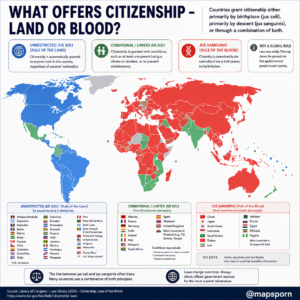
What Is Jus Soli?
Jus soli literally means “right of the soil.”
Under its broadest form, being born inside a country’s territory is enough to receive citizenship at birth regardless of the parents’ nationality or ordinary immigration status.
This is commonly called:
unconditional birthright citizenship.
It is especially associated with the Americas.
The Library of Congress’s global survey found that all but six of the 33 countries it then identified as providing unrestricted territorial birthright citizenship were in the Americas or Caribbean. (Library of Congress)
GLOBALCIT similarly found unconditional territorial birthright citizenship overwhelmingly concentrated in the Americas. (Globalcit)
That geographical pattern is one of the most striking features of the world citizenship map.
The United States
The United States is probably the world’s most famous jus soli example.
The Fourteenth Amendment states that persons born or naturalized in the United States and subject to its jurisdiction are citizens.
The issue became especially significant again after a 2025 executive order attempted to exclude some U.S.-born children whose parents were unlawfully or temporarily present.
On June 30, 2026, the U.S. Supreme Court decided Trump v. Barbara and held that children born in the United States to parents unlawfully or temporarily present are citizens at birth under the Fourteenth Amendment. (Supreme Court)
So as of August 2026, the broad American birthright-citizenship rule remains constitutionally protected.
There are narrow historical exceptions, especially involving children of certain foreign diplomats.
That is why even “unrestricted jus soli” does not literally mean zero exceptions.
Canada
Canada follows a similarly broad birthplace rule.
A person born in Canada is generally a Canadian citizen at birth.
But Canada also has an exception involving children of foreign diplomats and certain officials who possess diplomatic privileges, unless the other parent was Canadian or a permanent resident. (Canada)
This illustrates why the phrase:
“Anyone born there automatically becomes a citizen”
is convenient for an infographic but slightly too absolute.
A more accurate description is:
Broad territorial birthright citizenship, subject to narrow exceptions.
Why Is Jus Soli So Common in the Americas?
This is partly historical.
Many countries in the Americas developed as immigration societies.
After independence, governments often wanted to incorporate children born to immigrants rapidly into the national population.
Birthplace-based citizenship also fitted political ideas that emphasized membership in a territorial republic rather than membership in an old ethnic nation.
As migration continued through the 19th and 20th centuries, jus soli became deeply embedded in the citizenship traditions of much of the Western Hemisphere.
Countries commonly associated with broad territorial birthright citizenship have included:
- United States
- Canada
- Mexico
- Argentina
- Brazil
- Uruguay
- Paraguay
- Peru
- Ecuador
- Bolivia
- several Caribbean and Central American states
But the precise exceptions differ, so the legal text of each country matters.
What Is Jus Sanguinis?
Jus sanguinis literally translates as:
“right of blood.”
A less confusing modern description would be:
citizenship by descent.
Under this principle, a child receives citizenship because one or both parents are citizens.
The child’s birthplace can be secondary.
For example, suppose:
A Japanese citizen has a child while living abroad.
Japan’s nationality system is primarily based on descent.
The child’s claim to Japanese nationality therefore comes from the Japanese parent rather than simply from being born on Japanese territory.
Versions of the same principle exist virtually everywhere.
GLOBALCIT’s 190-country dataset found that citizenship acquisition for someone born abroad to a citizen parent existed in every state studied. (Globalcit)
That leads to one of the biggest problems with the infographic:
Blue jus-soli countries also use jus sanguinis.
Canada does.
The United States does.
Mexico does.
Brazil does.
Birthplace citizenship does not erase citizenship by descent.
Why Europe Looks So Different
Most European states do not provide completely unconditional citizenship simply because a child happened to be born there.
Instead, Europe commonly combines:
citizenship by descent
with
conditional citizenship based on birth and residence.
That reflects the historical development of European nationality law.
The Library of Congress notes that many continental European states moved toward jus sanguinis during the 19th century, influenced partly by the Napoleonic model. (Library of Congress)
However, modern European countries have increasingly introduced forms of jus soli for children of long-term immigrants.
So Europe is not simply “red.”
It is filled with hybrid systems.
Germany: A Good Example of Conditional Jus Soli
Germany’s modern rules demonstrate how the two principles can coexist.
A child automatically receives German nationality if at least one parent is German.
That’s classic jus sanguinis.
But a child born in Germany to two foreign parents can also acquire German citizenship at birth if one parent has:
- lawfully and habitually lived in Germany for at least five years, and
- holds a permanent right of residence at the time of birth.
Germany’s official immigration portal confirms those current rules. (Make It In Germany)
So Germany cannot accurately be described simply as either:
“citizenship by land”
or
“citizenship by blood.”
It uses both.
The United Kingdom
Britain once had much broader birthright citizenship.
That changed with the British Nationality Act 1981, effective in 1983.
Today, simply being born in the UK does not necessarily make someone British.
For children born under current rules, automatic British citizenship generally requires at least one parent to be:
- a British citizen, or
- “settled” in the UK, meaning legally able to remain without immigration time restrictions.
A UK-born child who did not acquire citizenship immediately may also have registration routes later, including in some cases after living in Britain through the first ten years of life. (GOV.UK)
Britain is therefore a classic example of conditional jus soli combined with jus sanguinis.
Ireland: From Broad Jus Soli to Conditional Citizenship
Ireland provides one of Europe’s most important recent changes.
Before 2005, being born on the island of Ireland generally gave a strong automatic entitlement to Irish citizenship.
Following a constitutional change, the rule became conditional.
For births from January 1, 2005 onward, a child generally qualifies at birth if a parent is Irish or British, has unrestricted residence rights, or has accumulated sufficient qualifying residence—normally three of the four years immediately before the child’s birth. (Immigration Service Delivery)
So Ireland illustrates a broader historical trend:
Some countries that once had expansive birthplace citizenship later introduced parent-residence conditions.
Australia
Australia followed a similar historical path.
Broad automatic birthplace citizenship ended in 1986.
Today, one common route is being born in Australia while at least one parent is an Australian citizen or permanent resident.
There is also an important “ten-year rule”: a child born in Australia who is ordinarily resident there throughout the first ten years of life can acquire citizenship automatically under the Citizenship Act, subject to legal details. (Home Affairs)
Again, that’s a hybrid system.
Birthplace matters—but birthplace alone is not always enough.
New Zealand
New Zealand ended unrestricted birthright citizenship for children born from January 1, 2006 onward.
A child born there now generally receives New Zealand citizenship at birth only if at least one parent is:
- a New Zealand citizen, or
- entitled to remain in New Zealand indefinitely.
Official New Zealand birth-registration guidance confirms this rule. (Govt.nz)
This puts New Zealand firmly in the conditional category.
India Also Tightened Its Rules
India’s citizenship history is another good example of laws changing over time.
Under India’s Citizenship Act:
For people born from 1950 until July 1987, birth in India generally provided citizenship regardless of the parents’ nationality.
For later births, parental citizenship became increasingly important.
For births after the 2003 amendment took effect, citizenship by birth generally requires either:
- both parents to be Indian citizens, or
- one parent to be an Indian citizen and the other not to be an “illegal migrant” under the Act.
India’s Ministry of Home Affairs publishes the statutory wording. (Ministry of Home Affairs)
So a person looking only at an old citizenship map could easily get India’s current system wrong.
France Has Yet Another Model
France is often mistakenly described as having straightforward American-style birthright citizenship.
It doesn’t.
France has important jus soli traditions, but children born there to foreign parents often receive citizenship based on combinations of:
- birthplace
- age
- residence in France
- sometimes a parent’s own birthplace
For example, a foreign-born-parent child born in France can generally claim French nationality from age 16 if the child lives in France and has accumulated at least five years of habitual residence since age 11. French law also contains “double jus soli”: in some circumstances, a child born in France to a parent who was also born in France is French from birth. (Service Public)
This is much more nuanced than simply coloring France green or red.
What Is “Double Jus Soli”?
This is one of the most interesting citizenship mechanisms.
Under double jus soli, birthplace citizenship can arise because:
- The child is born in the country, and
- One of the parents was also born there.
The parent does not necessarily have to be a citizen.
The idea is that two generations of birth on the territory demonstrate a sufficiently strong connection to the country.
GLOBALCIT treats this as a distinct form of territorial citizenship. (Globalcit)
France is among the countries historically associated with this principle.
What About Children Who Would Otherwise Be Stateless?
Here is another reason a three-color map cannot capture everything.
Many states that normally rely on parental citizenship have special rules for:
- abandoned infants
- children of unknown parents
- children who would otherwise have no nationality
These safeguards exist partly because statelessness can create severe problems accessing:
- passports
- education
- healthcare
- employment
- legal identity
GLOBALCIT treats citizenship for foundlings and otherwise-stateless children as separate acquisition categories. (Globalcit)
The Library of Congress likewise excluded some of these anti-statelessness provisions when counting countries as having ordinary birthright citizenship, because they serve a different purpose. (Library of Congress)
Being Born Abroad Does Not Necessarily Break Citizenship
The other side of the map is equally interesting.
A child may never set foot in a parent’s country and still receive that country’s citizenship.
But descent rules often have limits.
Some countries allow citizenship to travel through multiple generations born abroad.
Others impose:
- registration requirements
- residence requirements
- generation limits
- deadlines
- parental-birth requirements
Canada, for example, made major amendments to its citizenship-by-descent rules effective in December 2025, illustrating how even long-established descent systems continue to evolve. (Canada)
So “jus sanguinis” itself is not one universal rule.
Can Someone Receive Two Citizenships at Birth?
Absolutely.
Imagine a child born in Canada to an Italian parent.
Canada may grant citizenship because the child was born there.
Italy may grant citizenship through the Italian parent, subject to its applicable descent rules.
The child can therefore potentially acquire multiple citizenships at birth.
Whether both can be retained indefinitely depends on each country’s dual-nationality laws.
This is another reason “land OR blood” is technically misleading.
For millions of people, the answer is:
both.
Why Countries Choose Different Systems
Citizenship rules reflect very different ideas about what makes someone part of a nation.
A strong jus soli system emphasizes:
territorial membership.
If you are born and begin life here, you belong here.
A strong jus sanguinis tradition emphasizes:
family continuity.
Citizenship can follow citizens and their descendants even when they live abroad.
Conditional systems try to combine both ideas.
They might say:
Birth here matters—but your family must also have an established connection to the country.
There is no universal global rule.
Every state sets citizenship law according to its constitution, legislation and international obligations.
Why the Americas Stand Out
Perhaps the most visually striking fact is how heavily broad territorial birthright citizenship remains concentrated in the Western Hemisphere.
GLOBALCIT’s comparative work found unrestricted jus soli particularly pronounced in the Americas, while conditional systems are more common elsewhere. (Globalcit)
That means a baby born to foreign parents can face radically different citizenship outcomes depending on whether the delivery room is located in:
Toronto,
London,
Berlin,
Tokyo,
or Sydney.
The babies themselves may be in almost identical circumstances.
The legal philosophies surrounding them are not.
The U.S. Debate Got a Definitive New Chapter in 2026
For an article published now, this belongs prominently in the discussion.
Following renewed political and legal debate over American birthright citizenship, the U.S. Supreme Court ruled in Trump v. Barbara on June 30, 2026 that children born in the United States to parents unlawfully or temporarily present are within the Fourteenth Amendment’s citizenship guarantee. (Supreme Court)
That makes the map’s broad classification of the United States as jus soli correct as of August 2026.
It also demonstrates why maps of citizenship law can become outdated quickly:
A single statute, constitutional amendment or court decision can change the legal landscape.
The Biggest Problem With “Land vs Blood”
The title is catchy.
Legally, however, the real world looks more like:
Land + blood + residence + parents’ status + age + registration + anti-statelessness safeguards.
GLOBALCIT identifies dozens of different modes by which citizenship can be acquired or lost. Its global dataset uses 28 main acquisition categories, demonstrating just how much complexity a three-color map leaves out. (Globalcit)
That doesn’t make the map useless.
It makes the map a starting point.
The Better Way to Read This Map
Think of the colors as representing the dominant territorial-birth rule, rather than the only way citizenship works.
Broad jus soli
Birthplace usually grants citizenship immediately, apart from narrow exceptions.
Conditional jus soli
Birthplace can grant citizenship, but additional requirements involving parents, residence or later life in the country apply.
No general jus soli
Birth in the country by itself normally does not grant nationality; citizenship is primarily transmitted by parents, although special exceptions can still apply.
That wording is much more defensible.
Final Thought
Your birthplace is one of the most important facts recorded on a birth certificate.
But whether it determines your nationality depends entirely on where that birthplace happens to be.
In much of the Americas:
Being born there can itself create citizenship.
Across much of Europe:
Being born there matters, but parental residence or later residence may also be required.
Across many countries in Asia, Africa and elsewhere:
Parentage is the primary route to citizenship at birth.
Yet almost every country combines these ideas somehow.
The real question is therefore not:
“Does this country use land or blood?”
It is:
“How does this country balance birthplace, descent and genuine connection when deciding who belongs?”
That is the much more interesting story hidden inside the map.
Source & Accuracy Note
The infographic’s general geographic pattern is useful, but I would revise three things before publication. First, replace “Jus Sanguinis — citizenship determined by nationality of parents, not birthplace” with “No general territorial birthright citizenship; descent is the primary route.” Virtually all states also transmit citizenship by descent. Second, treat “unrestricted” jus soli as broad rather than literally exception-free, because countries such as Canada and the United States have narrow diplomatic exceptions. Third, replace the specific “33 countries” figure with “roughly three dozen in major comparative surveys” or individually verify all countries against current 2026 law; the Library of Congress source behind the well-known 33-country figure dates from 2018. (Library of Congress)