
Mother’s Day feels like one of those holidays that should have a universal date.
It doesn’t.
In the United States, Canada, Australia, Germany, Italy and dozens of other countries, mothers are honored on the second Sunday in May.
Travel to Spain or Portugal and the celebration comes a week earlier.
Visit Britain or Ireland and it can happen in March.
Sweden waits until the end of May.
Russia celebrates in November.
Thailand honors mothers every year on August 12.
And in several countries, celebrations of motherhood are connected with International Women’s Day or other national traditions.
So there is no single worldwide Mother’s Day.
Instead, today’s map is the result of religion, national history, royal traditions and the worldwide spread of a holiday that became especially influential after developing in the United States during the early 20th century.
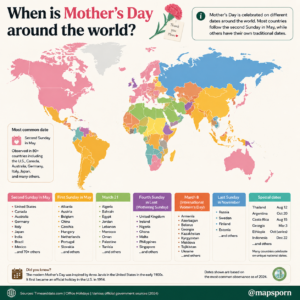
The Most Common Mother’s Day: Second Sunday in May
By far the most widespread modern date is the second Sunday in May.
In 2026, that fell on May 10.
Countries observing Mother’s Day on that date include the United States, Canada, Australia, Germany, Italy, Japan, Brazil, India, the Netherlands, Belgium, Austria, Finland, Estonia, Denmark, Greece, Malta, Singapore and many others. Timeanddate lists roughly 60 countries and territories using May 10 in 2026. (Time and Date)
Because the date is based on a Sunday rather than a fixed calendar date, it changes every year.
In 2025 it was May 11.
In 2026 it was May 10.
In 2027 it will be May 9.
This tradition spread internationally in large part because of the modern American Mother’s Day movement.
How the Modern American Mother’s Day Began
The modern U.S. version is strongly associated with Anna Jarvis.
After the death of her mother, Ann Reeves Jarvis, Anna campaigned for a special day honoring mothers.
On May 10, 1908, she organized a memorial observance at St. Andrew’s Methodist Church in Grafton, West Virginia.
The idea quickly spread.
West Virginia formally recognized Mother’s Day in 1910, and other states followed.
Then, on May 8, 1914, Congress approved a resolution establishing the second Sunday in May as Mother’s Day.
President Woodrow Wilson issued a proclamation the following day calling for Americans to observe it as an expression of appreciation for the nation’s mothers. (Research Guides)
That second-Sunday tradition eventually spread to dozens of other countries.
The United States
The United States continues to celebrate Mother’s Day on the second Sunday in May.
It is not a federal holiday that closes government offices in the way Christmas or Independence Day does.
Instead, it is a widely observed cultural celebration.
Flowers, cards, family meals and phone calls are common traditions.
The date established by Congress in 1914 remains the basis for the American observance today. (National Archives)
Canada, Australia, Germany, Italy and Japan
Several major countries follow essentially the same calendar.
Canada and Australia celebrate on the second Sunday in May, as do Germany and Italy.
Japan also uses this date.
This is why the pink “second Sunday in May” category dominates a corrected global map.
Although customs differ from country to country, the timing has become remarkably standardized across much of the Americas, Western Europe, East Asia and Oceania.
Finland and Estonia Also Use the Second Sunday
The infographic needs a correction in northern Europe.
Finland does not celebrate Mother’s Day on the last Sunday in November.
In 2026, Finnish Mother’s Day was Sunday, May 10, following the second-Sunday tradition. (Time and Date)
Estonia likewise observed Mothers’ Day on May 10, 2026. (Time and Date)
The November tradition shown in the image applies notably to Russia, not Finland and Estonia.
Sweden Is Different From Its Nordic Neighbors
Sweden is an interesting exception.
Swedish Mother’s Day—Mors dag—is observed on the last Sunday in May.
In 2026, that meant:
May 31. (Time and Date)
So despite Sweden, Finland, Norway and Denmark being neighboring Nordic countries, their Mother’s Day traditions are not perfectly synchronized.
This is a good example of why cultural maps often cannot simply group neighboring countries together.
Spain and Portugal Celebrate Earlier
Spain and Portugal generally celebrate Mother’s Day on the first Sunday in May.
In 2026 that was:
May 3.
Hungary also followed that date in 2026. (Time and Date)
This is one of the largest alternative European traditions.
So while someone in France or Germany might still be preparing for Mother’s Day, families in Madrid, Lisbon or Budapest may already have celebrated it.
The Netherlands Is Second Sunday, Not First
The infographic places the Netherlands in its first-Sunday category, but that should be corrected.
In 2026, Dutch Mother’s Day—Moederdag—fell on May 10, the second Sunday in May. (Time and Date)
Belgium and Austria followed May 10 as well. (Time and Date)
So these countries belong with the large second-Sunday group.
Britain Has Mothering Sunday
The United Kingdom is different because its celebration has a separate historical origin.
British Mother’s Day is traditionally known as Mothering Sunday.
It occurs on the fourth Sunday of Lent, exactly three weeks before Easter Sunday.
In 2026, Mothering Sunday was:
March 15. (Time and Date)
Historically, Mothering Sunday was connected with Christianity.
People would return to their “mother church”—the church or cathedral associated with their home area.
Over time, the custom became increasingly associated with visiting and honoring one’s own mother.
Today it functions much like Mother’s Day elsewhere, with cards, flowers and family gatherings, even though its historical origin is different from Anna Jarvis’s American movement. (Time and Date)
Ireland Also Celebrates Mothering Sunday
Ireland generally follows the same Lent-based tradition.
In 2026, Irish Mother’s Day was also March 15. (Time and Date)
Because Easter changes date every year, Mothering Sunday changes too.
It can fall in March or early April.
This means a British or Irish Mother’s Day can occur almost two months before America’s.
But Ghana, Malta and Singapore Are Not Mothering Sunday Countries
Another correction is needed in the infographic’s purple category.
Ghana, Malta and Singapore should not generally be grouped with Britain and Ireland under the fourth Sunday of Lent.
In 2026:
Ghana celebrated Mother’s Day on May 10. (Time and Date)
Malta celebrated on May 10. (Time and Date)
Singapore celebrated on May 10. (Time and Date)
All three therefore followed the second-Sunday-in-May pattern that year.
March 8: Motherhood and International Women’s Day Sometimes Overlap
Some countries have traditions in which celebrations of women and mothers are closely associated with International Women’s Day on March 8.
But this category needs especially careful wording.
International Women’s Day and Mother’s Day are not inherently the same holiday.
In several Balkan countries, March 8 can function culturally as a day when mothers, grandmothers, teachers and women generally receive flowers and gifts.
Timeanddate lists Albania, Bosnia and Herzegovina, Bulgaria, North Macedonia and Serbia with a March 8 Mother’s Day observance in 2026. (Time and Date)
But putting every former Soviet country into a universal March 8 Mother’s Day category can be misleading.
Some have completely separate official Mother’s Day observances.
Russia: Mother’s Day Is in November
Russia is one of the clearest examples.
Its official Mother’s Day falls on the last Sunday in November.
In 2026, that means:
November 29. (Time and Date)
International Women’s Day on March 8 remains enormously important in Russia, and mothers certainly receive recognition then.
But it is a separate holiday from Russia’s official Mother’s Day.
That distinction matters when creating a map based on formal observance dates.
Thailand: August 12
Thailand has one of the world’s most distinctive Mother’s Day traditions.
Thai National Mother’s Day is associated with the birthday of Queen Sirikit, the Queen Mother, on:
August 12.
The date is a national holiday and remains fixed rather than moving according to the day of the week. (Time and Date)
Jasmine is traditionally associated with Mother’s Day in Thailand, and family and public ceremonies honor mothers alongside the Queen Mother.
This demonstrates how the same basic idea—honoring motherhood—can become tied to a country’s monarchy and national history.
France Waits Until Late May
France has another distinctive arrangement.
Mother’s Day, or Fête des Mères, is usually celebrated on the last Sunday in May.
In 2026, it fell on:
May 31.
That happened to be the same date used by Sweden that year. (Time and Date)
However, the French rule has an additional detail: when the last Sunday of May conflicts with Pentecost, the celebration may shift into June.
So even seemingly simple country categories sometimes need footnotes.
Argentina Celebrates in October
Argentina stands out from most of the Americas because its Mother’s Day is traditionally celebrated in October, rather than May.
The observance is commonly held on the third Sunday of October.
This means the exact calendar date changes from year to year.
The map’s “October 20” should therefore not be presented as a permanent annual date; it represents a particular year’s calendar rather than the rule itself.
Costa Rica: August 15
Costa Rica uses a fixed date:
August 15.
The observance coincides with the Catholic Feast of the Assumption of Mary.
That religious connection demonstrates another pathway through which national Mother’s Day dates developed.
Rather than adopting the American May tradition, some countries linked motherhood with existing religious celebrations honoring Mary.
Indonesia: December 22
Indonesia’s observance is particularly interesting because Mother’s Day is held on December 22.
Its historical meaning is broader than simply a family celebration.
Indonesian Mother’s Day developed partly from women’s political and social movements and the history of Indonesian women’s organizations.
As with March 8 traditions, the concept can therefore carry themes of women’s social contribution in addition to honoring individual mothers.
Why Isn’t There One Universal Date?
Motherhood is universal.
Mother’s Day isn’t.
Different countries inherited different traditions.
Some adopted the American second-Sunday celebration.
Others preserved older Christian observances.
Some connected the holiday to national leaders.
Others linked it with women’s movements or religious dates.
And once a tradition becomes established, countries usually keep it.
That creates the colorful patchwork shown on maps like this.
In 2026, the Calendar Shows the Differences Clearly
For a useful comparison, several major 2026 dates were:
March 8 — Mother’s Day-related observances in several Balkan countries
March 15 — United Kingdom and Ireland
May 3 — Spain, Portugal and Hungary
May 10 — United States, Canada, Australia, Germany, Italy, Japan, Finland, Estonia, Netherlands, Belgium, Austria, Malta, Singapore and many others
May 31 — Sweden and France
August 12 — Thailand
November 29 — Russia
The second Sunday in May remains by far the most common pattern internationally. (Time and Date)
Mother’s Day Is Usually an Observance, Not a Day Off
Another misconception is that Mother’s Day is automatically a public holiday.
In many countries it is simply an observance.
Businesses operate normally.
Government offices remain open according to their normal weekend schedules.
The holiday is celebrated socially rather than through mandatory closures.
Finland, Austria, Russia and Singapore, for example, classify their standard Mother’s Day observances differently from ordinary national public holidays. Thailand is a notable exception because August 12 is a national holiday associated with the Queen Mother’s birthday. (Time and Date)
The Same Tradition Can Mean Something Different Everywhere
Flowers are common in many countries.
So are:
cards,
family meals,
small gifts,
school-made crafts,
and phone calls to mothers living far away.
But local culture changes the details.
In Thailand, jasmine has strong Mother’s Day symbolism.
Britain preserves the name Mothering Sunday.
Russia celebrates months after most Western countries.
Spanish and Portuguese families celebrate one Sunday earlier than their American counterparts.
And some cultures honor mothers within broader celebrations of women.
The result is not one global holiday but dozens of local versions of a shared idea.
The Most Important Map Lesson
The biggest takeaway from this map is not simply remembering seven different colors.
It is recognizing the difference between:
a global cultural idea
and
a globally standardized holiday.
Christmas has a largely fixed date.
New Year’s Day has a fixed date.
Mother’s Day doesn’t.
Even neighboring countries can celebrate it weeks—or months—apart.
And because some dates depend on Sundays, Easter or national traditions, the exact calendar day can change every year.
So before sending that Mother’s Day message to someone overseas, checking the local date may be a good idea.
You could otherwise be two months early—or six months late.
Source and Accuracy Note
Mother’s Day dates vary by country and sometimes by region, denomination or local custom. The accompanying infographic captures the overall diversity but contains several incorrect country groupings. For 2026, the widely used second-Sunday date was May 10, including Austria, Belgium, Czechia, Estonia, Finland, Ghana, Malta, the Netherlands, Singapore and Slovakia. Spain, Portugal and Hungary observed May 3; the UK and Ireland observed Mothering Sunday on March 15; Sweden used May 31; and Russia’s official Mother’s Day is November 29. (Time and Date)