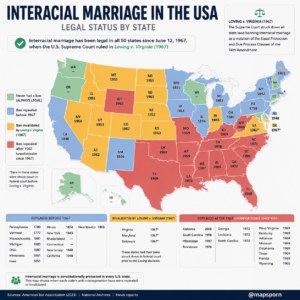
Today, interracial marriage is legal throughout the United States.
A couple does not lose the right to marry because one partner is Black and the other white, Asian and Latino, Native American and white, or any other racial combination.
That may seem obvious today.
But for much of American history, states passed laws specifically designed to prevent people classified as belonging to different races from marrying.
Some of those laws survived until 1967.
And remarkably, several states did not formally erase the old language from their legal codes until decades after it had become unenforceable.
The map above tells that story state by state.
At its center is one of the most consequential civil-rights cases in U.S. history:
Loving v. Virginia.
On June 12, 1967, the U.S. Supreme Court unanimously ruled that state laws prohibiting interracial marriage violated the Fourteenth Amendment. At the time, 16 states still maintained such laws. (U.S. Constitution)
The ruling changed marriage law nationwide.
But the history behind it stretches back hundreds of years.
What Were Anti-Miscegenation Laws?
The historical term often used for laws prohibiting interracial marriage is anti-miscegenation law.
“Miscegenation” was a term historically applied to interracial relationships and marriage.
These laws generally attempted to prevent marriages between people whom lawmakers classified as belonging to different racial groups.
The exact categories varied from state to state.
Different laws targeted marriages involving people classified at various times as:
Black, white, Asian, Native American or members of other racial categories.
The racial definitions themselves were often inconsistent and based on discriminatory ideas rather than coherent science.
Some statutes prohibited only marriage.
Others imposed criminal penalties for interracial relationships or cohabitation.
The laws formed part of a much broader legal system of racial segregation and discrimination.
The Restrictions Began in Colonial America
Interracial-marriage restrictions long predated the United States.
Colonial governments began regulating interracial relationships during the 1600s.
Maryland, for example, enacted a law in 1664 restricting interracial marriage. Maryland records show that the prohibition remained in some form for more than 300 years before being repealed in 1967. (Maryland State Archives)
Virginia also developed a long history of racial marriage restrictions.
By the 20th century, Virginia’s system had become particularly severe.
Its Racial Integrity Act of 1924 prohibited people classified as white from marrying people classified differently under the state’s racial rules.
That law would eventually bring Richard and Mildred Loving before the Supreme Court.
Not Every State Followed the Same Path
One of the most interesting aspects of the map is how differently states treated interracial marriage.
Some jurisdictions never established comparable prohibitions.
Others repealed them during the 18th or 19th centuries.
Still others kept them well into the 20th century.
A large number began repealing their bans in the decades following World War II.
And 16 states still had prohibitions when the Supreme Court finally settled the constitutional issue in 1967. (Congress.gov)
That means there was never one single moment when every state legislature voluntarily agreed to legalize interracial marriage.
The national change ultimately came through constitutional law.
California’s Landmark 1948 Decision
California became a particularly important early turning point.
In Perez v. Sharp (1948), the California Supreme Court struck down the state’s interracial-marriage restrictions.
Andrea Perez and Sylvester Davis had been denied a marriage license because California law classified them as belonging to different races.
The court ruled that restricting the choice of marriage partner solely because of race violated constitutional protections.
California later described Perez as the first state supreme court decision in the nation to strike down a law prohibiting interracial marriage. (LegInfo)
That was almost 19 years before Loving v. Virginia.
California’s decision showed where constitutional law might eventually be heading.
But it did not automatically invalidate laws in other states.
States Gradually Repealed Their Laws
During the 1950s and 1960s, more states removed their interracial-marriage restrictions.
The Supreme Court’s own Loving opinion noted that 14 states had repealed such laws during the previous 15 years.
Those states included:
Arizona, California, Colorado, Idaho, Indiana, Maryland, Montana, Nebraska, Nevada, North Dakota, Oregon, South Dakota, Utah and Wyoming. (Supreme Court)
Some repeal dates on the map illustrate how quickly the legal landscape was changing:
Montana — 1953
Utah — 1953
North Dakota — 1955
Nebraska — 1957
Colorado — 1957
Nevada — 1959
Arizona — 1962
Kansas and South Dakota are also shown with early-1960s changes, while Wyoming and Indiana had removed their restrictions by 1965.
The exact legal mechanism differed by state.
Sometimes legislatures repealed statutes.
Sometimes courts invalidated them.
That is why a map using a single color for all of these histories can oversimplify what happened.
Maryland Changed Its Law Just Days Before Loving
Maryland provides one of the most remarkable examples.
Its interracial-marriage prohibition had existed in some form for centuries.
In 1967, Maryland finally repealed it.
The repeal took effect on June 1, 1967.
Just 11 days later, on June 12, the U.S. Supreme Court announced Loving v. Virginia. (Maryland Attorney General)
The Supreme Court even mentioned Maryland’s last-minute change in its opinion, noting that Maryland’s repeal left Virginia and 15 other states still enforcing interracial-marriage statutes. (Supreme Court)
Richard and Mildred Loving
The national case began with two people who simply wanted to live together as a married couple.
Richard Loving, a white man, and Mildred Jeter Loving, a Black and Native American woman, lived in Virginia.
Because Virginia prohibited their marriage, the couple traveled to Washington, D.C., where interracial marriage was legal.
They married there in 1958.
Then they returned home to Virginia.
That was where the trouble began.
Virginia authorities charged them with violating the state’s interracial-marriage laws.
The National Archives preserves their District of Columbia marriage license and records how the couple was prosecuted after returning to Virginia. (National Archives)
They Were Convicted for Being Married
The Lovings pleaded guilty.
A Virginia judge sentenced each of them to one year in prison.
The sentence was suspended on the condition that they leave Virginia and not return together for 25 years.
In practice, they were forced to leave their home state simply because of whom they had married.
They moved to Washington, D.C.
But Mildred Loving eventually sought help challenging the law.
The legal battle ultimately reached the U.S. Supreme Court.
Loving v. Virginia
The Supreme Court heard arguments in April 1967.
The central constitutional questions concerned the Equal Protection Clause and Due Process Clause of the Fourteenth Amendment.
Virginia defended its law partly by arguing that it punished both racial groups involved in an interracial marriage.
The Court rejected that reasoning.
On June 12, 1967, the justices ruled unanimously for Richard and Mildred Loving.
The Court held that laws restricting marriage according to racial classifications were unconstitutional.
Congress’s Constitution Annotated summarizes the rule straightforwardly: statutes prohibiting marriage between persons of different races violate the Constitution. (U.S. Constitution)
Why the Decision Was So Important
The Court addressed two fundamental constitutional ideas.
Equal Protection
States could not use racial classifications to determine which adults were allowed to marry.
The Fourteenth Amendment’s guarantee of equal protection prohibited such discriminatory laws.
Liberty and the Right to Marry
The Court also recognized marriage as a fundamental freedom protected by the Constitution.
The government could not deprive individuals of that freedom solely because their partners belonged to another racial classification.
The result was much larger than the Lovings’ own marriage.
Every remaining state prohibition became unenforceable.
Which States Still Had Bans in 1967?
Congress later commemorated the decision and identified the 16 states that still had interracial-marriage restrictions when Loving was decided:
Alabama, Arkansas, Delaware, Florida, Georgia, Kentucky, Louisiana, Mississippi, Missouri, North Carolina, Oklahoma, South Carolina, Tennessee, Texas, Virginia and West Virginia. (Congress.gov)
From June 12, 1967 onward, none of those states could constitutionally enforce those prohibitions.
This distinction is crucial when reading the red states on the infographic.
Why Does the Map Show Repeal Dates After 1967?
This is probably the most surprising part of the map.
West Virginia — 1969.
Texas — 1969.
Florida — 1969.
Missouri — 1969.
Georgia — 1972.
North Carolina — 1973.
Louisiana — 1973.
Tennessee — 1978.
Mississippi — 1987.
South Carolina — 1998.
Alabama — 2000.
Did that mean interracial marriage remained illegal in those states until those dates?
No.
After Loving, the bans were unconstitutional and unenforceable.
The later dates indicate when states finally removed obsolete language from their statutes or constitutions.
That difference between legal effect and formal repeal is essential.
Alabama Waited Until 2000
Alabama became the most famous example.
Its constitution still contained language prohibiting interracial marriage more than three decades after Loving had rendered it legally meaningless.
In 2000, Alabama voters considered a constitutional amendment specifically stating that the interracial-marriage prohibition should be abolished.
The Alabama Secretary of State’s ballot materials described the proposal as an amendment “to abolish the prohibition of interracial marriages.” (Alabama Secretary of State)
It passed.
Congress later noted that Alabama became the last state to formally remove its interracial-marriage prohibition in 2000. (Congress.gov)
But interracial couples in Alabama had already possessed the constitutional right to marry since 1967.
The 2000 change removed outdated language.
It did not create the right for the first time.
South Carolina Removed Its Provision in 1998
South Carolina followed a similar path.
Its old constitutional language remained long after the Supreme Court had made it unenforceable.
The state removed the provision in 1998.
Again, this did not mean interracial marriages suddenly became legal that year.
They had already been constitutionally protected for more than 30 years.
The removal was legal housekeeping—but also symbolically significant.
Mississippi’s 1987 Date
Mississippi likewise kept obsolete interracial-marriage provisions on the books after 1967.
The map marks 1987 as the eventual removal.
This illustrates something common in American law:
When a court strikes down a statute as unconstitutional, the text does not necessarily disappear automatically from every printed legal code or state constitution.
A legislature or voters may have to take separate action to physically repeal it.
“Never Had a Ban” Does Not Mean “No Racial Discrimination”
The green states on the map represent jurisdictions described as never having comparable interracial-marriage bans.
But that should not be interpreted to mean those states were historically free from racial discrimination.
American racial discrimination appeared through many other institutions and practices, including:
Housing restrictions, segregation, school policy, employment discrimination, voting restrictions and discriminatory treatment of minority communities.
The map covers only one specific issue:
legal restrictions on interracial marriage.
How Common Was Interracial Marriage After Loving?
Legal change did not immediately erase social prejudice.
Interracial marriages remained relatively uncommon during the first years after Loving.
But their share increased substantially over subsequent decades.
A congressional resolution marking the 40th anniversary of Loving noted that interracial marriages grew from about 1% of marriages in 1970 to more than 5% by 2000. (Congress.gov)
Later demographic studies have documented continued growth in interracial and interethnic marriage.
That shift reflects several changes at once:
The removal of legal barriers, changing social attitudes, increasing racial diversity and greater interaction between populations.
Loving Day
June 12 has become informally known as:
Loving Day
The date commemorates the Supreme Court decision.
It is not a federal holiday, but events around the country celebrate the Lovings and the broader history of interracial families.
The story resonates partly because the case was not originally driven by national political ambitions.
Richard and Mildred Loving simply wanted to live as a married couple in their home state.
Their personal struggle ultimately changed constitutional law for the entire country.
Another Layer of Protection Arrived in 2022
The legal story did not end in 1967.
Congress passed the Respect for Marriage Act in 2022.
The law explicitly addresses both same-sex and interracial marriages.
Among other provisions, it prohibits state actors from refusing to recognize a valid marriage from another state on the basis of the spouses’ race, ethnicity, national origin or sex, and it requires federal recognition of marriages valid where entered into. The legislation became Public Law 117-228 on December 13, 2022. (Congress.gov)
That statute exists alongside the constitutional protection established in Loving.
Is Interracial Marriage Legal in Every State Today?
Yes.
Interracial marriage is legal throughout all 50 U.S. states.
The constitutional rule established in Loving v. Virginia remains part of American law.
Congress has also enacted federal statutory protections concerning recognition through the Respect for Marriage Act. (U.S. Constitution)
So a state cannot revive an enforceable racial prohibition simply because outdated language once existed in its constitution or statutes.
The Map Shows Two Different Timelines
The easiest way to understand the infographic is to recognize that it combines two histories.
The first is:
When did a state voluntarily repeal or judicially invalidate its interracial-marriage restriction?
The second is:
When did interracial marriage become constitutionally protected nationwide?
That second answer is simple:
June 12, 1967
Everything after that date on the map generally represents the removal of already-unenforceable laws or constitutional language.
One Map, Centuries of Change
This map begins with laws dating back to colonial America and ends with Alabama removing obsolete language in 2000.
In between were:
centuries of racial restrictions,
gradual state-by-state repeals,
California’s landmark 1948 decision,
Richard and Mildred Loving’s prosecution,
and the Supreme Court’s unanimous ruling in 1967.
The most striking part may be how recently it all happened.
Someone born when Loving v. Virginia was decided would still be under 60 years old in 2026.
And Alabama’s formal constitutional cleanup occurred only in 2000.
What today seems like an unquestioned freedom was therefore the subject of criminal law within living memory.
The Bigger Lesson
The history of interracial marriage demonstrates an important difference between a right existing in practice and discriminatory language disappearing from the law books.
The Supreme Court could declare racial marriage bans unconstitutional in one day.
But removing every remnant of those laws took decades.
That is why some states on this map carry dates well after 1967.
Those dates do not tell us when interracial couples finally gained the right to marry there.
They tell us how long it took the states to erase legal language that the Constitution had already made powerless.
And behind all those dates is the story of one couple whose last name could hardly have been more appropriate:
Loving.
Source and Accuracy Note
This map is a useful historical visualization, but some of its legend colors do not consistently match the repeal dates printed on individual states. The authoritative Loving v. Virginia opinion states that 14 states had repealed interracial-marriage prohibitions during the preceding 15 years and that 16 states still had such laws when the Supreme Court ruled on June 12, 1967. Maryland’s law had taken effect as repealed just 11 days earlier. After Loving, remaining state bans were unconstitutional regardless of when obsolete statutory or constitutional language was formally removed. (Supreme Court)