
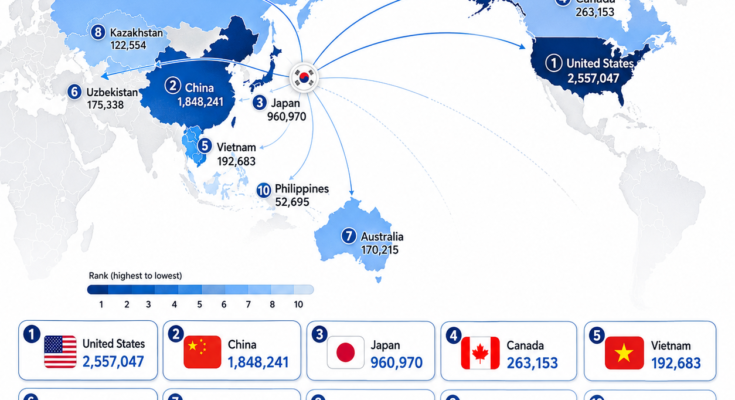
More than 7 million Koreans live outside South Korea, forming one of Asia’s most geographically widespread diaspora communities.
But they are far from evenly distributed around the world.
According to South Korea’s 2025 Status of Overseas Koreans, there were 7,006,703 overseas Koreans living in 181 countries as of December 31, 2024. The United States alone was home to more than 2.5 million, while China had more than 1.8 million and Japan nearly one million.
The map reveals not only where Koreans live today, but also traces more than a century of migration, war, colonial history, economic opportunity and globalization.
What Does “Overseas Korean” Mean?
An important detail is that the statistic does not simply count South Korean citizens temporarily living overseas.
South Korea’s official figures include two broad groups:
- South Korean nationals residing abroad
- Ethnic Koreans who hold citizenship in another country
Of the 7,006,703 overseas Koreans counted in the 2025 report, 2,402,026 were Korean nationals abroad, while 4,604,677 were ethnic Koreans with foreign citizenship.
This is why the figures can be much larger than the number of South Korean passport holders living overseas.
It also explains why countries such as the United States, China, Japan, Uzbekistan and Kazakhstan contain such large Korean communities.
1. United States — 2,557,047
The United States has the world’s largest overseas Korean population, with 2,557,047 people recorded in the latest official statistics.
Large Korean communities can be found across the country, but they are especially visible in major metropolitan areas such as:
- Los Angeles
- New York
- Washington, D.C.
- Atlanta
- Chicago
- Seattle
- San Francisco
- Honolulu
Los Angeles is particularly famous for Koreatown, one of the most recognizable Korean cultural districts outside Korea.
The modern Korean-American population grew rapidly during the second half of the 20th century as immigration increased and Korean families established businesses, churches, restaurants and community organizations throughout the United States.
Today, Korean influence can be seen far beyond traditional immigrant neighborhoods.
Korean food, K-pop, film, television, beauty products and technology have all become increasingly mainstream in American culture.
2. China — 1,848,241
China has the second-largest overseas Korean population, with 1,848,241 people.
Unlike many Korean communities created primarily through recent migration, China’s Korean population has deep historical roots.
Large ethnic Korean communities have lived for generations in northeastern China, particularly near the Korean Peninsula.
The best-known concentration is in Jilin Province, including the Yanbian Korean Autonomous Prefecture.
Many ethnic Koreans in China are Chinese citizens rather than South Korean nationals, illustrating why the official diaspora figures include nationality as well as Korean ancestry.
Interestingly, China’s overseas Korean population fell substantially compared with the previous survey.
South Korean authorities reported a decline of 261,486 people, or approximately 12.4%, citing factors including return migration to Korea and movement to other countries.
Even after that decline, China remains comfortably in second place.
3. Japan — 960,970
Japan ranks third with 960,970 overseas Koreans.
The Korean community in Japan has an especially complicated history involving the period of Japanese rule over Korea, wartime migration, postwar settlement and more recent movement between the two countries.
Today the population includes both long-established Korean communities and newer residents who moved to Japan for employment, education, marriage or business.
Japan also recorded one of the most striking changes in the latest statistics.
The reported overseas Korean population increased significantly compared with the previous survey. South Korean authorities said part of that increase resulted from children of international marriages being incorporated into the statistics beginning with the latest count.
4. Canada — 263,153
Canada is home to 263,153 overseas Koreans, giving it the fourth-largest Korean community in the world.
The population is heavily concentrated in major metropolitan areas, particularly around Toronto and Vancouver.
Canada has become an attractive destination for Korean families, students and professionals due to its education system, immigration opportunities and major multicultural cities.
While Canada’s Korean population is much smaller than that of the United States, it remains far larger than Korean communities in most other countries.
5. Vietnam — 192,683
One of the most interesting countries on the map is Vietnam, which now has 192,683 overseas Koreans.
Unlike some older Korean diaspora communities, much of Vietnam’s Korean population is connected to relatively recent economic ties.
South Korean companies have invested heavily in Vietnam, especially in manufacturing, electronics, construction and consumer industries.
As commercial ties expanded, Korean managers, workers, entrepreneurs and their families followed.
Large Korean communities can now be found in areas such as Ho Chi Minh City and Hanoi.
Vietnam’s fifth-place ranking demonstrates how modern business and investment can reshape migration patterns within just a few decades.
6. Uzbekistan — 175,338
Uzbekistan has 175,338 overseas Koreans, making it the sixth-largest Korean community outside Korea.
Its position may surprise readers who associate the Korean diaspora mainly with the United States, China and Japan.
The explanation lies largely in Soviet history.
Ethnic Koreans became established in the Russian Far East during the 19th and early 20th centuries. During the Soviet era, large numbers were forcibly relocated to Central Asia.
Their descendants became known as Koryo-saram, creating Korean communities across countries including Uzbekistan and Kazakhstan.
Generations later, Central Asia remains one of the world’s most important centers of the historic Korean diaspora.
7. Australia — 170,215
Australia has 170,215 overseas Koreans, ranking seventh.
Korean migration to Australia accelerated particularly during recent decades.
Sydney contains the country’s largest Korean community, while significant populations can also be found in Melbourne, Brisbane and other cities.
Students, skilled migrants, business owners and families all form part of Australia’s growing Korean population.
Australia’s position also reflects the broader growth of the Korean population in the South Asia-Pacific region.
8. Kazakhstan — 122,554
Kazakhstan has 122,554 overseas Koreans.
Like Uzbekistan, Kazakhstan’s Korean population is closely connected to the history of Koreans in the former Soviet Union.
Many families have lived in Central Asia for generations and are citizens of the countries where they were born.
This makes Kazakhstan another example of why the term “Korean diaspora” encompasses far more than modern South Korean expatriates.
9. Russia — 113,042
Russia has 113,042 overseas Koreans, according to the latest figures.
Korean settlement in the Russian Far East goes back well over a century.
Although Soviet-era relocations shifted many Korean communities toward Central Asia, Korean populations remained within Russia and later developed in other parts of the country.
The latest statistics show that the wider Russia and CIS region experienced a decline in its Korean population compared with the previous survey. South Korean authorities identified the effects of the Russia-Ukraine war as one factor contributing to the decrease.
10. Philippines — 52,695
Completing the top ten is the Philippines, with 52,695 overseas Koreans.
The Philippines has long attracted Korean students, retirees, tourists, entrepreneurs and families.
English-language education has been an especially significant connection between the two countries, with many Koreans traveling to the Philippines for language study.
Although its Korean population is much smaller than those of the countries at the top of the ranking, it is still large enough to place the Philippines among the ten biggest Korean communities worldwide.
The Top 10 Countries
According to the official 2025 report, the largest overseas Korean populations are:
- United States — 2,557,047
- China — 1,848,241
- Japan — 960,970
- Canada — 263,153
- Vietnam — 192,683
- Uzbekistan — 175,338
- Australia — 170,215
- Kazakhstan — 122,554
- Russia — 113,042
- Philippines — 52,695
Germany narrowly misses the top ten with 52,588, followed by Brazil with 51,640 and the United Kingdom with 47,006.
Nearly Half of the Diaspora Is Concentrated in North America
Looking at the map geographically reveals two enormous centers of the Korean diaspora.
The official report counted 2,820,200 overseas Koreans in North America and 2,816,295 in Northeast Asia.
Those two regions dominate the global distribution.
But other regions remain important.
The South Asia-Pacific region contained 577,483 overseas Koreans, while Russia and the Commonwealth of Independent States accounted for 444,971.
Europe had 213,161, Latin America 106,348, and Africa and the Middle East together accounted for 28,245.
The Korean Diaspora Is Changing
Perhaps the most interesting finding isn’t simply where overseas Koreans live.
It’s how quickly the map is changing.
The previous 2023 statistics recorded 7,081,510 overseas Koreans. The latest count fell to 7,006,703, a decline of 74,807 people, or about 1.1%.
But that decline was far from uniform.
Northeast Asia, North America and the Russia/CIS region recorded decreases, while the South Asia-Pacific region and Europe grew.
The South Asia-Pacific Korean population increased by 12.5%, while Europe’s increased by 7.6% compared with the previous statistics.
This suggests that the geography of the Korean diaspora is gradually shifting.
Traditional population centers remain dominant, but countries connected to growing South Korean investment, employment and education are becoming increasingly important.
Why Are Koreans Spread Across Such Different Countries?
There is no single Korean migration story.
Different parts of the map represent completely different historical periods.
China and Japan reflect deep historical migration and the turbulent history of Northeast Asia.
Uzbekistan, Kazakhstan and Russia reflect Korean settlement in the Russian Far East and later Soviet-era population movements.
The United States and Canada became major destinations during the modern era of global immigration.
Vietnam and other Southeast Asian countries demonstrate the influence of South Korea’s modern economic expansion.
And countries throughout Europe and Oceania increasingly attract Korean students, professionals, entrepreneurs and families.
The result is a diaspora shaped simultaneously by history and globalization.
A Global Korean Community of More Than 7 Million
The most striking thing about this map is its scale.
Outside the Korean Peninsula, communities with Korean heritage can be found from Los Angeles to Toronto, Tokyo to Tashkent and Sydney to São Paulo.
More than 7 million overseas Koreans are recorded across 181 countries.
Yet three countries dominate the picture: the United States, China and Japan.
At the same time, the prominence of Uzbekistan and Kazakhstan tells a lesser-known historical story, while Vietnam’s rapid rise illustrates a much newer chapter.
The Korean diaspora map is therefore more than a population ranking.
It is a map of migration, empire, forced displacement, economic growth and more than a century of Korean history extending far beyond the Korean Peninsula.
Data source: South Korea’s Overseas Koreans Agency, 2025 Status of Overseas Koreans. Figures refer to the situation as of December 31, 2024. The statistics include Korean nationals abroad and ethnic Koreans holding foreign citizenship.