PART 3: What the Camera Saw
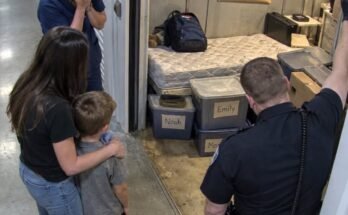
The next morning, Arthur walked up to the elementary school himself, footage saved on a flash drive, and asked to speak with the principal. I met him there, having gotten the call from the school an hour earlier, and watched a man the whole neighborhood had spent years avoiding sit calmly across a desk from Principal Reyes and lay out, in plain terms, exactly what he’d captured on camera — three boys, clearly identifiable, shoving a disabled child to the ground, filming his humiliation, and throwing his belongings into what they believed was a dangerous animal’s yard, hoping, as far as any reasonable person could interpret it, that something bad might happen to him.
Principal Reyes watched the footage twice, her face tightening more with each replay. By that afternoon, all three boys were sitting in a disciplinary hearing with their own parents present, the video playing on a laptop between them. There was no room left for the usual excuses — “just joking around,” “kids being kids” — not with timestamped footage of a ten-year-old boy dragging his own body through dirt because three older children thought it would be funny to watch him try.
All three were suspended. Two of the families, to their credit, reached out to me directly afterward, mortified, offering apologies that felt genuine rather than performed for an audience. The third family didn’t, and I’ve made my peace with the fact that some people only ever learn the parts of accountability that are convenient to them.
But something else happened in the weeks after, something I hadn’t expected at all. Sam started walking the long way home from school just so he could stop at Arthur’s fence and call for Buster, who’d come galloping up like he’d been waiting there the whole day. Arthur started leaving the side gate unlatched on nice afternoons, and eventually just told Sam to come around the front door instead of crawling through a loose board like a boy sneaking into enemy territory.
By spring, Sam was doing his homework most days at Arthur’s kitchen table, Buster’s enormous head resting across his feet under the chair, and Arthur — a man who’d spent eleven years being quietly avoided by an entire street — had somehow become the person my son talked about most at dinner. Arthur taught him how to change a bike tire. He taught him, patiently, without a hint of pity, how to build strength in the leg his brace supported, showing him stretches a physical therapist friend of his had once shown him during his own long recovery from the burns. He never once treated Sam’s disability as something to work around delicately. He just treated him like a kid worth showing up for.
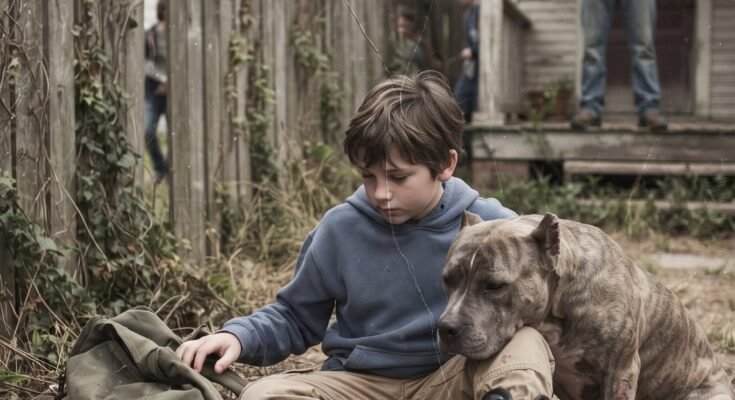
Buster, for his part, became something like Sam’s own personal shadow whenever he visited — leaning his full, scarred weight against Sam’s side on hard days the way he had that very first afternoon in the dirt, like he’d simply decided, the moment he smelled a frightened, hurting child in his yard, that this was a person to protect rather than fear.
The neighborhood’s story about “the monster and the recluse” quietly rewrote itself over that year, the way most fear does when somebody finally bothers to look closer. Kids who used to dare each other to touch Arthur’s fence started waving at him from the sidewalk. A few parents, sheepishly, started saying hello.
Sam still has the leg brace. He still gets stared at sometimes, though less than he used to, since half the kids at his school now know him as “the boy with Arthur’s dog,” which turns out to be a much better reputation to carry than the one those three boys tried to give him in the dirt behind that fence. And most evenings, if you walk down our street around dinnertime, you’ll find him on Arthur’s porch steps, one hand resting on a battle-scarred, one-eared dog who decided, on one terrifying afternoon, exactly whose side he was on.