Part One: The Kitchen Table
Her name is Bridget. She’s lived in my home for four years, and for three of them she’s told everyone she takes care of me.
Last Sunday, I learned what that actually meant.
But to understand why it didn’t work, you have to understand Rosalind first.
Rosalind Pryor and I have been playing bridge together every Wednesday for eleven years, since her husband Walter and my own late husband used to fish together on the same stretch of river every October. When Walter passed, I brought her a casserole. When my eyesight started failing six months ago — really failing, past the point where bigger print or better lamps could fix it — she was the one who noticed before I said a word.
“You held that card two inches from your face just now,” she said one Wednesday, not unkindly. “How long has that been happening?”
I told her the truth, mostly because I was tired of pretending. My eyes were going. Not gone, but going — enough that fine print on a page had become a blur of gray, enough that I’d started signing things by feel rather than by reading them.
“And Curtis doesn’t know?” she asked.
I hadn’t told my son. I told myself it was because I didn’t want to worry him, that he had enough on his plate with work and his marriage and the house. The truer answer was that admitting it out loud to Curtis would have made it real in a way I wasn’t ready for yet.
“Then bring your mail here,” Rosalind said, sliding the sugar bowl aside to make room on her kitchen table. “Every Wednesday. I’ll read it to you before you sign a single thing.”
It became a ritual so ordinary it stopped feeling like a workaround and started feeling like tea and cards — just something two old friends did together. Rosalind read. I listened. If something needed a second look, she made a photocopy at the library and marked the corner with a little green sticker from the roll she kept in her sewing box, so we’d both know, at a glance, which papers had already been through the two of us together.
It was Rosalind’s idea, originally, as a joke. “Consider it our own two-woman law firm,” she’d said, tapping a green dot onto a copy of my property tax statement. “Green means cleared. Nothing gets signed around here without a green sticker.”
Neither of us imagined it would end up saving my house.
Because every “standard form” Bridget had been quietly bringing home for me to sign over those six months had already crossed that kitchen table first — read aloud, twice, question by question — and I had not signed a single one of them. I told Bridget I’d mailed them back to the sender for my own file. She never checked. Why would she? She believed, completely, that I could no longer tell the difference between a real form and a routine one.
She was almost right. It just wasn’t me doing the reading.
Part Two: The Green Sticker
I was in the hallway with my walker last Sunday morning when I overheard Bridget on speakerphone with her sister, Denise.
“The paperwork is nearly finished. Curtis signs Tuesday.”
“And she still doesn’t know?”
“She thinks they’re ordinary forms,” Bridget laughed. “She signs whatever I put in front of her. She can’t really read the fine print anymore, and she’s too proud to admit it.”
“She’ll be at Fairview before Christmas,” Bridget continued, “and we’ll have the whole place.”
I stood very still in that hallway for a long moment. Then I called Ronnie Salzman, who’d changed the locks on half the houses on our street over the years, and asked if he could come by that afternoon.
By ten forty, when Bridget’s car rolled into the driveway, the locks were new and her key didn’t turn.
“You can’t do that. I live here.”
“This remains my property,” I said. “Your living arrangements will be handled through the proper legal process.”
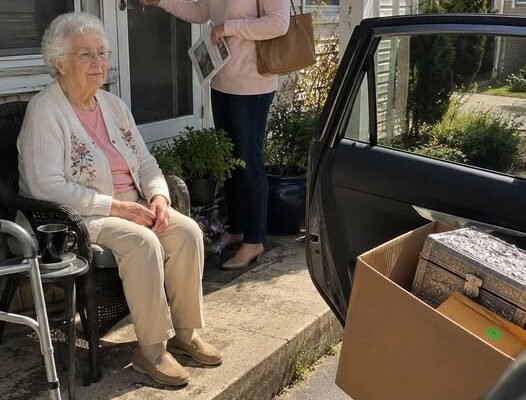
That’s when I saw it through her open car door — my mother’s silver chest sitting in a moving box on the back seat, and beneath it, a manila folder with a green sticker in the corner.
Rosalind’s copies always had green stickers.
I recognized the handwriting on the tab immediately. It wasn’t my name. It wasn’t Curtis’s either.
The name written on the tab was Denise Whitfield. Bridget’s sister.
I stared at it while Bridget scrambled to snatch the folder off the driveway, but I was faster than my hip had any business allowing that morning.
Inside were photocopies of the exact documents Rosalind and I had been quietly declining to sign for six months — power of attorney forms, a request to add a name to my property deed, a Medicare authorization granting someone far broader access to my accounts than any ordinary paperwork required. Except these copies had something the originals never had: a second signature line, already filled in. Denise Whitfield’s signature, dated three weeks earlier, naming her a secondary authorized party on my accounts.
Denise had never once set foot in my house.
“Bridget,” I said, “why does your sister’s name appear on documents about my finances?”
Her composure finally cracked. “It’s not what it looks like. Denise works in property management. She was just helping me understand the paperwork, that’s all.”
“Then why does she have a signature line as an authorized party?”
She had no answer. Instead she dialed her phone with shaking hands and asked Curtis to come home immediately.
I called Ronnie back over from around the corner, and together we waited on the porch, folder in hand, until my son arrived twenty minutes later — confused, and entirely unprepared for what he was about to learn.
Part Three: What Trust Finds
I showed Curtis the folder. I told him what I’d overheard that morning, the plan for Fairview, the Tuesday deadline built around his signature. I watched his face move through the same disbelief I imagine mine had gone through in that hallway hours earlier, and then something heavier, once he understood the full shape of what his wife had been building behind both our backs.
“Denise doesn’t work in property management,” Curtis said slowly, reading over my shoulder. “She works at Bridget’s old law firm. As a paralegal.”
The rest came together over the following days, with help from an attorney Rosalind recommended — someone with no ties whatsoever to Bridget’s old firm. Bridget and Denise had spent months quietly drafting documents meant to hand themselves increasing control over my finances and, eventually, my home, using Bridget’s paralegal training to make each form look routine enough that Curtis would sign without close scrutiny. The entire plan depended on two things: my failing eyesight, and my son’s complete trust that his wife was handling my care in good faith.
They never accounted for a green sticker system two old friends invented at a kitchen table, half as a joke, years before either of them had a reason to need it.
Curtis moved out of denial fast once the documents were laid plainly in front of him. He filed for divorce within the month — not out of anger at the paperwork alone, but from the deeper hurt of realizing how completely he’d been kept in the dark by someone he’d trusted without question.
I never went to Fairview.
My attorney helped me set up a proper power of attorney of my own choosing — Curtis and Rosalind’s daughter as co-authorized parties, with real safeguards this time, the kind that make a repeat of Bridget’s plan effectively impossible. Bridget moved in with Denise, the same sister whose careless signature had ended up exposing the whole scheme. I heard, through Curtis, that the two of them barely speak anymore, each blaming the other for the folder that slipped out of an open car door on an ordinary Sunday morning.
I still have Wednesday afternoons with Rosalind. We still read my mail together at her kitchen table, slower now, more out of habit than necessity, the sugar bowl still pushed to the same corner it’s occupied for eleven years. My mother’s silver chest sits back in the breakfront where it belongs, pheasants and all, exactly where my husband carried it in more than fifty years ago.
Curtis comes by most Sundays now, just the two of us, no papers between us that haven’t already been read twice.
Sometimes the people counting on your weakness forget that trust, once truly earned, doesn’t vanish just because your eyes start to fail. It simply finds a quieter set of eyes willing to read for you instead — and, if you’re lucky, a friend patient enough to keep a roll of green stickers in her sewing box, just in case.