Original Fiction: This story is fictional. Names, characters, dialogue, locations, and events were created for storytelling purposes.
PART 1 — THE BOOK HE NEVER FINISHED
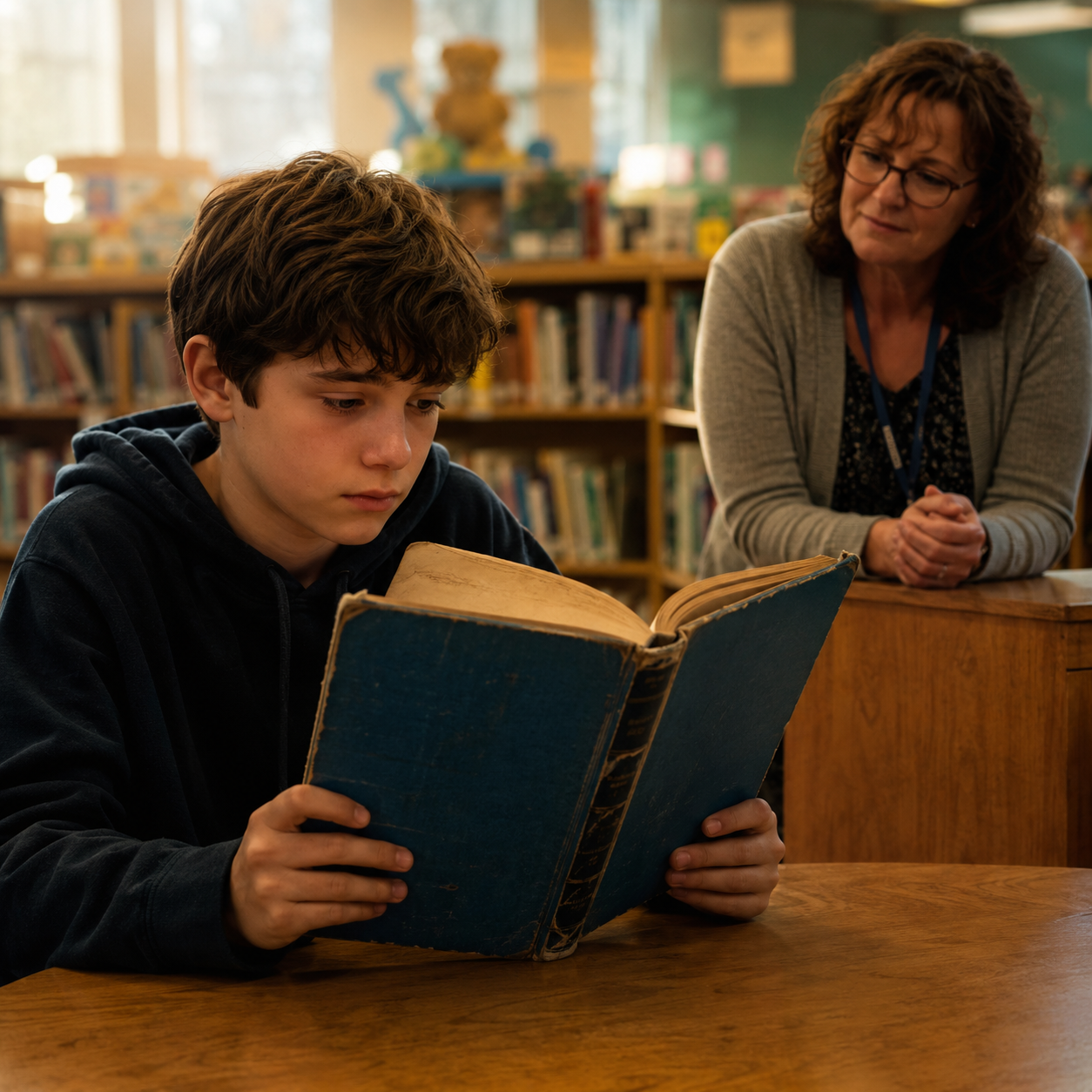
Every Friday afternoon, a twelve-year-old boy returned the same library book.
Then he immediately checked it out again.
The book was called The Lighthouse at Winter Bay.
Three hundred and twelve pages.
Worn blue cover.
A silver lighthouse stamped beneath the title.
For seven months, Noah Campbell borrowed it every week.
But he never read past Page One.
My name is Elaine Porter, and I was the children’s librarian at Hartwell Public Library.
I noticed Noah because he never asked for help.
Children usually arrived with questions.
Where are the dragon books?
Do fish sleep?
Can I use the printer?
Why does the computer know my name?
Noah entered quietly at 3:45 every Friday.
He placed The Lighthouse at Winter Bay on the counter.
“I’d like to renew this.”
“You can renew online.”
“I don’t have internet.”
“You may keep it for three weeks.”
“I like bringing it back.”
Then he waited while I scanned the book.
One Friday, I asked whether he enjoyed it.
“Yes.”
“What part are you on?”
“The beginning.”
“How far?”
“Page One.”
I laughed.
He did not.
“You’ve had it for months.”
“I know.”
“Is it difficult to read?”
“No.”
“Do you want the audiobook?”
“No.”
“Then why not continue?”
He took the book.
“I don’t want it to end.”
Children say strange things.
I assumed the story had emotional meaning for him.
Perhaps a parent had read it aloud.
Perhaps the lighthouse reminded him of somewhere he had lived.
Then I checked the book’s history.
Before Noah, the same copy had been borrowed repeatedly by another patron.
Margaret Campbell.
The last checkout occurred eight months earlier.
One month before Noah began borrowing it.
I searched the local obituary records.
Margaret Campbell had died the previous winter.
Age seventy-two.
Survived by one grandson, Noah.
The next Friday, I did not question him.
I stamped the due date and returned the book.
But as Noah walked away, a folded paper slipped from between the pages.
I picked it up.
A handwritten note.
Dear Noah,
The best stories are not about reaching the last page.
They are about who sits beside you while you read.
Love,
Grandma
I called after him.
Noah spun around.
When he saw the note, panic crossed his face.
“Give it back.”
“I’m sorry. It fell out.”
He grabbed it.
“Did you read it?”
“Only enough to see it belonged to you.”
His eyes filled with anger.
“You weren’t supposed to.”
“I didn’t mean to.”
He pressed the note inside the book.
“My grandmother read this to me.”
“I guessed.”
“She did voices.”
“Good ones?”
“Terrible.”
He looked down.
“She died after Page One.”
I understood.
Margaret began reading the book to Noah while she was in the hospital.
They finished the first page.
Then a nurse entered.
His grandmother promised they would continue the next day.
There was no next day.
“So you keep checking it out,” I said.
“As long as I stay on Page One, we haven’t stopped reading.”
The sentence broke something inside me.
My husband, Robert, had died four years earlier.
We had been married thirty-six years.
Afterward, I left his shoes beside the front door.
His mug remained in the kitchen cupboard.
His half-finished crossword puzzle stayed on the table.
I told myself I was preserving his belongings.
The truth was that finishing anything felt like admitting he would not return.
I placed my hand on the book.
“You don’t have to finish it.”
Noah looked suspiciously at me.
“Everyone says I should.”
“Everyone is often annoying.”
He almost smiled.
“You may keep renewing it.”
“For how long?”
“As long as you need.”
The following Friday, he returned.
This time, he did not hand me the book.
He sat at a table near the children’s section and opened to Page One.
For an hour, he stared at it.
Then he closed it.
That became our routine.
Every Friday, Noah sat with the book.
I worked nearby.
We did not talk.
Winter turned to spring.
Then, one rainy afternoon, Noah approached the desk.
“Did you know my grandmother?”
“Only as a library patron.”
“What did she borrow?”
I searched her history.
Gardening books.
Mysteries.
Cookbooks.
A guide to repairing clocks.
Thirty-seven children’s novels.
“Why children’s books?”
“Maybe for you.”
Noah shook his head.
“She said I was too old for bedtime stories.”
“Adults often lie about things they want an excuse to keep doing.”
I found a note attached to Margaret’s account.
It had been entered by another librarian.
Patron selects books for Saturday reading club.
“What reading club?” Noah asked.
The club no longer existed.
Years earlier, Margaret visited a family shelter every Saturday and read to children staying there.
She had never told Noah.
“She read to other kids?” he asked.
“It seems so.”
His expression tightened.
“Why didn’t she take me?”
“Perhaps she planned to.”
“Or maybe I wasn’t special.”
I closed the computer screen.
“People can love more than one person without dividing the love into smaller pieces.”
Noah looked unconvinced.
A week later, a woman entered the library asking for Margaret Campbell.
Her name was Denise Walker.
She worked at the family shelter.
When I explained that Margaret had died, Denise began crying.
“We didn’t know,” she said.
Margaret had read there for eleven years.
Every Saturday at ten.
When she stopped coming, staff assumed her health had worsened.
“She always talked about her grandson,” Denise told Noah.
“What did she say?”
“That you corrected her whenever she skipped words.”
“I did.”
“That you wanted to become an engineer.”
“I used to.”
“She said you were the reason she chose adventure stories.”
Noah held The Lighthouse at Winter Bay against his chest.
“Did she read this one?”
Denise nodded.
“It was the children’s favorite.”
“How far did she get?”
“Page Two Hundred and Eight.”
Noah’s face changed.
His grandmother had shared the book with dozens of children.
But with him, the story remained on Page One.
That evening, Noah left the library without renewing it.
He placed the book on the counter.
“I’m done.”
I watched him walk into the rain.
The book felt heavier than it should have.
PART 2 — PAGE TWO
Noah did not return the following Friday.
Or the week after that.
I contacted the number on his account.
His father answered.
“Noah doesn’t want to go to the library anymore,” he said.
“Is he all right?”
“He’s angry.”
“At his grandmother?”
“At everyone.”
Noah had lived with Margaret for most of his childhood.
His father, David, worked long construction jobs away from home.
After Margaret died, David returned permanently.
But father and son barely knew how to speak to each other.
“Can I visit?” I asked.
David hesitated.
“He doesn’t like visitors.”
“Neither do I. That gives us something in common.”
Their house was small and quiet.
Noah sat on the back steps.
I carried The Lighthouse at Winter Bay beneath my coat.
“I returned that,” he said.
“I know.”
“I don’t want it.”
“I know.”
“Then why bring it?”
“Because librarians have difficulty respecting dramatic exits.”
He looked away.
I sat beside him.
“She read it to everyone,” he said.
“Yes.”
“I thought it was ours.”
“Maybe it was.”
“How?”
I opened the book.
The inside cover contained a card pocket from the days before electronic checkout.
Margaret’s handwriting appeared beside dozens of dates.
But beneath the card was something I had never noticed.
A tiny envelope taped inside the cover.
On the front:
FOR NOAH—WHEN HE REACHES PAGE TWO
Noah stared at it.
“My name?”
“Yes.”
His hands shook as he opened the envelope.
Inside was a letter.
Dear Noah,
You may be wondering why I chose this book.
I have read it to many children, but I saved the final chapter for you.
I wanted us to read the whole story together.
If I cannot finish, please do something brave for me.
Turn the page.
Not because leaving Page One means leaving me.
Because everything I taught you is waiting on the pages ahead.
Love,
Grandma
P.S. My pirate voice is excellent, regardless of what you claim.
Noah began crying.
Not quietly.
The kind of crying children do only after spending too long pretending they are older than they are.
His father appeared in the doorway.
He sat on Noah’s other side.
“I didn’t know about the letter,” David said.
“You didn’t know anything,” Noah snapped.
David lowered his head.
“You’re right.”
The answer silenced Noah.
“I thought working was how I took care of you,” David continued. “Mom kept telling me you needed me home.”
“She was right.”
“Yes.”
“Then why didn’t you come?”
“Because coming home meant admitting I had already missed too much.”
Noah wiped his face.
“That’s stupid.”
“It was.”
They sat without speaking.
Then David pointed toward the book.
“What happens on Page Two?”
Noah opened it.
“I don’t know.”
“Could you read it?”
“Grandma did the voices.”
“I can do voices.”
“You sound terrible.”
“You haven’t heard them.”
“I’ve heard you sing.”
“That is unrelated.”
Noah began reading.
One paragraph.
Then another.
When a fisherman spoke, David attempted a deep voice.
It was terrible.
Noah laughed so suddenly that he lost his place.
They continued until Page Seven.
The next Friday, both of them came to the library.
They checked out the book together.
Every week, they returned.
Page Thirty-Four.
Page Eighty-One.
Page One Hundred and Fifty.
Sometimes they read at home.
Sometimes in the library.
When they reached Page Two Hundred and Eight, Noah stopped.
“This is where Grandma stopped at the shelter.”
Denise had invited him to visit.
The shelter’s reading room contained a worn rug, mismatched cushions, and shelves of donated books.
Six children waited.
Noah stood in front of them holding The Lighthouse at Winter Bay.
“I’m not good at reading aloud,” he said.
A little girl shrugged.
“Neither was the old lady at first.”
Noah looked at Denise.
“She means your grandmother,” Denise whispered.
“She remembered her?”
“All of them do.”
Noah sat down.
He opened to Page Two Hundred and Nine.
For the first time, the story continued beyond where Margaret had left it.
He read one chapter.
His fisherman’s voice sounded remarkably like his father’s.
Terrible.
The children loved it.
PART 3 — THE FINAL CHAPTER
Noah and David finished the book six months later.
They read the final chapter at the library.
I sat across from them.
When Noah reached the last sentence, he stopped.
“You read it,” he told his father.
David shook his head.
“Your grandmother saved it for you.”
Noah took a breath.
Then he read:
The lighthouse did not bring lost ships home by holding them in the harbor. It showed them where to go next.
He closed the book.
For several seconds, none of us spoke.
“Was that it?” Noah asked.
“That was it,” I said.
He looked disappointed.
“Endings are usually smaller than people expect.”
“What do I do now?”
“Return it.”
He held the book tighter.
Then, slowly, he placed it on the desk.
I scanned it.
For the first time in more than a year, The Lighthouse at Winter Bay became available for someone else.
The following Saturday, Noah returned to the shelter.
He brought a different book.
Then another.
By the time he entered high school, he led the reading club his grandmother had started.
David volunteered too.
He was still terrible at voices.
Noah eventually stopped correcting him.
I made a change of my own.
One evening, I went home and completed Robert’s crossword puzzle.
The final clue was:
A light that guides travelers home.
Nine letters.
LIGHTHOUSE.
I laughed and cried at the same time.
Then I washed his mug.
Moved his shoes.
Not because I loved him less.
Because love did not live inside unfinished objects.
It lived inside what I carried forward.
Years later, Noah returned to the library wearing a college sweatshirt.
He had decided to study engineering after all.
Before leaving, he placed a package on my desk.
Inside was a newly printed copy of The Lighthouse at Winter Bay.
The cover looked different.
The pages were clean.
On the title page, he had written:
For Elaine,
who taught me that turning the page does not erase the one before it.
—Noah
The original copy remained in the library.
We placed Margaret’s letter inside a protective sleeve.
A small note appeared beside the book:
THIS STORY MAY BE BORROWED BY ANYONE WHO IS AFRAID TO MOVE FORWARD.
People checked it out constantly.
Widows.
Children in foster care.
Parents after divorce.
Teenagers leaving home.
Most never knew Noah or Margaret.
They did not need to.
The story had become theirs too.
For months, I believed Noah refused to read beyond Page One because he was afraid of reaching the ending.
But he was not afraid of the book ending.
He was afraid that continuing without his grandmother meant abandoning her.
What he eventually learned was something many adults spend their whole lives avoiding:
Moving forward is not the same as leaving someone behind.
The people we love do not remain only on the page where we lost them.
They appear in the words we choose afterward.
In the voices we imitate badly.
In the kindness we repeat for strangers.
In every frightened person we sit beside while they begin again.
Noah thought his grandmother had left him an unfinished story.
In truth, she had left him a place to continue hers.