The Little Girl Left One Red Glove on My Bus Every Monday—Then I Learned Who She Was Leaving It For

Original Fiction: This story is fictional. Names, characters, dialogue, locations, and events were created for storytelling purposes.
PART 1 — THE GLOVE ON SEAT NINE
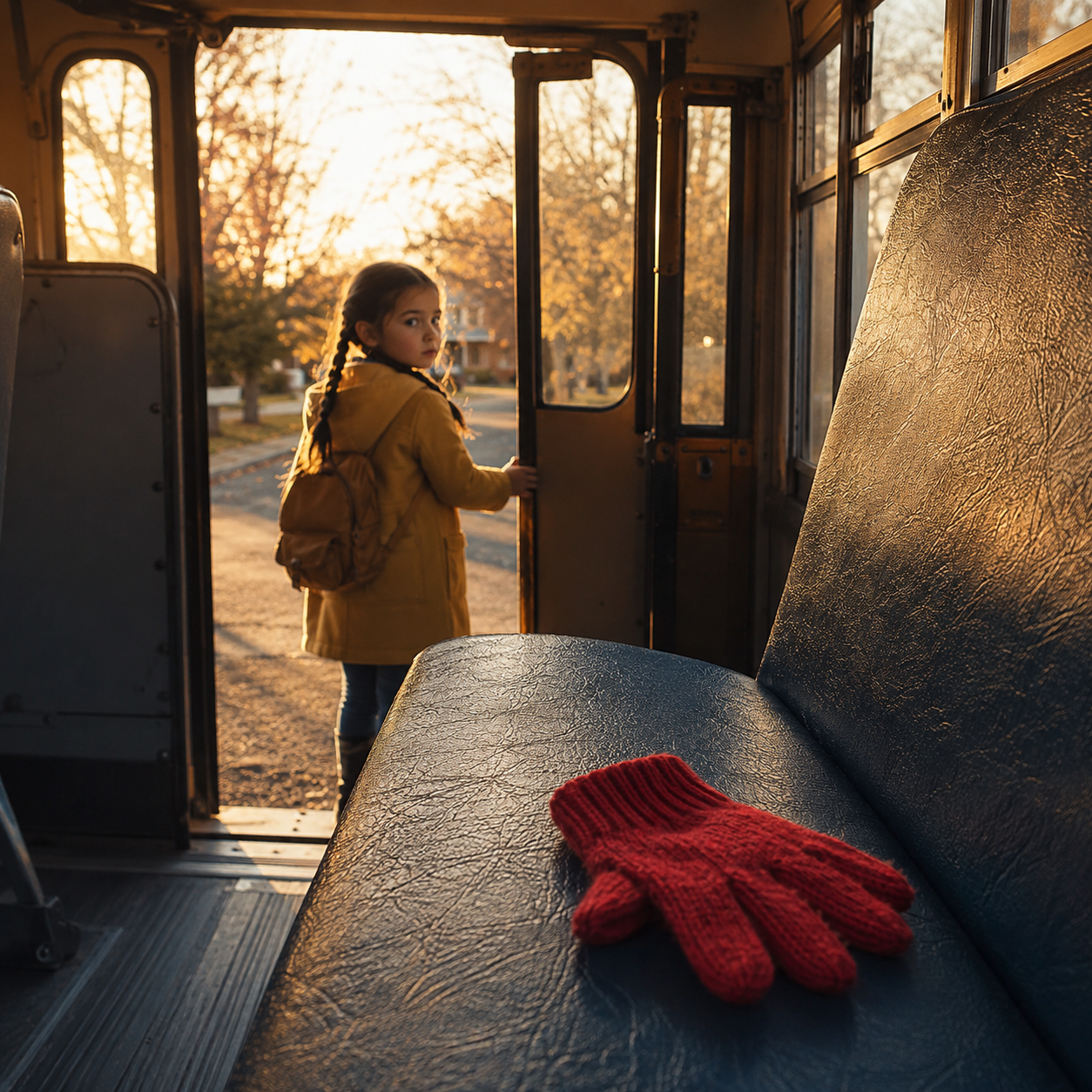
Every Monday afternoon, a little girl left one red glove on Seat Nine.
Never both gloves.
Never a hat, scarf, or lunchbox.
Always the left glove.
Always in the same place.
At first, I assumed she was forgetful.
By the fourth Monday, I knew she was doing it on purpose.
My name is Samuel Reed, and I drove Route 18 for the Millbrook School District.
For twenty-three years, I carried children from noisy classrooms to quiet houses, crowded apartments, foster homes, grandparents’ porches, and parents waiting impatiently beside idling cars.
Most drivers remembered children by name.
I remembered them by seats.
The twins who argued over Seat Three.
The sixth-grade boy who slept against the window in Seat Fourteen.
The kindergarten girl who sang to herself near the front because the older children frightened her.
And then there was Lila Moreno.
Seven years old.
Yellow coat.
Two dark braids.
Red knitted gloves connected by a piece of yarn threaded through her sleeves.
Lila usually sat in Seat Nine beside the window.
She rarely spoke.
Every Monday, when she stepped off at the Greenfield Apartments, she looked back at the bus as though checking something.
After completing the route, I would find the left glove resting neatly on the seat.
The first time, I placed it in the lost-and-found box.
The next morning, Lila climbed aboard wearing both gloves.
“You found it?” I asked.
She nodded.
Her grandmother must have retrieved it from the school office.
The following Monday, the glove appeared again.
Then again.
On the fifth Monday, I stopped her before she reached the door.
“Lila.”
She froze.
“You forgot your glove.”
She looked at the red glove in my hand.
Then at Seat Nine.
“I don’t need it tonight.”
“It is thirty-two degrees outside.”
“My other hand is warm.”
“That is not how hands work.”
A few children laughed.
Lila lowered her eyes.
I handed her the glove.
She took it reluctantly and stepped off the bus.
The next Monday, I watched her carefully in the mirror.
As the bus approached Greenfield Apartments, Lila removed her left glove.
She placed it beside the window.
Then she stood.
“Lila.”
Her shoulders stiffened.
I waited until the other children had exited.
“Why do you keep leaving this?”
She stared at the floor.
“I forget.”
“No, you don’t.”
Her fingers closed around the yarn connecting the two gloves.
“Are you giving it to someone?”
She shook her head.
“Is somebody taking things from you?”
“No.”
“Then tell me.”
Lila looked through the window toward the apartment building.
“My mom said drivers put lost things in a box.”
“That’s true.”
“And people can take them if they belong to them.”
“Only if they can describe them.”
She nodded slowly.
“He can describe it.”
“Who?”
Lila’s eyes filled with tears.
“My brother.”
I knew Lila lived with her grandmother.
I had never heard about a brother.
“What is his name?”
“Mateo.”
“How old is he?”
“Ten.”
“Does he go to Millbrook?”
“He used to.”
The words came quietly.
Then Lila snatched the glove from my hand and ran off the bus.
That evening, I called the school counselor.
She became silent when I mentioned Mateo.
“Lila’s brother disappeared eight months ago,” she said.
My grip tightened around the phone.
“What do you mean, disappeared?”
“The children were living with their mother. She struggled with addiction. Social services intervened.”
“Lila went to her grandmother?”
“Yes.”
“And Mateo?”
“He ran away before they could place him.”
“Has anyone found him?”
“No.”
I looked at the empty lost-and-found box near the front of the bus.
“Why the glove?”
The counselor sighed.
“Their mother knitted those gloves. Mateo had a matching blue pair.”
Lila believed her brother might return to the school.
She believed he might check the lost-and-found.
So every Monday, she left him a sign.
One red glove.
Proof that she was still riding Route 18.
Proof that she had not forgotten him.
The following Monday, I did not stop her.
Lila placed the glove on Seat Nine and stepped off the bus.
After finishing my route, I carried it into the school office.
Instead of placing it inside the lost-and-found box, I wrote a note.
Mateo,
Lila still rides Route 18.
She sits in Seat Nine.
She is safe.
She misses you.
—Mr. Reed, the bus driver
I tucked the note inside the glove.
For the next six Mondays, the glove remained untouched.
Then, one Tuesday morning, I opened the lost-and-found box.
The red glove was gone.
In its place was a blue one.
Inside it was a folded piece of paper.
The handwriting was uneven.
Tell Lila I still have the other one.
Please don’t tell the police.
I’m not ready.
PART 2 — THE BOY AT THE TERMINAL
I read the note three times.
Then I called the counselor.
She contacted the social worker assigned to the family.
The social worker wanted the note immediately.
I refused until she promised not to treat Mateo like a criminal.
“He is a missing child,” she said.
“He is also a frightened child.”
“We need to know where he is.”
“So does Lila.”
That afternoon, Lila boarded the bus.
I waited until the other children were talking before placing the blue glove on Seat Nine.
She stared at it.
For several seconds, she did not breathe.
Then she grabbed it with both hands.
“Where did you get this?”
“He left it in the lost-and-found.”
“Mateo?”
“Yes.”
She pressed the glove against her face.
“He found mine.”
“He did.”
“Is he coming home?”
“I don’t know.”
Her hope made me afraid.
I did not want to promise something I could not deliver.
Inside the blue glove, I had placed another note.
Mateo,
I will not force you onto the bus.
I will be at the old downtown terminal every Saturday at noon.
You do not have to speak to me.
You do not have to come close.
Just let me know you are alive.
—Mr. Reed
The downtown terminal had been closed for years.
Its benches were rusted, its ticket windows covered with plywood.
But several city routes still passed nearby.
The first Saturday, I sat there for two hours.
No one came.
The second Saturday, rain soaked through my coat.
No one came.
The third Saturday, I noticed a boy standing across the street.
Thin.
Dark hair.
Blue hooded sweatshirt several sizes too large.
He watched me from beside a newspaper box.
I did not wave.
I did not move toward him.
I placed a paper bag on the bench.
Inside were two sandwiches, juice, hand warmers, and Lila’s red glove.
Then I walked to my car.
When I looked back, the boy was gone.
So was the bag.
The next Saturday, he sat at the far end of the terminal.
“You’re Mr. Reed,” he said.
“You’re Mateo.”
He looked older than ten.
Not because of his height.
Because children who learn not to trust adults begin carrying themselves like smaller versions of tired men.
“Did you tell them?” he asked.
“I told them you were alive.”
His jaw tightened.
“Then they’ll come.”
“I came alone.”
“You’re lying.”
“I’m a school-bus driver. We are terrible liars. Children ask too many questions.”
He almost smiled.
Almost.
“Lila is okay?” he asked.
“She lives with your grandmother.”
“Abuela Rosa?”
“Yes.”
“She still burns toast?”
“According to Lila, constantly.”
Mateo looked down.
“Does Lila think I left her?”
“She thinks you’re trying to find your way back.”
His face crumpled for one second before he turned away.
“I was supposed to watch her.”
“You were ten.”
“I was nine.”
“That makes my point stronger.”
He told me what happened.
When social workers arrived, Mateo believed he and Lila would be separated permanently.
Their mother had told him foster homes were dangerous.
She had warned him that adults would take his sister away if he ever asked for help.
So Mateo ran.
He planned to return for Lila.
But by the time he reached their apartment again, she was gone.
He spent months moving between shelters, abandoned buildings, and the homes of older teenagers.
“Why didn’t you go to your grandmother?”
“I thought she only wanted Lila.”
“Why?”
“Mom said Abuela never liked me.”
“That was not true.”
“You don’t know that.”
“No. But Lila saves half of every dessert because she thinks you might come home. People do not do that in houses where your name is unwelcome.”
Mateo wiped his nose on his sleeve.
“Are they going to put me in foster care?”
“The social worker says your grandmother has been trying to become your legal guardian.”
“She wants me?”
“She has kept your room ready for eight months.”
He looked at me.
“What room?”
“The one with the soccer poster and the broken lamp.”
His mouth opened.
“How do you know about the lamp?”
“Lila told me you broke it and blamed the cat.”
“It did look like something the cat would do.”
“There was no cat.”
Mateo smiled.
This time, fully.
But he still refused to come with me.
I did not force him.
For five Saturdays, we met at the terminal.
I brought food.
He brought questions.
Did Lila still hate peas?
Did his grandmother still watch game shows too loudly?
Had anyone thrown away his drawings?
Each week, I answered.
Each week, he moved one seat closer.
Then, one Saturday, I arrived and found him shivering beneath the terminal roof.
His face was flushed.
He had a fever.
“I’m fine,” he insisted.
“You can barely sit upright.”
“No hospitals.”
“Then we go to your grandmother.”
He began shaking his head.
I placed Lila’s red glove in his hand.
“She has spent eight months leaving this for you.”
His fingers closed around it.
“You don’t have to be ready for everything,” I said. “You only have to be ready for the next ten minutes.”
“What happens after ten minutes?”
“We decide about the ten after that.”
He stared at the glove.
Then he whispered, “Can we take the bus?”
PART 3 — SEAT NINE
I drove Route 18 directly to Greenfield Apartments.
Mateo sat in Seat Nine.
He kept the red glove in his lap and wore the blue one on his left hand.
His other blue glove had been lost months earlier.
When we reached the building, he did not stand.
“What if she’s angry?” he asked.
“Lila?”
“Abuela.”
“Then she will probably be angry while making you soup.”
The apartment door opened before we reached it.
Lila ran down the walkway wearing only socks.
“Mateo!”
He barely had time to turn before she crashed into him.
She hit his chest with both fists.
“You took too long!”
“I know.”
“You said you would find me!”
“I know.”
“I hate you!”
“I know.”
Then she wrapped her arms around him.
Mateo held her so tightly that her feet lifted from the ground.
Their grandmother stood in the doorway.
For several seconds, she did nothing.
Then she crossed the walkway and touched Mateo’s face.
“Your hair is terrible,” she whispered.
Mateo began crying.
“I can cut it.”
“No. You have suffered enough.”
She pulled both children against her.
I stepped away.
Some reunions do not need witnesses.
They need privacy.
Mateo’s return was not magically easy.
There were interviews.
Court hearings.
Therapy appointments.
Nights when he slept beside the front door because he feared someone would take him.
Days when he shouted at his grandmother for rules he secretly needed.
But he stayed.
Every afternoon, Lila sat in Seat Nine.
Three weeks later, Mateo began riding the middle-school bus from the same stop.
Before boarding, he walked over to Route 18.
He handed me something wrapped in newspaper.
Inside was a pair of knitted gloves.
One red.
One blue.
They had been sewn together from the surviving gloves.
“Abuela said they look ridiculous,” he told me.
“She is correct.”
“They’re for you.”
“My hands are much larger.”
“You’re not supposed to wear them.”
Attached to the gloves was a note:
FOR THE DRIVER WHO KNEW LOST THINGS ARE SOMETIMES WAITING TO BE FOUND
I hung them above the windshield.
Years passed.
Lila became talkative.
Mateo joined the soccer team.
Their grandmother continued burning toast.
I eventually retired from Route 18.
On my final day, former students gathered beside the school.
Many had children of their own.
Mateo was there.
He had grown taller than me.
He was studying social work and volunteering with runaway youth.
Lila stood beside him wearing a red scarf.
They presented me with a wooden model of a school bus.
Tiny letters had been painted beside one window:
SEAT 9
“I used to think you found me,” Mateo said.
“I only waited at a terminal.”
“That’s what finding someone looks like sometimes.”
I looked toward the red-and-blue gloves still hanging above the windshield.
For months, I believed Lila left one glove because she was careless.
Then I believed she was sending a message to her missing brother.
But even that was only part of the truth.
The glove was not merely a message.
It was a promise.
A seven-year-old girl had decided that as long as something of hers waited in the lost-and-found box, her brother would have a reason to believe she was still searching for him.
She could not follow him through the city.
She could not call him.
She could not bring him home herself.
So she left one small, bright thing behind.
Week after week.
A signal.
A memory.
A path back.
Sometimes people do not need us to know where they are.
They need us to leave enough love behind that they can still find their way home.