Original Fiction: This story is fictional. Names, characters, dialogue, locations, and events were created for storytelling purposes.
PART 1 — WASHER TWELVE
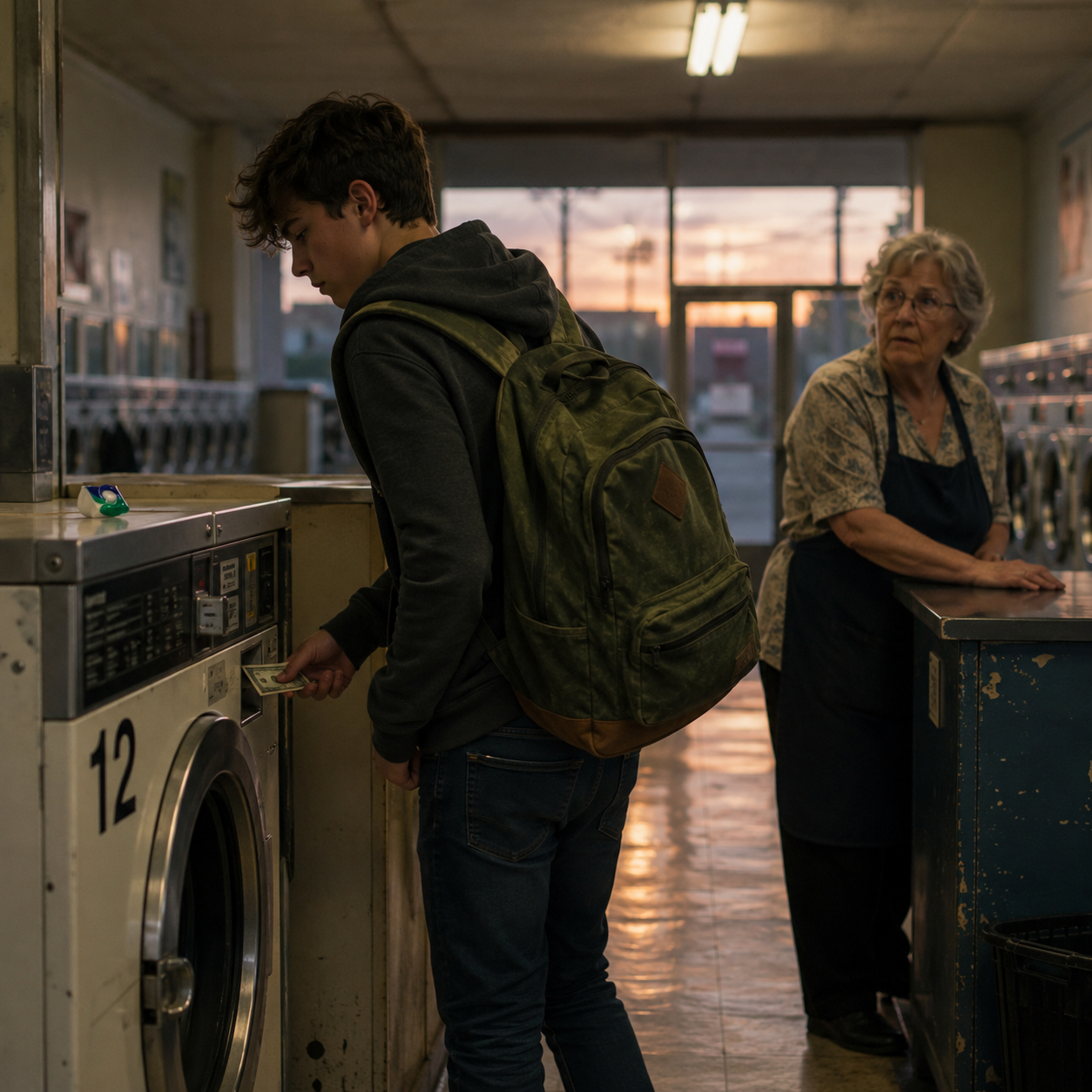
Every Tuesday evening, a teenage boy entered my laundromat, placed six dollars into Washer Twelve, and walked away without washing a single piece of clothing.
He never pressed the start button.
He never asked for the money back.
He simply left the machine prepaid and disappeared before anyone could question him.
At first, I assumed he was meeting someone.
Then I thought he might be playing a prank.
By the sixth Tuesday, I began watching him.
He was sixteen or seventeen, thin, with dark hair and a faded green backpack.
He always arrived at 6:40.
He walked directly to Washer Twelve.
Six dollars.
One detergent pod on top.
Then he left.
Ten or fifteen minutes later, someone usually discovered the machine.
A mother with several children.
A construction worker carrying muddy clothes.
An elderly man washing blankets.
They would look around, confused.
“Is anyone using this?”
I always gave the same answer.
“It looks like your lucky day.”
My name is Rosa Alvarez, and Bluebird Laundry had belonged to my family for twenty-four years.
My husband, Mateo, and I opened it shortly after our daughter was born.
We could not afford employees, so our daughter, Isabel, spent much of her childhood doing homework behind the counter.
The laundromat was never glamorous.
The ceiling leaked near the back wall.
Dryer Seven squealed.
The change machine rejected any bill that had experienced even minor disappointment.
But the neighborhood depended on us.
Then the neighborhood changed.
A large modern laundromat opened beside the supermarket.
It offered free Wi-Fi, televisions, oversized machines, and a coffee bar.
Bluebird lost nearly half its customers.
Mateo wanted to renovate.
Before we could, he became ill.
Cancer took him within eleven months.
After his death, I stopped planning for the future.
I repaired only what broke.
Paid only the bills that threatened to turn something off.
Isabel, now twenty-six and living in another state, begged me to sell.
“You’re exhausted, Mom.”
“This place is all I have left of your father.”
“That’s not true.”
But it felt true.
By the time the boy began prepaying Washer Twelve, I was three months behind on rent.
I had already spoken with a real-estate agent.
The laundromat would close at the end of summer.
One Tuesday, I stopped the boy before he reached the door.
“Excuse me.”
He froze.
“Did I do something wrong?”
“You keep paying for that machine.”
He glanced toward Washer Twelve.
“Yes.”
“Why?”
“No reason.”
“Teenagers do not voluntarily spend six dollars for no reason.”
He adjusted his backpack.
“Maybe I like laundry.”
“You don’t bring laundry.”
“Maybe I like other people’s laundry.”
“That is worse.”
He smiled despite himself.
“What’s your name?” I asked.
“Eli.”
“Why Washer Twelve?”
His smile disappeared.
“It works.”
“So do eleven other machines.”
He looked toward the front windows.
“I should go.”
“Is someone giving you the money?”
“No.”
“Are you trying to help a particular person?”
“No.”
“Then why?”
Eli opened the door.
“Because someone used to do it for us.”
Then he left.
The following Tuesday, I waited near Washer Twelve.
Eli entered at 6:40.
This time, he carried an envelope.
He inserted six dollars into the machine and placed the envelope beneath the detergent pod.
“What is that?” I asked.
“Nothing.”
I picked it up.
On the front, he had written:
FOR WHOEVER NEEDS THIS LOAD
Inside were eight dollars and a grocery-store gift card.
“Eli.”
“Please put it back.”
“Who used to do this for you?”
He stared at the floor.
“My mom and I lived in our car for a while.”
His voice was barely audible.
“She worked at a diner. I went to school. We came here every Tuesday because it was quieter.”
I remembered dozens of families.
I did not remember him.
“Someone kept paying for this washer,” he continued. “Sometimes there was detergent. Once there were bus passes.”
“Did you find out who?”
“My mom said kindness doesn’t always want to be recognized.”
“Where is she now?”
Eli’s jaw tightened.
“She died last year.”
“I’m sorry.”
He nodded quickly, as if refusing to let the words settle.
“She left me a notebook. She wrote down every person who helped us.”
“Was my name in it?”
He looked directly at me.
“No.”
The answer disappointed me more than it should have.
Eli turned toward the door.
“My foster family lives nearby. I work at the grocery store. Six dollars isn’t much.”
“It is when you’re sixteen.”
“It was a lot more when we had nothing.”
After he left, a woman entered carrying two black trash bags full of clothes.
Three children followed her.
One wore pajama pants despite the freezing weather.
The woman counted coins on top of Washer Ten.
Then she noticed the prepaid display on Washer Twelve.
She looked at me.
“Is this available?”
“Yes.”
She found Eli’s envelope.
When she saw the gift card, her eyes filled with tears.
“Who left this?”
I looked through the window.
Eli stood across the street pretending to check his phone.
“Someone who understands.”
PART 2 — THE NOTEBOOK
Eli continued coming every Tuesday.
I stopped questioning him.
Instead, I began adding one detergent pod beside his.
The next week, someone taped two dryer sheets to the lid.
Then a customer left four quarters.
Someone else left a note:
The next ten minutes in Dryer Three are yours.
A small tradition formed around Washer Twelve.
People called it the kindness machine.
No one knew Eli had started it.
He insisted on remaining anonymous.
“Why?” I asked.
“Because then people might think they owe me.”
“Maybe they would like to thank you.”
“My mom said help feels different when no one is watching your reaction.”
One evening, Eli remained after paying for the machine.
He sat in the plastic chair beside the front window.
“Do you remember a woman named Dana Brooks?” he asked.
The name stirred something.
“What did she look like?”
“Brown hair. Waitress uniform. Always tired.”
I closed my eyes.
Years earlier, a young woman and her little boy had visited every Tuesday.
The boy completed homework on top of a dryer.
His mother washed one uniform, two school shirts, and several towels.
She always arrived late.
Always apologized.
Always counted every coin twice.
“I remember,” I whispered.
“Were you the person paying for the machine?”
I did not answer.
Eli reached into his backpack and removed a worn black notebook.
He opened it to a page near the middle.
My name was written there.
ROSA AT BLUEBIRD LAUNDRY
Below it, Dana had written:
Pretends the machine malfunctioned whenever she sees I cannot pay.
Leaves detergent in Washer Twelve.
Gave Eli a blue winter coat and claimed another customer forgot it.
Do not embarrass her by thanking her directly.
I stared at the page.
“You told me my name wasn’t in the notebook.”
“I wanted to know whether you would admit it.”
“Why didn’t you tell me sooner?”
“You didn’t do it to be remembered.”
“No.”
“But you were.”
I sat beside him.
The blue coat.
I remembered it.
Isabel had outgrown it.
I had watched Eli walk through snow wearing only a sweatshirt and told Dana someone had abandoned the coat.
“You knew?” I asked.
“Mom knew.”
“Why didn’t she say anything?”
“She said accepting help was hard enough without making both people uncomfortable.”
I laughed through my tears.
“That sounds like her.”
Eli turned the pages.
Dana had recorded everything.
A bus driver who waited when they were late.
A teacher who packed extra lunches.
A mechanic who repaired their car without charging labor.
A waitress who shared tips.
My name was not the only one.
The notebook was a record of the small mercies that had kept them alive.
“My mom got an apartment eventually,” Eli said.
“She became assistant manager at the diner. She was saving for college classes.”
“What happened?”
“A drunk driver.”
He closed the notebook.
“After she died, I kept thinking about all these people. Some of them probably believed what they did was too small to matter.”
He tapped the cover.
“But our whole life was built out of small things.”
A prepaid washing machine.
A coat.
A bus waiting thirty seconds.
A sandwich packed without explanation.
The world had not changed for Dana and Eli all at once.
It had changed one ordinary kindness at a time.
That night, I told Eli the laundromat was closing.
His face fell.
“When?”
“End of August.”
“Why?”
“I can’t afford to keep it open.”
“What about Washer Twelve?”
“It is a washing machine, Eli.”
“No, it isn’t.”
He stood.
“It was the only place Mom didn’t look scared.”
I had no response.
To me, Bluebird had become an old building full of bills and memories.
To Eli, it was proof that his worst years had contained kindness.
The next Tuesday, he did not come.
Instead, twenty-three people arrived.
The bus driver.
The mechanic.
Dana’s former teacher.
Two waitresses from the diner.
Each carried an envelope.
Eli entered last.
“What did you do?” I asked.
“I used the notebook.”
The mechanic placed money on the counter.
“We heard Bluebird needs repairs.”
The bus driver held up a paintbrush.
“I have Saturdays free.”
The teacher pointed toward the leaking ceiling.
“My brother does roofing.”
“You cannot save a failing business with paintbrushes,” I said.
“No,” Eli replied. “But we can remind the neighborhood what it is.”
PART 3 — THE LOAD LEFT FOR SOMEONE ELSE
They repaired Bluebird Laundry over six weekends.
The ceiling was patched.
The walls were painted.
Dryer Seven finally stopped screaming.
Isabel returned home and built a simple website.
A local carpenter installed a folding table.
The grocery store donated a bench.
No one transformed Bluebird into a luxury laundromat.
It remained small.
A little old.
Occasionally temperamental.
But people returned.
They returned because Eli told them what Washer Twelve had meant.
A community organization installed a small donation box beside it.
Customers could leave coins, detergent, or gift cards.
Above the machine, we hung a sign:
THIS LOAD HAS ALREADY BEEN PAID FOR.
We did not mention Eli.
He refused.
Instead, a copy of Dana’s message appeared beneath the sign:
Our whole life was built out of small things.
Within a year, Bluebird became financially stable.
Not profitable enough to make me wealthy.
Profitable enough to remain.
Eli began working at the laundromat after school.
He repaired machines with Mateo’s old tools.
He was not naturally gifted.
The first dryer he attempted to fix stopped heating entirely.
“Everyone starts somewhere,” I told him.
“Was Mateo this bad?”
“Worse.”
“That is not comforting.”
Eli graduated from high school two years later.
At the ceremony, students were allowed to invite two guests.
He gave one ticket to his foster mother.
He gave the other to me.
“You could invite a friend,” I said.
“I did.”
I sat in the front row and cried loudly enough to embarrass him.
After graduation, Eli enrolled in community college to study social work.
He continued paying for Washer Twelve every Tuesday.
Even after the donation fund contained enough money for hundreds of loads.
“It’s tradition,” he said.
On the fifth anniversary of Dana’s death, Eli brought her notebook to Bluebird.
He placed it inside a glass case beside the change machine.
The book remained open to a blank page.
Beside it was a pen and a note:
WRITE DOWN THE SMALL THING SOMEONE DID FOR YOU.
The pages began filling.
A stranger held my baby while I folded clothes.
Rosa let me wait inside after closing when my ride did not come.
Someone left school supplies beside Washer Twelve.
Eli repaired my dryer and pretended it only needed five minutes. It took two hours.
A woman gave me her last detergent pod.
People began reading the notebook while waiting for their clothes.
Some added names.
Others left their entries anonymous.
One winter evening, a young mother entered with a boy about seven.
They carried their belongings in two plastic bags.
The mother counted her money, then quietly removed one bag of clothes from the machine.
She could not afford both loads.
Her son noticed the display on Washer Twelve.
“Mom, this one already has money.”
She looked toward me.
“Is someone using it?”
“No.”
“Why is it paid?”
I glanced toward Eli.
He was cleaning lint from a dryer across the room.
“Someone left it for you.”
The woman loaded her clothes.
Her son found a blue coat folded on the bench.
A customer had donated it that morning.
It fit him perfectly.
I watched his mother pull the zipper to his chin.
For a moment, I could see Dana and Eli standing there years earlier.
Not because their sadness was repeating.
Because the kindness was.
Eli approached the boy.
“Warm enough?”
The child nodded.
“Did you leave the coat?”
Eli smiled.
“No. Someone must have forgotten it.”
Across the room, I began to laugh.
Eli looked at me.
“What?”
“Nothing.”
But he knew.
The teenager who once received a blue coat had become the person pretending another one had been forgotten.
I used to believe I had helped Dana and Eli because I paid for a few loads of laundry when they were struggling.
The notebook revealed something else.
Years later, when grief and debt convinced me to close the doors, Eli returned carrying the kindness I had forgotten.
I prepaid a washing machine for a frightened mother.
Her son saved my husband’s business.
Neither act was larger than the other.
That is how kindness often works.
It leaves without announcing where it is going.
It disappears into someone’s hardest year.
Then, sometimes much later, it returns wearing a different face.
Every Tuesday at 6:40, Washer Twelve remains prepaid.
We never know who will use it.
That is the point.
Somewhere, there is always another person counting coins.
Another parent trying not to look afraid.
Another child remembering whether the world felt cruel or kind.
And sometimes six dollars is not merely six dollars.
Sometimes it is clean clothes for school.
A little dignity.
Proof that someone noticed.
Or a small kindness placed inside an ordinary machine—
waiting years to come home.