PART 1 — THE EMPTY SPACE
When I returned from burying my only son, the first thing I noticed was the sunlight.
Too much of it was pouring through the front windows.
For seventeen years, a large red maple had shaded that side of the house. Ethan planted it when he was nine years old, carrying the skinny sapling across the yard while his father followed with a shovel.
But when I pulled into my driveway after the funeral, the tree was gone.
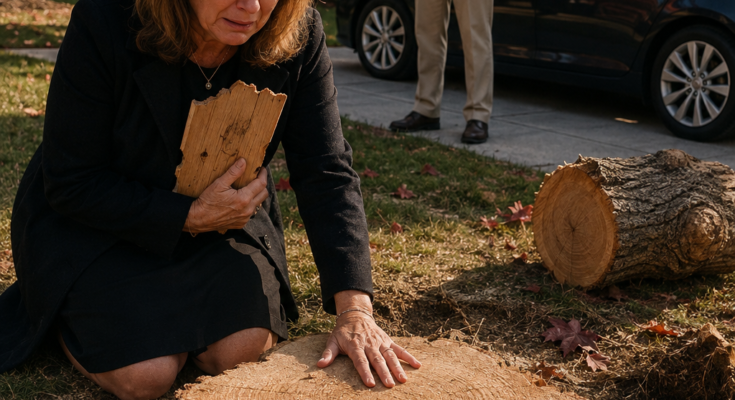
All that remained was a raw stump surrounded by sawdust.
For several seconds, I sat behind the steering wheel, unable to breathe.
My sister Rachel reached across the console.
“Linda, what happened?”
I opened the car door without answering.
Branches had been dragged across the lawn, leaving scars in the grass. Ethan’s small wooden memorial plaque lay facedown near the trash cans.
I picked it up.
The corner was broken, but the words were still visible:
ETHAN CARTER’S TREE
PLANTED MAY 12, 2009
Underneath, in Ethan’s crooked childhood handwriting, he had added:
DO NOT CUT UNTIL I AM TALLER THAN IT.
He had laughed about that sentence every year.
At twenty-six, Ethan was six feet two.
The tree had reached the second-story roof.
And now they were both gone.
Taped to my front door was a letter from the Lake Haven Homeowners Association.
LANDSCAPING CORRECTION COMPLETED.
Cost of removal: $4,850.
Amount charged to homeowner’s account: $5,300, including administrative fees.
At the bottom was the signature of HOA president, Malcolm Reed.
I called him immediately.
He answered on the fourth ring.
“Lake Haven Association.”
“You cut down my tree.”
There was a pause.
Then Malcolm sighed as if I had interrupted his dinner.
“Mrs. Carter, the maple had become a visual obstruction.”
“It was on my property.”
“The landscaping committee determined that it interfered with the community’s appearance and blocked the sightline toward the lake.”
“It was my son’s memorial tree.”
“I understand you’re upset.”
“I was at his funeral.”
Another pause.
This one was longer.
“The removal had already been scheduled,” he said.
“You knew where I was.”
“I don’t keep track of residents’ personal schedules.”
The lie was so casual that it stunned me.
Three days earlier, Malcolm had stood beside me at Ethan’s visitation. He had shaken my hand and said, “Take all the time you need. The neighborhood is here for you.”
Now Ethan’s tree was gone.
“You had no right,” I said.
“The board acted within its authority.”
“You are going to pay for this.”
His voice hardened.
“I would advise you to read your community rules before making threats. The removal fee is due in thirty days. After that, late charges will apply.”
Then he hung up.
I sat on the porch until darkness covered the stump.
Ethan had been killed by a driver who ran a red light while staring at his phone. One moment my son had been driving home from work; the next, a police officer was standing at my door.
The tree had been the one living thing in my yard that felt connected to him.
Every autumn, Ethan would rake the red leaves into a pile, even after he became too old to jump into them. During his last visit, he had rested his hand against the trunk and said, “This thing grew up better than I did.”
Now, while I was lowering him into the ground, Malcolm had sent men with chainsaws.
The following morning, he came to my house.
Malcolm was fifty-eight, always perfectly dressed, with silver hair and the smooth confidence of a man who had rarely been told no.
He stood beside the stump carrying a folder.
“This is the approval from the landscaping committee,” he said.
The page contained three signatures.
One belonged to Malcolm.
The other two belonged to board members I had never met.
“There was no emergency,” I said.
“The roots were approaching a common utility line.”
“That tree was thirty feet from the line.”
“I’m not an arborist.”
“Then why did you make the decision?”
His expression remained calm.
“You’ve been through a terrible loss, Mrs. Carter. Emotions can make these situations seem more personal than they are.”
My hands curled into fists.
“You cut down my son’s tree while I was burying him, and now you’re telling me I’m too emotional to understand it?”
“I’m saying the matter is closed.”
He handed me the folder and walked away.
That afternoon, an elderly neighbor named Mrs. Bell knocked on my door.
She held a small memory card in her palm.
“My security camera faces your yard,” she whispered. “I thought you should see this.”
We put the card into my laptop.
The video showed a landscaping truck arriving at 9:12 on the morning of Ethan’s funeral.
Malcolm was waiting in my driveway.
He walked the crew to the maple and pointed at the trunk.
The foreman appeared hesitant. He gestured toward the memorial plaque and then toward my house.
Malcolm stepped closer to him.
The camera had no sound, but Mrs. Bell had opened her window to speak to the workers. Her phone had recorded part of the conversation.
We turned up the volume.
The foreman’s voice was faint.
“Are you sure the homeowner approved this?”
Malcolm answered clearly.
“She won’t be back until Monday. Take all of it before then.”
PART 2 — THE REAL REASON
My attorney’s name was Ava Martinez.
She watched the security video twice without speaking.
Then she examined my property survey, the HOA rules, Malcolm’s landscaping approval, and photographs of the tree taken one week before Ethan died.
“The tree was entirely on your property,” she said. “The HOA may have certain enforcement rights, but that doesn’t automatically give its president permission to enter your yard and destroy it.”
“He said the roots threatened a utility line.”
“Did anyone inspect them?”
“I don’t know.”
“We’ll find out.”
Ava sent formal requests for every document related to the tree’s removal.
Malcolm responded with a twelve-page letter accusing me of harassing the board.
He also added another $750 in legal charges to my HOA account.
But he made one mistake.
He included the name of the landscaping company.
I called them.
The owner, a man named Carlos Mendoza, agreed to meet me at a coffee shop. He looked uncomfortable from the moment he sat down.
“I’m sorry about your son,” he said. “My crew didn’t know about the funeral until afterward.”
“You saw the plaque.”
“Yes. That’s why my foreman called me.”
“Why did you cut it down?”
“Mr. Reed said the HOA owned the first fifteen feet of every front yard. He said the tree was diseased and had already been approved for emergency removal.”
“It wasn’t diseased.”
“I know that now.”
Carlos placed a folder on the table.
Inside was the work order Malcolm had signed.
It described the tree as “dead, hazardous, and located on association-controlled land.”
All three statements were false.
“There’s something else,” Carlos said. “One of my workers felt bad about the plaque. He cut a section from the trunk before it went through the chipper. We still have it at our shop.”
I pressed my hand over my mouth.
A piece of Ethan’s tree still existed.
“May I have it?”
“It belongs to you.”
Ava hired a certified arborist to examine photographs, maintenance records, and the stump.
His report concluded that the maple had been healthy and structurally sound. Its roots had not threatened any utility line.
So why had Malcolm wanted it removed?
The answer arrived two weeks later.
Mrs. Bell called me and told me to search for Malcolm’s address on a real estate website.
His house was for sale.
The listing had gone live the morning after Ethan’s funeral.
Malcolm lived directly across the street from me on higher ground. From his second-floor balcony, my maple had partially blocked the lake.
The first sentence of his property listing read:
Enjoy an unobstructed panoramic lake view from both levels.
The listing photographs had been taken after my tree was cut down.
Suddenly, everything made sense.
Malcolm hadn’t removed the maple to protect a utility line or improve the neighborhood.
He removed it to improve the selling price of his own house.
Ava obtained emails exchanged between Malcolm and his real estate agent.
One message, sent a month earlier, read:
The front view would photograph much better if that large maple across the street were gone.
Malcolm replied:
I’m handling it through the association.
The worst email had been sent two days after Ethan died.
Malcolm wrote:
The homeowner will be away for the funeral Friday morning. Schedule the photographer for that afternoon. The obstruction should be gone by then.
I read those words until the screen blurred.
He knew.
He knew exactly where I would be.
He had stood beside Ethan’s casket, offered condolences, and used my son’s funeral as an opportunity to destroy the tree without me there to stop him.
Ava wanted to file the lawsuit immediately.
But I asked her to wait.
The HOA’s monthly meeting was ten days away, and Malcolm had already placed my “delinquent removal charges” on the agenda.
He expected to humiliate me publicly.
I decided to let him try.
The clubhouse was full on the night of the meeting.
Malcolm sat at the head table beneath a framed photograph of Lake Haven. Beside him were four board members who looked as though they would rather be anywhere else.
When my name was called, I walked to the front carrying Ethan’s broken memorial plaque.
Malcolm adjusted his microphone.
“Mrs. Carter currently owes the association $6,050 relating to the removal of a hazardous tree and subsequent legal expenses.”
Someone in the audience gasped.
Malcolm continued.
“While we sympathize with her recent personal tragedy, grief does not exempt a homeowner from community standards.”
I placed the plaque on the table.
“My son planted that tree when he was nine.”
“This meeting concerns unpaid charges.”
“No,” I said. “This meeting concerns why you cut it down.”
Malcolm leaned back.
“We’ve already addressed that.”
“Then you won’t mind if everyone sees the work order.”
Ava distributed copies.
Residents began whispering as they read Malcolm’s false claims about the tree being dead and located on HOA property.
Next came the arborist’s report.
Then my property survey.
Then still images from Mrs. Bell’s camera showing Malcolm directing the crew.
Malcolm’s face slowly lost its color.
“These documents are being taken out of context,” he said.
I looked toward the back of the room.
Carlos stood and raised his hand.
“I own the company that removed the tree,” he said. “Mr. Reed lied to us about the ownership and condition of the tree.”
The room erupted.
Malcolm struck the table.
“This is not a courtroom!”
“You’re right,” Ava said. “The courtroom comes next.”
Then I displayed the final email on the clubhouse projector:
The homeowner will be away for the funeral Friday morning. The obstruction should be gone by then.
No one spoke.
Malcolm stared at his own words on the wall.
His wife, seated in the front row, slowly stood.
“You told me the tree was dying,” she said.
Malcolm didn’t answer.
She removed her wedding ring, placed it on the table in front of him, and walked out.
PART 3 — WHAT GREW AFTERWARD
Malcolm resigned as HOA president the following morning.
His real estate listing disappeared that afternoon.
By the end of the week, three board members had admitted they signed the landscaping approval without reading it. Malcolm told them the tree was dead and had already fallen during a storm.
The HOA’s insurance company refused to cover all his actions because he had knowingly misrepresented the situation for personal gain.
Ava filed claims against Malcolm, the association, and the landscaping company.
Carlos cooperated completely. He apologized publicly and offered to replace the tree at his own expense.
I didn’t blame him the way I blamed Malcolm.
His crew had been deceived too.
Malcolm’s attorney proposed a private settlement.
The amount was more money than I had ever held at one time.
There was one condition:
I had to sign a confidentiality agreement and never publicly discuss why the tree had been removed.
I declined.
Ava stared at me.
“Linda, you understand this is a very generous offer?”
“He used my son’s funeral to clear his lake view. I’m not helping him hide that.”
We sent back our own settlement terms.
Malcolm would pay for the tree and damage to my property.
Every fine against me would be erased.
He would reimburse the HOA for the money used to remove the tree.
He would issue a written apology to the neighborhood.
And he would contribute to a memorial project honoring Ethan.
His attorney refused.
Three weeks later, after Ava scheduled depositions and requested Malcolm’s complete communications with his real estate agent, he accepted every condition.
I didn’t use the settlement money to buy a new car or renovate my kitchen.
I used part of it to create the Ethan Carter Memorial Grove on an unused piece of community land near the lake.
We planted twenty-six young red maples—one for every year Ethan had lived.
The new HOA board installed benches, walking paths, and small plaques where residents could write the names of people they had lost.
Carlos and his crew volunteered for the entire project.
On planting day, more than a hundred neighbors arrived with shovels.
Some came to honor parents.
Some came for spouses.
Some carried photographs of children they had lost far too young.
I had believed grief was something that separated people.
That day, I learned it could also bring them together.
But Carlos had one more surprise.
After the final tree was planted, he led me toward the center of the grove.
Beneath the largest sapling stood a beautiful wooden bench.
The seat had been made from the section of Ethan’s maple that his worker saved.
Across the back, someone had carefully preserved the marks Ethan carved into the tree as a child.
His initials.
A crooked star.
Three lines showing how tall he had been at ages ten, eleven, and twelve.
In the center of the bench was a small brass plate:
SIT FOR A WHILE.
ETHAN NEVER WANTED ANYONE TO FEEL ALONE.
I ran my fingers over the scratches my son’s hands had made so many years ago.
For the first time since the accident, I cried without trying to stop myself.
Carlos stood quietly beside me.
“I’m sorry we couldn’t save more,” he said.
“You saved enough.”
Malcolm sold his house six months later.
Without the promised “unobstructed view,” it remained on the market longer than expected and sold below his original asking price.
I watched the moving truck leave from Ethan’s bench.
I expected to feel victorious.
Instead, I felt tired.
Revenge hadn’t brought my son back. Malcolm losing his position, his reputation, and his perfect lake view did not fill the empty chair at my dinner table.
But accountability mattered.
Malcolm had looked at a grieving mother and seen an opportunity.
He believed sorrow had made me weak.
What he failed to understand was that grief is love with nowhere to go.
I gave mine somewhere to grow.
Every autumn, the twenty-six maples turn bright red together.
Families walk beneath them. Children collect the leaves. Widows sit on Ethan’s bench and speak the names of people no one else remembers to mention.
Sometimes I sit there alone at sunset.
I tell Ethan about my week.
I tell him which tree grew the tallest and which neighbor complained about the geese. I tell him I still miss him in ways I cannot explain.
Then I rest my hand over his initials.
Malcolm cut down one tree because he wanted a better view.
In the end, he gave the entire neighborhood a forest.