He said my parents had chosen the family who raised him. They told that family I wanted the adoption and never wanted contact with my son. They had let me believe for thirty-one years that they knew nothing more than I did.
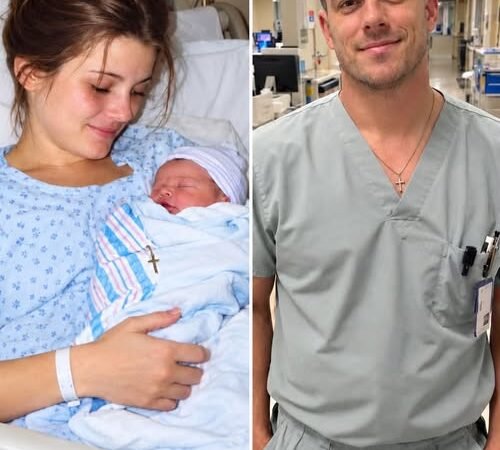
The doctor kept one hand around the cross. He looked at me as if he was trying to decide how much I could take while I was still in a hospital bed.
“I was adopted as a baby,” he said. “My parents told me your parents helped arrange it. They said you wanted a closed adoption.”
My hand tightened on the blanket. “They told you I didn’t want to know you?”
He nodded once. “They said you’d made your choice and wanted to get on with your life.”
The words landed harder than I expected. I’d spent years searching for him. Somewhere, all that time, he had been told I’d wanted nothing to do with him.
“I never said that,” I told him. “I never got to choose anything but signing those papers.”
He lowered his eyes to the cross. “My mother told me it was in my blanket when they brought me home. She said your parents picked them because they wanted a baby and could give one a good home.”
I looked at the tiny scratch on the cross. I could see it clearly from where I lay. “Did she tell you my name?”
“She told me you’d named me Fabian.” He paused. “My parents gave me a different first name, but they kept Fabian as my middle name.”
That was the first time I heard what had become of the name I’d chosen. I said it softly, just to feel how it sounded in the room.
“Fabian.”
His eyes lifted to mine. For a second, neither of us tried to fill the space.
Then he said, “I don’t want to assume. I’d like to know if we’re related, but the cross by itself can’t prove that.”
“I understand,” I said. I didn’t want to sound eager and scare him off, but I was afraid he’d leave before I could ask what I needed to ask. “Could we do a DNA test?”
“Yes,” he said. “After you’re discharged. I don’t want to mix this up with your care here. You need to focus on getting better.”
That answer was careful, and I was grateful for it. I was still weak from surgery, and I could feel my throat tightening every time he said “my parents” or “your son.” Part of me wanted to reach for him. I kept my hand on the blanket.
He explained that he’d learned he was adopted when he was young. His parents had never treated it as a secret. They told him he’d been wanted, and they had the cross and the name from the start.
“What did your parents say about me?” I asked.
He took a moment before answering. “That you were young. That you agreed to the adoption. That you didn’t want them to contact you later.”
“Did they say they’d met me?”
“They said your parents handled most of it.” He looked down at the cross again. “My mother thought they were helping you.”
I believed that his mother believed it. I could hear it in the way he spoke about her. And still, my stomach twisted. My parents hadn’t just kept my son’s name from me. They’d sent him into his life carrying a story that made me sound like I’d walked away.
“Did they tell you anything about who my parents were?” I asked.
“No. I don’t know your family’s names. I didn’t know where you lived or what happened to you.” He put the cross back under his shirt. “I didn’t know I’d found you until you recognized it.”
I thought of the years I’d spent chasing records and leads. I’d been sure that if I kept asking, someone would eventually tell me enough to find him. I had never thought he might be on the other side of the same silence, with a different version of it.
“Will you let me call you after I get home?” I asked.
He reached for a pen and wrote a number on the back of a card from his pocket. “Yes. I’d like that.”
He set it on the bedside table. His hand stayed there a moment, close to mine but not touching.
“I’m glad you asked me,” he said.
“I’m glad you came in.”
He gave me a small, uncertain smile. Then he checked my chart and spoke to me about my recovery, as my surgeon. We kept the rest of the conversation for later.
I held that card in my hand after he left. I held it through lunch, and when a nurse came in to check on me, I tucked it under my water cup so I wouldn’t lose it. I wasn’t thinking clearly enough to do much else.
When I was home, I put it beside the grocery list I keep under a magnet on the refrigerator. I have kept that list in the same place for years, and it looked ridiculous next to the number that might lead me to my son.
I waited until the next day to call. I told myself I was giving him room. If I’m honest, I was also scared he’d changed his mind.
He answered on the second ring.
“Hello?”
“It’s me,” I said. “The woman from the hospital.”
“I know.” His voice softened. “How are you feeling?”
“Sore. Tired. Better than I was.” I pressed the phone close to my ear. “I’ve been thinking about what you told me.”
“So have I.”
“I want to know whether we’re related. I don’t want to make you do anything you don’t want to do.”
“I want to know too,” he said. “I talked to my mother. She has the old adoption papers and the things that came with me.”
My heart gave a hard thump. “Could I see them?”
“I asked her. She said yes. She wants to meet you, if you’re comfortable with that.”
I was not sure I was comfortable with anything. “I’d like to meet her.”
We agreed to do the DNA test first. He said he’d arrange for a home kit to be sent to both of us. We’d use our own samples and wait for the result. Nothing about it was dramatic. It was a box in the mail, instructions, a return envelope, and then waiting.
When the test arrived, I called him before I opened mine.
“Are you sure?” I asked.
“I’m sure,” he said. “I’ve been wondering about this longer than you know.”
I did not ask him how long. I was afraid I would hear years of hurt in the answer.
The result took longer than I wanted it to. I tried to keep busy, but my mind kept returning to what he’d been told. I pictured him growing up with a cross at his chest and a story that I had wanted to leave him behind. I was angry at my parents. I was angry at myself for accepting their “we don’t know anything” for so long, though they had given me no reason to believe them.
The doctor called when the result came in. I was at home, sitting at my kitchen table with a cup of coffee I’d reheated twice.
“It says we’re mother and son,” he said.
I gripped the edge of the table. “It says that?”
“Yes. I’m looking at it now.”
I shut my eyes. My son was alive. He was the man who had come to check on me after surgery. He had worn my grandmother’s cross under his shirt while I looked at him and didn’t know.
“I’m sorry,” I said. I didn’t even know exactly what I was apologizing for. “I’m sorry you were told I didn’t want you.”
“I’m sorry you were told nothing.”
There was no accusation in his voice, which somehow made it worse.
“Do you want to meet?” I asked.
“Yes,” he said. “I want to meet you.”
We set a time after I was strong enough to be out of the house for a while. Before we hung up, I asked if his parents would be there.
“My mother wants to come,” he said. “She can bring the papers. You can ask her anything.”
I was glad he didn’t ask me to meet my own parents first. I needed the truth from someone who had been told a different version, and I needed to see the papers with my own eyes.
His adoptive mother arrived with him and carried a plain folder. I had imagined her many times over the years. In some versions she was a stranger who had taken my child and never thought about me again. In others, she was a kind woman who sang to him and kept him safe. I knew neither picture was fair. Still, I was nervous when I opened the door.
She looked at me and stopped just inside. Her eyes filled, and she took a second before she spoke.
“I’m glad you’re here,” I said.
“So am I,” she answered. “I’ve wanted to know how you were.”
That made me look at her. “You were told I didn’t want contact.”
She nodded. “That’s what we were told.”
We sat down at the table. My son sat beside her, the cross visible at his collar. The folder rested between us. His adoptive mother didn’t push it toward me until I asked.
“Can I see what you have?”
“Of course.” She opened the folder. “I brought everything we kept from the adoption. The official papers, and a note we were given about you.”
The first pages were copies of adoption paperwork. I recognized the style of the forms, though I hadn’t seen them since I was eighteen. Some of the information was covered or missing. I didn’t know every line, and I didn’t need to. I looked for what she had been told about me.
The note wasn’t a letter from me. It was a short account of the baby’s birth and placement, with a few lines about the birth mother. It said I had agreed to the adoption and did not want future contact. It said my parents had selected the family.
I read it twice. My hands began to shake, so I set the paper down.
“I never wrote this,” I said.
His adoptive mother looked stricken. “I’m sorry. We believed it came from the family.”
“I know you did.” I looked at my son. “I’m not angry with you or her.”
“I was told that’s what you wanted,” his mother said. “I wondered about you. I wondered if you changed your mind, but your parents said it would be cruel to bring you back into his life.”
My son looked at her. “They said that?”
She nodded. “They said you’d worked hard to move on, and that contact would hurt you.”
The sentence sat there between us. My parents had used my supposed wishes to keep both of us away from each other. They had told his family that protecting me meant keeping me in the dark.
“I was looking for him,” I said. “I never stopped.”
My son’s face tightened. He looked at the page again, then at me. “I know that now.”
I was grateful he didn’t say he understood. He couldn’t understand thirty-one years of it, and I couldn’t understand what it felt like to grow up with a mother who had supposedly chosen not to know you.
His adoptive mother reached across the table, then stopped short of touching my hand. “We loved him from the first day,” she said. “I want you to know that.”
“I’m glad,” I told her. “I really am.”
I meant it. The two people across from me had raised my son. Their love was part of the reason he was sitting there, healthy and kind enough to come looking for the truth. But I couldn’t make myself thank my parents for the way they had done it.
My son asked if he could take the papers back. He wanted to keep them with his own adoption records. I gave them back, then asked if he would be willing to come with me when I spoke to my parents.
He glanced at his mother, then at me. “I’ll come. I want to hear what they say.”
The thought of facing my parents with him beside me made my stomach clench. I had spent years asking them what they knew and getting the same answer. I’d stopped asking because each time I left with nothing, I felt foolish for hoping.
Maybe they were right about me. Maybe I was too emotional, too stubborn, too eager to make them the villains in a story where I had signed the papers myself. I knew what I had signed. I also knew I had not chosen the lie they built around it. I asked him to come anyway.
I called my mother that evening. She answered with her usual question about how I was feeling. I told her I was recovering and that I had something important to ask.
“Did you choose the family who adopted my son?” I said.
There was a pause. “Why are you asking me that now?”
“Because he found me. He’s my surgeon. He has the cross I put in his blanket.”
My mother drew in a breath. “You found him?”
“He found me. I did a DNA test. He’s my son.”
I heard her move the phone away, then return. “Your father needs to know.”
“Put him on.”
A moment later, my father came on the line. His voice was brisk.
“What is this about?”
I told him the doctor was my son. I told him the DNA test confirmed it. I told him his adoptive parents had been told that I wanted no contact and that they had been selected by my parents.
My father didn’t answer right away.
Then he said, “You signed the papers.”
I had expected those words. Hearing them again still hurt.
“I signed because you said I’d have nowhere to live if I didn’t. You and Mom had promised to help me keep him.”
“We thought we were doing what was best,” my mother said. Her voice had gone thin. “You were eighteen. You had no money.”
“I know what you thought. I’m asking why you told his parents I wanted nothing to do with him.”
“We didn’t want him growing up with a promise you might not keep,” my father said.
That was the first crack in the story. My mother spoke over him.
“Your father was afraid you’d regret it. We all were.”
“Did you pick the family?” I asked.
My father answered. “They were a good couple. They wanted a child. We knew they’d take care of him.”
“You knew them?”
“We knew of them,” my mother said. “They’d been waiting to adopt. We thought it was a good match.”
“Did you tell them I wanted the adoption?”
My father’s voice hardened. “You signed.”
“Did you tell them I didn’t want contact?”
“We told them not to trouble you,” my mother said. “We thought that would be kinder.”
“Kinder to whom?”
Neither answered.
I set the phone down on the table and put it on speaker. I had expected to be crying by then. Instead I was so angry my hands felt steady.
“My son has been sitting in the same room as me,” I said. “He was told I didn’t want him. You told him that.”
“We didn’t know where he was,” my mother said.
“You knew where he was when he went to that family.”
“Only at the beginning,” she said. “We didn’t keep in touch.”
My father cut in. “There was no point in dragging this out. You were trying to build a life.”
“I was trying to find him. You knew that.”
“We didn’t know what to say,” my mother said. “We were ashamed.”
I wanted to hear her say she was sorry. I wanted my father to say he had been wrong. But neither one had said it yet. They were still explaining what they had thought, as if good intentions could make thirty-one years of silence smaller.
My son sat quietly beside me. He hadn’t spoken since the call began. I could see his jaw set, and his hand rested near the cross at his collar.
I asked, “Did you tell them I wanted to move on because you were afraid I’d look for him?”
My mother started to answer, then stopped.
My father said, “We thought the adoption needed to stay closed.”
“That wasn’t your choice to make for the rest of my life.”
“We were trying to protect all of you,” my mother said.
My son leaned toward the phone. “You told my parents she didn’t want to know me.”
My mother made a small sound. “We were told you had a good life.”
“That isn’t what he said,” I told her. “He said you told them I didn’t want contact.”
“I didn’t mean you didn’t care about him,” she said. “We thought you were young. We thought it would be easier for both of you if you didn’t reopen it.”
My son looked down at the table. “Easier for who?”
My mother didn’t answer him.
My father tried again. “You have to understand, we thought you’d be grateful when you got older.”
There it was. The thing they had wanted from me all along. Gratitude for a decision I was frightened into making, and gratitude for the silence they chose after it.
“I am glad he had people who loved him,” I said. “I’m glad he had a good home. But I am not grateful that you lied to him about me.”
My father sighed. “You’re making this sound worse than it was.”
My son sat up straighter. “I grew up thinking my birth mother wanted no part of me. That’s what it was.”
The call went quiet. My mother began to cry. I could hear my father breathing into the phone, but he did not interrupt.
My son spoke again. “I’m not ready to meet you. I’m not ready to call you anything. I came because I wanted to hear the truth.”
My mother said his name, the name she knew for him. He looked at me, then back at the phone.
“Please don’t call me again until I reach out,” he said. “I need time.”
My father started to say something, but my son ended the call. He placed my phone on the table and sat back. His adoptive mother had warned my mother, in a voice I could hear faintly through the speaker, that she would not push him to have a relationship he didn’t want.
I felt grief for the years they had stolen from us, and anger at my parents for thinking their fear gave them the right. I also felt relief that he had said what he needed to say. I didn’t want him to be polite for my sake.
My mother called again later that night. I let it ring. Then she sent a message saying she was sorry and asking me to call when I was ready.
I was not ready to comfort her. I texted back that I would speak to her when she was ready to tell the truth without adding that she had done it for our own good. I told her I wouldn’t ask my son to forgive anyone.
She replied that she understood. My father didn’t contact me.
A few days later, I saw my son again. We met at a quiet place he chose, with his adoptive mother there at first. I had worried that I would start asking questions too fast. I had worried he would want to know every detail about his birth father, whose name I had never told my parents and whose name I had never told him. I worried about what I could give him after all this time.
His adoptive mother stayed long enough to make sure we were both comfortable, then left us to talk. He asked about the name Fabian. I told him I had chosen it before he was born, and that I used to say goodnight to him before I went to bed.
“I knew the name,” he said. “I didn’t know you’d said it to him.”
“I did. Every night.”
He told me about being adopted, about growing up knowing that his first family had made a plan for him. He told me his parents had never made him feel less theirs. I listened and tried not to fill every pause with the questions I had carried for years.
At one point he asked, “Did you look for me?”
“Always,” I said. “I’m sorry it took me so long to get to you.”
“You didn’t know where I was.”
“I know. I still wish I’d found you sooner.”
He nodded. He didn’t try to make that feeling go away. I was grateful for that too.
We talked for a while about ordinary things. His work, my recovery, the food I’d been able to eat since surgery. It felt strange that we could sit across from each other and talk like two people who had just met, when he had been the biggest missing piece in my life for so long.
Before we left, he touched the cross through his shirt.
“My mother said I could have it when I was old enough to understand where it came from,” he said. “She told me it was yours.”
“I’m glad she kept it safe.”
“Would you like to hold it?”
He unfastened the chain and laid the cross in my palm. The scratch was still there. It looked smaller than I remembered, but I knew it at once.
“I used to think of this as the only thing I had of you,” he said.
I could feel the metal warming against my skin. “I thought it was the only thing I had of you.”
He took it back and put it on. We weren’t ready to make up for thirty-one years in one afternoon. We didn’t pretend we could. But when he asked if he could call me again, I said yes.
At home that evening, I put the grocery list back under its magnet. The card with his number stayed beside my coffee cup.