PART 2
For the first time since I’d known him, the man who had always demanded the last word seemed incapable of finding one.
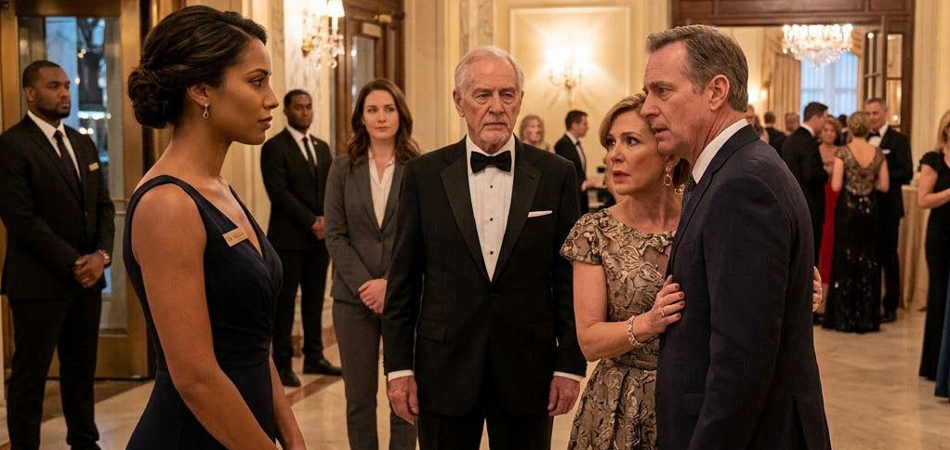
Arthur Sterling stood before him, perfectly composed, while guests continued passing through the lobby toward the ballroom. Clare remained beside me, and my mother was staring at Arthur as though she couldn’t decide whether to apologize or pretend none of this was happening.
Richard recovered first.
“Mr. Sterling, I believe there’s been a misunderstanding.”
Arthur’s expression didn’t change. “I’m afraid there hasn’t.”
Richard gave an awkward laugh. “My stepdaughter and I have had some family disagreements. Surely you understand how these things get exaggerated when emotions are involved.”
I felt my stomach tighten.
Fourteen years had passed, but Richard still knew how to make mistreatment sound like an ordinary disagreement.
Arthur glanced toward me, then returned his attention to Richard.
“Your family relationship is a private matter, Mr. Vance. Your company’s representations to our procurement department are not.”
Richard’s smile disappeared.
Arthur continued. “You submitted vendor materials indicating that Ms. Hayes had personally recommended your company and that you had an established professional relationship with our organization. Neither statement was accurate.”
Richard’s face reddened.
“I may have mentioned the family connection.”
“You did considerably more than mention it.”
For a moment, I couldn’t breathe.
I knew Richard had used my name to push his application forward. Our procurement department had already flagged the issue, and I’d disclosed everything to protect the hotel.
But hearing Arthur address it directly made the situation feel different.
Richard had come expecting a handshake, a photograph, and perhaps a private meeting with one of the hotel’s most influential directors.
Instead, he was being held accountable for what he’d actually done.
“Mr. Sterling,” Richard began, “I’m sure we can resolve this privately.”
Arthur nodded. “Our procurement and legal teams will address the business matter through the appropriate channels.”
Then he stepped aside.
“But tonight is a private charitable event, and you are not on the guest list. I believe Ms. Hayes has already asked you to leave.”
My mother made a small, offended sound.
“Arthur, surely there’s no need for this. We’re Laya’s parents.”
Arthur looked at her.
“Then I would hope you understand how important tonight is to your daughter.”
Denise blinked.
He continued. “She’s spent nearly a year organizing this benefit. Hundreds of guests are here because of work she and her team have done.”
He paused.
“I’m not going to let an uninvited family confrontation interfere with that.”
My mother turned toward me.
“Laya, are you seriously going to stand there and let this man throw us out?”
I took a slow breath.
“No, Mom.”
Hope flashed across her face.
Then I continued.
“I’m the one asking you to leave. Mr. Sterling is supporting that decision.”
Her expression collapsed.
And before she could argue again, two members of hotel security approached.
Richard immediately changed tactics.
The anger vanished from his face, replaced by a practiced smile.
“Gentlemen, this has gotten completely out of hand. We’re just parents who wanted to congratulate our daughter.”
Clare stepped forward.
“Mr. Vance, you’ve been asked to leave. Our security team will accompany you to the exit.”
My mother looked around at the nearby guests.
Some had stopped to watch.
Others were pretending not to notice.
I could almost see Denise calculating how the scene would look if she raised her voice again.
Then she turned toward me, her eyes filling with tears.
“After fourteen years, this is how you treat your own mother?”
The words struck an old, familiar place inside me.
For one brief moment, I was standing outside that visitor center again, watching the family car disappear.
I could feel the heat rising from the pavement.
The damp twenty-dollar bill in my pocket.
The sickening realization that nobody was coming back.
But then I looked around.
The marble floors.
The chandeliers.
The employees who trusted me.
The event I’d spent months preparing.
I wasn’t seventeen anymore.
And I didn’t have to explain my worth to people who had already decided it was negotiable.
“Mom,” I said quietly, “you had fourteen years to contact me without asking for anything.”
Her tears stopped.
I continued. “Your first message came with a business proposal attached.”
Richard shifted uncomfortably.
Denise whispered, “That’s not fair.”
I looked directly at her.
“Neither was leaving a seventeen-year-old girl in an unfamiliar city without a phone, money, or somewhere to sleep.”
She opened her mouth.
Then closed it.
I took another breath.
“Please leave.”
For several seconds, nobody moved.
Then Richard grabbed my mother’s elbow.
“Come on, Denise. We’re wasting our time.”
She pulled away from him.
Her eyes remained fixed on me.
“Laya, one day you’ll regret treating your family like this.”
I felt something settle inside me.
Not anger.
Not even sadness.
Just clarity.
“Maybe,” I said. “But I won’t regret protecting the life I built.”
Security accompanied them toward the front doors.
Richard never looked back.
My mother did.
Just once.
And for the first time in fourteen years, I watched her walk away without feeling the need to follow.
The moment the doors closed, my knees began shaking.
I hadn’t realized how hard I’d been holding myself together.
Clare noticed immediately.
“Laya, come with me.”
She guided me into a small private lounge behind the reception area.
I sat on a velvet chair while she handed me a glass of water.
For several minutes, neither of us spoke.
Then she said gently, “You handled that professionally.”
I laughed once.
It came out sounding almost like a sob.
“I feel like I’m going to throw up.”
Clare sat beside me.
“That’s understandable.”
I pressed my hands against my knees.
“They showed up here.”
“I know.”
“After fourteen years, they actually showed up at my workplace expecting me to give Richard a business deal.”
She nodded.
Then I whispered something I hadn’t meant to say aloud.
“A part of me still wanted my mother to hug me.”
Clare’s expression softened.
I stared at the carpet.
“Isn’t that ridiculous?”
“No.”
I looked at her.
She continued. “Wanting your mother to love you isn’t ridiculous. Neither is refusing to let her mistreat you.”
My eyes filled.
I wiped them quickly.
“I spent so many years imagining what I’d say if I ever saw them again.”
“And?”
I gave a shaky laugh.
“I never imagined I’d be wearing an evening gown and worrying about table assignments.”
Clare smiled.
“Well, for what it’s worth, the table assignments are excellent.”
I laughed through my tears.
Then she reached for my hand.
“Laya, you’re allowed to be upset. You don’t have to turn everything into a professional performance.”
I looked toward the door.
“But the gala—”
“The team can manage for a few minutes.”
I shook my head.
“I need to go back.”
Clare studied me.
“Because you feel you have to, or because you want to?”
That question stopped me.
For years, I’d worked through exhaustion because I was terrified that one mistake might take everything away.
The younger version of me believed security was something I had to earn again every morning.
But this hotel wasn’t going to disappear because I needed ten minutes to recover.
I took a long breath.
“Because I want to,” I finally answered.
Clare smiled.
“Then let’s get you back upstairs.”
The ballroom was beautiful.
Hundreds of candles glowed beneath the chandeliers. White flowers decorated the tables, and a string quartet played near the windows overlooking Savannah’s historic district.
Guests moved between the silent auction displays and the reception area.
Servers carried silver trays through the crowd.
Everything was unfolding almost exactly as planned.
Nobody seemed aware that my mother and stepfather had just tried to turn the lobby into a public family confrontation.
I walked through the ballroom checking on my team.
A vendor needed clarification about the auction closing time.
A donor requested a different seating arrangement.
One of the microphones needed adjustment.
Ordinary problems.
Manageable problems.
Problems with solutions.
And with each small decision, I began feeling like myself again.
Then Arthur approached.
“Ms. Hayes.”
I turned.
“Mr. Sterling. I’m sorry about what happened downstairs.”
He shook his head.
“You have nothing to apologize for.”
I hesitated.
“I never intended for my family situation to become a distraction.”
“It wasn’t your decision to bring them here.”
He looked toward the ballroom.
“Your team has done extraordinary work tonight.”
I smiled faintly.
“Thank you.”
Then his expression became serious.
“I also want to make something clear. Your professional standing here is not dependent on how your relatives behave.”
My throat tightened.
Arthur continued. “You disclosed the potential conflict before it became a procurement problem. You stepped away from the vendor decision. You handled the situation appropriately.”
I swallowed.
“I appreciate that.”
He nodded.
“As for the documents you provided, those were reviewed through the proper channels. Nobody is going to turn your private childhood history into entertainment for our guests.”
For a moment, I couldn’t speak.
That was what I’d feared most.
Not that Richard would embarrass himself.
That my past would become a spectacle.
That people would stop seeing the director who’d organized a major charitable event and start seeing the abandoned girl from the newspaper article.
Arthur seemed to understand.
He smiled gently.
“Tonight is about the future you’re helping create for other people.”
Then he added, “Don’t let two uninvited guests convince you otherwise.”
At eight-thirty, the ballroom lights dimmed.
The gala chairman welcomed everyone and introduced the scholarship initiative.
Our new program was designed to help young adults facing serious financial or housing instability enter the hospitality industry through accredited training, mentorship, and paid work opportunities.
It had been my idea.
Not because I wanted recognition.
Because I remembered exactly what it felt like to be young, capable, and desperate for somebody to give me a chance.
When the chairman invited me onto the stage, I walked toward the podium.
The applause was warm.
I smiled.
Then I looked toward a table near the front.
And almost lost my composure.
Evelyn was sitting there.
The county caseworker who had helped me when I was seventeen.
Her hair was almost completely white now, and she wore a navy dress with a little silver brooch near the collar.
She’d retired from social services two years earlier.
I’d invited her personally.
She’d insisted she didn’t need any special recognition.
But I couldn’t imagine celebrating this program without the woman who had helped me find a safe place to sleep when I had nowhere else to go.
Our eyes met.
Evelyn smiled.
Then she gave me the smallest nod.
The same reassuring gesture she’d used fourteen years earlier whenever I struggled to answer a difficult question.
Take your time.
I gripped the podium.
Then began.
“Good evening, everyone. Thank you for being here.”
My voice sounded steady.
I continued by explaining the program, the hotel partnerships, and how scholarship recipients would receive both training and practical support.
I told the guests about the first group of applicants.
Young people who had aged out of foster care.
Students working multiple jobs.
Individuals rebuilding after family instability.
People whose potential had too often been judged by what they lacked instead of what they could accomplish.
Then I paused.
“There is something I want to say about opportunity.”
The room grew quiet.
I looked toward Evelyn.
“Sometimes the difference between a young person giving up and continuing forward isn’t an extraordinary gift. Sometimes it’s one adult who listens, takes them seriously, and helps them find the next step.”
My throat tightened.
I continued.
“Most of us will never know how many lives have been changed by a teacher staying after class, a supervisor offering training, or a stranger deciding not to walk past someone who needs help.”
Evelyn’s eyes filled.
I smiled.
“This program is our way of making those opportunities easier to find.”
Then I said the words I’d wanted to say since the first planning meeting.
“No young person should have to prove they deserve a future simply because the people they depended on failed to provide one.”
For a moment, the room was silent.
Then the applause began.
I stepped away from the podium.
And when I looked toward Evelyn again, she was standing.
Clapping.
With tears running down her cheeks.
The benefit exceeded its fundraising target.
By the end of the evening, several donors had committed to multiyear support, and our partner organizations had enough funding to begin the first training cohort.
The final guests departed shortly before midnight.
I helped my team finish the last checks.
Then I found Evelyn waiting in the lobby.
She opened her arms.
I walked straight into them.
For a long time, neither of us spoke.
Then she whispered, “I’m proud of you, Laya.”
I began crying.
Not the careful tears I’d wiped away earlier.
The kind that made my shoulders shake.
Evelyn held me.
Then she pulled back and looked at my face.
“I heard what happened before the gala.”
I wiped my cheeks.
“Of course you did.”
She smiled sadly.
“Clare told me after everything was settled. She wanted me to know in case you needed someone.”
I looked away.
“I’m sorry you had to hear about it.”
Evelyn took my hand.
“Laya, you don’t have to apologize to me for what your mother did.”
My throat tightened.
“I thought I was past all this.”
She shook her head gently.
“You can build a wonderful life and still be hurt by someone who hurt you before.”
I looked at her.
She continued.
“Those things aren’t contradictions.”
For a moment, I thought about the frightened girl who’d sat in Evelyn’s office, trying to explain why her parents had left her behind.
I remembered how carefully Evelyn had listened.
How she’d written down my words without interrupting.
How she’d told me that refusing to surrender my education did not make me responsible for an adult’s decision to abandon me.
And I remembered the first time she asked what I wanted for my own future.
Not what my mother wanted.
Not what Richard demanded.
What I wanted.
I squeezed her hand.
“You were the first person who asked whether I felt safe.”
Evelyn’s eyes filled.
She smiled.
“You deserved to be asked.”
Then she hugged me again.
And I realized something I’d never fully understood before.
My family hadn’t been the only people who shaped my life.
The people who helped me after they left had become part of my story too.
The following morning, my phone contained eleven missed calls.
Six from Denise.
Four from Richard.
One from an unfamiliar number.
There were also three emails.
Richard’s message was brief and furious.
He accused me of humiliating him before an influential hotel director and suggested I had deliberately damaged his company’s reputation.
He demanded that I contact Arthur and explain that the situation had been a family misunderstanding.
My mother’s email was longer.
Much longer.
She wrote about forgiveness, family loyalty, and how difficult it had been for her when I “chose not to come home.”
She claimed they’d tried repeatedly to find me.
She said Richard’s business was struggling and that helping him would be a small gesture compared with everything they’d once provided for me.
Near the end, she added:
You have no idea how much pain your disappearance caused this family.
I stared at that sentence.
For fourteen years, I’d carried memories of sleeping in temporary accommodation, working sunrise shifts, and building a life without anyone from home checking whether I was safe.
Now my mother was describing my survival as something I’d inflicted on her.
I opened a blank reply.
Then closed it.
Instead, I forwarded the relevant messages to my attorney.
I was no longer interested in arguing with Richard about his company.
Any business concerns belonged with the hotel’s procurement and legal departments.
But my mother’s claim that she’d spent fourteen years searching for me was personal.
And I wanted an answer.
Not another emotional speech.
An answer.
Three days later, Denise called from a different number.
I nearly declined.
Then I answered.
“Hello?”
“Laya?”
Her voice sounded uncertain.
“Yes.”
There was a pause.
Then she whispered, “Thank you for picking up.”
I didn’t respond.
She continued.
“I’d like to talk about what happened.”
I looked toward my office window.
“Which part?”
She sighed.
“Must you be difficult?”
And there it was.
The familiar tone.
The immediate assumption that my unwillingness to cooperate was the problem.
I took a slow breath.
“Mom, you contacted my workplace after fourteen years of silence. You brought Richard’s business proposal. Then you arrived uninvited at a private event and accused me of embarrassing you.”
She was quiet.
I continued.
“If you want to talk, I need you to acknowledge what actually happened.”
Denise sighed again.
“We’ve both made mistakes.”
I closed my eyes.
“What mistake did I make at seventeen?”
“Laya—”
“Tell me.”
She hesitated.
Then said, “You refused to come home.”
I stared at the wall.
“Mom, you checked out of the hotel and left Savannah without me.”
“We thought you’d call.”
“I did.”
Silence.
“I called the hotel. You’d already left.”
She didn’t answer.
I continued.
“Evelyn called you the next day.”
A long pause.
Then Denise said quietly, “I remember.”
I felt my heart begin pounding.
“Do you remember what you told her?”
She whispered, “I said you’d run away.”
I closed my eyes.
For fourteen years, I’d carried the sound of that lie.
Hearing my mother finally acknowledge it made my chest ache.
“Why?”
Denise began crying.
“I was angry.”
I waited.
“Richard was furious about the way you spoke to him.”
I felt something cold settle inside me.
“So you lied to a caseworker because Richard was angry?”
She sobbed.
“I didn’t know what else to do.”
I swallowed.
“You could have told the truth.”
She didn’t answer.
“You could have said you’d made a terrible decision and wanted to bring your daughter home safely.”
More silence.
“You could have apologized.”
Denise cried harder.
“I know.”
Then she whispered something I hadn’t expected.
“Richard said if we admitted we’d left you there, everyone would think we were terrible parents.”
I stared at the phone.
For several seconds, I couldn’t speak.
Then I asked, “And what did you think?”
She hesitated.
I waited.
Finally, she whispered, “I thought he was right.”
My throat tightened.
There it was.
My mother hadn’t simply lied because she was confused.
She’d chosen to protect her reputation while I was alone in an unfamiliar city.
And she had lived with that choice for fourteen years.
We spoke for nearly forty minutes.
For the first time, I asked questions I’d avoided for years.
Had they returned to Savannah after leaving me?
No.
Had my mother contacted the outreach organization after Evelyn told her I was safe?
Not beyond the initial conversations.
Had she ever written me a letter that didn’t demand I apologize or return to Richard’s business plans?
No.
Then I asked the question that frightened me most.
“Mom, did you ever wonder whether I was okay?”
She began crying.
“Of course I did.”
“Then why didn’t you contact me?”
She hesitated.
Then said, “Because I kept waiting for you to admit you’d been wrong.”
I pressed one hand against my forehead.
Fourteen years.
She’d waited fourteen years for the teenager she’d abandoned to apologize for wanting an education.
I took a slow breath.
“Mom, I wasn’t wrong to want to go to college.”
“I know that now.”
“I wasn’t wrong to refuse to work for Richard.”
She cried quietly.
“I know.”
“And I wasn’t wrong to accept help when you left me with nowhere to go.”
There was a long silence.
Then she whispered, “No.”
I closed my eyes.
I had imagined hearing those admissions for so many years.
But instead of relief, I felt exhausted.
Because none of them changed what had happened.
I had still been seventeen.
Still frightened.
Still alone.
And she’d had fourteen years to say those words before she needed something from me.
Finally, Denise whispered, “Can we start over?”
I looked toward the photograph on my desk.
It showed me standing beside Evelyn at my college graduation.
She was smiling proudly, one arm around my shoulders.
I took a breath.
“I don’t know.”
My mother began crying again.
I continued.
“I’m willing to consider talking with you. But I won’t pretend the past didn’t happen.”
She sniffled.
“Okay.”
“And Richard’s company is not part of this conversation.”
She became quiet.
I added, “I’m not going to use my position to obtain contracts for him. That decision is final.”
Another pause.
Then she whispered, “I understand.”
I wanted to believe her.
But I had learned not to confuse an agreement made during an emotional conversation with lasting change.
Two weeks later, a letter arrived at my apartment.
It was from Denise.
Not an email.
Not a text.
A handwritten letter.
I stared at the envelope for a long time before opening it.
The first page was filled with explanations about her marriage to Richard, the arguments during our vacation, and how ashamed she’d felt when relatives began asking why I hadn’t returned home.
Then, halfway down the second page, she wrote something different.
I made a choice that day, Laya.
I chose to leave you because I wanted you to be frightened enough to agree with us.
When I learned you’d found help, I was relieved. But I was also angry that you hadn’t come crawling back.
I told myself you were stubborn, that you were punishing us, and that eventually you’d realize you needed your family.
As the years passed, it became easier to repeat that story than admit what we’d done.
I stopped reading.
For a moment, I couldn’t breathe.
Then I continued.
When I saw your photograph in the magazine, I felt proud. But I also felt ashamed, because everything you’d accomplished made it impossible to keep believing you’d ruined your life by refusing Richard’s plan.
I should have contacted you just to say I was sorry.
Instead, I let Richard convince me that helping his business would give us a reason to reconnect.
You were right about that too.
Tears slipped down my cheeks.
Near the end, she wrote:
I don’t expect you to forgive me because I’ve finally told the truth.
I only want you to know that you did not deserve what happened at seventeen.
I was your mother. I should have protected you.
I’m sorry I didn’t.
I folded the letter.
Then sat quietly for a long time.
It wasn’t the apology I’d needed when I was seventeen.
Nothing could give me that now.
But it was the first time Denise had acknowledged what happened without insisting that I was equally responsible.
And that mattered.
Richard never apologized.
Instead, he sent a formal complaint to the hotel’s corporate office, accusing me of using personal grievances to damage his company.
The complaint was reviewed independently.
Because I’d disclosed the family relationship, removed myself from the procurement decision, and preserved the relevant communications, there was a clear record of what had happened.
His company’s proposal had been assessed through the same process as other vendor applications, and the hotel had no obligation to award him a contract.
The separate concerns about the representations he’d made were handled by the appropriate departments.
He didn’t receive the partnership he’d come to demand.
And the hotel didn’t suffer the public scandal he’d threatened.
When I learned the matter had been closed, I felt relieved.
Not triumphant.
Just relieved.
Richard had spent much of my childhood teaching me that disagreeing with him would have consequences.
This time, I disagreed.
I said no.
And my life continued.
That was an extraordinary feeling.
Six months after the gala, our first scholarship recipients began their training.
One of them was a young woman named Tessa.
She was eighteen, quiet, and painfully nervous during her interview.
She’d been moving between temporary living arrangements since finishing high school and had been working irregular shifts at a restaurant.
She wanted to study hospitality management.
But she didn’t know how to afford the training.
I recognized the way she sat.
Her shoulders slightly hunched.
Her hands folded tightly in her lap.
The expression of someone who believed every opportunity could disappear if she answered one question incorrectly.
I remembered being that girl.
During our conversation, Tessa apologized three times for not having much experience.
Finally, I smiled.
“Tessa, that’s why this is a training program.”
She looked up.
“You don’t have to know everything before you begin.”
Her eyes filled.
Then she whispered, “I just don’t want anybody to regret giving me a chance.”
My throat tightened.
I took a breath.
“Your job is to learn, ask questions, and take your responsibilities seriously. You don’t have to repay kindness by being perfect.”
She stared at me.
Then nodded.
For a moment, neither of us spoke.
And I thought about Evelyn.
The day she’d asked what I wanted to do.
The way she’d listened.
The way she’d made me feel that my future was still possible.
Now, fourteen years later, I was sitting on the other side of the desk.
I understood the responsibility that came with it.
The following spring, Evelyn and I returned to the visitor center where I’d been abandoned.
It was her suggestion.
At first, I refused.
I hadn’t gone back since I was seventeen.
I’d driven past the neighborhood occasionally.
I’d attended meetings only a few blocks away.
But I’d never walked through those doors again.
Eventually, I decided I wanted to.
We went on a warm Saturday morning.
The city was busy with tourists.
Families studied maps beneath the trees. Children complained about the heat. A guide was explaining the history of Savannah’s squares to a small group near the entrance.
Everything looked ordinary.
That almost hurt more than if the building had changed.
I stood near the bench where I’d waited for my family to return.
For a moment, my chest tightened.
I could almost see the younger version of myself.
The girl with twenty-three dollars.
No phone.
No hotel key.
Trying not to cry because she was certain her mother would be back in a few minutes.
Evelyn stood beside me.
“You okay?”
I nodded.
Then shook my head.
“I don’t know.”
She waited.
I looked toward the street.
“They drove away right there.”
Evelyn said nothing.
I continued.
“I sat here for hours. Every time a car slowed down, I thought it might be them.”
My voice broke.
“I remember trying to figure out what apology would make Richard happy enough to let me come back.”
Evelyn’s eyes filled.
I looked toward the bench.
“Then I found out they’d checked out of the hotel.”
For a moment, I couldn’t continue.
Evelyn took my hand.
I swallowed.
“And everything changed.”
We stood quietly for a long time.
Then I looked at her.
“You know what I remember most?”
She shook her head.
“The woman at the information desk.”
Evelyn smiled faintly.
“She called our office.”
I nodded.
“She gave me a glass of water. She let me sit somewhere cool. She didn’t treat me like I was causing trouble.”
My throat tightened.
“Such a small thing.”
Evelyn squeezed my hand.
“Small things aren’t always small to the person who needs them.”
I smiled through my tears.
Then I sat on the bench.
Not because I was waiting for anyone.
Because I wanted to sit there as the woman I’d become.
The girl who’d once felt trapped on that sidewalk had grown into someone with a career, friends, a home, and a future.
Her family had left her in Savannah.
But Savannah had also become the city where other people helped her begin again.
For the first time, I could remember both truths without feeling that one erased the other.
Denise and I continued corresponding occasionally.
Mostly letters.
Sometimes short telephone calls.
I wasn’t ready for visits.
She respected that, though I could hear the disappointment in her voice.
Richard continued to live with her, and as far as I knew, his business remained under financial pressure.
I didn’t ask for details.
His problems were no longer mine to solve.
One afternoon, Denise asked whether I’d ever come home.
I considered the question.
Then answered honestly.
“Savannah is home, Mom.”
She became quiet.
“I meant come see us.”
“I know.”
I paused.
“Maybe someday. But I’m not promising that.”
She sighed softly.
“Okay.”
Then she asked about the scholarship program.
For once, the question didn’t come attached to a request.
I told her about the students.
The training.
The jobs some had already secured.
She listened.
Then whispered, “Your grandmother would have been proud.”
My throat tightened.
“Maybe.”
“She always said you were determined.”
I smiled faintly.
“I suppose she was right.”
There was a pause.
Then Denise said quietly, “I’m proud of you too, Laya.”
For a moment, I couldn’t answer.
I’d waited so long to hear those words.
But I no longer needed them to believe in what I’d accomplished.
“Thank you, Mom,” I said.
And that was enough.
Nearly two years have passed since the Centennial Benefit.
The scholarship program has expanded.
Several graduates now work in hotels, restaurants, and event management companies across the region.
Tessa completed her training and accepted a full-time position with one of our partner hotels.
On her final day, she came to my office carrying a little paper bag.
Inside was a small notebook.
On the first page, she’d written:
Thank you for giving me a chance to become someone I didn’t know I could be.
I stared at those words.
Then looked at her.
“Tessa, you did the work.”
She smiled.
“I know.”
Then she added, “But you made me believe I could.”
My eyes filled.
After she left, I sat at my desk for a long time.
I thought about all the people who had helped me.
The woman at the visitor center.
The outreach worker who arranged a safe place to sleep.
Evelyn.
The innkeeper who offered me early shifts.
The teachers who stayed late to help me finish assignments.
The managers who trusted me with bigger responsibilities.
So many people.
None of them owed me the future I’d eventually built.
But each had helped me reach the next step.
And now I had the privilege of doing the same.
Last month, I received another letter from Denise.
This one was short.
She wrote that she was beginning counseling and trying to understand why she’d allowed Richard’s anger to influence so many decisions.
She said she didn’t expect me to participate in that process.
She simply wanted me to know she was trying to change.
At the end, she wrote:
I spent fourteen years believing you needed to come back and admit you were wrong.
Now I understand I was the one who needed to come back to the truth.
I read the letter twice.
Then placed it in a drawer.
Not in the thick manila folder from my childhood.
That folder remained separate.
The documents inside it were records of what happened.
I wasn’t going to throw them away or pretend they were unnecessary.
But I no longer opened them when I needed reassurance that I hadn’t imagined the abandonment.
I knew what happened.
The records confirmed it.
And my mother’s own words finally acknowledged it.
I didn’t need to keep arguing with the past.
This morning, I arrived at the hotel before sunrise.
We were preparing for another major event.
The ballroom was empty when I walked inside.
The chairs were stacked.
The tables hadn’t been dressed.
Fresh flowers waited in buckets near the service entrance.
I stood in the middle of the room, looking around.
Fourteen years earlier, I’d been a frightened teenager with no idea where she’d sleep.
Now I was responsible for events in one of the city’s most respected hotels.
It still surprised me sometimes.
Not because I doubted my ability.
But because I remembered every uncertain step that had brought me here.
My phone buzzed.
A message from Clare.
Coffee in your office. Also, the scholarship board approved the new training partnership.
I smiled.
Then another message arrived.
This one from Evelyn.
Thinking of you today. Proud of the woman you’ve become.
I stared at the screen.
For a moment, my eyes filled.
I typed back:
Couldn’t have done it without you.
She responded a minute later.
You did the hard work, sweetheart. I only helped you get started.
I smiled.
Then slipped my phone into my pocket.
A young employee was standing near the ballroom entrance, holding a clipboard.
It was her first week.
She looked nervous.
“Ms. Hayes?”
I turned.
“Yes?”
“I’m sorry to bother you, but I’m not sure where the vendor check-in table should go.”
I walked toward her.
“You’re not bothering me.”
She looked relieved.
I smiled.
“Come on. I’ll show you.”
And as we crossed the ballroom together, I thought about the girl I’d been at seventeen.
How badly she’d needed someone to say those words.
You’re not bothering me.
You can ask for help.
You still belong somewhere.
Sometimes people ask whether I’ve forgiven my mother.
I don’t have a simple answer.
I’ve stopped wishing terrible things would happen to her.
I can recognize that she made choices she now regrets.
I can appreciate an apology without pretending it came when I needed it most.
And I can wish her well without allowing her or Richard to control my life.
Perhaps that’s forgiveness.
Perhaps it’s simply peace.
I don’t feel compelled to give it a name.
What matters is that I no longer wake up wondering whether I was wrong to stay in Savannah.
I wasn’t.
I was seventeen.
I wanted an education.
I wanted a future that didn’t require me to abandon my own plans to satisfy my stepfather.
And when the people responsible for protecting me left me behind, I accepted help from people who treated my safety as more important than their pride.
That wasn’t betrayal.
That was survival.
For fourteen years, Richard and Denise told themselves I’d disappeared because I was stubborn.
But I hadn’t disappeared.
I’d gone to school.
Worked.
Built relationships.
Made mistakes.
Learned from them.
Found people who cared about me.
And created a life that belonged to me.
They didn’t see any of it because they were waiting for me to return on their terms.
Then one day, they saw my photograph in a magazine.
Suddenly, they remembered they had a daughter.
But they came looking for a business opportunity before they came looking for forgiveness.
That was the difference between the family I was born into and the people who helped me build my life.
One group wanted me to prove my loyalty by giving up my future.
The other helped me create one.
Sometimes I still visit the visitor center.
Not often.
Only when I feel like it.
I sometimes sit on the bench for a few minutes and watch families pass by.
Tourists studying maps.
Children holding ice cream.
Couples taking photographs.
The same ordinary scenes I watched through tears fourteen years ago.
But I don’t wait for my mother’s car anymore.
I don’t imagine Richard rolling down the window and demanding an apology.
And I don’t wonder whether I should have called them one more time.
I know how that story ended.
More importantly, I know what happened afterward.
The frightened girl on that bench eventually found people who helped her.
She went back to school.
She worked her way through difficult jobs.
She built a career.
And she returned to that same part of Savannah years later, not as somebody begging for a ride home, but as a woman who had finally learned what home meant.
My mother and stepfather left me in a strange city at seventeen because I refused to give up my future.
Fourteen years later, they walked into the hotel where I worked, expecting me to sacrifice that future for Richard’s business.
They thought I would still be afraid to embarrass them.
They thought my silence meant I had forgotten.
They thought calling themselves family would be enough to make me obey.
But they were wrong.
I had spent fourteen years learning something they never taught me.
Love doesn’t require obedience.
Gratitude doesn’t require surrender.
And a child who survives being abandoned does not owe the people who abandoned her control over the life she builds afterward.
When my mother shouted that nobody remembered what happened fourteen years earlier, I told her I remembered.
And I did.
I remembered every frightening moment.
But now, I remember something else too.
The woman who handed me water.
The caseworker who listened.
The innkeeper who offered me work.
The teachers who encouraged me.
The friends who showed up.
And the hundreds of small decisions that turned a terrible beginning into a meaningful life.
That is the story I choose to carry forward.
Because fourteen years ago, two people drove away from me and believed they were teaching me a lesson.
They were.
Just not the one they intended.
They taught me that I couldn’t always depend on the people who called themselves family.
But the people who helped me afterward taught me that I was still worthy of love, safety, and a future.
And when I finally stood in that hotel lobby facing my mother again, I understood the most important difference between seventeen-year-old me and the woman I’d become.
At seventeen, I watched them leave because I had no way to stop them.
At thirty-one, I asked them to leave because I finally knew I had every right to stay.