Dalton pushed the document across the desk toward me.
“That yours?”
I looked down.
At the top were the words:
QUITCLAIM DEED.
My stomach tightened.
The document transferred my house to Chloe and Vance.
My name appeared at the bottom.
So did a signature.
It looked almost exactly like mine.
Almost.
I stared at it.
“I’ve never seen this before.”
Captain Morales leaned closer.
“When was it executed?”
Dalton checked the date.
“Six weeks ago.”
I was still overseas six weeks ago.
Not on leave.
Not stateside.
Not standing in front of a notary signing away the house my grandfather had left me.
Dalton turned another page.
“There’s a notarization.”
Captain Morales frowned.
“Can that be verified?”
“Absolutely.”
He reached for his phone.
Then he looked at me.
“Harper, before we go any further, I need you to understand something.”
I waited.
“If this was submitted knowingly with a forged signature, we’re no longer talking about a family disagreement.”
“I understand.”
“And if somebody used a fraudulent power of attorney to access your money while you were deployed, that’s separate.”
“I understand that too.”
He studied my face.
“You’re very calm.”
I almost laughed.
“I’ve had nine months of people trying to blow things up around me.”
I tapped the forged deed.
“This is paperwork.”
Captain Morales smiled despite herself.
Dalton did not.
He turned the page again.
Then something in his expression changed.
“What?”
He looked up.
“Your grandfather was smarter than everyone involved.”
That got my attention.
He pulled out the original trust documents.
The house had never been transferred directly to me in the simple way my parents apparently believed.
Grandpa had placed it in a protective trust.
I was the sole beneficiary.
But the trust contained restrictions.
The property could not be sold, mortgaged, transferred, or pledged by any agent acting under a general power of attorney.
Any attempted transfer required my personal signature and written approval from the independent trustee.
My parents had neither.
Dalton tapped the forged deed.
“This document doesn’t transfer anything.”
I exhaled.
“So the house is still mine?”
“The trust still owns it for your benefit.”
“And Chloe?”
“Has no ownership interest.”
“And my parents?”
“None.”
I leaned back.
For the first time since walking into the garage and seeing my life packed into garbage bags, some of the pressure inside my chest loosened.
Then Dalton added,
“But somebody tried.”
I nodded.
That mattered.
It would have been easy to stop there.
The house was protected.
The deed was worthless.
I could have gone home, thrown everyone out, changed the locks, and told myself I had won.
But there was still forty-five thousand dollars missing.
And there was still a forged power of attorney.
So I gave them everything.
Bank statements.
Login records.
Copies of the power of attorney.
The forged deed.
My deployment orders.
Messages from my parents.
And the email my father had sent six months earlier asking for a scanned copy of my signature because he claimed he needed it for “insurance paperwork.”
At the time, I hadn’t thought much about it.
Now Dalton stared at the email for several seconds.
“Did you send him one?”
“Yes.”
Captain Morales closed her eyes briefly.
“That may explain how they created the signature.”
I felt sick.
Not because I had made some terrible mistake.
Because suddenly every small thing made sense.
The requests for documents.
My mother insisting she needed access to one account “in case something happens while you’re away.”
My father asking which bank held my deployment deposits.
Chloe casually asking whether Grandpa had ever officially put the house in my name.
None of it had felt dangerous at the time.
It had felt like family.
That realization hurt more than the missing money.
Dalton gathered the documents.
“Do you have somewhere else to stay tonight?”
I almost laughed.
“I own a house.”
“Yes.”
He gave me a serious look.
“But the people currently occupying it believe they do.”
Captain Morales nodded.
“Don’t confront them alone.”
That afternoon, I didn’t go home immediately.
I drove to the cemetery.
Grandpa’s grave was near the back beneath an old maple tree.
He had died four years earlier.
He was the person who taught me how to change a tire.
How to balance a checkbook.
How to sharpen a mower blade.
How to lose an argument without becoming cruel.
He was also the first person in my family who ever told me that being dependable did not mean allowing people to take advantage of me.
I sat on the grass beside his headstone.
“You knew, didn’t you?”
Of course there was no answer.
But I could hear him anyway.
Grandpa had always been suspicious of vague paperwork.
“Read what you sign, kid.”
He used to say it constantly.
Apparently, he had read what he signed too.
I stayed there almost an hour.
Then I went home.
The barbecue was over.
Paper plates were still stacked beside the grill.
My father was sitting in the kitchen.
My mother was beside him.
Chloe and Vance were there too.
They had been waiting.
Dad looked at the folder under my arm.
“You get it handled?”
“Yes.”
He smiled.
“Good.”
I placed the folder on the table.
“Very thoroughly.”
His smile faded.
Mom looked between us.
“What does that mean?”
I sat down.
Then I looked at Chloe.
“How long have you been living here?”
She folded her arms.
“Why?”
“How long?”
“Four months.”
“In my bedroom?”
She rolled her eyes.
“It’s the master bedroom.”
“It was my bedroom.”
“You weren’t here.”
There it was again.
As though absence meant surrender.
As though serving overseas had turned my life into unattended property.
Vance leaned forward.
“Look, Harper, nobody’s trying to fight.”
I looked at him.
“You moved into my house.”
He sat back.
My father interrupted.
“It’s a family home.”
“No.”
My voice stayed level.
“It isn’t.”
Mom’s expression tightened.
“Your grandfather wanted this house kept in the family.”
“Yes.”
I opened the folder.
“That’s why he put it in a trust.”
Silence.
Dad stared at me.
“What trust?”
That was the moment I knew.
He truly hadn’t understood the documents.
I slid a copy across the table.
“The one you tried to work around.”
His face changed.
Chloe looked at him.
“Dad?”
I placed the forged quitclaim deed beside it.
“Would anyone like to explain this?”
My mother went pale.
Vance looked away.
Chloe stared at the signature.
Dad spoke first.
“That was just preliminary paperwork.”
“My forged signature is preliminary?”
“You were overseas.”
“Yes.”
I nodded.
“That’s generally what deployment means.”
Mom spoke softly.
“We were going to explain.”
“When?”
Nobody answered.
“Before or after you transferred the house?”
Chloe suddenly snapped.
“You don’t even need it!”
There it was.
The real argument.
Not ownership.
Need.
“I have two children,” she continued. “Vance and I have been renting forever. You’re single. You’re gone all the time. Grandpa never understood how different our lives would be.”
I stared at her.
“So you forged my signature.”
“I didn’t forge anything.”
I looked at Dad.
He didn’t meet my eyes.
Chloe followed my gaze.
Her voice became quieter.
“Dad?”
He remained silent.
Mom started crying.
And suddenly I knew exactly who had done what.
Maybe not every detail.
But enough.
Dad had organized it.
Mom had gone along with it.
And Chloe had accepted the benefit without asking enough questions.
I pushed another paper forward.
“And the forty-five thousand dollars?”
Chloe looked confused.
“What forty-five thousand?”
That reaction was immediate.
Real.
I looked at Mom.
She was staring at the table.
“Mom?”
Dad stood.
“This conversation is over.”
“No.”
I remained seated.
“It’s just beginning.”
His face reddened.
“You will not speak to me that way in my house.”
I almost admired the confidence.
Almost.
I turned the trust document around so he could read the highlighted section.
“This is not your house.”
He didn’t touch it.
“You think some paperwork changes who sacrificed to maintain this place after your grandfather died?”
“I paid the taxes.”
“You were gone.”
“I paid the insurance.”
“You weren’t living here.”
“I replaced the roof.”
“With money.”
“Yes, Dad.”
I looked at him.
“That is generally how roofs are purchased.”
Vance looked down to hide a smile.
Dad slammed his palm against the table.
“You think because you wear that uniform you can come home and order everyone around?”
“No.”
I stood.
“But the deed does give me some influence regarding who sleeps in my bedroom.”
Nobody spoke.
Then I said the thing I had been trying not to say all day.
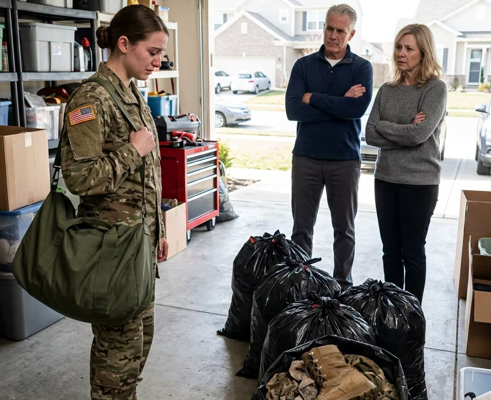
“You packed my uniform into a garbage bag.”
Mom’s face crumpled.
I pointed toward the garage.
“You packed the boots I wore during deployment into the same kind of bag you use for lawn clippings.”
“Harper—”
“You packed my photographs.”
My voice cracked.
I hated that it did.
“You took Grandpa’s quilt off my bed.”
Mom covered her mouth.
“And then you told me I could sleep in the basement.”
The room blurred for a moment.
I forced myself to continue.
“I came home thinking this was the place where I could finally stop being on guard.”
Nobody looked at me.
“And somehow, this was the place where I needed to be most careful.”
That finally silenced my father.
I took a breath.
“There will be an investigation into the money.”
Mom started crying harder.
Dad stared at me.
“You called the police?”
“I contacted the appropriate people.”
“You would do that to your own family?”
I looked at him.
“No.”
The words came surprisingly easily.
“You did this to your own family.”
Then I looked at Chloe.
“You and Vance have thirty days to move.”
She blinked.
“You’re evicting us?”
“I’m giving you thirty days.”
“My kids live here.”
“I know.”
“You’d throw your own niece and nephew out?”
“No.”
I shook my head.
“I am giving their parents thirty days to arrange housing.”
She looked furious.
Then frightened.
And for a second I saw my little sister.
Not the woman who had taken my room.
The girl who used to crawl into my bed during thunderstorms.
That didn’t change my decision.
But it changed how I said the next part.
“If you need help with a deposit on a rental, I’ll pay the landlord directly.”
She stared at me.
“After all this?”
“They’re still my niece and nephew.”
My father’s jaw tightened.
“You’ll help her but come after us over money?”
“I’ll help children who didn’t create this situation.”
That ended the argument.
The next several weeks were ugly.
There is no graceful way to investigate financial fraud inside a family.
The forged power of attorney was traced back to documents my father had submitted.
The bank reversed some transactions.
Other money had already been spent.
Part of it had gone toward Chloe and Vance’s debts.
Part had paid for renovations to my house.
New flooring.
New bedroom furniture.
A patio set.
And nearly twelve thousand dollars had gone toward one of my parents’ credit cards.
Chloe claimed she had believed the money came from Dad.
I believed her.
Not because I wanted to.
Because the records supported it.
My mother admitted she knew Dad had access to my account.
She claimed she didn’t know the authorization was forged.
That was harder to accept.
Dad denied everything until denying everything became impossible.
There were consequences.
Real ones.
I won’t pretend they didn’t hurt.
For months, my father and I barely spoke.
My mother sent messages almost every morning.
At first they were defensive.
Then apologetic.
Then, eventually, simple.
Thinking of you.
Hope you’re safe.
No demands.
No guilt.
Just words.
Chloe moved out twenty-three days after our conversation.
I helped with the deposit exactly as promised.
On her final day, I came home and found her sitting on the front porch.
The moving truck was nearly full.
Her children were chasing each other across the yard.
She held something in her lap.
Grandpa’s quilt.
She handed it to me.
“I washed it.”
“Thank you.”
She looked toward the driveway.
For a long time, neither of us spoke.
Then she said,
“I knew the house wasn’t really mine.”
I sat beside her.
“What do you mean?”
“I knew Grandpa wanted you to have it.”
“Then why did you move in?”
She shrugged.
“Dad said you wouldn’t care.”
I looked at her.
“Did that sound like me?”
“No.”
Her eyes filled.
“I think I needed it to be true.”
That was painfully honest.
She wiped her face.
“Vance got laid off. We were behind. Dad said you had everything figured out.”
I almost laughed.
“I was sleeping in a plywood building with twelve other officers and showering in water that occasionally came out brown.”
She smiled weakly.
“I know that now.”
“No.”
I nudged her shoulder gently.
“You knew it then.”
She nodded.
Another silence.
Then she whispered,
“I’m sorry I took your room.”
I looked through the front window.
The curtains she had hung were still there.
The walls were a different color.
The room wouldn’t look like mine anymore.
“That was the least of it.”
“I know.”
She looked down.
“I’m sorry I let Dad convince me that you having more meant I was entitled to some of it.”
That one mattered.
I unfolded Grandpa’s quilt.
One corner was frayed.
He had used that quilt for twenty years before giving it to me.
He said good blankets should be worn out by people, not preserved in closets.
I looked at Chloe.
“I’m still angry.”
“I know.”
“I don’t trust you yet.”
“I know.”
“But you’re my sister.”
Her mouth trembled.
“Yeah.”
“So let’s start there.”
She leaned her head against my shoulder.
We sat on the porch until the movers finished.
There was no dramatic reconciliation.
No promise that everything would go back to normal.
Normal had been part of the problem.
We needed something new.
Three months later, my promotion board results came out.
I made major.
Dad’s threat had meant nothing.
He had never had the influence he claimed.
Captain Morales called me after the list was released.
“Congratulations, Major.”
I laughed.
“That sounds strange.”
“You’ll get used to it.”
I didn’t tell my parents immediately.
I told Chloe.
She screamed so loudly into the phone that I had to pull it away from my ear.
Then she showed up at my house that evening with a grocery-store cake.
It said:
CONGRATS MAJOR HARPER.
Except the bakery had written:
CONGRATS MAYOR HARPER.
We laughed until we cried.
That cake stayed in my refrigerator for four days because I couldn’t bring myself to throw it away.
A year passed.
The house became mine again.
Not legally.
It had always been mine legally.
I mean it felt like mine.
I moved my furniture back.
I repainted the bedroom.
I put Grandpa’s quilt on the bed.
But I didn’t restore everything exactly as it had been.
That surprised me.
At first I thought I would.
I wanted to erase every trace of the months I’d been gone.
Instead, I kept one thing Chloe had changed.
She had painted the kitchen a pale green.
I liked it.
That felt important too.
Healing did not require pretending nothing had happened.
Sometimes you keep what became good and remove what caused harm.
My relationship with Mom slowly improved.
She went to counseling.
So did I.
Eventually we went together.
The first session was awful.
The second was worse.
By the fifth, she finally said something I had waited years to hear.
“I taught you that being the strong child meant you needed less.”
I stared at her.
She continued.
“You never asked us for much. So every time Chloe struggled, we took from you because we believed you would survive it.”
Tears filled her eyes.
“That wasn’t love.”
I didn’t answer.
“It was convenience.”
That was the beginning of forgiveness.
Not the end.
My father took longer.
Almost two years.
Then one Saturday morning, I heard a truck pull into the driveway.
Dad got out alone.
He looked older.
He was holding a cardboard box.
I stood on the porch.
“What’s that?”
He carried it toward me.
“Things I should’ve given back a long time ago.”
Inside were documents.
Copies of Grandpa’s trust papers.
Old family records.
The spare house keys.
And at the bottom, forty-five envelopes.
Each contained one thousand dollars.
I stared at him.
“Dad.”
“I sold the boat.”
I looked up.
His fishing boat had been the one possession he cared about more than almost anything.
“You didn’t have to do this all at once.”
“Yes.”
He shook his head.
“I did.”
I counted.
“There’s forty-five thousand here.”
“I know.”
“Some of that money was already recovered.”
“Then keep the difference.”
“I don’t want extra.”
His mouth twitched.
“Still stubborn.”
“Learned from you.”
That hurt him.
I saw it.
But he nodded.
“Probably.”
He sat on the porch step.
For a while he watched the maple leaves moving in the wind.
Then he said,
“I thought being your father meant I was allowed to make decisions for you.”
I said nothing.
“I kept seeing you as twenty-two.”
He rubbed his hands together.
“Then one day you came home in uniform, carrying more responsibility than I’ve ever had in my life, and I still treated you like the kid I could order around.”
His voice dropped.
“I was ashamed of you.”
That surprised me.
I stared at him.
“What?”
“No.”
He shook his head quickly.
“I said that wrong.”
He looked at me.
“I was ashamed of myself around you.”
I didn’t understand.
“You did everything.”
“College. Army. Promotions. Bought the roof. Paid the taxes. Never asked us for money.”
He stared at the yard.
“And Chloe needed us constantly.”
“So?”
“So I knew how to be needed.”
His voice cracked.
“I didn’t know how to be proud without also feeling useless.”
That was the first time I saw my father clearly.
Not as the man who had taken money.
Not as the man who tried to force me out of Grandpa’s house.
But as a deeply flawed man who had confused control with usefulness.
It didn’t excuse anything.
But explanations and excuses are not the same thing.
He stood.
“I don’t expect you to forgive me today.”
“Good.”
He almost smiled.
“I figured you’d say that.”
He handed me the spare keys.
Then he started toward his truck.
“Dad.”
He stopped.
I looked at the envelopes.
“Do you want coffee?”
He turned around slowly.
For a moment, he looked like he might cry.
“Yeah.”
So we had coffee.
That was all.
Not reconciliation.
Not forgiveness.
Coffee.
Sometimes that is enough for a first step.
Years later, when Grandpa’s old maple tree had to come down after a storm, I kept part of the trunk.
Dad and I built a bench from it.
Mostly Dad.
I held boards and criticized.
Chloe brought her children over.
Mom made sandwiches.
At one point, Dad measured the same board three times.
I laughed.
“Grandpa would’ve already cut that.”
Dad smiled.
“Your grandfather also spent twenty years telling me I cut things too short.”
We placed the finished bench on the porch.
A small brass plate is attached to the back.
It says:
HAROLD MITCHELL
HE BUILT THIS HOUSE TO BE A HOME, NOT A WEAPON.
That line came from Grandpa’s trust attorney.
Apparently Grandpa had said it when the documents were drafted.
When Dalton eventually found the handwritten notes in the attorney’s old file, he mailed me a copy.
Grandpa had written:
Harper will probably spend half her life going places she is needed.
I want her to always have somewhere nobody can tell her she doesn’t belong.
I cried harder reading that sentence than I had through the entire investigation.
Because suddenly the house made sense.
Grandpa wasn’t giving me property.
He was giving me a place to return to.
He knew I might deploy.
He knew I might spend years moving from base to base.
He knew life could make a person feel temporary.
So he made one thing permanent.
A door I was allowed to open.
A room nobody could assign to someone else.
A piece of ground where I would never need permission to come home.
My family almost took that from me.
But strangely, what happened after my deployment taught all of us what Grandpa had understood from the beginning.
A home isn’t valuable because your name is printed on a deed.
It’s valuable because of what happens when someone arrives tired at the door.
Do you make room for them?
Do you carry their bags inside?
Do you ask if they’ve eaten?
Do you let them rest?
Or do you tell them there’s space in the basement?
I came home from nine months overseas and found my entire life stuffed into garbage bags.
At the time, I thought those bags were proof that my family had erased me.
They weren’t.
They were proof that belongings can be moved.
Bedrooms can be taken.
Money can disappear.
Signatures can be forged.
Even family can fail you.
But some things are harder to take.
The life you’ve built.
The boundaries you’ve earned.
The people willing to repair what they’ve broken.
And the certainty that you are allowed to protect what someone entrusted to you.
I still have one of those black garbage bags.
It’s folded in the bottom drawer of Grandpa’s old workbench.
Not because I enjoy remembering what happened.
Because sometimes, before another deployment, I see it there.
And I remember the woman who came home that night.
Exhausted.
Confused.
Still carrying desert dust in her boots.
Standing in her own garage wondering whether there was still a place for her.
There was.
Grandpa had made sure of it years before.
It just took the rest of us a little longer to understand what he meant when he left me a house.
He wasn’t giving me something to own.
He was giving me somewhere to belong.