My stepfather didn’t come to one thing of mine for forty-five years. At my graduation, the chair next to Mama sat empty. When he died, he left his house to his nephew and not one photo to me. At the funeral lunch, my cousin Delfina leaned over and said, “Guess he never cared, Carla.”
I laughed as if she had made a joke. Then I went to my car and sat beside my grandbaby’s car seat, unable to start it. I run a pharmacy. I count things for a living, and I still couldn’t make Leon Montoya add up.
He married my mother when I was eleven. He was a mechanic, with grease under his nails and Old Spice on his collar. That first Christmas, he built me a dollhouse with a real little porch light. I never thanked him.
I missed my real dad, and I made sure Leon knew it. When I was fourteen, he grounded me for sneaking out. I stood in the kitchen and screamed, “You’ll never be my daddy. Don’t you ever come to anything of mine.”
Mama cried. Leon set down his coffee.
“Okay, mija,” he said. “If that’s what you want.”
At fourteen, I heard that as him giving up. I didn’t ask him to explain. I wanted him to be hurt, and I wanted the last word. I got both.
He didn’t come to my graduation. I walked across the stage and looked toward Mama.
The chair beside her was empty. I asked her afterward, “Was that Leon?”
“Leon’s working, mija,” she said.
She didn’t look at me. I accepted the answer, though something about her face stayed with me. I didn’t press her.
He didn’t come to my wedding, either. A card appeared on the gift table with five hundred dollars inside, signed “from a friend of your mama’s.” I thought it might have been my aunt, so I asked her at the reception.
“Not me, honey,” she said. “Must be somebody who loves you.”
I let the question go. It was easier to believe the gift had come from a person who didn’t need to be named.
At Mama’s funeral in 2019, Leon stood when I walked in.
“Carla, mija, if you ever need anything,” he said.
“I’m fine, Leon. I’ve always been fine.”
He nodded. I could see he wanted to say more, but I had made it easy for him not to. After that, I stopped calling.
Forty-five years of nothing. That’s what I told myself, anyway.
Leon died this August at eighty-six. At his funeral I sat in the second row like a guest. His will left the house he and Mama had lived in to his nephew, Ruben. Ruben had driven him to the doctor for the last five years, so I couldn’t even be mad about that.
Still, the house was the one I grew up in. It would sell for about $240,000. There wasn’t one thing in it left to me. Not a photo, not even Mama’s rocking chair.
Delfina watched me take that in. “Guess he never cared, Carla.”
I laughed because I didn’t know what else to do. In the car, I sat beside the empty car seat and tried to make the facts fit together: the dollhouse, the empty chair, the wedding money, his words at Mama’s funeral, the house left to Ruben. I couldn’t.
Three weeks after the funeral, my phone rang at work.
“This is Marisela, out at the café on the old highway. Is this Carla?”
“Yes?”
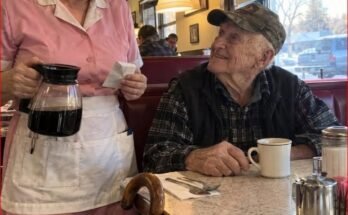
“Your daddy ate breakfast at my counter every morning for thirty years.”
“He wasn’t my daddy,” I said.
I don’t know why I said it. Habit, I suppose. Marisela didn’t argue.
“He left something with me,” she said. “He said you’d get it only after he was gone.”
That night I told my husband, Tomás. He listened, then leaned back in his chair.
“Ruben’s family already thinks you only showed up at the funeral for the house,” he said.
“I’m not asking Ruben for anything.”
“I know. But if you go asking about a box, they’ll say you’re sniffing around for more.”
“He left it for me.”
“That’s what she told you.”
I had no good answer. Tomás wasn’t accusing me. He was trying to keep a family argument from getting worse, and he wasn’t wrong about how it could look.
“Maybe I don’t deserve whatever’s in it,” I said.
He waited before answering. “You can decide that after you see it.”
The next day I drove out to the café on my lunch break. Marisela was about seventy, with reading glasses pushed up in her gray hair. She looked at me for a long time.
“You’ve got your mama’s eyes,” she said.
“He showed me your picture a hundred times. You and those two boys.”
“He didn’t have pictures of my boys.”
“Honey, he had every one. He took them himself, from the back.”
I had no idea what she meant. Marisela reached under the register and set a shoebox on the counter. It was a Red Wing boots box, taped at the corners more than once.
“He’d come in after,” she said.
“After what?”
“After all of it. He’d sit right there and grin into his eggs and tell me how you did.”
I stared at her. “He told you about me?”
“Every time.”
I remembered the man in the straw cowboy hat by the gym doors at graduation. I had made myself forget him. He left before they called the last name. When I asked Mama if it was Leon, she said he was working.
“He stood in the back,” Marisela said. “Every time. He left early so you’d never feel pushed.”
She tapped the lid. “He said he gave you his word, and a man keeps his word.”
My fingers slipped on the tape. Marisela slid a pair of kitchen scissors across the counter and didn’t say anything.
On top was my high school graduation program, folded once and soft as cloth. My name was circled in pencil. Across the top, in Leon’s square block printing, he had written: “I was there, Carla. Every time. I kept my promise.”
I read it twice.
The sentence didn’t tell me why he had never come inside, so I lifted the program. Under it were more programs and photographs. I recognized myself in the pictures, though in some I was years younger and hadn’t known anyone was there to take them. There were photos of my boys, too, taken from the back as Marisela had said.
Near the bottom was the card from my wedding. The same plain words appeared inside: “from a friend of your mama’s.” I recognized the handwriting. The five hundred dollars had been Leon’s.
“He kept all this here?” I asked.
“He brought things in after each event,” Marisela said. “Some days he talked. Some days he just sat.”
“Why didn’t he tell me?”
Marisela shook her head. “He said you had asked him not to come. He took that seriously.”
I wanted to argue with her. I had spent years telling myself he had chosen to stay away. But I had told him not to come. I was fourteen. I had not thought he would carry that sentence for the rest of his life.
“Did he ever say he was angry with me?”
“No,” she said. “He said you were his girl, and that he was proud of you.”
The box was still open between us. I touched the corner of the wedding card, then pulled my hand back.
“I thought he didn’t care,” I said.
Marisela lowered her eyes to the box. “I know.”
I took the box home and told Tomás what I had found. He read the note at the top of the program, then looked through the photographs without trying to turn the moment into an explanation.
“He really was there,” he said.
“Yes.”
“And he never told you.”
“He thought he was keeping his word.”
Tomás handed the program back. “You should show Ruben.”
I didn’t want to make the box into a claim on the house. But Ruben had been the person caring for Leon during those last years, and he was the one who had inherited the home. He deserved to know what I had found. I also wanted Delfina to see it. She had said what I had been saying to myself for years.
I called Ruben and asked if we could meet. I told him about Marisela and the box.
“Is this about the house?” he asked.
“No. I’m not contesting the will. I want you to see what’s in the box.”
There was a pause. “All right,” he said. “I’ll ask Delfina to come, too.”
When we sat down together, I placed the program and the wedding card where they could see them. The photographs were beside them. Ruben looked from the circled name on the program to the note above it.
“I never knew he went,” he said.
“Neither did I,” I said.
Delfina leaned closer to read the words. “He was at your graduation?”
“In the back, Marisela said. He left early.”
“But you told us he never came to anything.”
“I thought he didn’t.”
Ruben turned over one of the photographs. “He took this?”
“Marisela said he took them himself.”
Delfina looked again at the picture, then at the folded graduation program. She didn’t have another explanation for what we were looking at. She had only her words from the funeral lunch.
“I shouldn’t have said he never cared,” she said. “I didn’t know.”
“No,” I said. “You didn’t.”
She started to answer, then stopped. “I thought the house meant he chose Ruben and left you out.”
“Ruben drove him to the doctor for five years. The house is his.” I heard how firm I sounded. “This box is what Leon left me.”
Ruben nodded. He didn’t defend the will or ask me to defend my claim to the box. He looked at the photographs again.
“I want copies of these,” I said. “I don’t need the originals all to myself.”
“Take the ones you want,” Ruben said. “I’ll make copies of the rest.”
Delfina touched the edge of the program but didn’t pick it up. “He kept it all this time.”
“Yes,” I said.
She had no more to say about his not caring. Neither did I.
I took the box home. I wasn’t going to challenge the will or pretend the house should have been mine. Ruben had cared for Leon, and Leon had left him the house. Both things could be true. For years, I’d treated the empty chair as proof that Leon had rejected me. Now I knew he had stood in the back, keeping the promise I had made him swear.
I kept the program and the wedding card. I let Ruben copy the photographs, and I kept copies for myself. Leon had been at the milestones I thought he had missed. He had not come close enough for me to see him.
I had been wrong about what his absence meant.