Grandma used to tell me something I had always dismissed as overly cynical.
“Pay attention to who loves you when you stop being useful.”
At seven, I thought she was talking about bad friends.
At twenty-eight, sitting alone in a temporary apartment with rain tapping against the windows, I finally understood.
I slept maybe three hours.
At 7:18 the next morning, my phone rang.
The number wasn’t saved.
Normally, I would have ignored it.
Instead, I answered.
“Hello?”
“Natalie?”
The voice was familiar.
“This is Marcus Hale.”
I sat upright.
Marcus was Blake’s boss.
He owned Hale Development, one of the largest commercial construction companies in the county.
I had met him twice at family gatherings.
Blake had worked for him for three years.
“Yes?”
There was a pause.
“I saw Blake’s post last night.”
My stomach tightened.
I looked toward the boxes stacked against the wall.
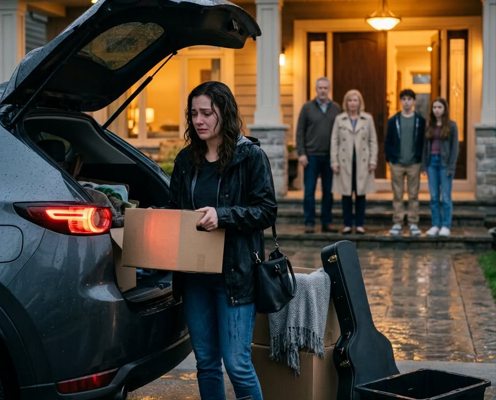
For a second, I was back outside in the rain.
My coats on the pavement.
My drafting table scraped against concrete.
Jessica’s champagne emojis glowing beneath a photograph of my life beside the trash cans.
Apparently, someone had screenshotted the post before Blake deleted it.
Marcus continued.
“Did your family really put your belongings on the curb?”
I swallowed.
“Yes.”
“And that drafting table?”
“What about it?”
“That was yours?”
I looked across the room at the damaged metal corner.
“Yes.”
Another pause.
Then Marcus said something strange.
“Natalie, what exactly do you do for work?”
I almost laughed.
Not because it was funny.
Because after everything that had happened, I was hearing my family’s version of me from someone outside the family.
“I’m an architectural drafting consultant.”
“For whom?”
“Several firms.”
“Which firms?”
I hesitated.
Marcus must have heard it.
“I’m not trying to pry,” he said. “I just noticed something in that photograph.”
“What?”
“The black portfolio beside your boxes.”
I looked toward my drafting case.
“What about it?”
“It has a Meridian Studio badge.”
My grip tightened around the phone.
“Do you work with Meridian?”
“Yes.”
“How closely?”
“I’ve been contracting with them for almost five years.”
Silence.
Then:
“You’re N. Carter?”
I closed my eyes.
There it was.
Professionally, I didn’t use Natalie Carter on most project documents.
I used N. Carter.
Not because I was hiding anything.
It was simply how my portfolio had been branded when I started freelancing.
“Yes.”
Marcus actually laughed.
Not cruelly.
In disbelief.
“You designed the Riverview adaptive reuse plans.”
“I did the technical drafting and layout revisions.”
“And the Westfield medical complex?”
“Part of it.”
“The Henderson mixed-use project?”
“Yes.”
He was quiet again.
Then he said,
“Natalie, Blake has been telling everyone his sister occasionally draws residential floor plans online.”
I looked around the little apartment.
My whole life was still inside boxes.
And suddenly I understood something that hurt in a completely different way.
Blake had not simply misunderstood my work.
He had reduced it.
Deliberately.
Because my success did not fit the role he had assigned me.
The family burden.
The sister who needed help.
The one who hadn’t “established herself.”
I pressed my fingers against my eyes.
“I’m not surprised.”
Marcus exhaled.
“I think we need to talk.”
That afternoon, I met him at his office.
I expected coffee and an awkward conversation.
Instead, Marcus had three project binders on the conference table.
He opened the first one.
The title page showed a project I recognized immediately.
Hale Development — Northpoint Corporate Center.
My stomach dropped.
I had worked on the project through Meridian.
Blake had talked about Northpoint constantly.
He had called it the project that would “make his career.”
Marcus tapped the plans.
“You drafted these.”
“Yes.”
“You solved the circulation issue on the east wing.”
“I proposed a revised layout.”
“You saved us from moving two structural columns.”
I shrugged automatically.
“That was the engineering team’s final call.”
Marcus smiled.
“Design professionals always do that.”
“Do what?”
“Give everybody else credit.”
He slid another binder toward me.
“And this?”
I recognized that one too.
A hotel conversion downtown.
“Yes.”
Marcus leaned back.
“So for the last eighteen months, Blake has been bragging at work about projects his ‘unemployed sister’ was helping design.”
Something in my chest cracked.
Not because I needed Blake to brag about me.
I didn’t.
But for four years, I had worked until two in the morning at that drafting table.
I had taken calls from engineers while reheating leftovers.
I had revised plans while waiting for repairmen at my parents’ house.
I had built a real career quietly because every time I spoke about it, someone changed the subject to Blake.
And now I was learning that my brother had stood inside buildings carrying my work and still found a way to make me small.
Marcus’s expression softened.
“That isn’t why I called you.”
He opened his laptop.
Then he showed me Blake’s post.
My boxes.
My clothes.
My table.
The caption.
Finally got rid of the dead weight.
Now I can build the life I deserve.
Underneath were my family’s responses.
Jessica’s champagne glasses.
Mom’s comment:
ABOUT TIME. NEW BEGINNINGS!
Dad’s thumbs-up.
I had already seen it.
But sitting in a conference room under fluorescent lights, seeing strangers’ reactions beneath it, the humiliation hit differently.
My family had not just thrown me out.
They had celebrated publicly.
They had turned my pain into entertainment.
Marcus looked at me.
“Blake has been presenting himself here as someone who supports his family.”
I remained quiet.
“He specifically told me he was helping cover the mortgage after your father’s business trouble.”
That got my attention.
“What?”
“He said he was carrying the household.”
For one second, I couldn’t speak.
Then I laughed.
A sharp, stunned sound.
Marcus frowned.
“What?”
“I’ve been paying it.”
His eyebrows rose.
“How much?”
“Depends on the month.”
I explained.
Property taxes.
Mortgage installments.
Utilities.
Furnace repair.
Appliances.
Insurance.
The emergency plumbing bill.
The credit card I had used when Dad’s business collapsed because my parents couldn’t qualify for another line of credit.
By the time I finished, I felt exposed.
Not financially.
Emotionally.
I had spent years quietly rescuing people who had rewritten the rescue until I looked like the burden.
Marcus didn’t speak for almost a minute.
Finally, he asked,
“Does Blake contribute anything?”
“Groceries sometimes.”
He rubbed his forehead.
Then he said something I didn’t expect.
“I owe you an apology.”
“You didn’t do anything.”
“I believed him.”
“So did my family.”
“That doesn’t make it right.”
I looked down at my hands.
“No.”
Marcus closed the laptop.
“What are you going to do?”
I thought he meant about Blake.
Instead, I realized I didn’t know.
For four years, nearly every financial decision I made included my parents.
Every bonus became a repair.
Every large invoice payment became a household emergency fund.
Every good month meant someone else could breathe easier.
For the first time, there was no one left asking me for anything.
The thought should have felt freeing.
Instead, it felt terrifying.
Because when you build your identity around being needed, freedom can feel a lot like abandonment at first.
“I don’t know,” I admitted.
Marcus nodded.
“Then maybe don’t decide today.”
Before I left, he handed me a business card.
On the back, he had written a name and phone number.
“Call her.”
“Who?”
“Dana Brooks. She runs our design coordination division.”
“Why?”
“Because we’ve been trying to recruit N. Carter for two years.”
I stared at him.
He smiled.
“Apparently, we were asking the wrong Carter.”
For the first time since the night before, I laughed.
A real laugh.
And that tiny sound felt like the first piece of myself coming back.
I didn’t call Dana immediately.
I went back to the apartment first.
Then I opened the spreadsheet I used to track family expenses.
I had never totaled everything.
Maybe because I already knew it would hurt.
I started four years earlier.
Mortgage payments.
Taxes.
Repairs.
Groceries.
Insurance.
Cash transfers.
Emergency bills.
The number at the bottom made me sit back.
$86,340.
I stared at it.
Eighty-six thousand three hundred forty dollars.
That was how much I had poured into a household where my brother had called me dead weight.
My mother had celebrated getting rid of me.
My father had approved.
My sister had raised a virtual glass.
For several minutes, I did nothing.
Then something shifted.
The number stopped looking like proof that they had used me.
It became proof that I had carried far more than anyone had ever acknowledged.
I wasn’t weak.
I wasn’t behind.
I wasn’t dependent.
I had been holding up part of the house they threw me out of.
I closed the spreadsheet.
I didn’t send it to anyone.
I didn’t post it online.
I didn’t try to embarrass my family.
I simply canceled every automatic transfer.
Mortgage contribution.
Utilities.
Household account.
Internet.
Insurance reimbursement.
All of it.
My finger hovered over the final confirmation button.
For one second, guilt surged so hard I almost stopped.
What if Mom panicked?
What if Dad couldn’t cover the mortgage?
What if Jessica blamed me?
Then Grandma’s voice came back.
Pay attention to who loves you when you stop being useful.
I pressed confirm.
The screen changed.
Transfer canceled.
I stared at those two words.
Then I whispered,
“Okay.”
It was the first boundary I had ever set without asking permission.
The first call came two days later.
Mom.
Blocked.
Then Dad.
Blocked.
Then Jessica borrowed someone else’s phone.
I answered before realizing it was her.
“Natalie, what did you do?”
I nearly laughed.
“Good morning to you too.”
“The mortgage payment bounced.”
“No.”
I sat down at my desk.
“My transfer stopped.”
“That’s what I mean!”
“No, Jessica. Those are two very different sentences.”
She became quiet.
Then angry.
“Mom is freaking out.”
“I’m sorry to hear that.”
“You can’t just stop paying.”
“Yes, I can.”
“You’ve always paid it.”
“And Tuesday night you all agreed I was dead weight.”
“That was Blake.”
“You replied with champagne emojis.”
Silence.
“That was a joke.”
I looked at the damaged corner of my drafting table.
Rain had gotten into one of the scratches.
The metal was beginning to rust.
“I didn’t laugh.”
“Natalie, the house could fall behind.”
“Then the adults living there need to figure it out.”
“You’re being vindictive.”
The word landed exactly where she wanted it to.
For a moment, I almost apologized.
Then I stopped.
“No.”
My voice surprised me with how calm it sounded.
“I’m not punishing you.”
I looked around the apartment.
“I’m just no longer volunteering to be punished myself.”
Jessica said nothing.
Then I added,
“I’m being gone.”
I ended the call.
Dad appeared at my apartment that evening.
When I opened the door, his expression was furious.
“You need to turn those payments back on.”
No hello.
No apology.
Not even a question about whether I had somewhere to sleep.
I leaned against the doorframe.
“No.”
His face reddened.
“You lived under our roof for years.”
“And paid to keep it over everyone’s head.”
“You’re part of this family.”
My throat tightened.
Because once, those words could have controlled me completely.
Family.
The magic word.
The one that meant give more.
Forgive faster.
Ask for less.
Swallow it.
Stay quiet.
“That wasn’t what Tuesday looked like.”
He pointed at me.
“Don’t be dramatic.”
Something inside me went very still.
“Dad, you put my possessions on the curb.”
“I didn’t put them there.”
“You stood there while Blake did.”
“That was between you and him.”
“You commented approval on the photograph.”
His mouth tightened.
“You needed a push.”
“A push toward what?”
“Independence.”
I almost smiled.
The absurdity was too perfect.
“You mean the independence where I stop paying your mortgage?”
He stared at me.
For the first time, I watched him see the contradiction.
He wanted me gone.
But he wanted my money to remain.
“You have money,” he said.
I nodded.
“And now I’ll be using it for my life.”
His expression hardened.
“You’ve changed.”
That sentence would have crushed me a week earlier.
Instead, I thought about my boxes in the rain.
About Grandma.
About $86,340.
About the relief I felt when the transfers stopped.
“No.”
I shook my head.
“I think this is the first time you’ve met me without access to everything I provide.”
His face changed.
I continued.
“And maybe you don’t like me as much without the benefits.”
He looked as though I had slapped him.
Part of me hated that.
Another part knew I had finally told the truth.
He left without apologizing.
I closed the door.
Then I locked it.
And only after the deadbolt clicked did my knees start shaking.
I slid down against the door and cried.
Not because I wanted him to come back.
Because some boundaries hurt even when they’re necessary.
For a while, things got worse.
Blake called me ungrateful online.
Jessica accused me of abandoning our parents.
Mom told relatives that I had suddenly cut the family off financially because I was jealous of Blake’s career.
Then something unexpected happened.
People started asking questions.
Not because of anything I said.
Because Blake had posted the photograph.
Family members remembered seeing my name on checks.
My aunt remembered me paying for the furnace.
My cousin had helped unload the refrigerator I bought.
A neighbor knew I had covered six months of property taxes after Dad’s business failed.
The story my family had told about me depended on nobody comparing notes.
Once they did, it started falling apart.
Marcus didn’t discuss Blake’s family drama at work.
But he did something far more damaging to the story Blake had built.
He stopped protecting him professionally.
Apparently, Blake had been taking credit for coordination work done by other people.
Not mine.
His coworkers’.
He exaggerated his responsibilities.
Missed deadlines.
Blamed junior staff.
The story about supporting his struggling family had been part of a larger pattern.
Marcus later told me something I never forgot.
“People who need to be the hero of every story eventually start rewriting everyone else’s part.”
Blake wasn’t fired because he threw me out.
He was eventually dismissed because of his own work.
That distinction mattered to me.
I hadn’t destroyed his career.
I simply stopped being part of the story he used to disguise what was already happening.
Meanwhile, I called Dana.
We talked for two hours.
Three weeks later, Hale Development offered me a permanent senior design-coordination position.
More money.
Benefits.
My own office.
I almost declined.
Freelancing had given me freedom.
Then Dana showed me the office.
One wall was glass.
Another was completely blank.
“For your plans,” she said.
I looked at her.
“And the drafting table?”
“Bring your own if you’re attached to it.”
My hand went automatically to the scraped corner.
“I am.”
So I accepted.
But the best change wasn’t the job.
It was the apartment.
Six months after leaving my family, I bought a small two-bedroom house.
Nothing extravagant.
A brick bungalow on a quiet street.
The kitchen needed work.
The hardwood floors had scratches.
The backyard fence leaned slightly.
I loved every inch.
On closing day, the realtor handed me the keys.
I stood alone in the empty living room.
For several seconds, I couldn’t move.
Then I walked to the front door.
Opened it.
Closed it.
Locked it.
Unlocked it.
Opened it again.
No one told me whether I could stay.
No one assigned my room to someone else.
No one asked what I was contributing in exchange for being allowed inside.
I pressed the keys into my palm until the edges hurt.
Then I sat down on the bare floor.
And cried.
Not graceful tears.
Not happy-movie tears.
I cried for the twenty-four-year-old version of me who had started quietly covering bills.
For every time I had mistaken being useful for being loved.
For the woman standing in the rain while her family photographed her things.
And for the fact that I finally had something I had spent years buying for everyone else.
Security.
I placed Grandma Evelyn’s blue mug on the kitchen counter.
Then I whispered,
“I did it.”
The room was empty.
But for once, empty didn’t mean abandoned.
It meant mine.
A week later, there was a knock at the door.
Jessica stood outside.
No champagne emojis this time.
She was holding a cardboard box.
“I brought your things.”
“What things?”
She opened it.
Inside were items I hadn’t realized were missing.
My high school sketchbooks.
A wooden ruler that had belonged to Grandma.
A framed photograph.
And the little brass desk lamp I used when I first started drafting.
I looked at her.
“Why?”
She stared at the porch.
“Because they were going to throw them out.”
My chest tightened.
She continued quickly.
“I didn’t let them.”
I stepped aside.
She came in.
For several minutes, she looked around the house.
Then she said,
“This is nice.”
“Thank you.”
She sat on the edge of the couch.
I remained standing.
Finally, she whispered,
“I’m sorry.”
I waited.
“I thought you were being cheap all those years.”
“What?”
“Whenever Mom said she needed money, she’d tell us you had plenty.”
Jessica looked ashamed.
“Blake said your work barely paid anything because you never bought expensive stuff.”
I laughed softly.
“That was his evidence?”
“I know.”
She wiped her eyes.
“I didn’t know about the mortgage.”
“You could’ve asked.”
“I know.”
“You didn’t know about the taxes?”
“No.”
“The furnace?”
“No.”
“The refrigerator?”
“I knew you picked it out. I didn’t know you bought it.”
I sat across from her.
“Then what did you think I was doing?”
She looked at me.
“Honestly?”
“Yes.”
“I thought you were living there because you couldn’t afford to leave.”
The words hit harder than I expected.
I looked away.
All those years I had stayed because I believed the family needed me.
They had interpreted my staying as failure.
Every sacrifice had been rewritten as dependence.
Every dollar I contributed had disappeared from the story.
Jessica started crying.
“I saw the bank statements after you left.”
I frowned.
“What statements?”
“Dad had printed them because he was trying to figure out how much you usually transferred.”
Of course he had.
Jessica continued.
“I saw four years.”
She swallowed.
“I felt sick.”
Neither of us spoke.
Then she said,
“I wasn’t celebrating because I hated you.”
“Jessica—”
“I know that doesn’t make it better.”
She wiped her face.
“I was celebrating because Blake had spent months telling us the house would finally become successful once you stopped holding everyone back.”
I stared at her.
“And you believed him.”
“Yes.”
She looked around my living room.
“I was stupid.”
“No.”
I shook my head.
“You were cruel.”
Her eyes met mine.
I continued.
“Don’t turn it into stupidity. You knew I was standing in the rain while my belongings were on the curb, and you sent champagne emojis.”
She flinched.
I hated saying it.
But I needed her to hear the part she wanted to soften.
She nodded.
Tears slid down her cheeks.
“You’re right.”
That mattered.
No excuse.
No “but.”
Just:
You’re right.
Something inside me loosened.
Not forgiveness.
Not yet.
Just the first small place where forgiveness might someday fit.
I got up.
“Do you want coffee?”
She looked surprised.
“That doesn’t mean everything’s okay.”
“I know.”
“It means I’m making coffee.”
She smiled through her tears.
“Okay.”
That was how Jessica and I started again.
Coffee.
Then occasional texts.
Then lunch.
Trust came back slowly.
Mom took longer.
Her first apology contained so many excuses that I stopped her halfway through.
The second was shorter.
The third finally sounded like an apology.
“I liked what you provided more than I respected what it cost you.”
I said nothing.
She continued.
“I convinced myself that because you didn’t complain, you weren’t sacrificing.”
My eyes filled.
Because there it was.
The sentence that explained almost everything.
Quiet people aren’t hurting less.
Capable people don’t need less care.
And the person who always solves the problem eventually becomes invisible inside the solution.
Mom looked at me.
“You made it easy for us.”
I frowned.
“What?”
“To depend on you.”
She shook her head immediately.
“That sounded awful.”
“It did.”
“I mean… you always handled everything. And instead of being grateful, we started acting like that was your job.”
Her voice broke.
“I don’t know when we stopped asking what it cost you.”
I did.
But I didn’t say it.
Because for the first time, she was looking at the damage without asking me to comfort her for seeing it.
That was the beginning of forgiveness.
Not the end.
Dad never became good with words.
One Saturday, almost a year after I left, his truck pulled into my driveway.
I went outside.
He had my drafting table in the bed.
The same one Blake had dragged downstairs.
Except the scraped corner had been repaired.
Dad had sanded the damaged metal.
Repainted it.
Replaced one bent adjustment knob.
He stood beside it awkwardly.
“Thought you might want this.”
I stared at the table.
For a moment, I couldn’t speak.
That table had been beside the trash cans the night they threw me out.
Now it was standing in the sunlight, repaired.
Not erased.
Repaired.
“You fixed it.”
“Wasn’t hard.”
That was Dad.
Apologies disguised as repairs.
I ran my hand across the smooth corner.
The damage was still faintly visible beneath the paint.
I liked that.
It meant repaired didn’t have to mean pretending something had never been broken.
“Thank you.”
He nodded.
Then reached into the truck.
There was a small wooden box.
Inside was Grandma Evelyn’s old mechanical pencil.
I hadn’t seen it since she died.
My breath caught.
“Where did you find this?”
“In her desk.”
I picked it up carefully.
Grandma used that pencil when she helped me draw houses as a child.
Suddenly I was seven again.
Sitting at her kitchen table.
Drawing crooked walls.
Grandma telling me windows didn’t have to be perfectly straight as long as the people inside felt safe.
Dad looked toward my bungalow.
“You bought this?”
“Yes.”
“By yourself?”
I laughed.
“Yes, Dad.”
He looked embarrassed.
“Right.”
Then he said,
“I should’ve known.”
“Known what?”
“That you were doing better than all of us.”
I shook my head.
“That isn’t what I wanted you to understand.”
He looked confused.
“I didn’t need you to think I was more successful than Blake.”
I pointed to the drafting table.
“I needed you to respect me even when you thought I wasn’t.”
Dad looked down.
I watched the words reach him.
Really reach him.
His shoulders lowered.
After a long silence, he said,
“I failed at that.”
“Yes.”
“I’m sorry.”
It was the first clean apology my father had ever given me.
No explanation.
No defense.
And strangely, hearing it hurt.
Because some part of me had spent years imagining the relief I would feel if he ever admitted it.
Instead, I felt grief.
For how much time had passed before he could say three words.
Still, I nodded.
“I know.”
He helped me carry the table inside.
We put it in the second bedroom beneath the window.
Before he left, Dad stood in the doorway looking at my plans pinned across the wall.
One was for a community center.
Another was a rehabilitation clinic.
Another was affordable senior housing.
He pointed at the largest.
“You drew all that?”
“I helped design it.”
He stared at the sheets for a long time.
Then smiled.
“Your grandma would’ve bragged about this to everybody.”
“She did enough bragging when I was seven.”
He laughed.
“She sure did.”
That evening, after he left, I sat at the restored drafting table.
Grandma’s mechanical pencil was beside my hand.
And for the first time, I understood something she had been trying to teach me for years.
Pay attention to who loves you when you stop being useful.
She hadn’t meant that people must never fail.
People fail.
Parents fail.
Siblings fail.
Friends fail.
Sometimes terribly.
She meant love reveals itself in what happens after the failure.
Do they blame you for the boundary?
Or do they examine why you needed one?
Do they demand the old version of you back?
Or do they learn how to meet the person you’ve become?
Blake never apologized.
Not really.
He sent one message almost two years later.
He said he hoped we could “put everything behind us.”
I stared at the message for almost an hour.
Once, I would have answered immediately.
I would have tried to find the right words.
The gentle words.
The words that allowed him to skip the uncomfortable part.
Instead, I wrote:
When you’re ready to acknowledge what you’re asking me to put behind me, we can talk.
He never answered.
That hurt too.
But not in the old way.
I stopped waiting.
That’s another thing Grandma would have understood.
Forgiveness is not the same thing as reopening every door.
My parents eventually sold the townhouse.
Without my monthly contributions, it was simply more house than they could afford.
They downsized to a small condo.
For years, I might have viewed that as failure.
It wasn’t.
Dad’s business slowly recovered.
Mom found part-time work she loved at a library.
They had fewer rooms.
Fewer bills.
Less pressure to appear successful.
Strangely, they seemed happier.
Jessica eventually moved nearby.
On Sundays, she sometimes comes over with her daughter.
Her little girl loves my drafting table.
Last month, I found her sitting there with Grandma Evelyn’s mechanical pencil in her hand.
She had drawn a square house with six windows, three chimneys, and what appeared to be a swimming pool on the roof.
“Aunt Natalie?”
“Yes?”
“Do you think I could design houses when I grow up?”
I looked at the drawing.
“Absolutely.”
“My mom says you’re really good.”
I glanced toward the kitchen.
Jessica was pretending not to listen.
I smiled.
“She says that now?”
My niece nodded seriously.
“She says you’re the smartest person in the family.”
From the kitchen Jessica yelled,
“I said one of the smartest!”
I laughed.
Then my niece looked at me again.
“Did Grandma Evelyn teach you?”
The question stopped me.
I looked at the old pencil between her fingers.
“Yeah.”
“In school?”
“No.”
I pulled up a chair beside her.
“She taught me somewhere better.”
“Where?”
“At a kitchen table.”
My niece considered that.
Then moved her paper toward me.
“Can you teach me?”
For a second, I couldn’t answer.
Because I suddenly saw everything at once.
Grandma’s kitchen.
My old bedroom.
My belongings in the rain.
The temporary apartment.
Marcus’s phone call.
The $86,340 spreadsheet.
Dad standing in my doorway demanding money.
Jessica crying on my couch.
My repaired drafting table.
And now this child sitting beside me, waiting for me to show her how to build something.
I looked around my house.
My house.
At Grandma’s photographs on the shelf.
At the blue mug beside my laptop.
At the family slowly learning how to enter my life without taking ownership of it.
Then I picked up another pencil.
“Start with the front door.”
She drew a crooked rectangle.
“Like this?”
I smiled.
“Perfect.”
It wasn’t.
But neither was anything worth building.
I used to think the night my family put my belongings on the curb was the night I lost my home.
It wasn’t.
It was the night I stopped confusing a house with belonging.
I had spent years believing love meant making myself useful.
Paying bills.
Solving emergencies.
Saying yes.
Taking up less space so everyone else could have more.
Then my family put everything I owned beside the trash cans and celebrated.
For a while, I thought that meant I had wasted four years caring for people who didn’t care about me.
I don’t think that anymore.
Helping them wasn’t the mistake.
Forgetting myself was.
There is a difference.
I don’t regret the furnace.
I don’t regret the groceries.
I don’t regret helping Dad through the collapse of his business.
Those were choices I made because I loved them.
What I regret is believing love required me to keep giving after respect disappeared.
Grandma understood that before I did.
Pay attention to who loves you when you stop being useful.
Some people vanished.
Some became angry.
Some came back carrying apologies.
One brought my things in a cardboard box.
Another repaired a drafting table.
And a little girl eventually sat at that same table and asked me how to draw a front door.
That was when I realized I hadn’t been thrown out of my family.
I had been pushed out of a role.
The fixer.
The provider.
The quiet one.
The person everyone could take from because she would always find a way to keep standing.
Once I stopped playing that role, every relationship had to reveal what was underneath it.
Some survived.
Some didn’t.
And that was okay.
Because the life I built afterward had something the old one never did.
A front door I could close without guilt.
A table nobody would drag to the curb.
Money I could spend without explaining why I deserved it.
A room where my work was taken seriously.
And people who understood that being welcome inside was no longer something they could demand.
It was something we gave each other.
With respect.
With honesty.
And with love that finally knew the difference between needing someone—
and valuing them.