My Father Refused to Walk Me Down the Aisle Because I Married a Nobody—Then 30 Veterans Entered My Wedding
Part One — “Walk Yourself”
“Walk yourself.”
My father laughed when he said it.
“That’s what happens when you marry a nobody.”
Then Charles Montgomery turned his back on me, walked into the chapel, and took a seat in the last row beside my mother.
As if I were not his daughter.
As if this were not my wedding.
As if refusing to walk me down the aisle were simply the final punishment for failing to marry the kind of man he believed our family deserved.
I stood alone beneath the arched doorway of the small chapel in Charleston, South Carolina, wearing an ivory wedding dress I had spent six months choosing.
My bouquet shook in my hands.
Inside, nearly one hundred guests had heard him.
The whispers stopped.
Heads turned.
My mother, Margaret, stared into her lap.
My younger brother, Caleb, sat several seats away from our parents, jaw clenched.
At the altar waited Julian Vance.
My fiancé.
Thirty-eight years old.
A public defender.
A man who drove a twelve-year-old Honda, bought suits on sale, and once spent Christmas Eve helping a veteran complete emergency housing paperwork because the man had nowhere else to go.
My father called him a nobody.
Julian looked directly at me.
The second he realized Dad had abandoned me at the doors, something changed in his face.
Pain.
Then anger.
Then concern.
He took one step toward me.
I gave the smallest shake of my head.
No.
I would walk.
Not because my father was right.
Because I refused to let Charles Montgomery turn thirty feet of wooden floor into proof that I needed his approval.
The pianist began again.
I stepped forward.
Click.
Then another.
Click.
Each heel sounded louder than the music.
As I passed my father’s row, I heard him murmur:
“Maybe now she’ll understand choices have consequences.”
My eyes burned.
That sentence had followed me my entire life.
When Caleb wanted to study art instead of business, choices had consequences.
When Mom wanted to visit her sister instead of attending one of Dad’s dealership galas, choices had consequences.
When I refused to date the son of one of Dad’s business partners, choices had consequences.
My father believed every choice had consequences.
Except his own.
Charles Montgomery owned three luxury car dealerships across South Carolina.
He had built them from one used-car lot and loved telling the story.
He also loved being photographed beside veterans.
Eleven years earlier, he’d created the Valor Trust, a foundation that raised money for military families.
There were gala dinners.
Oversized checks.
Magazine photographs beneath American flags.
Dad loved saying:
“America owes its veterans more than words.”
I used to be proud of that sentence.
Until I realized how easily he could honor strangers in uniform while humiliating his own daughter over a man’s salary.
Julian had never cared about wealth.
Maybe that was why Dad disliked him.
Money impressed almost everyone around Charles Montgomery.
Julian was not impressed.
Then, halfway down the aisle, the chapel doors opened behind me.
The music stopped.
I turned.
Thirty men and women stood in the doorway.
Some wore dress uniforms.
Others wore old military jackets, veterans’ caps, or dark suits with service pins.
Two men sat in wheelchairs.
An older woman leaned on a cane.
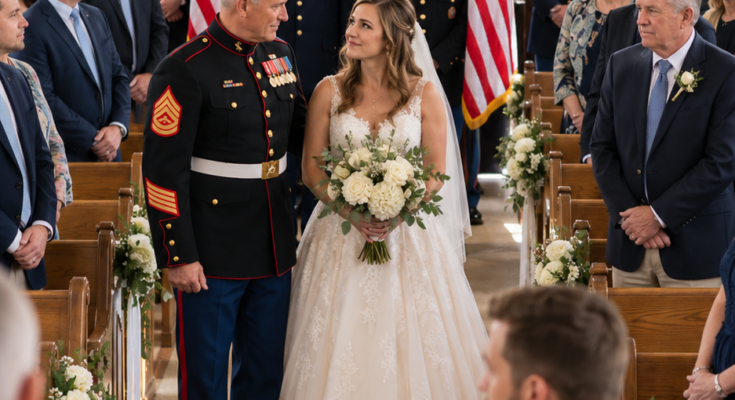
At the front stood a broad-shouldered man with steel-gray hair wearing a carefully preserved Marine dress jacket.
For a moment, nobody spoke.
Then he looked at me.
“Clara?”
“Yes?”
He smiled.
“I’m Douglas Vance. Julian’s uncle.”
I looked toward Julian.
He looked just as stunned as I was.
Douglas continued.
“These folks are from the veterans’ legal clinic Julian’s been working with for the last six years.”
My father slowly stood.
Douglas glanced toward him, then back to me.
“We heard there might not be anyone walking with you today.”
My throat tightened.
He did not mention my father.
He didn’t need to.
Then he said:
“If you’ll allow us, ma’am, we’d be honored to make sure you don’t walk alone.”
I covered my mouth.
Behind Douglas, one of the veterans smiled.
Another nodded.
A woman in an Air Force cap quietly wiped her eyes.
I looked toward Julian.
He had tears on his face now.
“I would be honored,” I whispered.
Douglas stepped beside me and offered his arm.
But before I could take it, something unexpected happened.
My brother Caleb stood.
“Wait.”
He walked into the aisle.
Then my mother stood too.
My father grabbed her wrist lightly.
“Margaret.”
She looked at him.
“No, Charles.”
Two words.
Quiet.
But I had never heard my mother speak to him that way.
She walked toward me.
Caleb joined her.
Douglas smiled.
“Looks like you’ve already got a few people.”
Then the veterans began lining both sides of the aisle.
Not as a performance.
Not as props.
Just people making room for me to pass.
My mother reached me first.
She took my hand.
“I should have stood up sooner.”
I looked at her.
“Mom—”
“No. Let me say it.”
Her voice broke.
“I’ve spent too many years keeping peace by letting you children absorb your father’s anger.”
Caleb stepped beside us.
“You don’t have to walk alone.”
So I didn’t.
My mother walked on one side.
My brother on the other.
And thirty veterans stood along the aisle while we passed between them.
When I reached Julian, Douglas gave him a small nod.
Julian took my hands.
“You okay?”
I laughed through tears.
“No.”
He smiled.
“Me neither.”
Then the ceremony began.
━━━━━━━━━━━━━━━━━━━━
Part Two — The Nobody My Father Never Bothered to Know
At the reception, I finally learned why the veterans had come.
Julian had never told me most of it.
He had spent years volunteering through a legal clinic that helped veterans with housing disputes, benefits appeals, discharge-record corrections, debt problems, and other cases people often abandoned because they couldn’t afford representation.
One veteran told me Julian had helped him keep his apartment after months in rehabilitation.
Another said Julian spent nearly a year helping her navigate an appeal after her benefits paperwork disappeared into administrative limbo.
A third simply said:
“He answered the phone.”
I didn’t understand.
The man swallowed.
“My wife had died. I was drinking too much. I called him about a legal problem at midnight and ended up telling him I didn’t think I wanted to wake up the next morning.”
He looked toward Julian.
“He stayed on the phone until my brother got there.”
I stared at my new husband.
“You never told me that.”
Julian shrugged.
“It wasn’t my story to tell.”
That was Julian.
My father spent money making sure people knew when he helped.
Julian often helped in ways nobody saw.
Late in the evening, I found Dad sitting alone near the edge of the terrace.
He had not left.
That surprised me.
He stared through the glass doors toward the veterans laughing with Julian.
I almost kept walking.
Then he said:
“I know some of them.”
I stopped.
“From the foundation?”
He nodded.
“One of them spoke at our gala two years ago.”
There was no pride in his voice.
Only embarrassment.
“He thanked me onstage.”
Dad looked down at his hands.
“I shook his hand for a photograph.”
I waited.
“He hugged Julian tonight.”
That sentence told me more than a speech could have.
I said:
“Julian doesn’t have your money.”
Dad nodded.
“I know.”
“He doesn’t have dealerships.”
“I know.”
“He doesn’t have a foundation with his name on it.”
Dad closed his eyes.
“I know, Clara.”
Then he looked at me.
“But thirty people showed up for him without being invited.”
Neither of us spoke for a moment.
Finally Dad said:
“I think I may have misunderstood what success looks like.”
It was not an apology.
Not yet.
But it was the first crack I’d ever seen in something I thought was made of stone.
━━━━━━━━━━━━━━━━━━━━
Part Three — The Walk He Asked For Years Later
My father did not transform overnight.
Real people rarely do.
He did not wake up the next morning humble and emotionally fluent.
For several weeks, he barely called.
Then one Sunday, he came to our house.
No driver.
No expensive gift.
No announcement.
Just Dad.
Julian opened the door.
Dad stood awkwardly on the porch.
“I came to talk to Clara.”
Julian stepped aside.
“She’s in the kitchen.”
Dad found me making coffee.
He placed something on the table.
It was a photograph from the wedding.
Me between Mom and Caleb.
Veterans lining both sides of the aisle.
Julian waiting at the altar.
Dad visible in the background.
Alone.
“I’ve looked at this every day,” he said.
I didn’t answer.
“I thought I was teaching you a lesson.”
“You were.”
His face tightened.
“Just not the lesson you intended.”
“No.”
He nodded.
Then he said something I had never heard from him before.
“I was cruel.”
Not strict.
Not disappointed.
Not misunderstood.
Cruel.
“I used your wedding to punish you because you wouldn’t let me choose your life.”
My eyes filled.
Dad continued.
“And I called Julian a nobody because I only knew how to measure men by the things I’ve spent my own life collecting.”
He looked around our small kitchen.
“Money. Position. Recognition.”
Then:
“I didn’t know him.”
“No.”
“I didn’t try.”
“No.”
He swallowed.
“I am sorry.”
I believed he meant it.
That did not erase what happened.
Forgiveness is not a time machine.
But I let the apology exist without demanding it repair everything immediately.
Dad turned toward Julian, who had quietly entered the doorway.
“I owe you one too.”
Julian shook his head.
“The wedding wasn’t about me.”
“No,” Dad said. “But I insulted you because I thought income and worth were the same thing.”
Julian studied him.
Then said:
“They aren’t.”
“I know that now.”
Dad eventually became involved differently with the Valor Trust.
He stopped appearing at every check presentation.
He hired veterans and military-family advocates to help decide where the money actually went.
Once a year, he still attended the gala.
But he no longer gave the longest speech.
Douglas Vance did that once.
Dad sat in the audience.
And listened.
My parents changed too.
Mom began saying no.
Caleb went back to school for design.
Dad hated it for approximately three weeks.
Then, to everyone’s surprise, he asked Caleb to redesign one of the dealership waiting areas.
Caleb charged him full price.
I told him he should have doubled it.
Five years after my wedding, our daughter, Sophie, was flower girl at Caleb’s wedding.
Dad was older then.
His hair had gone silver.
Right before the ceremony, he found me outside the chapel.
Not the same chapel.
But similar enough that both of us noticed.
He looked toward the aisle.
Then at me.
“Can I ask you something?”
“Sure.”
“If I could go back…”
He stopped.
Dad was never good at vulnerable sentences.
I waited.
Finally:
“If I could go back, would you let me walk you down the aisle?”
I thought about it.
Then smiled.
“No.”
His face fell slightly.
I took his arm.
“But I’d let you walk beside me.”
He stared at me.
There was a difference.
Walking someone down the aisle had always sounded, to Dad, like authority.
Ownership.
Permission.
Walking beside someone was different.
It meant neither person was leading.
Neither was being handed over.
You simply chose to move in the same direction.
Dad understood.
He nodded.
“I’d like that.”
So before Caleb’s ceremony began, my father and I walked together from the chapel entrance to our seats.
No crowd stood.
No veterans saluted.
No music played.
Nobody photographed it.
And somehow, that made it matter more.
Years earlier, Dad had told me:
Choices have consequences.
He had been right.
Choosing Julian gave me a husband whose value could never fit on a bank statement.
Choosing to walk forward after my father’s humiliation gave me a marriage that began with dignity instead of permission.
Thirty veterans choosing to show up reminded an entire chapel that a person’s worth is often measured best by who comes when there is nothing to gain.
And my father’s choice to finally admit he was wrong did not erase the past.
It changed what happened next.
That became the lesson I kept.
A wedding aisle is only a few dozen feet long.
But sometimes it shows you exactly who is willing to walk beside you.
My father once believed refusing to accompany me would make me understand the cost of choosing a “nobody.”
Instead, he watched thirty people step forward for the man he had dismissed.
And years later, when Dad finally asked for another chance to walk with me, I understood something too.
Family is not the person who insists on leading your life.
It’s the person who learns, eventually, how to walk beside you.